Found in my father’s papers

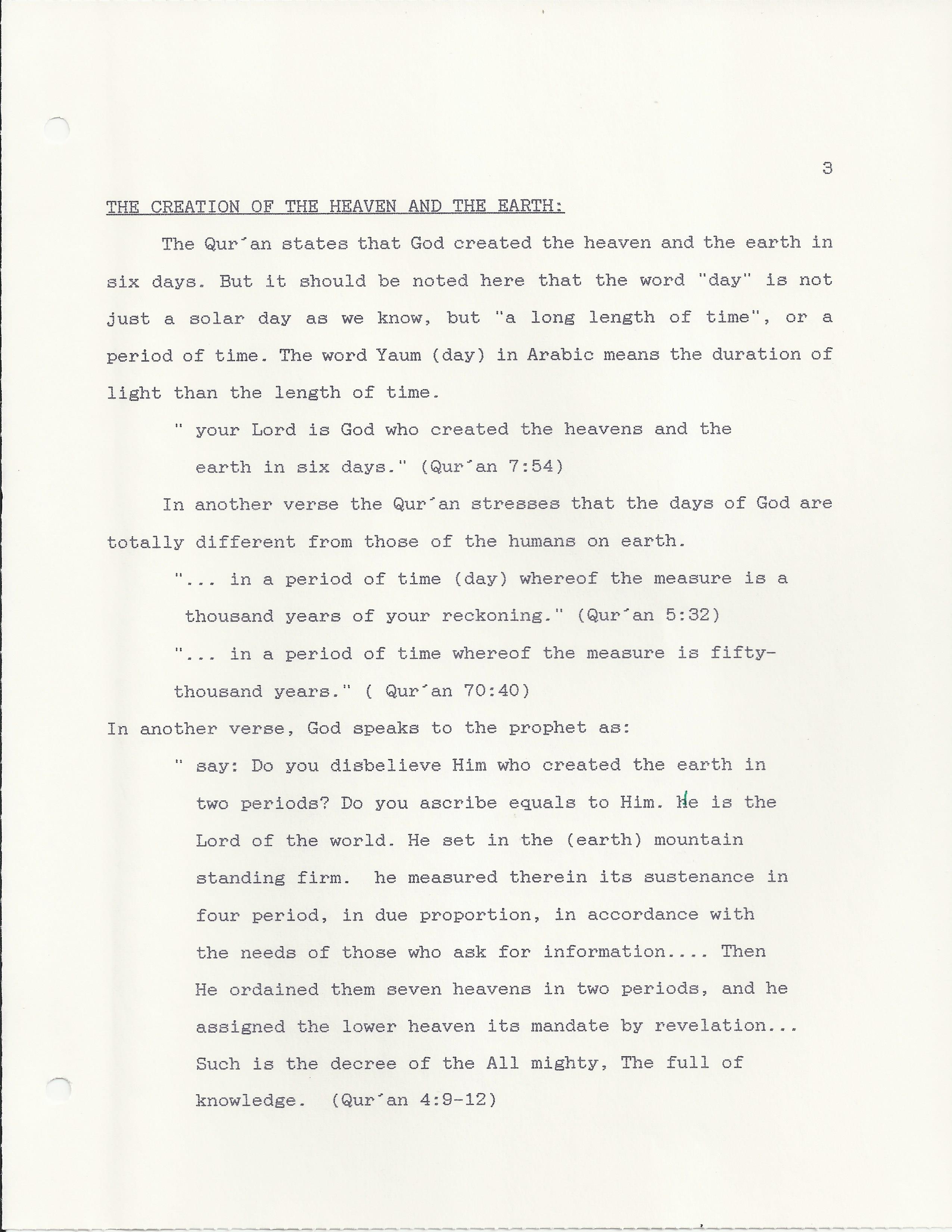
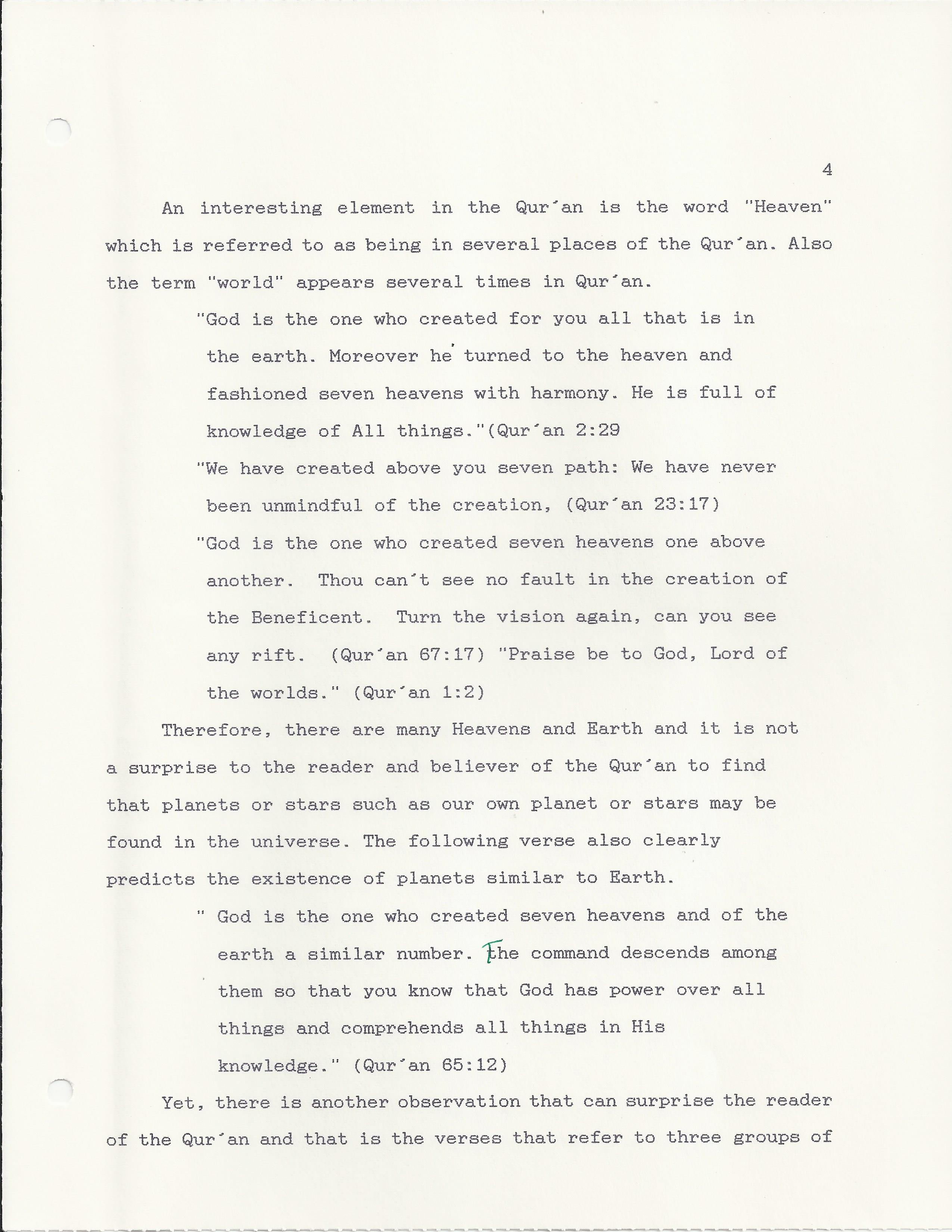
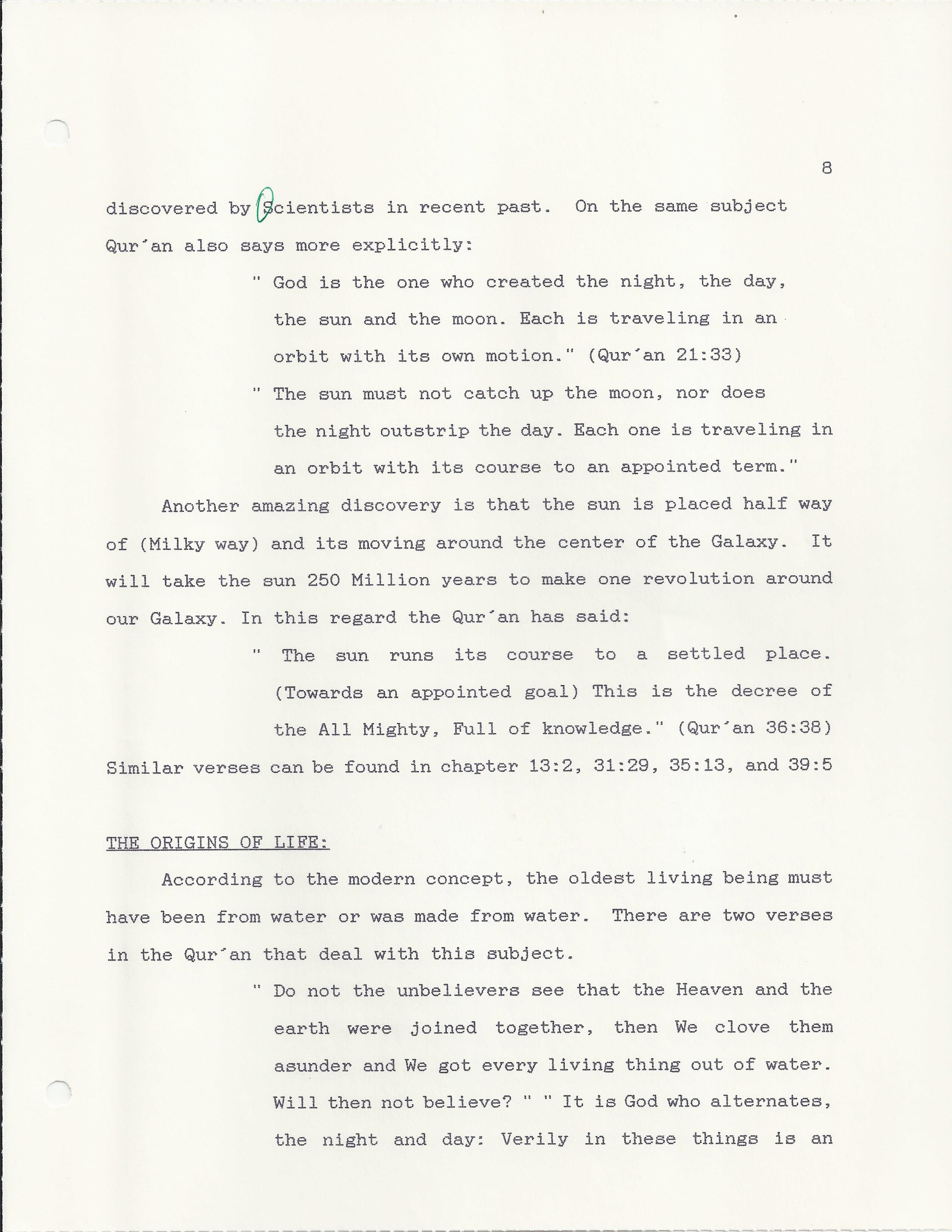
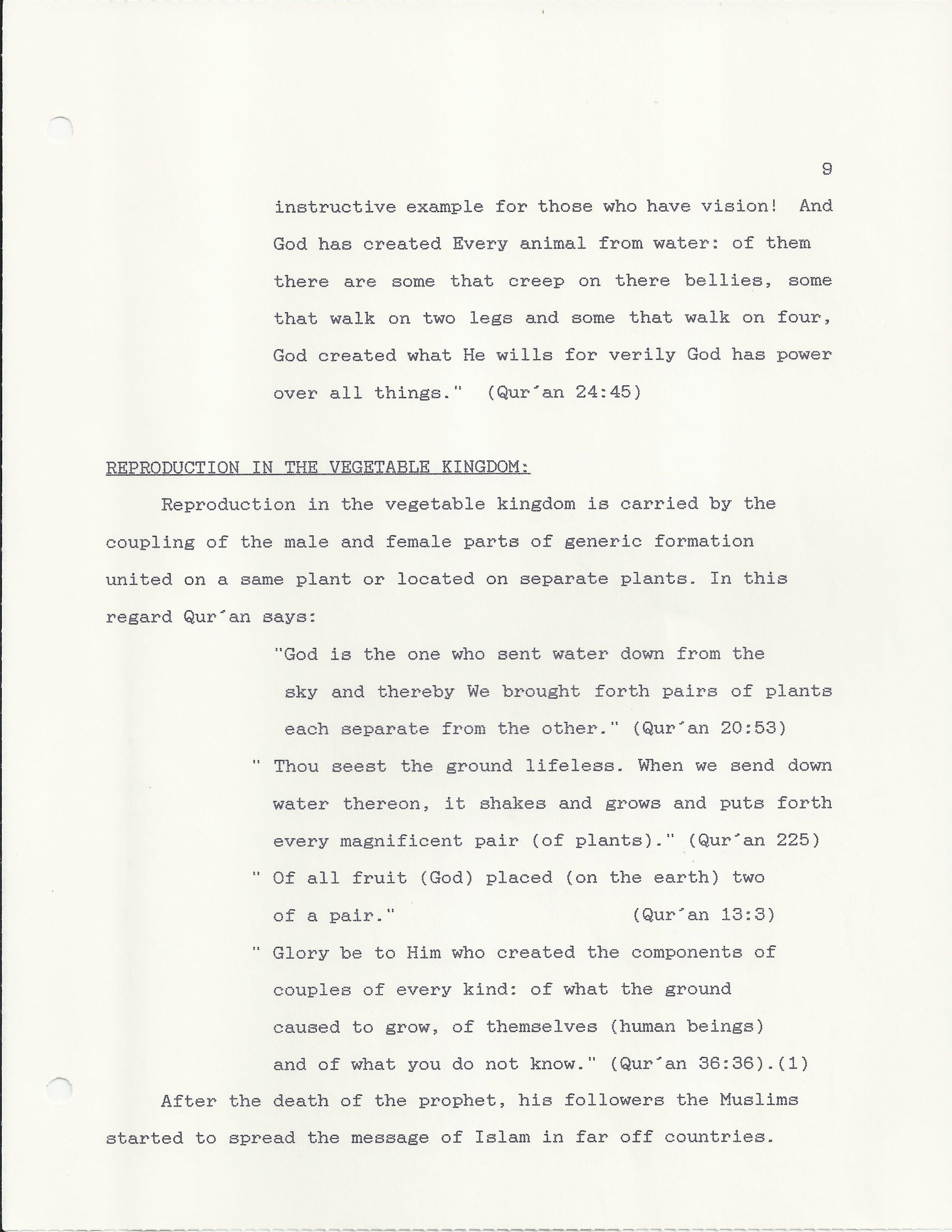
My father was an adjunct professor for over two decades and enjoyed learning from his students as much as he enjoyed teaching them.  One of his students shared his cultural/religious/scientific view with my father via a report — interesting to think about as we debate military action in and around Syria:


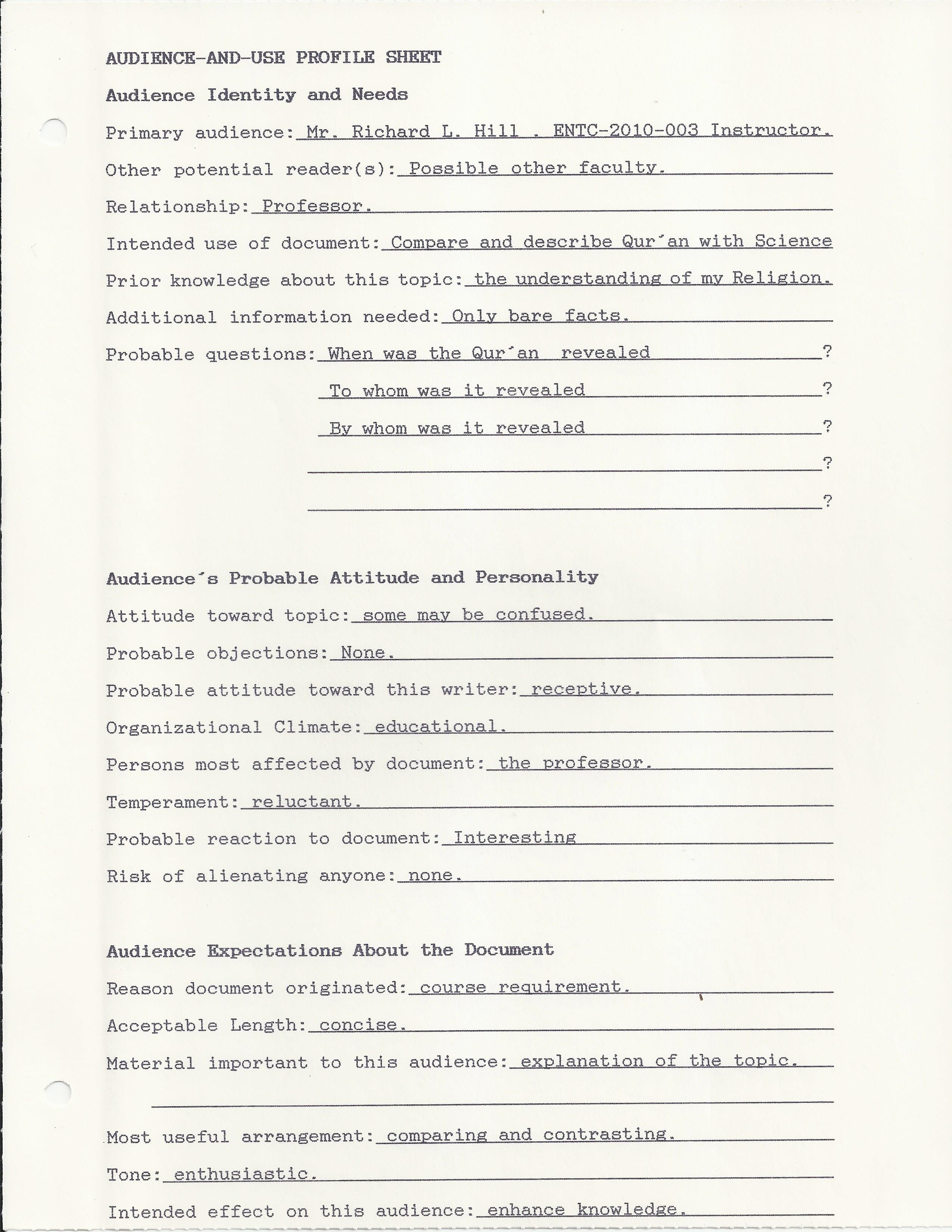
Technical Writing 2010-003 Spr 1993 000

Technical Writing 2010-003 Spr 1993 001

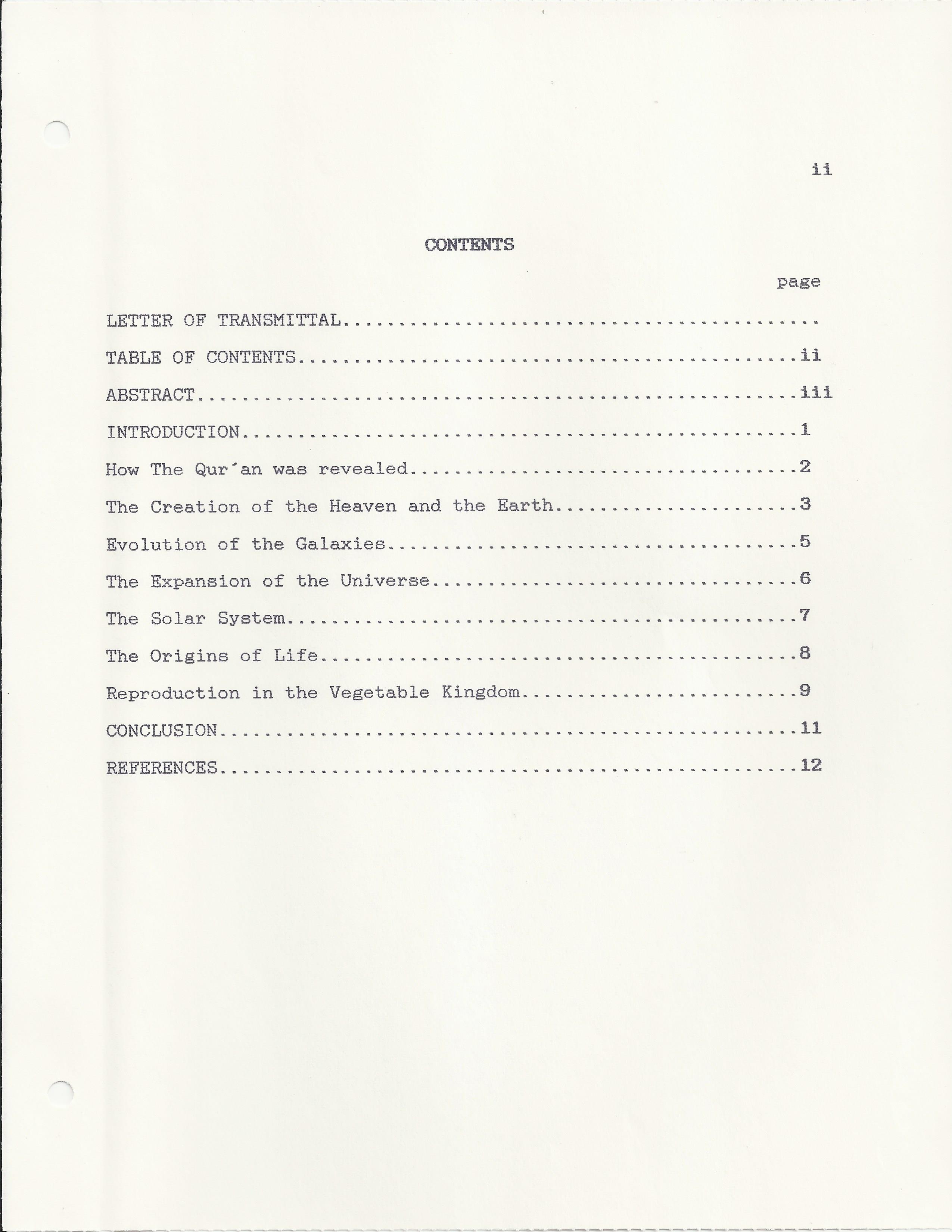
Technical Writing 2010-003 Spr 1993 002

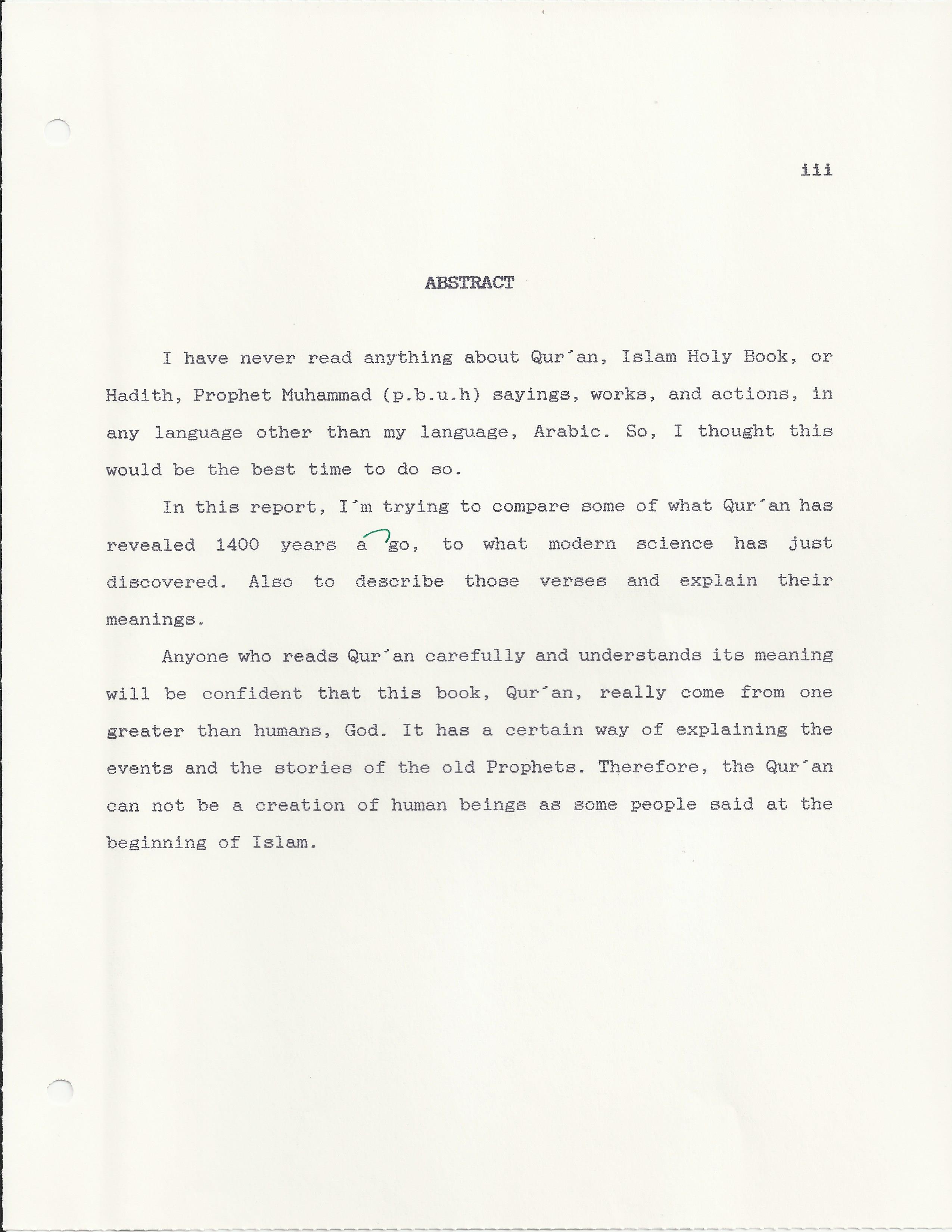
Technical Writing 2010-003 Spr 1993 003

Technical Writing 2010-003 Spr 1993 004

Technical Writing 2010-003 Spr 1993 005

Technical Writing 2010-003 Spr 1993 006

Technical Writing 2010-003 Spr 1993 007

Technical Writing 2010-003 Spr 1993 008

Technical Writing 2010-003 Spr 1993 009

Technical Writing 2010-003 Spr 1993 010

Technical Writing 2010-003 Spr 1993 011

Technical Writing 2010-003 Spr 1993 012

Technical Writing 2010-003 Spr 1993 013

Technical Writing 2010-003 Spr 1993 014

Technical Writing 2010-003 Spr 1993 015

Technical Writing 2010-003 Spr 1993 016

Technical Writing 2010-003 Spr 1993 017

Jhgf

Lee stood in the middle of the nature preserve, his crosstraining shoes upon the concrete path of the city greenway, and looked up through light pollution at the dim outlined threads of the Milky Way galaxy.

The ends of his toes were calloused from running inside shoes a half-size too small, Lee unable to afford a new pair, his three-dollar pair of running shorts and twenty-year old T-shirt a reminder that the life of a middle-aged ascète led him to austerity years before austerity was cool all over again for the very next time.

He felt a pain on the left side of his neck that throbbed through the back of his shoulder, down into his left shoulder blade like a thick rubber band freezing up.

He was tired, a deep-seated nervousness gripping him like an invisible creature digging its claws into his upper back, its body hovering over him, hunching him over like a crooked old man.

Recent phrases echoed in his head, repeatedly refreshing themselves in volume before decaying into icy pain in his neck.  “It’s not about what’s in your pants,” which translated into “You’re not attractive as a man.”  “You’re one of my weird friends,” which translated into “You’re lucky I consider you a friend because otherwise you wouldn’t have any.”  “He’s very passive-aggressive with his wife,” which translated into “Every time I see you, I talk about another person being passive-aggressive to hint to you about your own passive-aggressive issues.”

Lee took a deep breath.

He knew that writing stories was his way of dealing with a world he didn’t understand, his coping mechanism, his stress relief, his private conversation with himself as his own best friend because he trusted no one else to listen to him without judgement or reinterpretation.

His arms and hands drooped by his side.

Lee felt small, like the iridescent insects that hunkered down in the grass next to the greenway, their eyes or wing shells reflecting the light of the LED headlamp he wore while running after dark.

He had always been uncomfortable in his body, hearing kids make fun of his clumsiness, overhearing his father tell other fathers it’s not always what a kid can’t do on the ballfield that counts, his father bragging about Lee’s academic study habits and keen interest in both science and sports.

Lee put his hands on his hips, watching puffs of his breath rise up through the light beam pointing off his forehead.

He had only pretended to be interested in science and sports to keep his father’s anger directed away from Lee.

Lee knew at an early age that it was not his own interests that kept peace in the family, it was ensuring that his father’s anger was kept under control.

Thus, Lee had learned it was not what he liked that mattered.

He walked the world in fear.  He developed a survivor’s mentality.  He could easily tick off on his fingers what he didn’t like but had no idea what he liked for himself.

Writing was therapy, a purifying source of anti-joy that propped him up.

His thought patterns started splitting themselves into what made his father leave him alone, what made school bullies leave him alone and whatever else kept controversy and the fear of physical/mental abuse to a minimum.

After an automobile smashup in his teens, a lot of his thought patterns were reshuffled, his fears realigned, the noise in his thoughts, a kind of screaming pain with no source, making him wish every day that he was dead if the pain of the discordant thoughts would just go away and leave him alone in peace.

Years of self therapy ensued.

He depended upon the kindness of strangers to see his body in their own image, awarding him a four-year university scholarship based more on imagery than cold, hard facts.  The facade quickly crumbled when Lee arrived at university, with no study skills, no motivation and little in the way of a support network for Lee himself rather than a system that was geared to keep him going down the road toward an officer’s commission in the U.S. Navy.

He spent hours in the Georgia Tech library looking at diagrams of early personal computers, dreaming of building his own, back in his parents’ basement when he was in high school playing with hand-assembled CPU systems that did little more than accept octal code in memory and display it back, Lee unable to understand how to go any further, his brain lacking logic circuitry to convert opcodes into useful subroutines and programs that weren’t spelled out in a programmer’s cookbook.

He walked the streets of Atlanta by himself, fearful of local gangs looking to protect their turf by beating a white kid in nominally black neighbourhoods.

He let his charm and innocent, nonthreatening personality protect him, which they did.

He never cared about his grades.  He barely studied for the freshman calculus and chemistry classes that felt like his father’s threats all over again, leaving him no escape this time, finally showing his father the falsehood, failure and disappointment that Lee had felt he had been to his father, who had based his pride on a son simply hoping to survive childhood, if not die by a random mugging in some dark downtown Atlanta alleyway.

Those nine months in Atlanta taught Lee he had no friends.  He had people who wanted to be friends with him until Lee shared his odd thought patterns with them, breaking the iconic imagery he represented in their thoughts, quickly walking away, watching them shake their heads as they wondered who he was.

Years of loneliness followed as Lee wandered from one person’s pretend image of him to the next.

He kept his thoughts to himself, burying them deeper.

He believed he was a gentle soul who just wanted to live in a cabin in the woods, freed from the cycle of first impressing and then unimpressing people, tired of one disappointment after another.

The girl from his summer camp days, with whom he had exchanged handwritten letters in the mail, seemed to be the only one who never saw Lee as strange or disappointing.

He loved her and hated her for accepting him as he was because by loving him she accepted him as a product of his father whom he feared which meant that Lee feared her, too.

Lee’s thoughts drifted, returning to the present.

How long had he stood by himself under the stars on a concrete path surrounded by woodland wrapped by suburban tracts filled with thousands of people?

He held the contemplative thoughts in as close a sequence as possible for writing down later on.

His thoughts were the only thing that mattered to him, worth more than gold.

He had once been a person who negotiated multimillion-dollar international contracts, flying across the globe for meetings, wondering when he was going to fulfill his dream of an ascète, withdrawing from the world his only hope for quieting the painful noise in his thoughts that never went away except when he was drunk or asleep, constantly on alert to cocoon himself from his business colleagues so they wouldn’t see his brain was crisscrossed with insane thought patterns.

The numbed ends of his toes and the needlepoint pains in his hips woke him from his daydream.

He shuffle-jogged over the concrete pathway, knowing he had forty-five more minutes with himself on the trail and roadside to add to his thoughts that he’d write down after he returned home, kissed his wife, petted the cats and showered.

The life of the frugal millionaire was coming back to him again, as close to happiness as a hunched-over simple man could ask for before he died, as entertained by a caterpillar munching on a redbud leaf outside the window as by the behaviour of his species in its desire to develop and maintain weapons of mass destruction as a form of godlike deterrent against the use of our worst hatred toward people unlike us.

Lee had learned to manage his fear.  What about the other seven-plus billion of us?

If it weren’t for paying expensive health insurance premiums, my wife and I would be fully retired already?

The past two weekends, my wife and I combined a visit with family with a trip to the college football stadium.

This weekend, we visited with my cousin and her [second] husband, whom we have embraced as a member of our family.  He humbled us by saying we’re like the family he hasn’t had since he doesn’t know when.

The previous weekend, we spent time with my mother, my sister and her [second] husband, whom we have embraced as a member of our family.  He humbled us by saying a few years ago we gave him a present that was greater than any he had ever received before.

I live with a head full of thoughts, many of them self-deprecating, which science tells us is not an unusual phenomenon.

When other people tell me how nice I am, one of my automatic thoughts is that they must be lying to me to get something from me because I know I am not a nice person.

That thought alone says something — if I think it and have written about it more than once, then is that who I really am?

Is that why suicidal thoughts creep into my day, wishing the cruel, devious person that drives me out of bed every day would be dead and not influencing the world?

Our society is packed with history and textbooks discussing this very issue, offering various solutions.

The hope that drives me past my cruel side is that I’ll outlive my worst tendencies and die a happy man, having made one good contribution to our society at large, if just in one simple act of kindness I never knew about.

Otherwise, I’ll continue to be what many people refer to as one of their “weird” friends whose thought patterns run tangentially to the mainstream, running parallel occasionally through good brainwashing during my formative years.

Time for this set of states of energy to meditate upon the nothingness of the mundane.

Have a great day!

It’s from me it’s for you. It’s from you, it’s for me. It’s a worldwide symphony

The U.S. president stood at the podium and looked at the camera.

“Earlier today I authorised a large-scale mobilisation of our naval and air forces to converge on Syria.

“I have not made this decision lightly.  In fact, I consulted with historians as well as your elected representatives on both sides of the aisle.

“Based on the advice I graciously received, I instructed our armed forces to take the following action.

“One, we have a brotherly and sisterly love for the Syrian people.  Our first order of business is to flood the cities and neighbourhoods of Syria with leaflets warning of our plans we are declaring in full disclosure to every country that wants to interfere with our humanitarian mission to prevent more senseless bloodshed, offering a peaceful solution backed by our military might to restore order.

“Two, a massive airlift is now underway.  We will soon drop air cargo loads filled with blocks of pure, nutritious American cheese from our country’s heartland to feed the Syrian people in dire need of real food.

“Three, to address the rumours of starvation driven by despair and depression and to prevent any chance of malaria or other tropical disease, we will spray the people of Syria and their beloved geography with a special formulated mix of pest-deterring organic cannabinoids and low-concentration psilocybin, which I have been assured by both scientific and medical experts will restore the appetites and happiness of war-weary inhabitants of the City of Jasmine and other metropolitan areas ravaged by over two years of civil war.

“Four, we will offer a trade-in program for citizens on all sides of the Syrian conflict.  Every gun, tank, missile, ammunition or other weapon not authorised for the strict use of American military to protect global citizens in Syria is eligible for this program.  If you turn in a weapon, we will provide you with enough food and clothing to last you a year.  In addition, we will send you to a nearby training centre to provide you the trade skills and business acumen to start your own business to compete in the world economy.

“My fifth and final announcement on this important issue.  We ask not only the Syrians but all the people of the Middle East to open their stores and shops to people of any race, creed, national origin, political or religious difference.  If you do so, your family will prosper.  At the end of the day, isn’t that what we want for ourselves and our children?

“That’s all that the United States of America is trying to do here, provide Syrians with a peaceful path toward prosperity, cementing a healthy relationship with the rest of the world.  No other country can offer or is offering you such a solution.

“My administration will keep our phones and doors open for Syrians.  Talk to us after you read our leaflets.

Thank you.  No questions.”

The president walked off the platform and turned to his closest advisor.  “Okay, now that that’s over, do you have the latest update on Tiger’s golf score?”

Yard Art Sculpture Update # ICANTKEEPCOUNT

After setting up an offgrid meeting with the powers that be, using a dance-with-my-shadow practice session as a cover story, I’m returning to the yard art sculpture currently in S-L-O-O-O-O-W-W-W progress.

Still on the to-do list:

  • Creating the metal framework for the arms.
  • Creating the arms with keyboards and computer mice.
  • Creating the body armor using old floppy disks.
  • Incorporating an 18-foot LED rope light.
  • Deciding how much animation to put into a yard art sculpture exposed to the weather 24/7 —
    • Phase/Version 1: easy, wind-activated response
    • Phase/Version 2: moderate, motion-activated response
    • Phase/Version 3: time-consuming, animatronic interactive response

Is civility civil in “civil war”? Does it matter if it’s Spanish or Syrian by nature?

                                                                                                                                                            
Yesterday all the past. The language of size
Spreading to China along the trade-routes; the diffusion
Of the counting-frame and the cromlech;
Yesterday the shadow-reckoning in the sunny climates.

Yesterday the assessment of insurance by cards,
The divination of water; yesterday the invention
Of cartwheels and clocks, the taming of
Horses. Yesterday the bustling world of the navigators.

Yesterday the abolition of fairies and giants,
the fortress like a motionless eagle eyeing the valley,
the chapel built in the forest;
Yesterday the carving of angels and alarming gargoyles;

The trial of heretics among the columns of stone;
Yesterday the theological feuds in the taverns
And the miraculous cure at the fountain;
Yesterday the Sabbath of witches; but to-day the struggle

Yesterday the installation of dynamos and turbines,
The construction of railways in the colonial desert;
Yesterday the classic lecture
On the origin of Mankind. But to-day the struggle.

Yesterday the belief in the absolute value of Greek,
The fall of the curtain upon the death of a hero;
Yesterday the prayer to the sunset
And the adoration of madmen. but to-day the struggle.

As the poet whispers, startled among the pines,
Or where the loose waterfall sings compact, or upright
On the crag by the leaning tower:
“O my vision. O send me the luck of the sailor.”

And the investigator peers through his instruments
At the inhuman provinces, the virile bacillus
Or enormous Jupiter finished:
“But the lives of my friends. I inquire. I inquire.”

And the poor in their fireless lodgings, dropping the sheets
Of the evening paper: “Our day is our loss. O show us
History the operator, the
Organiser. Time the refreshing river.”

And the nations combine each cry, invoking the life
That shapes the individual belly and orders
The private nocturnal terror:
“Did you not found the city state of the sponge,

“Raise the vast military empires of the shark
And the tiger, establish the robin’s plucky canton?
Intervene. O descend as a dove or
A furious papa or a mild engineer, but descend.”

And the life, if it answers at all, replied from the heart
And the eyes and the lungs, from the shops and squares of the city
“O no, I am not the mover;
Not to-day; not to you. To you, I’m the

“Yes-man, the bar-companion, the easily-duped;
I am whatever you do. I am your vow to be
Good, your humorous story.
I am your business voice. I am your marriage.

“What’s your proposal? To build the just city? I will.
I agree. Or is it the suicide pact, the romantic
Death? Very well, I accept, for
I am your choice, your decision. Yes, I am Spain.”

Many have heard it on remote peninsulas,
On sleepy plains, in the aberrant fishermen’s islands
Or the corrupt heart of the city.
Have heard and migrated like gulls or the seeds of a flower.

They clung like burrs to the long expresses that lurch
Through the unjust lands, through the night, through the alpine tunnel;
They floated over the oceans;
They walked the passes. All presented their lives.

On that arid square, that fragment nipped off from hot
Africa, soldered so crudely to inventive Europe;
On that tableland scored by rivers,
Our thoughts have bodies; the menacing shapes of our fever

Are precise and alive. For the fears which made us respond
To the medicine ad, and the brochure of winter cruises
Have become invading battalions;
And our faces, the institute-face, the chain-store, the ruin

Are projecting their greed as the firing squad and the bomb.
Madrid is the heart. Our moments of tenderness blossom
As the ambulance and the sandbag;
Our hours of friendship into a people’s army.

To-morrow, perhaps the future. The research on fatigue
And the movements of packers; the gradual exploring of all the
Octaves of radiation;
To-morrow the enlarging of consciousness by diet and breathing.

To-morrow the rediscovery of romantic love,
the photographing of ravens; all the fun under
Liberty’s masterful shadow;
To-morrow the hour of the pageant-master and the musician,

The beautiful roar of the chorus under the dome;
To-morrow the exchanging of tips on the breeding of terriers,
The eager election of chairmen
By the sudden forest of hands. But to-day the struggle.

To-morrow for the young the poets exploding like bombs,
The walks by the lake, the weeks of perfect communion;
To-morrow the bicycle races
Through the suburbs on summer evenings. But to-day the struggle.

To-day the deliberate increase in the chances of death,
The consious acceptance of guilt in the necessary murder;
To-day the expending of powers
On the flat ephemeral pamphlet and the boring meeting.

To-day the makeshift consolations: the shared cigarette,
The cards in the candlelit barn, and the scraping concert,
The masculine jokes; to-day the
Fumbled and unsatisfactory embrace before hurting.

The stars are dead. The animals will not look.
We are left alone with our day, and the time is short, and
History to the defeated
May say Alas but cannot help nor pardon.

Sandbagging

How to maximise the local resources?

That question dogged us for many years as we planned our electromech construction crew that would “set up house” on Mars before we got there.

The mechs were fully capable of building adobe houses on Earth.

Water, though, was a key missing factor.

That encouraged us to find liquifying alternatives because we wanted to minimise the material we sent with the mechs.

We could have sent tonnes of sandbags and had the mechs build dry adobe huts under which our habitation modules would fit, providing extra protection in the Martian atmosphere, like parking an RV or caravan in a garage.

We challenged ourselves to create a solution that was both energy-efficient and easy to build.

Then, one day, after we had received the list of common chemical elements in Martian soil samples tested by the first wave of mech probes sent in the early 21st century to find suitable colonisation sites and entered it into our lab network, our semi-autonomous 3D printer on a mobile robot base started constructing an extruded Martian home.

Watching the 3D printbot create its own construction scaffolding was fun as it built a two-story structure that hinged and opened up to accept our current working version at the time of the habitation module that also served as transportation ship and landing craft.

Our Test and Evaluation department set to work calculating the wear-and-tear on the 3D printbot, estimating how many spare parts would be needed as the bot coordinated with the mechs to excavate Martian surface for the right ingredients, processing the Martian soil and then feeding the bot or its future equivalent the “right stuff” for habitation module protective shells.

To verify their theories, they drove the printbot and several prototype mechs out into the high desert, skipping a Martian landing simulation in order to focus on the printbot/mech adobe house construction techniques.

One of our lab personnel proposed commercialising the process, which later helped fund many of our side projects that we encouraged in case a crazy idea panned out and led to better procedures and/or understanding of settling Mars — whole desert communities were 3D-printed, followed by sustainable neighbourhoods in temperate zones around the world.