Any Wonder, One Hit, Two Hits, Three Hits, Four

I was told yesterday that the Rutles are getting back together and recording a new studio album.  Rumour has it that they plan to name their album “Minus One for Tea – Before It Becomes Minus Two,” releasing it in either audiocassette or 8-track tape format exclusively.  One band member allegedly insists that publishing the album in parlour pump organ sheet music is the only route to eternal infamy, but not necessarily success.

Also, protesters have assembled their own list of the Seven Wonders of the World:

  • The world’s largest potato chip
  • The world’s largest open pit mine
  • The world’s smallest inbred dog
  • The world’s most inept government because it actually operates at a profit
  • The world’s least useful technological achievement that still made its inventor a gazillionaire
  • The world’s longest running protest movement that doesn’t achieve anything worthwhile, nor plans to
  • The world’s most creative business card that still did not generate any new leads
  • The world’s first bullet point listing the eighth wonder of the world which does not exist because eight is seven plus one and, as you know, one is is the loneliest number…

And people wonder why Kingsport is…

…the butt of jokes told about the Tri-Cities.

Pardon me while write a little joke of an angry rant about a place that I hope time will forget.

I grew up near a town that belched stench, polluted rivers and ruined fishing waters.

Sure, some of my schoolmates live there with their children.

My parents live not far away (take that back – they were recently annexed into the dirty industrial town).

However, little has changed in the fiefdom.

Kingsport still stinks.

The Model City has no respect for rural landowners.

Like no many other towns in which I’ve lived in or near.

Who’s there to protect those who prefer the rural life from the flood of city/suburban dwellers with no respect for pastoral peace and quiet?

As always, I wish the fleas of a thousand camels to infect anyone associated with the government of Kingsport, especially those who impose their expansionist beliefs upon decent farmers and their families not wishing for industrial estates, interstate highway fast-food stops or other such “civilised” dis/interruptions.

May Kingsport remain the forgotten stepchild of upper east Tennessee.

May tornadoes and floods destroy the town.

May misery and disease beset the people who live there.

May Eastman Chemical Company find some other worthless place to park its enterprising headquarters.

May any chain/franchise that opens a business in Kingsport suffer bankruptcy and scandal.

May crime and drug abuse attract the children of Kingsport.

May God forsake anyone who dares step foot onto Kingsport city limits.

And if that’s not enough, may door-to-door salespeople sweep through houses and apartment buildings 24 hours a day, nonstop for years, until whole neighbourhoods are abandoned and house prices collapse precipitously because the residents have all entered the funny farm, their backs laden with magazine subscriptions to help young salesmen and saleswomen live their dream of traveling overseas.

There, I feel better.

I guess you can guess that I’ll never move back to Kingsport or anywhere near where its malodorous/cancerous fumes can reach.

Davos Koolaruckus

Can you name the top five — yes, 5 — competitive advantages, relative or absolute, that the industries and people in the geographic region called Greece have in the global economy?

Seriously.

I’d rather watch Brian/Carley Lee and Joe dancing a Pentozalli “Five Disorienting Steps” than judge that any news of Greek debt restructuring gives us the real picture of hope and prosperity for Athenians and their ilk any time soon.

Meanwhile, the ruckus in Davos…but do you really care what pompous circumstances mean to those who want to give meaning to their lives?

Observing the kids on the dance floor, such as Raymond Linton and Jenn Nye in a waltz, I ponder the future of clashing subcultures, from those who propose and adhere to strict, austere religious practice to those for whom life has no bounds other than gravitational pull and energy consumption.

Can you lift up your subculture without putting down others?  Can we not all sail on a ship rising in a high tide together?

When a deputy sheriff like Steve Adkison and his beautiful partner Suzy can put the saucy in salsa in front of appreciative onlookers, we know everything is going to be all right.

Of course, with weapons of mass and minidestruction at the ready, from wooden clubs to radioactive bombs, we’re going to keep killing some of us in our seven-billion-and-growing population from now until the end of time (or perhaps until the end of the leap second).

Gotta go before I get too winded…or windy.

I’ll leave you with these gems:

Don’t get annoyed if you neighbour plays his music at two o’clock in the morning.  Call him at four and tell him how much you enjoyed it.

“I hate housework!  You make the beds, you do the dishes — and six months later you have to start all over again.” — Joan Rivers

“Let’s be frank, the Italians’ technological contribution to humankind stopped with the pizza oven.” — Bill Bryson, Neither Here Nor There, 1991

“The sport of skiing consists of wearing three thousand dollars’ worth of clothes and equipment and driving two hundred miles in the snow in order to stand around at a bar and get drunk.” — P.J. O’Rourke, Modern Manners, 1984

“If savings are below investment, foreigners are financing some of the domestic investment.  The difference between savings and investment is equal to the trade (or more precisely, the current account) surplus.  If savings fall short of investment, the difference is a trade deficit and is equal to the net foreign capital inflows that are used to make up the difference between investment and saving.  In common-sense terms, if we sell more to other countries than we buy from them, we send back the difference as savings, and that partially finances their investment or their consumption.” — Michael Spence, The Next Convergence, 2011

You decide which one is more humorous….or needs some hummus and pita chips.


Quick! Someone just killed your family. How do you seek “justice?”

 from the Washington Post:

10 reasons the U.S. is no longer the land of the free

By Jonathan Turley, Published: January 13

Every year, the State Department issues reports on individual rights in other countries, monitoring the passage of restrictive laws and regulations around the world. Iran, for example, has been criticized for denying fair public trials and limiting privacy, while Russia has been taken to task for undermining due process. Other countries have been condemned for the use of secret evidence and torture.

Even as we pass judgment on countries we consider unfree, Americans remain confident that any definition of a free nation must include their own — the land of free. Yet, the laws and practices of the land should shake that confidence. In the decade since Sept. 11, 2001, this country has comprehensively reduced civil liberties in the name of an expanded security state. The most recent example of this was the National Defense Authorization Act, signed Dec. 31, which allows for the indefinite detention of citizens. At what point does the reduction of individual rights in our country change how we define ourselves?

While each new national security power Washington has embraced was controversial when enacted, they are often discussed in isolation. But they don’t operate in isolation. They form a mosaic of powers under which our country could be considered, at least in part, authoritarian. Americans often proclaim our nation as a symbol of freedom to the world while dismissing nations such as Cuba and China as categorically unfree. Yet, objectively, we may be only half right. Those countries do lack basic individual rights such as due process, placing them outside any reasonable definition of “free,” but the United States now has much more in common with such regimes than anyone may like to admit.

These countries also have constitutions that purport to guarantee freedoms and rights. But their governments have broad discretion in denying those rights and few real avenues for challenges by citizens — precisely the problem with the new laws in this country.

The list of powers acquired by the U.S. government since 9/11 puts us in rather troubling company.

Assassination of U.S. citizens

President Obama has claimed, as President George W. Bush did before him, the right to order the killing of any citizen considered a terrorist or an abettor of terrorism. Last year, he approved the killing of U.S. citizen Anwar al-Awlaqi and another citizen under this claimed inherent authority. Last month, administration officials affirmed that power, stating that the president can order the assassination of any citizen whom he considers allied with terrorists. (Nations such as Nigeria, Iran and Syria have been routinely criticized for extrajudicial killings of enemies of the state.)

Indefinite detention

Under the law signed last month, terrorism suspects are to be held by the military; the president also has the authority to indefinitely detain citizens accused of terrorism. While the administration claims that this provision only codified existing law, experts widely contest this view, and the administration has opposed efforts to challenge such authority in federal courts. The government continues to claim the right to strip citizens of legal protections based on its sole discretion. (China recently codified a more limited detention law for its citizens, while countries such as Cambodia have been singled out by the United States for “prolonged detention.”)

Arbitrary justice

The president now decides whether a person will receive a trial in the federal courts or in a military tribunal, a system that has been ridiculed around the world for lacking basic due process protections. Bush claimed this authority in 2001, and Obama has continued the practice. (Egypt and China have been denounced for maintaining separate military justice systems for selected defendants, including civilians.)

Warrantless searches

The president may now order warrantless surveillance, including a new capability to force companies and organizations to turn over information on citizens’ finances, communications and associations. Bush acquired this sweeping power under the Patriot Act in 2001, and in 2011, Obama extended the power, including searches of everything from business documents to library records. The government can use “national security letters” to demand, without probable cause, that organizations turn over information on citizens — and order them not to reveal the disclosure to the affected party. (Saudi Arabia and Pakistan operate under laws that allow the government to engage in widespread discretionary surveillance.)

Secret evidence

The government now routinely uses secret evidence to detain individuals and employs secret evidence in federal and military courts. It also forces the dismissal of cases against the United States by simply filing declarations that the cases would make the government reveal classified information that would harm national security — a claim made in a variety of privacy lawsuits and largely accepted by federal judges without question. Even legal opinions, cited as the basis for the government’s actions under the Bush and Obama administrations, have been classified. This allows the government to claim secret legal arguments to support secret proceedings using secret evidence. In addition, some cases never make it to court at all. The federal courts routinely deny constitutional challenges to policies and programs under a narrow definition of standing to bring a case.

War crimes

The world clamored for prosecutions of those responsible for waterboarding terrorism suspects during the Bush administration, but the Obama administration said in 2009 that it would not allow CIA employees to be investigated or prosecuted for such actions. This gutted not just treaty obligations but the Nuremberg principles of international law. When courts in countries such as Spain moved to investigate Bush officials for war crimes, the Obama administration reportedly urged foreign officials not to allow such cases to proceed, despite the fact that the United States has long claimed the same authority with regard to alleged war criminals in other countries. (Various nations have resisted investigations of officials accused of war crimes and torture. Some, such as Serbia and Chile, eventually relented to comply with international law; countries that have denied independent investigations include Iran, Syria and China.)

Secret court

The government has increased its use of the secret Foreign Intelligence Surveillance Court, which has expanded its secret warrants to include individuals deemed to be aiding or abetting hostile foreign governments or organizations. In 2011, Obama renewed these powers, including allowing secret searches of individuals who are not part of an identifiable terrorist group. The administration has asserted the right to ignore congressional limits on such surveillance. (Pakistan places national security surveillance under the unchecked powers of the military or intelligence services.)

Immunity from judicial review

Like the Bush administration, the Obama administration has successfully pushed for immunity for companies that assist in warrantless surveillance of citizens, blocking the ability of citizens to challenge the violation of privacy. (Similarly, China has maintained sweeping immunity claims both inside and outside the country and routinely blocks lawsuits against private companies.)

Continual monitoring of citizens

The Obama administration has successfully defended its claim that it can use GPS devices to monitor every move of targeted citizens without securing any court order or review. (Saudi Arabia has installed massive public surveillance systems, while Cuba is notorious for active monitoring of selected citizens.)

Extraordinary renditions

The government now has the ability to transfer both citizens and noncitizens to another country under a system known as extraordinary rendition, which has been denounced as using other countries, such as Syria, Saudi Arabia, Egypt and Pakistan, to torture suspects. The Obama administration says it is not continuing the abuses of this practice under Bush, but it insists on the unfettered right to order such transfers — including the possible transfer of U.S. citizens.

These new laws have come with an infusion of money into an expanded security system on the state and federal levels, including more public surveillance cameras, tens of thousands of security personnel and a massive expansion of a terrorist-chasing bureaucracy.

Some politicians shrug and say these increased powers are merely a response to the times we live in. Thus, Sen. Lindsey Graham (R-S.C.) could declare in an interview last spring without objection that “free speech is a great idea, but we’re in a war.” Of course, terrorism will never “surrender” and end this particular “war.”

Other politicians rationalize that, while such powers may exist, it really comes down to how they are used. This is a common response by liberals who cannot bring themselves to denounce Obama as they did Bush. Sen. Carl Levin (D-Mich.), for instance, has insisted that Congress is not making any decision on indefinite detention: “That is a decision which we leave where it belongs — in the executive branch.”

And in a signing statement with the defense authorization bill, Obama said he does not intend to use the latest power to indefinitely imprison citizens. Yet, he still accepted the power as a sort of regretful autocrat.

An authoritarian nation is defined not just by the use of authoritarian powers, but by the ability to use them. If a president can take away your freedom or your life on his own authority, all rights become little more than a discretionary grant subject to executive will.

The framers lived under autocratic rule and understood this danger better than we do. James Madison famously warned that we needed a system that did not depend on the good intentions or motivations of our rulers: “If men were angels, no government would be necessary.”

Benjamin Franklin was more direct. In 1787, a Mrs. Powel confronted Franklin after the signing of the Constitution and asked, “Well, Doctor, what have we got — a republic or a monarchy?” His response was a bit chilling: “A republic, Madam, if you can keep it.”

Since 9/11, we have created the very government the framers feared: a government with sweeping and largely unchecked powers resting on the hope that they will be used wisely.

The indefinite-detention provision in the defense authorization bill seemed to many civil libertarians like a betrayal by Obama. While the president had promised to veto the law over that provision, Levin, a sponsor of the bill, disclosed on the Senate floor that it was in fact the White House that approved the removal of any exception for citizens from indefinite detention.

Dishonesty from politicians is nothing new for Americans. The real question is whether we are lying to ourselves when we call this country the land of the free.


Jonathan Turley is the Shapiro professor of public interest law at George Washington University.

Read more from Outlook, including:

“Imagining a world without Gitmo,” by Karen J. Greenberg.

“A world without 9/11: No President Obama, more China trouble, same debt crisis,” by Michael Lind.

“Five myths about Dick Cheney,” by Stephen F. Hayes.

Friend Outlook on Facebook and follow us on Twitter.

To think, Old MacDonald Had a Farm, GI, GI Joe

The 1% of 1%, we don’t see the world in geographic political boundaries.

Of course, as you know, we pretend the boundaries exist, telling you stuff like “Look out for that country over there — it’s against us this year,” and “Our strategic partnership with these countries is the only thing keeping your economic livelihood stable.”

Now that more than 50% of our species lives in sub/urban areas, “free” of the bind to land-based [subsistence] living, you are all our virtual slaves, depending on our virtual chess game results to tell you what to do next.

Two steps forward, one step to the left/right, please.

And then, as previous chapters have told you, there is the Committee, which also manages the lives of the 1% of the 1%.

Finally, there is the universe itself, spinning off little eddies of atoms and molecules that collect and replicate their patterns.

You should have in your thought patterns by now the full understanding that the universe as we know it is simply revealed by a 360-degree searchlight from the point of our planet/solar system, reaching a finite boundary and creating the illusion of a symmetrical sphere in which we are the center.

Feel free to comprehend our ignorance, vast as it is and will continue to be, ad infinitum.

There is just so much that I, the individual, can bother to talk about here while supervising the construction of the interwebs of interwebs tying you to your personal supercomputers tied to everyone else’s supercomputers tied, as if all of that is a single node, to the Internet of the Next Big Things to Come.

So, to me, all military actions, no matter how we label them in nationalistic or terror group or lone wolf terms, are all one.

For instance, I don’t see an Iranian nuclear scientist killed by the CIA or Mossad.  I see us managing to control ourselves by killing ourselves.

Same for sports and other categories of diverting ourselves from our primary tasks of eating and breathing.

Let us move on to more important matters.

Details in the next chapter of the story of our lives seen from the vantage point of 1000 years from now.

Happiness and humour — share them endlessly.

While chewing my lunch…

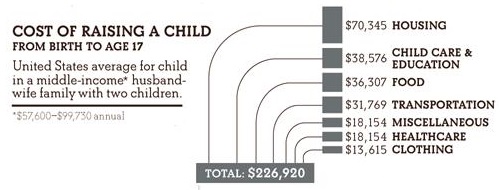
Ahh…an appetite for budgetary constraints.  Here’s another tidbit to put into the computer for future admiration — the cost to raise a child in modern society:


Family planning has made the news headlines lately and I’ll let it alone.  I’m more interested in comparing apples to oranges, family budget to national government budget, for an analysis that contains no paralysis.

If you want, we can throw in capital punishment for a right good show on touchy topics du jour.

Let’s not and say we’re knotted on this one.

Back to lunch.

If you want reform…

A friend on facebook wants to reform her national government.

Kathy, if you want reform — that is, to make significant changes to the way tax revenues are spent (and possibly, collected, decreasing the debt load) in your local/state/national government — look at the numbers.

And, while looking, ask yourself what you’re willing to give up, both now and in the future, if reform to you means lowering the total expenditure.

For instance, here’s the pie chart of U.S. total spending for FY 2011:

Perhaps your  local political entity has a similar, easy-to-view breakdown of the way tax revenues/debts are supposed to be divided.

Where do you want to see changes made?

Where are the areas that change will be most effective for you and your sub/culture?

Can we manage government budgets as if they’re our own households?

What is a manageable public debt load?  After all, who’s going to call in your government’s debt?  Has your government’s debt been called in?

If bankruptcy is not an option, is eliminating the wishy-washy ratings agencies a good starting point?

More later.

Time for lunch and a few good books to read, including an ebook titled “Three Cups of Deceit – How Greg Mortenson, Humanitarian Hero, Lost His Way,” by John Krakauer.

= = =

Thanks to Joe and Harold at KCDC; Tee Aundra at Krystal.

LiFePo4

Thinking about Maslow’s hierarchy of needs today, comparing individualistic versus collectivist societies.

And then, remembering the kid on the playground who ended the game by saying, “It’s my ball and I’m going home,” while reading about the U.S. and Iran trading words over a no-longer flying electronic gizmo called a drone.

Will Brazil clear the Amazon rain forest in my lifetime?

Will governments shrink as retirement/pension plans are taken away from workers, thus decreasing the desire of people to get quasi-guaranteed-for-life government jobs?  How will decreased tax revenues (a/k/a redistribution of wealth) change sociopolitical behaviour in the longterm?  Is there a destabilising effect by fewer government bonds being issued?

Should the leaders of MF Global be hung by their short and curlies as a lesson to everyone else who says, “Well, sure, I was the head of the company — ‘the buck stops here’ and all that — but I’m just there as a leech to earn a big salary, using my face recognition as a selling point.  I have no idea what I’m doing and certainly don’t know what’s going on in the company.  I use coded words and phrases all the time — management doublespeak — how am I supposed to know which code words or phrases are actually interpreted and implemented by my employees?”?

Is there a tipping point in biodiversity for our species?  Do we really want to find out?

What is the economic impact of Burt Rutan’s new venture?

Insects fly past the window.

A solar cell charges a battery on the front deck.

How many times have you gone out on a date with someone you met via an e-dating site and the date tells you, after meeting you in person, “Oh, well, I’m really serious about someone else”?  We use coded words and phrases all the time.  It’s up to us to figure out how to change our tactics/behaviour to hear different words and phrases the next time.  Remember, insanity is hearing the same thing over and over and expecting to hear something different even though you haven’t changed.

Thanks to Garrett, Linda, Tiffany and Heath at Cracker Barrel; Batteries Plus; Sophie’s link to a Simple Guide to Having Fun; those who don’t use mobile phones, the Internet or electronic social networks.

Time to have fun away from the computer-connected global subcultural meme set.  I assume the freedom of the Internet will be here when I get back.

Oh, and hey, be careful out there when buying Chinese real estate — the price of nest eggs in China DOES have an effect on you right now.  Somehow, I feel like I’m repeating myself, repeating myself, myself, myself, self, my, oh my…

Seven Billion People and Countless Other Beings to Talk About

What is Julia the Thanksgiving Girl or Jenn the rocket propulsion specialist doing right now?

What about John in the checkout line or Michelle in the deli at Publix?

Terrence or Mildred of Comcast, what does either one do on the weekend?

Or KK at Carson’s Grille?

Imagine a small fleet of crafts heading toward a distant habitable planet, sending and receiving reports along the journey, landing 1,000 years from now, funded by private individuals and companies on Earth that no longer exist in 3011.

What if government as we know it anywhere on Earth right now is no longer tenable in the near or distant future?

Would you trust the backers of a privately-funded, online voting or vote-matching system?

Shouldn’t our new system of cooperating with one another (what we commonly call politics or government) be more, not less, transparent?

Many business people are used to meeting in private, negotiating and signing nondisclosure agreements or other documents that prevent the average person on the street from seeing the details of average business transactions.

We call it competition, trade secrets, intellectual property and similar terms that ensure protection of privacy.

Government is that odd amalgam of public and private interfaces, where sole-source contracts and competing bids go up against marketing and advertisement campaigns.

If two ideas are competing against one another for limited resources, which of the ideas’ weak points or strengths is more important than the other’s?

I can talk about free, live, open source software (FLOSS) because there’s enough profitmaking available and excess resources for such a concept in small to medium markets.

What about on a global scale?

After all, a gaboodle of mobile phones contain Android, which contains a core, or kernel, of Linux code.

In our newly-connected global economy, which operates by and large as a supergossip network, where much of what we say to each other is superfluous but informational, we have created a citizenry that lives and loves outside the bounds of geographically-based political entities.

[Cue several paragraphs of historical comparisons to previous interconnected civilisations]

Are you interested in the status quo — government as it is and has been — or something new, something that develops from grassroot efforts, where we seamlessly become part of the Internet of Things, and transparency is commonplace but there’s room to respect the needs of profitmaking and intellectual/personal property rights?

I grew up playing board games called “Monopoly,” “Risk,” “Life,” and other cultural teaching tools centered on competition.  I didn’t play boards games that directly taught cooperation.  Instead, collusion of players ganging up on another was the indirect lesson I learned when one player was dominating and the others didn’t want that player to win.

It was in team sports and partner-based card games that I learned to cooperate with others in order to win against a respected opponent.

What are we teaching each other and our children about the future?