Making the Obvious even more Obvious

Notice the man in the newspaper article below.

He’s smiling, almost smirking.  Could he be addicted to prescription medication?

See yellow arrow: is this the reason?  Most likely!

Could his smile use a makeover?  Probably!  Now that he’s in jail!

Dentist Angela R. Cameron has a market she never dreamed of — getting the state legislature to mandate full dental benefits for prison inmates, with her as sole provider for making over the smiles and changing the lives of convicts.

Never miss a market opportunity staring you in the face with an open mouth!

Who says you shouldn’t look a gift horse in the mouth?!

MegaMeeting

After years of back-room wrangling, leaders of every major sport played on or near Earth announced a two-tier approach to their individual sports.

For instance, in the Olympics, athletes who use no enhancement drugs will compete in the same event with those who do.  Two separate award ceremonies will be held for every event, giving the best three who use use enhancement drugs, and the best three who don’t, Olympic medals.

Same for individual awards in cricket, football, baseball, hockey, basketball, cycling, swimming, running, motorsports, wrestling, etc.

That way, we keep a sense of honesty and integrity out of the picture, allowing “dopers” to show the latest advances in medical enhancement technology and non-dopers to show the latest advances in “natural” training methods.

As the saying goes, may the best team/player win!

Kick it!

The producers of the film, “Kick-Ass,” expressed their wishes to dedicate their movie to the girl, Malala Yousafzai, for her courageous stand for girls’ education and survivor of an attack by the Taliban.

The graphic novel creators have not confirmed they are writing a fourth book in the series of the story expressly turning Malala into a Pakistani superhero.

News Digest, 14th of October 2012

A few years ago, I installed a couple of ultrasonic buzzers in our attics to keep out animals.  The first year, it was quieter than usual — fewer bumps in the middle of the night by our furry friends.  Then, this year, I discovered a family of raccoons had taken up residence in the attic.

Call it affirmation of survival of the fittest except, in this case, it is a family of deaf raccoons that discovered a place to live peaceably under the roof of our house.

I found out that fact last night by opening the attic door and shouting at the raccons to be quiet.  The baby raccoons kept chasing each other until one of them must have smelled me and turned, catching the attention of the other two who turned and froze, too.

Waving my arms and making aggressive charging motions scared them off into the unreachable corners.

Well, at least there’ll be no more screaming at the top of my lungs and confirming to my neighbours that the crazy man next door is trying to commune with the dead again.

In robot news, more from the analysis of Heidegger’s Being and Time by Hubert L. Dreyfus…

“2. Comportment is adaptable and copes with the situation in a variety of ways. Carpenters do not hammer like robots.  Even in typing, which seems most reflex-like and automatic, the expert does not return to the home keys but strikes the next key from wherever the hand and fingers are at the time.  In such coping one responds on the basis of a vast past experience of what has happened in previous situations, or, more exactly, one’s comportment manifests dispositions that have been shaped by a vast amount of previous dealings, so that in most cases when we exercise these dispositions everything works the way it should.”

“4. If something goes wrong, people and higher animals are startled. Mechanisms and insects are never startled. People are startled because their activity is directed into the future even when they are not pursuing conscious goals.  Dasein is always ahead of itself.”

In other words, our actions/thoughts are based purely on the past while focused on the future.  No wonder we have no idea what we’re doing in the present moment.

In business news, UPS made a hostile bid for the company Space Exploration Technologies Corp, commonly known as SpaceX, now that SpaceX has demonstrated its near-Earth-orbit package delivery service is reliable.

Experts expect FedEx to make a competitive bid to prevent UPS from expanding its reaches to “infinity and beyond,” with FedEx merely wanting to “be there before there are customers to be there,” mainly the Earth-to-Moon route that international transportation corporations are watering at the mouth to sink their teeth into.

The UPS CEO denied that Felix Baumgartner would be vice president of dropoff service for the new SpaceX division, if their bid is accepted.

The bicycle messenger union has opened negotiations for a stratospheric drop and parachute deployment training center that could provide pinpoint hand-delivery of packages to customers in remote locations via sky-high balloon or dirigible.

Pickup of the delivery person is a major sticking point in the negotiations at this time.

While…

While we wait for the launch of the balloon/capsule combo that will take Felix Baumgartner to a 23-mile jumpoff altitude, we pause to reflect on the activities of our species elsewhere:

  • Children are born
  • Bombs are set off in street bazaars
  • Flowers bloom from planted seeds
  • Families gather for reverent reasons
  • People suffer smashups on highways
  • A person learns to read
  • Someone dies from an accidental injection of meningitis
  • A phone rings

A song for the moment.

Return to ROI

Something, some thought, some idea, in the back/top/middle of my head is itching.

I look at old stats such as this:

I wonder about the average cost of postsecondary education for a college student in the U.S.:

Figure 40-1: Total cost of attending an undergraduate institution for first-time, full-time students receiving aid, by level and control of institution and living arrangement: Academic year 2010-11

Figure 40-1: Total cost of attending an undergraduate institution for first-time, full-time students receiving aid, by level and control of institution and living arrangement: Academic year 2010-11

I examine tables such as this one:

Figure 29-1: Percentage of youth ages 16-24 who were neither enrolled in school nor working, by sex: Selected years, 1990-2011

Figure 29-1: Percentage of youth ages 16-24 who were neither enrolled in school nor working, by sex: Selected years, 1990-2011

Finally, I ask myself, what, based on the salaries of youth who reached adulthood, was my ROI (return on investment) of these kids?:

Figure 49-2: Median annual earnings of full-time, full-year wage and salary workers ages 25-34, by educational attainment and sex: 2010

Figure 49-2: Median annual earnings of full-time, full-year wage and salary workers ages 25-34, by educational attainment and sex: 2010

And that’s just the U.S. domestic market.

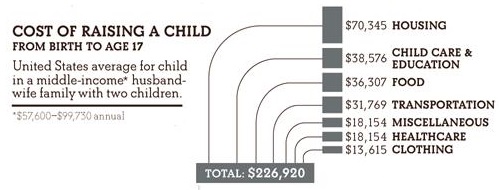
I’m thinking about this one…~$227k to raise a middle-class kid.  Looking at salary figures above, the kid has to work for quite a few number of years to pay back the investment in his upbringing.

Where is the line where ROI is achieved?

Meanwhile, those shrinking middle-class kids are having kids and using public resources, contributing some small amount toward supporting public employee pension funds, Medicare, Medicaid, Social Security, etc., that they hope to receive themselves one day, even if they don’t believe the benefits will be available when they reach their senior citizen years.

In other words, our investment in the average citizen continues throughout that citizen’s life, well after ROI on childhood is achieved.

But there’s something else here in and out of this data set that still itches, has itched and continues to itch every time the subject passes through my thought set.

More than social responsibility.

More than cultural expectations.

More than formative years brainwashing.

More than standard/quality of living.

I see the costs, I see the benefits of straightline ROI, but the je ne sais quoi…???

What about the noneconomic value of a person?  Where are we accounting for the individual person’s thoughts, dreams, wants, needs, etc.?

One thousand years from now, we hold a history class and talk about the concept of worship through the rise and fall of civilisations.

During the first few thousand years of our species’ history, we slowly replaced the worship of unseen deities with the worship of money, as simply demonstrated through the construction and sole function of edifices found during archaeological digs.

It took a hard turn from deity-to-money history for us to change what we worship 1000 years later.

But we’ll save that lesson for another blog entry.

Thanks to Meagan at Tenders; Joe and Jennifer at KCDC.

More points to [re]ponder

  • Technology disrupts former profit models, closing businesses and increasing unemployment, but provides no equal replacements for jobs/profitability
  • Technology creates high-stimulus, addictive leisure activities that are easily available (cheap, abundant, etc.), making instantly-gratifying tasks like searching the Internet and gaming more appealing than delayed-gratification tasks like studying for high-skill jobs
  • Technology creates demand for high-skill jobs but large workforce not interested/motivated for high-skill job training
  • Local skill gap in job requirements for businesses seeking expansion, as well as national governmental barriers to entry/competition for eligible, highly-skilled, internationally-mobile workforce, contributes to regional high unemployment

When do local people, en masse, say “no more!” to higher education and highly-technical skill sets, creating viable subcultures that revert back to lower skill needs?  How do they remain competitive enough to be profitable and stay in business as owners/employees?

Does a technology-based socioeconomic system, in general, have a fixed lifespan like a classic technology lifecycle?

Yes, these are repetitive thoughts but ones I want to grasp onto for myself and understand their implications for the future in this parallel universe of a blog.

Either we admit that our model of nations is out-of-sync and possibly obsolete or we open up the floodgates and let subcultures compete against each other at full blast, with subcultures, like species and languages, going extinct at a faster rate than before.

If the latter, will your subculture withstand the onslaught?