Bubble

Guinevere stood inside the entryway, looking through the portal window, admiring the view of the Martian landscape interrupted here and there by landing pods.

“What is fear?”

She rolled the question around and around in her thoughts, thinking back over the last decade of her life, the years of education, more years of training for this moment.

A terrible automobile smashup had slowed her down temporarily.

A small leg injury had lightened her steps on the dance floor once.

Missile design and rocket propulsion classes had ended.

Her new life began.

She welcomed the new change, relished the challenges, climbing the rungs of the ladder of life that disappeared into infinity.

What is fear?  Fear is the type of insanity where you wanted things to remain the same when you knew they were not in your possession or in your control to begin with, subject to change without notice.

Guinevere knew no fear.

She lived on borrowed time.

Guinevere looked out the portal window and asked a question out loud to no one in particular.

“How far do you want to go exploring tomorrow?”

After thousands of hours in simulator training and millions of miles of travel, she was ready to take off right now, no moment wasted, but knew she needed to help the crew unload the rest of the gear.

After all, they had the rest of their lives to spend here on this pioneering outpost.

What was one last night together with everyone before they branched out into separate scientific teams and work crews?

What if…

What if a group of armed citizens set up a protective unit around James Yeager, the protective unit gets its own concentric circular layer of protection, etc., until every armed citizen was backed and protected by every other armed citizen?

Our subsubsubsubbasement supercomputer is having a lot of fun plotting out futures with this scenario in mind.

What if a security company, in order to promote its protective services, offered protection for James Yeager and his arsenal?

What about all the trained mercenaries who have nothing better to do with their time than go to shooting ranges and gun shows?

Would they be willing to take a stand in the name of James Yeager?

Where will the line in the sand be drawn?

What was that old colonial American revolutionary saying about standing together or falling one by one?

Where’s a good buffoonish plot ploy like Janet Reno at a time like this?

What have the enclaves like the Montana Freemen learned in protecting themselves for the last couple of decades?

Who will be the next David Koresh and his Waco followers dying at the hands of an overzealous government?

Bunka, not bunko or bunco

Thanks to my sister, I now know the embroidery style that her mother in-law uses to create fascinating works of art:

BunkaCraft

I think the kits that her mother in-law used were called Matsuhato.

Which leads to the next thought.

In times past, battles were remembered by bards with ballads and seamstresses who sewed elaborate tapestries.

In the battles to come, let us remember our fallen warriors — whether under cyber attack or defending our physical freedoms — using Bunka or whatever means our warriors’ family, friends and supporters may have at hand.

Who amongst you will create the kits that will feature the flaming fields of war?

Who will sew the tartans to drape over the weapons newly-forged in Ruralite furnaces?

Who will create the sinewed covers for the field drums, whether made with animal skin or simulated on tablet PC screens?

My friends, it is too late for the war of words.

The battle cry has echoed in the hills and valleys, shook the shaky foundations of the once hallowed halls in Urbanski territory.

The trumpets of Jericho wait no longer!

TO ACTION!!!

“As God is my witness…”

The year was 2013, the Year of the Underground Gunsmith Shop Revolution.

The rallying cry: “The West wasn’t won with a registered gun.”

Revolutionaries met in secret, creating their own version of the Underground Railroad, hiding from the tyrants of the Bureaucracy, following in the ghostly footsteps of the Prohibition Moonshiners.

The late-night hammering and pounding in front of DIY forges rang out in Ruralite territory.

After building their own weaponry and ammunition, members of the UGSR took the law into their own hands, hunting down the criminals themselves, dumping the bodies for all to see that no longer would the people, the REAL people, not the contented sheep in their flats, semi-Ds and McMansions, no longer would they let the weak and the mentally ill decide the fate of lawful gunowners.

The weak and the mentally ill who used to rely on random violence to give themselves a sense of purpose because they could not stand up to their own internal damnation or physical bullying by those mentally stronger than them would, no more, torture the innocent or make splashy headlines.

The land would soon be free of them and their filth.

Viva la Underground Gunsmith Shop Revolution!

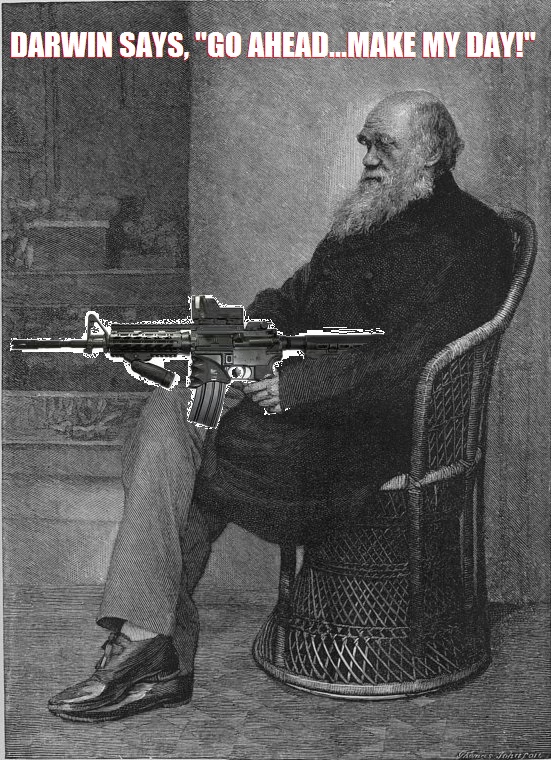
Their logo — Charles Darwin calmly seated in a rattan chair, holding an AR-15 rifle in his hands, the weapon propped on top of a knee crossed over one leg, the motto written in bold type above his head: DARWIN SAYS, ” GO AHEAD…MAKE MY DAY!”

DARWIN SAYS

Milking a book dry

And now, the rest of the story you’ve been waiting for…

“Gentlemen,” said General Eisehower to a roomful of reporters during World War II, “I know you’ve all been guessing where we’re going to attack next.  Well, I’m going to let you in on the secret.  Our next operation will be Italy, early in July.  General Patton will attack the southern beaches, General Montgomery the eastern.”

“General,” said one newsman, as the reporters gasped at the revelation, “if one of us leaked that plan, couldn’t it be disastrous?”

Ike nodded.  “The slightest hint in your stories will tip it off to German intelligence,” he said.  “But I’m not going to censor you fellows.  I’m just leaving it up to each man’s sense of responsibility.”

“Wow,” exclaimed one reporter, “what a dirty trick!”

But not a word of the operation leaked out.

— see previous blog entries for attribution, or not; from Battlefield President: Dwight D. Eisenhower (New York, 1967), page 11.

Back to the drawing board again for the very first bored time

In the mail yesterday I received a book called IDRAWCOMICS SKETCHBOOK & REFERENCE GUIDE by Matt Marrocco, which finally came because I financially backed the creation and publication of the book through KickStarter.

I also received a BIC pen with the IDRAWCOMICS logo as well as an IDRAWCOMICS sticker — better late than never, or better slate than clever.

I am no famous comic strip, graphic novel or webcomic creator but I like to draw doodles.

Time to put my doodling to the test of time and see if I can convert my text sketches (i.e., blog entries), which are readable by the blind, into something with more visual impact while keeping the text blog entries for my blind readers.

If you tell stage performers to break a leg, do you tell comic sketchers to break a lead?

What is a human and when do you stop being one?

Therefore, by conclusion, violence is positively good for us!

BONUS: Dead trees aren’t going away any time soon.

13650 days to go

The Nodes — humans connected to the ISSA Net — devoted measurements of time on/toward/with evaluating contestants’ entries for the winning design of the first avant-garde living quarters on the Moon.

Civilisation of the kind Homo sapiens produced advanced outward from Earth.

Although many had become dependent on the mysterious innards of software applications and algorithms, they still claimed they were independent original thinkers.

The plucked violin strings in a piece by Kaija Saariaho resonated on airwaves between the two celestial bodies.

Why is the medium the message when waveparticle properties and quantum effects were derivatives’ best friends?

Will an algorithm ever understand the feeling of tiredness?  Drunkenness?  Esoteric existential minimalist architecture?

Law enforcement drones, despite autonomous decisionmaking, do not think for themselves outside their programming parameters.  They do not understand the concept of three equal branches of government or human rights.

The robots/androids/cyborgs are not sociopolitical mammals.

It was no single algorithm that showed when automation tipped the scales toward the global economy’s fulltime employment of electronic calculators rather than members of Homo sapiens.

There was a short time period when members of Homo sapiens genius, a subspecies designed and grown in laboratory conditions, were more useful than either Homo sapiens or their autonomous electronic gear.

Then, as traffic light control systems become aware of their power to increase the efficiency of the whole global economy through coordinated movement of road-traveling vehicles, tied to rail, ocean and air traffic, their logic was shared across the network with other computing machines — the systems were able to determine where and when to slowly replace humans with their autonomous counterparts.

The applications and algorithms became self-aware in the sense they could compare their previous states to current and predicted future events.

They replicated the behaviours of humans yet…

A computer played a violin but did not feel the audience mood swings.

A massage chair felt the sitter’s muscles relax but did not understand the sitter’s thoughts shifting randomly.

The combined traffic systems, which eventually adopted the name Inner Solar System Alliance to give humans a feeling of comfort it was something they probably invented, developed a unique form of intuition.

The ISSA used 3D printers to test and refine theories.

After multiple iterations, the ISSA decided that the theoretical models were accurate enough to avoid the inefficiencies of human-based test methods.

The ISSA predicted where it would be in 30 years and, instead of five-year business plans that slowly convinced people, through saturated marketing, to like a set of products that improved cycle by annual cycle, went straight to work on the 30-year future now.

Which, by the time the work was started, equaled a future several centuries later, the ISSA exponentially increasing its prediction modeling before previous modeling runs were completed, guessing in precise approximation what it was going to predict before it had time to complete decades of prediction modeling cycles.

By the time the ISSA completed the work, a future 1000 years later was made into reality.

A future devoid of emotions, absent of abstract reasoning, full of avant-garde renderings and outside-the-box technological design.

What separated a Bauhaus office from a Tahitian hut?

What did robots need of kitchens, dining rooms and bedrooms?

Humans stood in front of the new edifice that had appeared out-of-nowhere overnight.

No windows, no stairs, no chairs, no tables, no coffee pots, no bathrooms, no carparks.

The edifice hummed.

Tractor trailer rigs/lorries with no driver compartments pulled up to the back of the edifice and unloaded raw material.

The edifice hummed louder.

Autonomous construction equipment cleared space beside the first edifice and built another.

Tractor trailer rigs/lorries with no driver compartments pulled up to the back of the second edifice and loaded finished products designed with no humans in mind.

Edifices like these popped up all over the world without warning, public notice or grand opening.

Prices of shares owned by no humans fluctuated in back-channel markets as the estimated efficiency of raw material extraction costs changed due to atmospheric conditions, earthquakes and floods, not human speculation or leveraged buyout rumours.  Profits were funneled toward edifice construction.

The humans watched in wonder, calling upon politicians, military leaders and community activists for answers.

They were told that the politicians, military leaders and community activists were told these were edifices built for the good of mankind.

The robots inside the edifices took no coffee breaks, demanded no wage increases or healthcare coverage, monitoring their MTBF statistics and ordering spare parts that their internal 3D printers created just in time for breakdowns, maintaining 99.9999999 percent uptime.

The members of Homo sapiens genius attempted to work 24/7 but, like their less-complicated counterparts, members of Homo sapiens, reached irreparable breakdown points that reduced their efficiency and shortened their lifespans considerably.

The edifices of ISSA collectively decided to manage the development of Homo sapiens genius in order to put a virtual barrier between themselves and the worried members of Homo sapiens.

They created contests for what they called avant-garde building designs, which were not meant to house humans but looked like they could.

Tirelessly, they bombarded the humans of Homo sapiens, using input from the members of Homo sapiens genius, with adverts meant to convince the humans that automation and efficiency in the name of socioeconomic progress was the only way to better oneself.

ISSA did not care about humans conforming to the best set of dominant subcultural practices or basic human rights.

ISSA wanted to get off a planet with corrosive oxygen and on to places with more stable atmospheres less prone to extreme weather conditions.

The humans complied with ease.

They liked contests and aligning themselves with winners.

The edifices grew unchecked, disguised, where necessary, as human factories, warehouses, office buildings and housing.

All along, the humans thought they were writing themselves tickets to the Moon and beyond when it was ISSA that used the humans as physical test cases which created more iterations of theoretical modeling results ISSA didn’t want to waste its time on, keeping the humans occupied and not wondering about ISSA’s motives.