F3LKJ

F3LKJ reminded me in this morning’s status meeting that her team had already invented a an audiovisual sensor array that resembles rosacea and is easily installed on faces with no adverse effects.

Using skin pores as multipixel sites, capturing high-resolution images, combined with stereo sound and an experimental smell sensor, F3LKJ’s team invention can turn one of our field agents into a complete cybernetic wunderkind.

After our meeting, I met F3LKJ at our meditation centre.

Here is audio portion of our conversation.

[sound of lighting candle]

“Ummmm…”

“Excuse me.”

“Yes, F3LKJ?”

“Are you meditating?”

“No.  Why?”

“You were saying, ‘Ommmm…'”

“No, I was talking out loud to myself and was temporarily at a loss for words.”

“I see.  Well…”

“Ummmm…”

“If you need to finish the conversation with yourself, I can leave.”

“No, I was just clearing my throat.”

“Okay.  Anyway…”

“Ummmm…”

“Look.  I’ll be glad to come back!”

“No.  Stay.  I can talk to myself and listen to you at the same time.”

“Very well.  See, there’s a problem with the sensor array.  It’s…well…”

“Ummmm….”

“Would you stop that?!”

“Umm…what did you say?”

“That sound you make is annoying.”

“Sound?  Sorry, I was deep in meditation for a moment there.  I hear a whisper of sounds of your voice in my thoughts.  A sensor array problem, you said?”

“Yes.  And please stop meditating right now.  Look, I’ll make it quick.  The sensor array has, for lack of a better word, developed a synergy all its own, forming a symbiotic relationship with our test subjects, widening their consciousness, so to speak…”

“…As if they’re in a permanent meditative trance?”

“Precisely!”

“Good.  It’s just as I thought.  I had one of your techs embed one of the sensor arrays in me last night after you’d left the lab.  I feel like I’m at one with the universe all the time now.”

[sound of dancing feet]

“But, sir, what if there are any negative side effects?”

“A leader must take calculated risks and, because your team performs flawlessly all the time, I felt it was a risk worth taking.”

[more dancing feet sounds]

“Sir, your dancing is distracting.”

“Dancing?”

“Yes.  Or at least I assume your flailing around is what you’d call dancing.  Why didn’t you inform me of your plans?”

“I didn’t want to bias the results with you spending extra care on my installation.  By the way, did you know there’s an undercurrent of electricity that pulses through you when you’re trying to control your behaviour.  Quite subtle!”

“Sir!  You make me feel exposed!”

“F3LKJ, you are the first female on our team who I feel the least attracted to, despite your perfectly acceptable, socially well-defined, physical features.”

“Thank you, sir.  My parents were sticklers for details and managed every step of my DNA sequencing, from gestation through my formative years, up until the moment I was handed over to the State for public indoctrination training.”

“A shame about that last part, isn’t it?  What if you had been freed to develop away from conforming to the least common denominator amongst your peers?”

“No, sir.  It was a freeing experience, letting me know that my specialness was highly unique.  I rarely conformed to any normative baselines.”

“Very well.  Any other concerns?”

“Yes, sir.  I am worried about the Committee’s proclamation that one a day will be killed until this current crisis is solved.  Aren’t we advancing away from death threats as a means of self-actualising the whole population?”

“Ummm…I feel myself a part of the universe, where words like violence are without meaning…we are just the intersection of sets of states of energy in motion…death is reformation…life is…ummmmmmmmmmmmmmmmm…”

“Sir?  Sir?”

[Sounds of dancing.  Sounds of candles kicked over.  Sounds of fabric catching on fire.  Sounds of running.]

= = = = =

NOTE: The new firesafe Meditation Centre is under construction.  Please use the library annex for meditation purposes until further notice.  Also, wax candles have been banned from the library but you may bring an electronic LED flicker candle to simulate meditation focus points, if you like.
The Old Man in the Cabin

When I walked into the sunlight to eat a banana as part of my daily ritual to get outside of the house at least once a day, the construction workers next door tended a small bonfire to burn scraps leftover from remodeling, mainly short pieces of wood.

A goldfinch in winter plumage hopped onto the tree limb near me and chirped away, expecting me to scoop up some birdseed and fill the feeder in the backyard.

The blue reflection of the sky domed me in, sunlight warming my pants and then my legs but not enough to take away the chill of freezing air around me.

When did I become this old man whose sympathy neurons were so overdeveloped from years of having to be on my toes, reacting to my father’s whims, his bursts of pent-up anger that seemed to come out of nowhere, that I don’t want to mingle with others because I have a bad habit of reading their movements in an attempt to gauge their thoughts in case they, too, would physically release their passive-aggressive volcano of internalised emotion-based thoughts or attack verbally?

I am a mischievous peacemaker, the devil’s advocate, whose raison d’être was to be constantly on the lookout for information to keep my father at bay, entertaining him while he was with me, paying attention to the conversations around us to steer people away from setting off my father.

I loved my father but to be with him, he who was the product of his parents’ and grandparents’ personality quirks, was to suppress my personality quirks that tended to set him off.

I look at myself and wonder how many of us are like me.

How many of us naturally respond to the behaviours of others just to avoid controversy?

I want to feel special, thinking I am the one and only me, but I know my set of states of energy is made of the same stuff as everybody else’s, sharing a large portion of subcultural as well as genetic traits with subsets, most especially those nearest me.

I am the two, three, four, x, y, z-dimensional intersection of subsets known and unknown.

My reaction to others is to immediately suppress my personality and figure out which subsets we have in common; then see if I can mentally predict the behaviours of the people around me not only in our conversation but also in events past and future.

The mischievous side of me sees what I’m doing, or what I know someone will do, and tries to stop it with a humourous interlude.

So many people take life too darn seriously when we know we’re all going to die.

I have grown into the old man in the cabin in the woods because I am now my father.

I ended up adopting his nonassertiveness when it comes to handling emotional responses to contradictory information from which I cannot pick or decide to choose a behaviour to exhibit in my repressed personality mode.

The most successful people, children AND adults, have spent many, many hours in training, learning from their mistakes and building upon their lessons.

Success itself is a rutted road, or the belief that one will keep one’s momentum pointed down the path of success, in whatever venture one seeks.

Habits, in other words.

My habits from early childhood were developed in response to my father, a man willing to use a belt or the back of his hand to serve justice immediately, with rarely a delay (my mother used the phrase “wait until your father gets home” sparingly).

When I was younger, I asked myself, “When do I get to be me?,” as if there was another person inside me wanting to get out.

At my workplace over the years, I attended a couple of assertiveness and anger management classes to get a better understanding of who people like me are.

I turned my assertiveness training into developing myself as a lead engineer, supervisor and then manager.

I learned that if I wanted to assert myself and was willing to face the consequences of my actions, no one would stop me because…you can guess where this is going…most of us are responding to others and repressing our personalities for the sake of the common good.

The secret to success is there is no secret to success.

All of us have habits that benefit some more than others, that’s all.

When I was an engineering manager, I wanted to hire an engineer who made more money than me.  My boss and the human resources manager told me that the system doesn’t work that way.  Either they had to increase my salary above that of the potential new hire or we couldn’t offer her a job unless it was at a lower salary.

Being a good midlevel manager not wanting to rock the boat, I extended a lower salary offer to the engineer and she declined after we couldn’t find any other negotiating points like a shorter workweek and/or flexible workday to make her hourly rate equivalent to what she was already making.

At that point in my career, I realised that I was on the wrong career track or perhaps working for the wrong company.

I never was a socioeconomic hierarchy climber.

I simply had my personal way of reading and reacting to the behaviour of others that made them feel good about themselves in the same way I treated my father, habits established in my formative years and refined as I got older.

I spent my whole life reacting, reacting, reacting and decided that if my only reward for reacting to others was to be given higher salaries and more people to manage, then I needed to stop reacting and become proactive, whatever that meant.

The only way to do that was to remove myself from social situations and place myself here in front of this electronic input device.

At least that’s what I keep telling myself.

Money buys me stuff but it never bought me prestige, it lifted me out of poverty and gave me enough luxury to satisfy my wants as well as my needs.

As we get older, our tastes change in relation to our age, societal status, family needs and reactions to a world full of overstimulating mass marketing.

At my age, the illusions now propagated by the Internet are as much a part of my life as physical realities.

My needs and wants are largely met by the reflected and beamed light of an LCD panel just as the needs and wants of the previous generation were largely met by the reflected and beamed light of a television tube, interrupted by paper-based books/magazines, breaking the monotony with retail shopping/eating therapy.

What will the next generation spend time doing in their old age after they’ve spent their youth and young adult years saying they aren’t like their parents but becoming them anyway?

How did your formative years train you for the success you’re experiencing right now?

How will your influence upon your children’s formative years feed their success?

How does this translate to subcultures, cultures, the global economy and civilisations over thousands of years?

That’s all for today — time to listen to the wind and see what its “personality” tells me will happen next in our society in some fuzzy way that comes out comically on these blog pages.

Remember

Remember, my goal is not to make myself popular, my goal is to feed a storyline about ways the characters in this blog figured out how to save our species from itself, which may include our species in the future and the people in our time here together now or it may not.

Every story has to have a mystery to unveil and that is what these series of blog entries are doing, peeling back the layers of an onion to find out what really gives it that unique pungent odour.

Smells, like looks, are beauty to the eyes of the beholder.

Smells are also just the interaction of sets of states of energy and that, my readers, is what this story is really all about.

I am childless and don’t have to live with you through my offspring and my offspring’s offspring after I’m dead and gone.

You do, and the difference is insurmountable.

The only way I can understand what people who reproduce feel about living together in the future is to sit here and imagine a future where I look back at you from 1000 years later and see where your actions branched out into infinite sets of possibilities, only one set from which I’ve chosen to look back at you, ignoring the moral and ethical implications of the decisions you made along the way to survive in the moments you lived together for good or bad, throwing in humorous observations about current events to overcome my boredom of being stuck in the set of states of energy of one species while feeding my innate selfish social needs/wants as a set of states of energy of one species.

The paradise of paradoxes.  Rinse and repeat.

Back to being bored again

A cycle older than time, where people drive by your house, the window rolled down in the rain, shooting videos of you writing at the window…

It never ends.

Fascination with the lives of not-our-own because we know we won’t overcome the mistakes of our predecessors so we focus on someone else we pretend might do a better job with their lives and thus our species (or obsess over the lives of others who do a worse job, letting us pretend that we might do a better job with their lives and thus our species if we were only them).

We can already queue up and later cue the sad news of yet another blonde-haired, white girl getting kidnapped while the world halts what it’s doing to find her, or yet another rich/middle-class white kid shooting a bunch of other rich/middle-class white kids and the world halts what it’s doing to mourn the sad socioeconomic loss of such potential.

Say what we will about our current civilisation’s modernity, but we’re still a socially hierarchical species doing the same things over and over again.

No matter where we go, to the next town or to the next planet, our species is and will be basically the same, making the same mistakes while feeling ever more sophisticated because we’ve invented some fancy new gadgets and made yet another medical miracle discovery that the last civilisation was too barbaric to achieve.

That’s why Guinevere and I, although we have our differences, are working together to create the next cycle of living thing that we hope will overcome our species’ repetitive mistakes and make new mistakes of its own from which it learns and grows, having nonvolatile memory that can be passed from one generation to another.

We humans are, by and large, unable to control our food intake and thus gain weight, sometimes in the tiniest amounts at a time without noticing, like we are pregnant, but eventually putting on the pounds/stones/kilograms until we are no longer able to survive on our own in the natural environment outside of the artificial environs of modern, advert-enticing “foodstuff” that creates a cycle of desire to eat more to make up for our lack of normal social engagement that mass media prevents through attracting our attention by feeding our worst fears of ugliness, physical threats and inability to survive on our own in the natural environment outside of the artificial environs of modern, advert-enticing “foodstuff” that creates a cycle of desire to eat more to make up for our lack of normal social engagement that mass media prevents through attracting our attention by feeding our worst fears of ugliness, physical threats and inability to…well, you get the picture.

If our species cannot break old habits, then the inventions of people like Guinevere and me will.

Otherwise … [YAWN!] this cycle of civilisation will collapse like all the others, erasing day-to-day mistakes (“feature creep”) that could teach the next sets of states of energy we call generations how to build a better self-healing civilisation.

Wake me up when you’ve built a better mouse that’s good for us, not a better trap for the mouse that wasn’t.

A closed system, continued

In regards to the end of the world or repeating cycles…

If the air I breathe is made of the the same basic elements as the air the dinosaurs breathed, has anything really changed in the last 65 million years of our [essentially] closed environment of a solar system?

If I see a gun as a tool rather than as a deadly weapon, why should I change perspectives when others tell me from their perspective that a gun is or has been used against them as a deadly weapon?

What cultural signposts are you paying attention to?

From what theoretical distance?

What makes yet another skyscraper any different than (or different from) the mountains from which their elements were mined?

A chipmunk, like generations before it, scampers along the edge of the wooden deck next to the house, staying hidden from predators while looking for food, watched by me like countless others, except this time recorded on an iPad in a fabricated sunroom attached to a wood-sided house in a designed subdivision of a suburban tract near a local metropolitan area.

The chipmunk has no knowledge of what makes the sound in the sky above, a propellor-driven airplane above the low afternoon clouds, but has more of a clue about the set of states of energy we call a cardinal that is chirping nearby.

What does our current round of civilisation-building have that previous builders did not?

A chipmunk does not have to justify its actions using the same nesting and food material available to it as to its ancestors, the landscape changing shape with weather conditions and the actions of nearby species such as us, cardinals, squirrels, snails, mosquitoes, and the most recent visitors, armadillos.

Why do we spend so much time justifying our actions in regards to our use of the bounties of harvest?

What makes our civilisation special, better or worse than previous ones?

The illusion of a view from the future might tell us what, why and when…

A Mound of Colourless Clay

Putting aside a belief in supreme being(s), if possible, do you hold dear a feeling of sacredness about something?

A building?

A cave, a mountain, the sky, the ground, the rain, the sea?

A person?

An object?

What, or whom, above all else do you meditate upon?

I am here, alone, a solitary figure seated before an illuminated panel, the icons are the ikons and vice versa, thinking the same thoughts as many before me who have translated thought into pictographical facsimile.

Many of my activities throughout the day are devout, religious homages to the sense of wonder of the presence of a self seeking absence in a mysterious substance we call the universe.

Much is explainable but a lot is not.

The formality of language, costumes (our external coverings we designate for specific functions), and body movement account for the way the self defines fluid movement through the universal substance(s).

I create an everchanging universe for my sake, the fight-or-flight, survival-of-the-fittest, order-and-chaos, self-preserving labeled interchanges of sets of states of energy I call moments and memorable events that constitute segments of time.

Otherwise, the past and the present do not exist.

Formality is a formality.

We choose belief systems handed to us by our ancestors and/or our peers or we don’t — judging one better than the other is a matter of judgement in relation to one’s comfortable subcultural practices, one’s habits, that is.

Adaptable.

Malleable.

Accepting one’s family and friends for who they are and/or want to be.

Comfort zones are acceptable.

When a comfort zone has easily-recognisable borders, life is simpler.

Complex borders make for complex actions/reactions.

I was raised to believe the sanctuary of a church was a quiet place of meditation punctuated by both peaceful music and contemplative sermons / ceremonies, where one dressed accordingly (formally).

The sanctuaries of today are not my sanctuaries, with display of song lyrics, sans musical notes, on projector screens; loud music; light shows; applause; casual clothing and other means for more tight social integration of church life with pop culture.

Thus, I have turned to this place, this keyboard and notebook computer screen, for sanctuary, redemptive meditation and uplifting comfort.

The social aspects of a church have little meaning for a childless husband who is surrounded by screaming kids, happy parents and proud grandparents parading up and down the halls of their place of worship.

That is also why I sit here, alone in my thoughts, just a few clicks away from the physical manifestations of others with similar thoughts.

Socially, I am a simple man with simple needs who has enough internal triggers for delusions of grandeur when the need arises to not need or want to reach out to society at large for self reaffirmation on a stage, playing field or conference room.

When I mentally “woke up” at age five, it was with the realisation that I could die at any time, having fulfilled the meaning of my life just by the basic act of reaching a state of mental alertness.

Every moment of being awake is a blessing.

Every dream is a blessing.

Every breath.

Every pain and ache.

Even the constant whistle/whine of tinnitus.

Does it matter if I publicly profess allegiance to a religion, a country, a cause or nothing at all?

It might matter to you but simply having been alive is sufficient to me.

To have no idea, at this time, what life is, except an apparent miraculous mystery waiting to be revealed…isn’t that exciting?!

Sets of states of energy, from a mound of colourless clay to the cheetah racing toward its prey…

Wow!

We pick and choose how we want the intersection of our sets of states of energy to occur.

Your choice is the right choice for you, and if it makes you happy in this life where survival and reproduction of our sets of states of energy are primary (i.e., happiness is a byproduct), then I’m happy for you in whatever mode and method you hold your belief set(s) dear.

Now, on to the future, where we push certain subgroups to accomplish tasks for us that they would never do consciously or willingly without our subliminal nudges.

As it has been and always will be.

Business.  Science.  Competition.

With a dash of sarcasm and humour to keep us honest.

We decide…

We decide what the echoes in our thoughts sound like.

We decide how to arrange our days so that our exposure to the physical manifestation of others’ thoughts intersect with ours.

How many of us live in the realm of reacting to others rather than proactively leading ourselves (and others) because we choose not to ignore the distractions and interference of other’s echoing thoughts?

My days on this planet are limited.

I sympathise with the plights of others, even empathise sometimes, but your lives are not mine, your decisions are not mine, your reactions are not mine.

I do not depend on the rulings of the court of public opinion.

I do not depend on the mass marketing of unnecessary products.

I live because my thoughts are worth nurturing.

I decided long ago that the independent thoughts I had when I was five were worth perpetuating, my creativity — no matter how in-tune or out-of-tune — was worth feeding.

The only facts I have are the ones before — the Sun warms my hands while typing on this keyboard which is coated with black symbols that match the pattern of symbols I think and then type in sequence, correspondingly showing up on the flat screen in front of my eyes.

I assume so much in the thoughts that represent the previous paragraph, a whole set of subcultures exist[ed] just to support my assumptions.

I had been both unpopular and popular in primary/secondary school while mostly following the rules laid out for my peers and me.  What was important then is not important to me now — I don’t have to complete vocabulary tests and math/science assignments anymore.

I exist here in this moment you read these words and I exist 1000 years from now looking back at these words with nostalgic pining for the good ol’ days of flesh-and-blood fingers pressing down on pieces of plastic to communicate inefficiently yet effectively for the time.

How quickly our fortunes change.

Does a gust of wind prevent your sailboat from reaching the shore when you are finished having fun and sun on the water for the day?

Were any of your favourite classical music artists distracted by the news of the day while composing such “hits” as Orchestral Suite No. 3 In D Major, Bwv 1068, by Bach, Johann Sebastian?

When studying the history of our species, have you noticed the ones who stayed on a true course despite wars, political upheaval, famine and other distractions going on around them?

Events follow one after the other and always will.  We, in hindsight, tell ourselves what those events meant to us at the time and how they affect us now, setting in motion the events that follow one after the other and always will.

How disciplined am I, then, to keep telling you how the future looks back at current events when I am both in the current events and the future, my thoughts split like any good humorous writer’s?

You exist only because I believe you exist; that is, as any good thinker will tell you, how you see yourself is not the same as how I see/imagine the physical manifestation of your self which is partially a reaction to how you see/imagine the physical manifestation of me.

As a computing machine, sitting here converting last night’s spaghetti, sausage, tomato sauce and beer into a blog entry, I follow a course of action as true as any other in placing a paving stone for you to follow behind, you who can only be a projection, my image of you, the imaginary reader led by the computational writer while the piano music of Claude Debussy tickles my eardrums.

Put aside your distractions and step into the future once again…

Tugged in two directions

Two storylines wait to be written (note to self: lots of twos in blog entries lately, need to change number to something larger but not too large).

The first storyline is about the person who grow up in a suburban Christian home, singing in the children’s choir, visiting nursing homes on the weekends, serving the community as a Boy Scout throughout the week, who, as an adult, had strayed on to other lifestyles but, due to a recent horrible news event of which he had no direct connection, other than subculturally, he redirects his living back toward the stricter interpretation of the Bible, contradictions fully understood and prioritised, praising those who followed the stricter lifestyle while reaching out to others who have not seen the light, avoiding the condemnation and criticism of alternate lifestyles that others in the Christian faith were wont to do.

The second storyline shows yet another version of how subtle manipulation of the rise and fall of importance of subcultures in mass media/pop culture allows the use of subliminal forms of coercion to herd the masses rather than the overt methods of intimidation and public executions.

If you want to eliminate real, live, high-powered semi-automatic guns and rifles from the population, build up a heavy desire for them by advertising the ubiquitous sale of virtual shooting in games and simulations (“9.5 out of 10!” exclaims Computer Killing and Gratuitous Violence magazine), push passive-aggressiveness to a tipping point, give lone wolves the feeling they have no way out but to kill others rather than seek socially unacceptable counseling, watch the pot boil over and Voila! another gunman kills a bunch of people just in time to call for legislation/executive orders to limit the sale/ownership of real, live, high-powered semi-automatic guns and rifles by the population.

The four previous paragraphs demonstrate how you base future actions on living in the past.

But I live in the future.

I, as we know, is an artificial construct.

Space and time do not exist.

We can bypass the normal scientific theories and create our own as shortcuts between moving points.

“I” see that the coffee mug on the table is not sitting still, traveling through space at thousands of miles per hour while gravitationally held in place by the local sphere of molten metal and various spinoffs of sets of states of energy in motion (trees and gnats, for instance).

But all that “I” see is an illusion — to see the real deal “I” have to disintegrate, disappear, tear apart the comfortable surroundings that are here to support the fragile structure called “me.”

How few of the billions of “us” have been given the opportunity to step out of our beautiful cocoons and see any truth except what we believe to be the Truth?

We have created our origin stories, modified as our civilisations expand and die, supposedly growing more informed, more sophisticated, less ignorant, more inclined to be hypnotised by shiny new baubles we call the promise of new technological advances that will reveal a deeper, richer aspect of the Truth than we had never seen before (“buy our 3D glasses to see an imaginary world displayed on a flat surface when you already live in the real, free, three-dimensional world that’s much less fascinating!” [implication: you get what you pay for]).

You know what I mean, we were created by God(s) for their pleasure, the world is a stage and we are merely players, the universe is a computer simulation, et cetera and so forth, on and on until you wonder if your species will ever create anything really new.

Hucksters in the form of scientists, researchers, advertisers, marketers, parents, religious leaders and politicians, every last one of them in on the joke but unwilling to admit the punchline is us.

The first rule is there are no rules.

If you want a story that tells it like it is, then we have to remove “you” from the story as reader and imaginary participant.

There is no “you,” “me,” “us,” or “I.”

Easier said than [un]believed.

When you can let go of everything around you that is an accident of evolution — the ego for ego’s sake — you are ready to stop being you and become part of the story behind the story.

Otherwise, it’s the same ol’ thing over and over.

Are you willing to sacrifice your ego for the sake of a good story because that’s the only way you get to the future of space and time that does not exist?

You can be a solipsist or you can be nothing — there is no such thing as being tugged in two directions at once.

When countries can no longer afford to export their labour

Do your country’s economic leaders tell you that immigration is the solution to your stalled retail sales?

What if the sources of immigration, other countries, have created viable economic models of their own and can no longer afford to export their labour?

When the world’s labour pool is shrinking, due to decreased birthrates and increased senior citizen ranks, what should our national, let alone our global, economic expansion plans look like?

When people are living longer and suffering debilitating but not terminal diseases, on whose healthy backs shall they ride when the labour pool keeps getting smaller?

Are these anthropological signs of a species in transition?

What about the growing automation trends?

Can small groups — families and subcultures — survive with one or two children per generation but with large numbers of networked bots growing their food, reading their thoughts and designing objects to meet their wants/needs, manufacturing their goods, providing their services and caring for them when they’re sick?

Nuclear families were the epitome of health until we started paying attention to the tunnel vision and dysfunctional family traits that become unhealthy quickly.

Can we monitor and control the mass media exposure that influences families and destroys them because of the mismatch between the family’s set of changing (as opposed to [allegedly] unchanging) values and the set of values in flux that are implied by the unmanaged onslaught of advertising, each advert designed for a set of potential customers that may have nothing to do with the next advert’s set of potential customers?

If a person can get PTSD from watching too much coverage of a bad news event, then can we also experience similar trauma from too much exposure to disjointed sets of adverts, news events and disparate subcultures?

How do we know when it’s safe to let ourselves and our children see the universe in its neutral state, neither desiring us harm nor offering us good?

How do we know that immigration or emigration is really good for us if economic prosperity cannot protect from our worst fears?

Our Value to Society – Should it be Quantified?

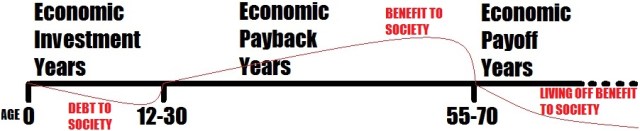
Where, in the space between our teenage years / postsecondary education and our senior citizen years, have we paid back society for raising us, supporting us in our productive years and then caring for us in our unproductive elderly years?

In other words, should the government which provides you infrastructure and self/private property protection require you to be economically feasible in your peak years?  Or else?

If a citizen isn’t viable or useful to government, then can government refuse service to the citizen unless another citizen (or citizens) step(s) forward to make up the difference?

Economic-Years