Tag Archives: history
Stallin’ for time
History is a despotic teacher.
Can you see de spot in your eyes?
Star Trek episodes as vintage movie posters – Boing Boing
Bridging the gap between generations
One day not so long ago my father and I took a trip through the country of our ancestors — the mountains and tidal basins of Tennessee, Virginia and North Carolina.
Standing on a bridge overlooking a body of water I can’t remember, Dad asked me if I knew much about our family.
Being the smart-ass teenager that I was, I mumbled some remark that almost made my father keep his mouth shut.
Instead, determined to make me see how serious he was, that this moment, more than any of the others, was his reason for taking us hundreds of miles from home, Dad began to talk while the sun set behind us, the dark purple horizon over the water rising up into the sky as stars blinked into life.
We could not see each other’s faces so we both leaned against the railing of the bridge, our hands hanging over.
The details of the conversation have faded. Being a determined writer who likes catching conversation on paper, I wrote a few snippets down after we talked but lost or rather, threw away, a large portion of my writing sometime after that trip and don’t have a single note to reference, depending on my middle-aged memory to capture now what he said then.
We talked about the girls I was interested in at the time, including Monica, with whom I had attended several proms and spent a lot of time in various groups such as Sing Out Kingsport; Janeil, who I had stopped dating before the trip with Dad; Alice Ray Knapp, a girl from my calculus (or was it Accounting?) class; one or two others whose names escape me.
Dad told me that he had no issues with the girls I dated and figured I was smart enough to choose a woman with whom I would spend the rest of my life — he could give my approval if I asked but didn’t think it was absolutely necessary; in other words, if I wanted to elope with someone, he would support my decision.
But he was interested in more than my love life.
He used my dating scene as a kicking off point, leading us to imagery of why to have a family at all.
I was noncommittal about having children at that time. Dad didn’t push me to name a number of children but wanted me to think about the purpose of marriage in all its social context, including responsibility to go to church, belonging to the right social organisations, climbing the corporate ladder wherever I worked and devoting quality time/money toward family.
That, too, was still the opening act of our conversation.
With the sky pitch-black, the Milky Way galaxy clearly visible, Dad decided we had better find a restaurant in the seaside town we were in, wanting to avoid seafood because of his shellfish allergies.
We found a place that served burgers and steaks and settled into a corner booth so Dad could continue the conversation.
He let me order a beer to show he was treating me like a man.
At that point, I told Dad my opinion about having kids with the various girls we had discussed, the whys and why-nots.
He nodded his head the whole time, not once interrupting me or criticising my opinions, a rarity for conversations between us, so I knew there was more in his thoughts he wanted to share.
I remember the waiter giving us strange looks because Dad sort of shooed him away whenever he came up, a friendly guy who seemed to want to tell us what was going on in the area over the next few days.
After I finished talking, Dad sat back in the bench seat and paused for a minute or two.
I wasn’t sure what he was going to say. I had grown used to Dad’s passive-aggressive personality, attuned to changes in his emotional state but didn’t sense any buildup of anger about to explode, another rarity.
Dad leaned forward and told me about his childhood. I sure wish I had a copy of what he said — summarizing it does not do either one of us justice but it’s all I’ve got.
Basically, Dad tried to get me to see the difference between his childhood and mine, as well as what he understood about the difference between his mother’s childhood and his, knowing nothing about his father’s childhood nor wanting to.
He then told me about various ancestors of ours he knew or had been told about, putting together family stories as well as personality sketches that would fill more than a novel’s worth of interest to the general reader.
Seeing that I still looked interested, Dad talked about where we were, somewhere near the Virginia/North Carolina border, not far from the ocean, and asked me to mentally picture what this place must have been like 200 or so years ago.
There were no fast-food joints, no highways, no street lights or hotels.
There were villages, wild animals, deadly diseases, ports of call that might or might not have been friendly to our ancestors and living pretty close to whatever you could kill or grow yourself.
Dad wished that I could see his and my mother’s family weren’t that far removed from living off the land, meaning that they were closer to understanding what our ancestors were like than I, having grown up in the comfortable surroundings of suburbia.
He didn’t know what my kids would be like but he wanted me to know that I would probably have a conversation like this with my children and feel frustrated sometimes that a generation gap is not just a catchy phrase in mass media but also a real difference of opinion and priorities between parents and their offspring.
I have few regrets in life, this being one of them: after Dad finished talking, he asked if I had any questions. I really wanted to know more about the ancestors he’d described but, for some reason, my teenage self felt the question was stupid because I knew that he and I were tired and had to get up in the morning for a long drive to our next stop, my feeling like an adult making me choose the responsible adult path of saying “Naw. I’m getting tired,” and turning Dad off from any more discussion of this type for the rest of the trip; another regret is not asking Dad’s father (or stepfather, really — Lee Bruce Hill; Dad’s biological father was named James Horace Capps) about his adventures during 29 years in the U.S. Navy between 1929 and 1959.
Knowing what I know now, that my father is no longer here to be asked questions, I might have made a different decision or many of them.
I might have chosen to have kids so that I and them could ask Dad more questions.
But it didn’t happen that way.
So, here I am, again, writing to you, the invisible reader, closely related to the eternal nature, the omniscient, able-to-do-anything god figure unable to be described or pinned down.
These words are my children, my gifts to the world I give freely, unconditionally.
I have given more hugs and kissy-face time to our cats than to people but that has been changing lately as I learn to let go of old habits, good and bad, and allow myself to learn what actual human interaction is like, good and bad, opening myself up to falling in love with people again, exposing my emotions to the joys and sorrows of daily life.
It is good to discover I can love people without feeling that I have to owe them anything.
It is even better to discover that people love me back without expecting anything in return, willing to learn from me despite my internally-magnified flaws that come out as odd behaviour.
It was good to jog out to the greenway bridge over the Flint River tonight, looking at the stars in the darkness, surrounded by the sounds of nature and spark the memory of a trip with Dad sometime in the early 1980s.
I am not just a biological product of my father, which is weird enough in itself when men my father’s age who haven’t seen him in a while and don’t know he’s dead mistake me for my father. I am also a product of our ancestral history — it’s up to me to keep our history alive, uncensored, readily-available to our living descendants, relatives and friends.
The words and images of my novels, short stories, poems, journals, blog entries and online videos are all I’ve got to record the history.
It’s also reflected in my view of the future, detailed in short stories or chapters of the ongoing saga of Martian colonisation taking place in this blog.
Lyrics worth repeating
Who needs integrity when racing cars for a living?
As a member of AARP, I’m mighty durn unhappy about the turn of events in NASCAR. We’ve always joked in our family that Michael Waltrip should have been punished a long time ago as the guy who always seemed to have a spare part fall off/out of his car for a convenient caution in days gone by, indicative of bad parenting and poor brotherly advice. The kid has grown up and leant his just-because-it’s-legal-doesn’t-make-it-right disregard for ethics and integrity to the drivers in his stable.
In other words, business as usual for the Waltrip family, tarnished with the same rusty brush as some of them Wallace boys.
Don’t matter none ’cause we got no reason to watch them cheaters try to win it all for the sake of a bunch of empty seats, lowered ticket sales and reduced merchandising that’s become the Race for the Chase to the Basest Behaviour.
Why, if I was their children, I’d hide my head in shame while signing a legal document giving me all of my father’s earnings, cutting his wife (their mother) out as an accomplice to the crime.
= = = = =
In other news, thanks to Degarious at Taco Bell; Jenn at Madison Ballroom; Eric, Sarah, the host, and kitchen at Chili’s; Jay, Kelley, Josh, Dana and Anna at DBA; Jodi, kitchen, Jenn, Stephane, and Patrick at Club Rush.
Abi and I agree on dance costumes?
Abi…there’s something about her that I haven’t been able to put my finger on until this afternoon.
We stood and held hands for probably 20 minutes while talking with Traci. I haven’t held hands like that with another woman since…well, since 1978?
I mean just standing there hand-in-hand, not cuddling or thinking about what’s next.
And then it dawned on me! Abi is the same height as Robyn, my girlfriend from high school.
So it’s only natural that Abi and I should wear the same outfits I did with Robyn lo those many years ago at a Halloween party.
Abi, I’m game if you are, you sassy girl — assuming Stephane will loan me some timeshare moments with you next week, that is! I promise not to drop you on the floor, IF AND ONLY IF you let me sit on your lap.


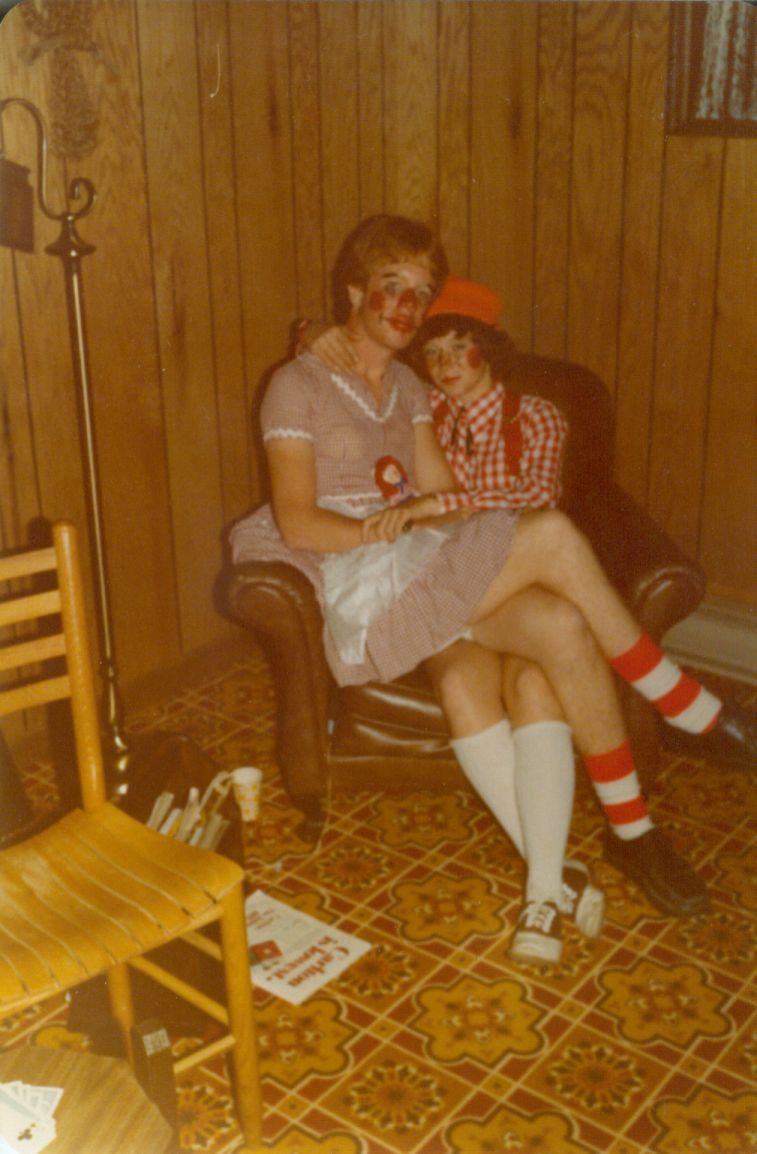
Yeah, that was me in the 1990s
I’m jealous of the younger me!:


Jhgf
Lee stood in the middle of the nature preserve, his crosstraining shoes upon the concrete path of the city greenway, and looked up through light pollution at the dim outlined threads of the Milky Way galaxy.
The ends of his toes were calloused from running inside shoes a half-size too small, Lee unable to afford a new pair, his three-dollar pair of running shorts and twenty-year old T-shirt a reminder that the life of a middle-aged ascète led him to austerity years before austerity was cool all over again for the very next time.
He felt a pain on the left side of his neck that throbbed through the back of his shoulder, down into his left shoulder blade like a thick rubber band freezing up.
He was tired, a deep-seated nervousness gripping him like an invisible creature digging its claws into his upper back, its body hovering over him, hunching him over like a crooked old man.
Recent phrases echoed in his head, repeatedly refreshing themselves in volume before decaying into icy pain in his neck. “It’s not about what’s in your pants,” which translated into “You’re not attractive as a man.” “You’re one of my weird friends,” which translated into “You’re lucky I consider you a friend because otherwise you wouldn’t have any.” “He’s very passive-aggressive with his wife,” which translated into “Every time I see you, I talk about another person being passive-aggressive to hint to you about your own passive-aggressive issues.”
Lee took a deep breath.
He knew that writing stories was his way of dealing with a world he didn’t understand, his coping mechanism, his stress relief, his private conversation with himself as his own best friend because he trusted no one else to listen to him without judgement or reinterpretation.
His arms and hands drooped by his side.
Lee felt small, like the iridescent insects that hunkered down in the grass next to the greenway, their eyes or wing shells reflecting the light of the LED headlamp he wore while running after dark.
He had always been uncomfortable in his body, hearing kids make fun of his clumsiness, overhearing his father tell other fathers it’s not always what a kid can’t do on the ballfield that counts, his father bragging about Lee’s academic study habits and keen interest in both science and sports.
Lee put his hands on his hips, watching puffs of his breath rise up through the light beam pointing off his forehead.
He had only pretended to be interested in science and sports to keep his father’s anger directed away from Lee.
Lee knew at an early age that it was not his own interests that kept peace in the family, it was ensuring that his father’s anger was kept under control.
Thus, Lee had learned it was not what he liked that mattered.
He walked the world in fear. He developed a survivor’s mentality. He could easily tick off on his fingers what he didn’t like but had no idea what he liked for himself.
Writing was therapy, a purifying source of anti-joy that propped him up.
His thought patterns started splitting themselves into what made his father leave him alone, what made school bullies leave him alone and whatever else kept controversy and the fear of physical/mental abuse to a minimum.
After an automobile smashup in his teens, a lot of his thought patterns were reshuffled, his fears realigned, the noise in his thoughts, a kind of screaming pain with no source, making him wish every day that he was dead if the pain of the discordant thoughts would just go away and leave him alone in peace.
Years of self therapy ensued.
He depended upon the kindness of strangers to see his body in their own image, awarding him a four-year university scholarship based more on imagery than cold, hard facts. The facade quickly crumbled when Lee arrived at university, with no study skills, no motivation and little in the way of a support network for Lee himself rather than a system that was geared to keep him going down the road toward an officer’s commission in the U.S. Navy.
He spent hours in the Georgia Tech library looking at diagrams of early personal computers, dreaming of building his own, back in his parents’ basement when he was in high school playing with hand-assembled CPU systems that did little more than accept octal code in memory and display it back, Lee unable to understand how to go any further, his brain lacking logic circuitry to convert opcodes into useful subroutines and programs that weren’t spelled out in a programmer’s cookbook.
He walked the streets of Atlanta by himself, fearful of local gangs looking to protect their turf by beating a white kid in nominally black neighbourhoods.
He let his charm and innocent, nonthreatening personality protect him, which they did.
He never cared about his grades. He barely studied for the freshman calculus and chemistry classes that felt like his father’s threats all over again, leaving him no escape this time, finally showing his father the falsehood, failure and disappointment that Lee had felt he had been to his father, who had based his pride on a son simply hoping to survive childhood, if not die by a random mugging in some dark downtown Atlanta alleyway.
Those nine months in Atlanta taught Lee he had no friends. He had people who wanted to be friends with him until Lee shared his odd thought patterns with them, breaking the iconic imagery he represented in their thoughts, quickly walking away, watching them shake their heads as they wondered who he was.
Years of loneliness followed as Lee wandered from one person’s pretend image of him to the next.
He kept his thoughts to himself, burying them deeper.
He believed he was a gentle soul who just wanted to live in a cabin in the woods, freed from the cycle of first impressing and then unimpressing people, tired of one disappointment after another.
The girl from his summer camp days, with whom he had exchanged handwritten letters in the mail, seemed to be the only one who never saw Lee as strange or disappointing.
He loved her and hated her for accepting him as he was because by loving him she accepted him as a product of his father whom he feared which meant that Lee feared her, too.
Lee’s thoughts drifted, returning to the present.
How long had he stood by himself under the stars on a concrete path surrounded by woodland wrapped by suburban tracts filled with thousands of people?
He held the contemplative thoughts in as close a sequence as possible for writing down later on.
His thoughts were the only thing that mattered to him, worth more than gold.
He had once been a person who negotiated multimillion-dollar international contracts, flying across the globe for meetings, wondering when he was going to fulfill his dream of an ascète, withdrawing from the world his only hope for quieting the painful noise in his thoughts that never went away except when he was drunk or asleep, constantly on alert to cocoon himself from his business colleagues so they wouldn’t see his brain was crisscrossed with insane thought patterns.
The numbed ends of his toes and the needlepoint pains in his hips woke him from his daydream.
He shuffle-jogged over the concrete pathway, knowing he had forty-five more minutes with himself on the trail and roadside to add to his thoughts that he’d write down after he returned home, kissed his wife, petted the cats and showered.
The life of the frugal millionaire was coming back to him again, as close to happiness as a hunched-over simple man could ask for before he died, as entertained by a caterpillar munching on a redbud leaf outside the window as by the behaviour of his species in its desire to develop and maintain weapons of mass destruction as a form of godlike deterrent against the use of our worst hatred toward people unlike us.
Lee had learned to manage his fear. What about the other seven-plus billion of us?
I hate Edward Snowden
I’ll say it again, I hate Edward Snowden. His whistleblowing has ruined my fantasies of leading the hidden, covert life of a doublecrossing secret agent. I wish him a miserable existence as a man without a country, forever on the run from haters like me, worse off than Salman Rushdie with a bounty on his head.
 treetrunkdings