
Tag Archives: academics
notes from an alumnus written on illuminated aluminum
Rachel Osby registered at Shelby Center, Room 301.
David kingsbury(?) opened UAH alumni lunch-&-learn lecture.
Dr. Lillian Joyce.
UAH dept of art and history moved into Wilson Hall.
Available degrees:
- BA in Art (studio art or art history)
- BFA in graphic design, painting and drawing, photography, printmaking and sculpture.
POMPEII
Archaeology. Bay of Naples — former Roman navy/shipping center, home of Pompeii and Mt. Vesuvius.
Vesuvius volcano report issued like weather reports because of active volcanic activity. 217 BCE last known eruption. 5 Feb 62 CE — major earthquake before devastating eruption in 79 CE. Many eruptions since.
The Pompeii ruins are getting worse due to tourist funding reallocation by the government.
Negative spaces that were once bodies in the volcanic ash were filled with plaster to show what the bodies looked like as they fell, before they deteriorated.
Dr. J worked out of one the large four level houses built on the city wall overlooking the Bay of Naples.
Popular art on Pompeian walls: Abandonment of Ariadne by Theseus, picked up by Dionysus.
All the Pompeian houses had relatively plain exterior walls – luxury was displayed on the inside, created by artisans specialising in plaster, mosaic, painting, sculpting, etc.
Pompeii covered with both informal and professional “graffiti” artwork — 98 percent were commissioned for political campaigns. Ex: “vote my candidate for aidae.”
Around 10000 people lived in Pompeii — about 2800 political campaign paintings on walls in town.
Women wore wigs to emulate fashionable hairstyles on statues.
Many fresco portraits in Pompeii were cut out and displayed in Naples museum.
Running water in rich people’s houses and public fountains for everyone else.
“Cave canem” – beware the dog. Warning at doorway entrances where dogs were chained to keep people out because rarely were locked doors used. Dogs, like people, suffocated of poisonous gas exposure before buried in ash.
In homes, there was a public receiving area for men to get visitors and be attended by women and slaves.
Pretty garden scenes painted and created in mosaics on walls.
[Advert: the Department of Art and Art History and the Archaeological Institute of America, North Alabama Society’s lecture The Mosaics of Zeugma on the Euphrates, January 28, 7:30 p.m., Wilson Hall Theatre (first floor 001); presented by Dr. Katherine Dunbabin, Professor Emerita, from McMaster University. The lecture is free and open to the public.]
Alexander the Great was popular subject for mosaic tilework.
Nouveau riche land speculators came in, such as former slaves, and built elaborate palaces in Pompeii, collecting objects such as marble/stone water basins like some nouveau riche collect cars or velvet Elvis paintings.
Houses were rooms for entertaining and hosting business get-togethers — invitation only to visit gardens in back of house.
The kitchen was not a public gathering place — used by slaves only.
No bathroom per se, either. Public latrines and baths usually.
Bath house water temp was regulated, heated from below. Some bath houses had libraries and shops.
Two theaters, one with a fixed roof and one with a retractable roof (seated 3100-3500)
Amphitheater offered gladiator fights and wild animal hunts. Had retractable roof / awnings (seated 15000).
Romans had fast food eateries on street corners. Dozens of them in Pompeii.
Standing room only.
UAH sponsors Dr. J’s summer research.
Frescos are falling apart with time – exposure, polishing by guards, etc.
Sent from my iPad
News you can use — Monday edition
Ever wondered what a phased array of light would look like? I sure do. Now, what about that old bucket brigade down in the basement closet? Hmm…
Next on the list: combining solar systems into a super large wavelength phased array antenna set — we’ve got work to do this year to impact schedules a few thousand years from now!
Two types of readers
On what you focus is who you are:
A subculture calls me home…
Over the past couple of years, I have met with people who’ve asked me to reconsider the subcultural training of my youth in what I see as an attempt to keep me in the fold or bring me back in, depending on their views.
I met my wife at a summer church camp when we were 12, we married in her hometown church when we were 24 and, 26+ years later, we’re still married so I haven’t cut ties from my childhood subculture in any hard, abrupt, total sense.
Over the New Year’s Day extended holiday weekend, a good friend, medical doctor by trade, who with colleagues bought a primary school for a church congregation that has expanded from a few people to over 2000 since 2009, loaned me the following books to read:
- How Should We Then Live? (L’Abri 50th Anniversary Edition): The Rise and Decline of Western Thought and Culture, by Francis A. Schaeffer (Author), Lane T. Dennis (Foreword)
- How Now Shall We Live?, by Charles Colson (Author), Nancy Pearcey (Author), Harold Fickett (Collaborator)
Before I read them, I shall provide for myself and the reader a snippet of a review of each book.
- The first: “Finally, Schaeffer names well, twenty-five years before such things unfolded in Washington, just how societies without a sense of what the political means, would respond to terrorism. Such societies, Schaeffer writes, because they do not have any sense of liberty as a genuine political good, will “give up liberties” and welcome “a manipulating authoritarian government” (248) when decades of comfort get disturbed and the government promises to destroy evil (a strange promise for a government to make, as I tried to say even back in the last decade, but then again, it was the folks who recommended Schaeffer who seemed most convinced that a government could do just that).”
- The second: “For Catholics—as well as for Protestants who have kept up contact with their Catholic past—natural law has been the principal vehicle for reflection upon general revelation. Though [John] Calvin accepted the natural law, he did not make much of it—for fear, perhaps, of obscuring the depravity of the mind. Among most of his heirs, the tradition has languished. Some even oppose it as a de facto denial of the fall, a neo–Scholastic treason more in debt to Aristotle than to Jesus Christ. I believe that this is a misunderstanding, and the Colson and Pearcey project would have been impoverished had it enjoyed no access to this great river of thought. [C.S.] Lewis—who, like the authors, only rarely refers to natural law by its proper name—is in many ways its ideal missionary, not only for laypeople who have never heard of it and for scholars leery of its Scholastic form, but also for specialists who have forgotten its roots in common sense. The authors have drunk deeply from his well.”
For recent Christmas gifts, I received two other books:
- How the Irish Saved Civilization, by Thomas Cahill
- How the Scots Invented the Modern World: The True Story of How Western Europe’s Poorest Nation Created Our World & Everything in It, by Arthur Herman
I contemplate my individual future, compare it to our species’ future, determine where we share goals and plot a true course that benefits us both.
What is religion?
Cultural anthropologists observe line of vehicles at petrol station, assume the vehicles are receiving tinctures of holy temple oil, declare petrol stations the ultimate church/temple/mosque/synagogue.
Pull up, receive instant blessing, and drive off — that’s the kind of drivebys we need these days!
The more change in your pocket, the more your pocket stays the same.
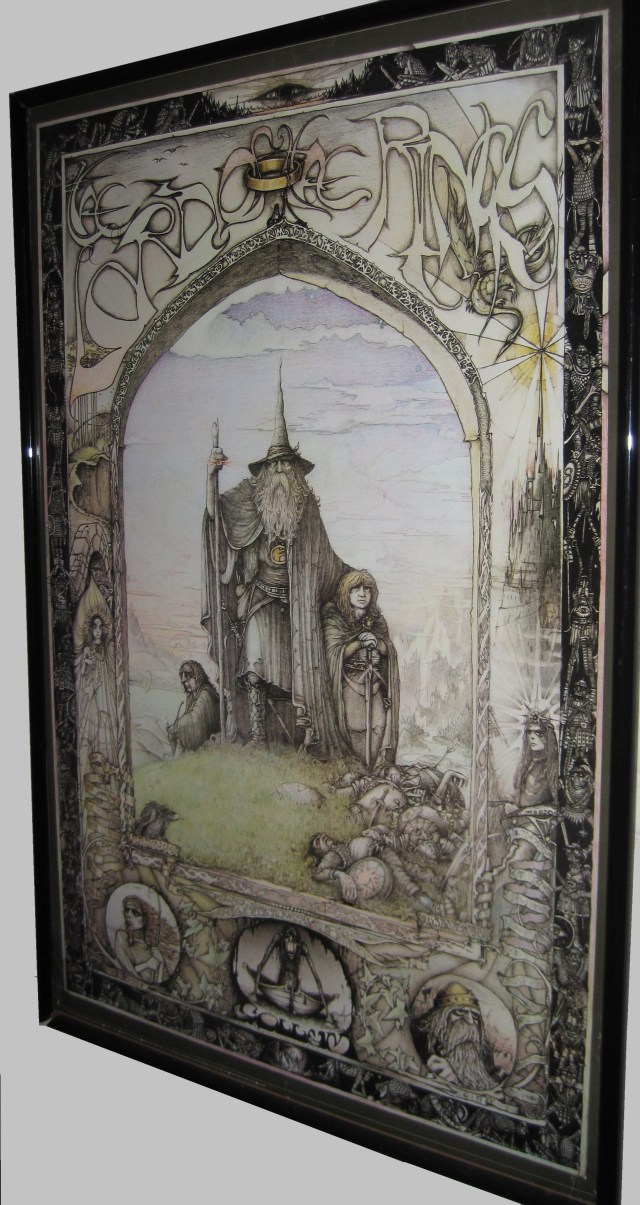
That cinematic time of year, again for the very first time
Ahh…memories of my youth…
Time to repost the poster that adorned my college dorm walls loke (as opposed to Lo) so many years ago…
Sigh…time flies while flies time thyme growing next to drying paint…
Countdown to infinity by halves
Dr. G. Brottel bent his knees and leaned back.
Neill, his dance instructor nodded. “Yes, young man. That’s exactly how you do it — chin up, look past your partner’s right ear and slightly point your right shoulder to hers, your hips straight.”
Galdous followed the instructions, just as he had followed instructions during his years at university, culminating in his dissertation, “Applying The Lamaze Method Aboard An L5 Society Geostationary Observation Station Boosted To An Earth-Moon Lagrange Point.”
This, of course, fed his interest in leading his partner, Yui, around the dance floor.
Mimicry circuitry in his central nervous system sped up his learning.
At night, he and Yui watched each other watch a 3D video which enhanced their sympathy learning of the moves in a weightless acrobatic encounter combining waltz, tango, Lindy hop, Balboa and East/West Coast swing.
By the end of their work shift the next day, their supplemental brain systems had worked out the coordinated muscle movements needed for smooth swaying on the spherical dance surface.
Yui, assigned to him and he assigned to her at birth, along with several alternative matches based on known genetic symmetry, melted into his arms as they spun “in the air” while holding the formal dance frames required for interplanetary competitions they planned to win.
Having grown up in adjoining educational centres but, not allowed to constantly interact like siblings, which tended to discourage the compatibility of their genetic material for later replication needs of the space colony, they had just enough similar phys-ed workout routines that meant they could anticipate each other’s moves without thinking.
Guinevere, a theoretical science university student and specialty dance instructor from Moon Base Amber Road, made mental notes about Galdous and Yui’s trajectories.
Her mental notes were sent to a supercomputer which adjusted the subroutines that would generate the next dance video for Galdous and Yui to watch that evening.
Guinevere, working on her PhD, the dissertation preliminarily titled, “Recalibrating Rocket Propulsion Guidance Systems Using Realtime Algorithm Remodeling of Neural Network Flow Diagrams,” general enough to give her flexibility with her university sponsor, had found that teaching others the dance steps she had learned during physical rehab not only helped her repair skeletomuscular damage from a bad spaceship smashup but also reinforced the pathways of her upgraded organic wireless circuitry.
In other words, practice what you preach, do what you say and say what you do, be a do bee, and go with the flow, as her therapist liked to say in mock repetition.
Guinevere held out her arms and Neill kicked off the floor toward her.
“Here’s what I mean, Galdous.” Neill cupped his palm and placed it in the small of Guinevere’s back. “Lift your left arm and gently push Yui forward. Yui, bend your knees to your chest, balling yourself up, and spin around Galdous’ waist.”
As Guinevere spun around Neill’s waist, she remembered a mistake in her recent classroom experiment calculations, which meant that the student satellite they had launched yesterday was going to miss its target.
She closed her eyes and focused on correcting her mistake.
If she could work out the logic in the next few seconds, she just had time to send the new algorithm to the Moon for automatic coding, then routed to the satellite for reprogramming.
Later, while Galdous and Yui watched their evening dance instruction video, a student satellite performed a series of maneuvers in space that oddly resembled the steps in the instructional video.
Only Guinevere knew what was going on, silently laughing to herself as she explained to her fellow students recording the satellite’s path that she had invented a new method of optimising a satellite’s stress test by putting strong centripetal forces into effect that pushed the physical limits of the satellite, including triaxial shear test methods employing all six degrees of freedom at once.
Lee Colline managed the lives of everyone on the space station.
He paid attention to all communication between the station and bases throughout the solar system. A pattern matching program alerted him to the accidental conjoining of Guinevere’s dance instructions and satellite reprogramming.
Lee ordered a review of future upgrades to all persons working and/or living on the station.
Although Guinevere’s “accident” had caused no harm and, in fact, may have led to a new discovery, he had to make sure that the next accident didn’t adversely affect the station.
The immediate application of basic science to practical living had long bothered Lee, who thought that some amount of peer review should separate the two after the Great Cataclysm had demonstrated the fallacy of shortterm economic subsystem profits over the longterm needs of the whole ecosystem.
Who, though, understood that socioeconomic systems rarely used peer review as a safety measure the way that scientists had long agreed peer review was necessary for protection against false claims and inaccurate conclusions?
He mentally wrote an emergency measure that would be reviewed by the Committee for implementation across the Solar System Space Station Network: “All student experiments must align their policies with the Post-Great Cataclysm Procedures for Protection Against Instant Gratification.”
Does this comic piece from the New Yorker really exist? Does it matter?
Le Blog de Jean-Paul Sartre
Posted by Bill Barol

Saturday, 11 July, 1959: 2:07 A.M.
I am awake and alone at 2 A.M.
There must be a God. There cannot be a God.
I will start a blog.
Sunday, 12 July, 1959: 9:55 A.M.
An angry crow mocked me this morning. I couldn’t finish my croissant, and fled the café in despair.
The crow descended on the croissant, squawking fiercely. Perhaps this was its plan.
Perhaps there is no plan.
Thursday, 16 July, 1959: 7:45 P.M.
When S. returned this afternoon I asked her where she had been, and she said she had been in the street.
“Perhaps,” I said, “that explains why you look ‘rue’-ful.”
Her blank stare only reinforced for me the futility of existence.
Friday, 17 July, 1959: 12:20 P.M.
When S. came through my study just now I asked her to wait a moment.
“Rueful,” I told her. “Because ‘rue’ is the French word for street.”
“What?” she said.
“From yesterday,” I said.
“Oh,” she said. “Yeah. Right.”
“And you said you had been in the street.”
“I got it,” she said.
“It was a pun,” I said.
“Got it,” she said. “Puns aren’t your thing, are they?”
“They fill me with dread,” I admitted, for it is true.
“I gotta go,” S. said. “Hey, from now on? Maybe not so much for you with the jokes. It’ll be like an hour for lunch, I gotta thaw the poulet.”
Existence is a vessel that can never be filled.
Sunday, 19 July, 1959: 8:15 A.M.
Let others have their so-called “day of rest”! I shall continue to strive, to think, for in work alone is Man’s purpose. This is what the bourgeoisie seem never to grasp. Especially that lout M. Picard from No. 11. Every day is a “day of rest” for that tête de mouton. How I wish he did not have his Citroën up on blocks in the front yard! Appearances are without meaning, but still, it does not look nice.
Wednesday, 22 July, 1959: 10:50 A.M.
This morning over breakfast S. asked me why I looked so glum.
“Because,” I said, “everything that exists is born for no reason, carries on living through weakness, and dies by accident.”
“Jesus,” S. said. “Aren’t you ever off the clock?”
Monday, 27 July, 1959: 4:10 A.M.
Lunch with Merleau-Ponty this afternoon in Saint-Germain-des-Prés. I was disturbed to hear that he has started a photoblog, and skeptical when he told me that although all its images are identical—a lonely kitten staring bleakly into space as rain falls pitilessly from an empty sky—he averages sixteen thousand page views per day. When I asked to see his referrer logs, he muttered evasively about having an appointment with an S.E.O. specialist and scurried away.
So this is hell.
Monday, 3 August, 1959: 11:10 A.M.
I was awakened this morning by the sound of an insistent knocking at my door. It was a man in a brown suit. He seemed to be in a hurry, as if Death itself were pursuing him.
“One always dies too soon—or too late,” I told him. “And yet one’s whole life is complete at that moment, with a line drawn neatly under it, ready for the summing up. You are—your life, and nothing else.”
“Okay,” he said. “But I’m just the UPS guy.”
“Oh,” I said. “I— Oh.”
“Sign here,” he said.
“I thought you were a harbinger of Death,” I told him.
“I get that a lot,” he said, peering down at the place on the clipboard where I had signed. “Spell your last name?”
“S-A-R-T-R-E,” I said.
“Have a nice day,” he said.
A nice day. How utterly banal.
Tuesday, 4 August, 1959: 3: 30 P.M.
A year ago, in a moment of weakness, I allowed my American literary representative to sell one of my books to a cinema producer for what was described as “a bold exploration of contemporary issues.” Yesterday I received a packet of publicity materials for a film titled “Johnny Sart: PD Squad.” The subtitle, or “tag line,” was “No badge. No gun. No exit.” A series of transatlantic telephone calls followed. Apparently I am unable to have my name removed from this abomination, but I will receive what is called a “co-producer” credit.
Existence is an imperfection.
Thursday, 20 August, 1959: 2:10 P.M.
If Man exists, God cannot exist, because God’s omniscience would reduce Man to an object. And if Man is merely an object, why then must I pay the onerous fees levied on overdue balances by M. Pelletier at the patisserie? At least this was the argument I raised this morning with M. Pelletier. He seemed unconvinced and produced his huge loutish son Gilles from the back, ominously brandishing a large pastry roller. The pastry roller existed, I can tell you that.
Friday, 2 October, 1959: 5:55 A.M.
My sleep continues to be troubled by odd dreams. Last night I dreamt that I was a beetle, clinging to the slick surface of a water-soaked log as it careened down a rain-swollen stream toward a waterfall. A figure appeared on the horizon, and as the log drew closer I could see that it was Camus. He held out a hand and I desperately reached for it with my tiny feeler. Just as the log drew abreast of Camus he suddenly withdrew his hand, swooped it through his hair, and sneered “Too slow,” adding superfluously, “Psych.”
It is my belief that the log symbolizes the precariousness of Existence, while the tiny feeler represents Man’s essential powerlessness. And Camus represents Camus, that fatuous ninny.
Tuesday, 10 November, 1959: 12:05 A.M.
It has been over a month since I have updated my blog. I am seized with an urge to apologize. But to whom, and to what end? If one truly creates for one’s self, why then am I so disturbed to find that my unique visitors have dwindled away practically to nothing, with a bounce rate approaching ninety-five per cent? These twin impulses—toward reckless self-regard and the approbation of others—neatly negate one another. This is the essential paradox of our time.
I will start a podcast.
Keywords
Read more http://www.newyorker.com/online/blogs/shouts/2012/10/le-blog-de-jean-paul-sartre.html#ixzz2AuHZHRIw
News Digest, 14th of October 2012
A few years ago, I installed a couple of ultrasonic buzzers in our attics to keep out animals. The first year, it was quieter than usual — fewer bumps in the middle of the night by our furry friends. Then, this year, I discovered a family of raccoons had taken up residence in the attic.
Call it affirmation of survival of the fittest except, in this case, it is a family of deaf raccoons that discovered a place to live peaceably under the roof of our house.
I found out that fact last night by opening the attic door and shouting at the raccons to be quiet. The baby raccoons kept chasing each other until one of them must have smelled me and turned, catching the attention of the other two who turned and froze, too.
Waving my arms and making aggressive charging motions scared them off into the unreachable corners.
Well, at least there’ll be no more screaming at the top of my lungs and confirming to my neighbours that the crazy man next door is trying to commune with the dead again.
In robot news, more from the analysis of Heidegger’s Being and Time by Hubert L. Dreyfus…
“2. Comportment is adaptable and copes with the situation in a variety of ways. Carpenters do not hammer like robots. Even in typing, which seems most reflex-like and automatic, the expert does not return to the home keys but strikes the next key from wherever the hand and fingers are at the time. In such coping one responds on the basis of a vast past experience of what has happened in previous situations, or, more exactly, one’s comportment manifests dispositions that have been shaped by a vast amount of previous dealings, so that in most cases when we exercise these dispositions everything works the way it should.”
“4. If something goes wrong, people and higher animals are startled. Mechanisms and insects are never startled. People are startled because their activity is directed into the future even when they are not pursuing conscious goals. Dasein is always ahead of itself.”
In other words, our actions/thoughts are based purely on the past while focused on the future. No wonder we have no idea what we’re doing in the present moment.
In business news, UPS made a hostile bid for the company Space Exploration Technologies Corp, commonly known as SpaceX, now that SpaceX has demonstrated its near-Earth-orbit package delivery service is reliable.
Experts expect FedEx to make a competitive bid to prevent UPS from expanding its reaches to “infinity and beyond,” with FedEx merely wanting to “be there before there are customers to be there,” mainly the Earth-to-Moon route that international transportation corporations are watering at the mouth to sink their teeth into.
The UPS CEO denied that Felix Baumgartner would be vice president of dropoff service for the new SpaceX division, if their bid is accepted.
The bicycle messenger union has opened negotiations for a stratospheric drop and parachute deployment training center that could provide pinpoint hand-delivery of packages to customers in remote locations via sky-high balloon or dirigible.
Pickup of the delivery person is a major sticking point in the negotiations at this time.
 treetrunkdings