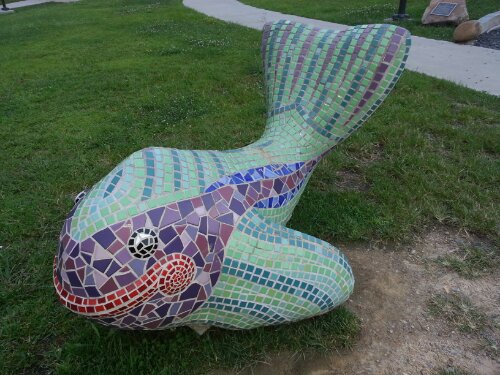
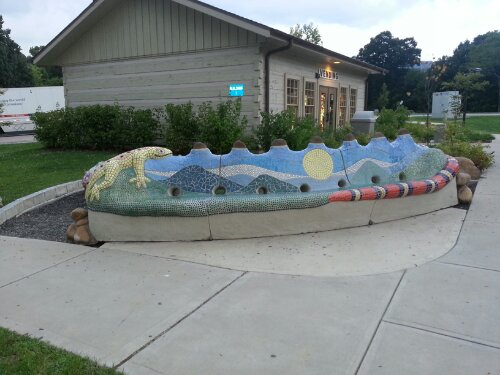
The key to happy Ness monsters

Muscle wire.”

“What?”

“Muscle wire.  Do you have any muscle wire?”

“I don’t know what you’re talking about.”  The man standing beside her looked at her strangely.

Guin sighed.  She had temporarily accepted an assignment to escort a group of tourists off-base.  During their excursion to the nearest overlook, nicknamed the Loch Ness Monster due to the group of humps that seemed to loom out of the landscape as you drove up to it but gave a sweeping view back to their research outpost when you turned around on top, a torsion bar was torqued out of shape.

“Oh, if only…well, never mind.  I don’t think we’d have any in the lab.  Back on Earth, though…”

Every now and then, Guin recalled her younger years.  She smiled and laughed inwardly as a scene from her childhood, when she first had an inkling she wanted to be a mechanical engineer, flashed through her thoughts.

She was in the mountains visiting her grandparents.

Her father, who had grown up there, had warned her about the kind of folks that lived deep in the hills.

“Now, our family is mainly of the preaching kind, as you know.  But the other families don’t take too kindly to strangers, being drug runners, mainly ‘shine, but some of them have been known to grow the wacky weed, especially Pennsylvania Pure, said to be a direct descendant of crops raised by George Washington and Benjamin Franklin.”

Even down in the valley, where Guin’s father had raised her, the drug dealers lived nearby.

Once, when Guin was out mountain biking, she blew a tire and hitched a ride home from a nice boy with a really cool 4×4 Jeep.  The moment the Jeep pulled into the driveway, her father let loose two warning shotgun blasts in the air.

Guin yelled it was her so her father set down the shotgun, telling her to get out and the boy to take off.

“He’s one of those drug dealers I told you to stay away from.  He’s bad!”

Guin shook her head.  “No he’s not, Dad.  He gave me a ride home.”

“Well, don’t go near him again.”

Guin kept this in her thoughts as she pulled up into her grandparents’ driveway, honking her horn long before she got to the house.

Her grandfather met her at the door.  “Praise Jesus.  I was worried about you, child.  Your father said you’ve been hanging out with those bums in the valley.  Don’t you know they’re the devil’s brood?”

“Aw, come on, Granddad.  I just had a flat tire.”

“Well, you shouldn’t’ve.  You need to learn to fix a tire yourself ’cause if you go out riding around here and get a flat, you will not be coming back.”

Guin wondered why her grandparents, who claimed to be good Christians, were so quick to dismiss the very people who they should be preaching to.  Instead of asking, she noticed her grandfather had a can of of spray foam insulation in his hand.

“Whatcha got there, Granddad?”

“Oh, this?  Well, your grandmother noticed bugs getting into the laundry room.  I noticed a gap running along the line between the window and the wall, probably from the house settling all these years.  I’m going to spray some of this and fill the gap, hoping that’s where the bugs are coming in.”

“Granddad, you’ve given me an idea.”

“Yes, dear, what’s that?”

“Well, that spray foam’d make a great inner tube for my mountain bike tires, don’t you think?”

“That is a great idea.  I’ll save you some.”

“Thanks, Granddad.”

While Guin loosened the brake cables on her bike and removed the wheels, she looked at the brake cables and shocks.

Her thoughts wandered.  What if…

She covered the inside of the wheel rims with a thin coat of oil to keep the spray foam from sticking but left a thin line of the rim clean just inside where the tires would touch the rims, allowing the foam and tires to stick together and bond with the rims.  She slowly sprayed the wet foam along the inside of each tire and seated one at a time back on the wheel rim, letting the expanding foam dry out and form a fully-inflated tire tightly wrapped around the wheel.  She didn’t know how long the foam-filled tires would last but surely long enough for her to have fun biking around the old home place in the mountains.

She dug through the mechatronic play set her grandfather had given her for Christmas and pulled out the muscle memory wire kit.

The heat generated by her bike could activate the muscle wire.  With a tip actuator, she could use the heat generated by her brakes to…hmm…well, what exactly?  A recoiling strand of muscle wire, as part of a nitinol heat engine, could turn a pulley.  What would it take for the system to know if she was about to tip over her handlebars because the front brakes were locking up tighter than her back brakes and ease off pressure on the front wheel so she could still slow down controllably?

Guin’s grandparents wished her goodnight but Guin got out of bed after she heard them quietly snoring down the hall.

She snuck outside with her gear and biked down the road to one of the moonshiners’ hangouts, loudly announcing her presence in the middle of the night.

Needless to say, she was met by flashlights and rifles with hidden voices behind the blinding lights demanding to know who she was and what she was doing in the middle of dadgum night.

Guin explained who she was and the guns lowered.

She further explained why she was there and the lights motioned her on into the barn and down into the hidden chamber where the moonshine was being cooked.

One good thing about being herself, Guin knew how and when to hide her geekiness just long enough for guys to warm up to her good looks.  Most guys got a kick out of a preacher’s granddaughter saying that she liked a strong sip of good moonshine.

She passed on the bong of Pennsylvania Pure getting handed around.

After 15 minutes of shooting the bull, trading stories about high school and cruel principals who didn’t take a liking to mountain folk, Guin sauntered over to the moonshine still.  She paid close attention to the welding, how neat everything was put together.

“You fellows sure know how to assemble piping.  Any chance you have any soldering equipment I can use?”

One boy’s face lit up.  “Yes, ma’am.”

“I’m sorry, what’s your name?”

“Nathaniel.”

“Well, Nathaniel, is this your handiwork?”  She pointed at the temperature control gauge and electronic control board that was hooked up to the still.

“Yes’m.  My daddy taught me.  He went to trade school and all that.  Was working at the steel mill over in Pittsburgh back before all that was shut down or automated.”

“Can you show me how to operate your equipment?”

“What fer?”

“I broke my bicycle and need to fix it but I want to make it better than before.  Any assistance you could give me would be greatly appreciated.”

“You aren’t trying to steal my ‘shine recipe, are you?  A purty girl like you?”

“No, Nathaniel, I’m not.  I just want to get to know you and your kin better.”  She looked around the group of guys, a couple of them in their teens, three or four in their 30s and two of them in their 50s or 60s.  “Right now, I don’t see much difference between you guys and my brothers or my father and grandfathers.”  She shrugged her shoulders.  “They preach fire and brimstone.  You make white lightning from fire and piping.  Both of you want to make the world a better place from your point of view.”

The guys nodded in general agreement.

Nathaniel pointed toward the back of the room.  “Over here, then.”

“Okay, I’ll get the rest of my gear.”  Guin climbed the ladder and walked over to where she had been made to set her stuff down in the barn.

The memory seemed like yesterday.  Had it been decades?

Guin looked at her reflection on the side of the all-terrain vehicle filled with antsy tourists, some who’d paid a life’s savings for this trip to Mars.  She had paid dearly for a treatment of Syndrome X, “freezing” her body at the age of 40, more than a life’s savings, sacrificing some of her memory and all of her wealth on Earth in order for the biological parts of her body not to die of natural causes for many more decades, what her friends called the ultimate energy exchange.

She opened her thoughts to Lee and Shadowgrass who were leading a tourist group out to an old historic landing site.

Between the three of them, they mentally created a reconfiguration of the ATV to operate without the need for one torsion bar, recording a note to themselves to request an expedited repair bot not only for their domicile but one each of the latest generation bots for the tourist ATVs.  Guin applied their fix and drove on, wishing for a new repair but wishing more that she’d had time to design one herself.

The new bots contained their own smelters which could forge hybrid parts from just about any chemical found in Martian soil, allowing Guin, Lee and Shadowgrass to expand their exploration and free up time for research after the tourista bots were allowed to go back into operation once the latest supply ship had landed with much-needed irreplaceable parts.

At the top of the ridge, the tourists oohed and aahed, recording themselves together in small groups, drinking water replacement fluids and eating spicy snack treats exclusive to this tour.

Guin virtually handed out commemorative electronic stamps that were actually coded algorithms once called apps that could only be sent and activated from the geolocation of the Loch Ness Monster Overlook, the tourists choosing the colour schemes, soil/clothing smells, wind/walking sounds, and 3D background scenes to include with their immersive experience video that was included as part of their tour package.

Guin sent a silent smile and hug to her two “guys,” which they returned within microseconds.

To get this far with their development of the Martian colonies had cost them many close friends on Mars and lost time with family members back on Earth.

But it was worth every sol (Martian day) and marsec (Martian second).

Whatever it took, even a week of giving tours instead of time devoted to pure research.

They always had each other.

But how many women fully support the idea of a patriarchal system and want their men to rule the universe?

To get hit with the blinding headaches of a major sinus infection in the middle of summer (but during the coldest days in decades), hands shaking and body not able to sleep due to intake of suphedrine, Mucinex D and the usual cholesterol/blood pressure control medication is the least of my worries.

To be able to write stories, I must have a polyamorous and polysexuality thought set.

Being in love with the characterised versions of people I know whom I use as models is driving me mad at this point.

[Pardon me while I honk my nose.]

Rarely do the people match the characters I’ve created.

Rarely still do the people feel the way I do toward them as characters.

But sometimes it takes experimenting with the people and their emotions to give me better understanding of where I want to take the storyline.

Meanwhile, keeping two mapsets — one of reality and one of the science fiction fantasy mapped onto the reality — takes its toll on my sanity.

Throw in an attack on my body’s balanced health and the imbalance throws me off-kilter.

I am a rudderless boat caught in a horrendous storm.

Then, while drifting in and out of daydreams while my wife snores and the cats lickclean themselves while resting on my chest, a story emerges…

[NOTE: Amateurs plagiarise, professionals steal.]

My successful Kickstarter campaign for a 3D printer that’s connected to a computer program that creates a 3D-layered robot complete with 100-DOF motion and 3D built-in electronics which can repair/replicate itself using the 3D printer and eventually creates its own successful Kickstarter competitor for robots that create their own successful businesses, giving me residual revenue for copyright/trademark/patent purposes.

In my dreams, I find ways to build layers to protect me from my klutzy personality and its intersection with other sets of states of energy.

I admit that my polyamorous side is in love with many people right now and the only way to keep myself straight is to write myself a controlled situation in which we are all relatively happy in our cocooned thought sets as we encounter each other in fictional life.

Fortunately or unfortunately, writing these fictional tales here adds to the confusion when the plots seem to align with storylines taking place in what, for lack of a better phrase, I’ll call “real life.”

Sometimes, I hypnotise myself into believing that I can imagine a future which has almost completely aligned with real events and think I have made a prediction.

That is why I keep a calendar countdown which tells me sometime 13,410 days or revolutions of our mother planet from now, we will experience something that is related to our species establishing permanent colonies off-Earth.  It can be the Moon or Mars, preferably the latter, which followed in our species’ timeline of sending one of our electromechanical wonders outside of the solar system; I’d be happy with a human-populated space probe, too.

As they say, if you work hard enough on a goal, it becomes reality.

At the beginning of the year, when I weighed 244 pounds, I told myself that I wanted to weigh 225 pounds by the fall quarter.  Yesterday morning, on the 17th of August, I weighed 225 pounds.  Goal became reality because I believed I could reasonably reach the goal and worked diligently, slowly, with setbacks, frustrations and elations, to get there.

Which reminds me, why aren’t we working more diligently and telling our species about the ways we plan to capture/collect water on the Moon and Mars?

There aren’t enough water molecules in near-Earth orbit for us to capture but there are certainly places on the Moon and Mars for us to dig in the ground and/or “net” water from the air, if not generate water (or its equivalent (hint, hint)) using other processes.

Instead, using my “robotic” money-generating algorithms on the stock market, I am putting myself out of business by skipping Kickstarter altogether and going straight to the 3D-printer self-repair/replicate robot realised dream.

If only there was some way I could automate my polyamorous/polysexual storylines and get me out of the thought-mapping business!

But then, what would I do about my thoughts that pop up when I’m engaged in normal small-talk conversations with people whom I fear would not understand my verbalised thought maps in realtime, as they have in the past?

At 2:30 a.m. in the morning, I don’t have an answer to that question.  Best keep my tangentially-weird thoughts and ideas to myself and my closest friends, whom I fear more than most because their weird thoughts and ideas are even more amazingly complicated than mine!

Pinnacle

Another stain appeared on the ceiling, nearer to the point where two sloping surfaces of the cathedral ceiling meet than where the first stain materialised.

Shadowgrass, a name the boy accepted from parents who thought that labels were arbitrary, pulled out a golf ball ranging device and measured the width of the stain from where he was standing 15 feet below.

First, he stood directly beneath one edge of the stain and wrote down the distance.  Holding the device at the same height, he rotated it slightly until he measured the new distance and wrote it down.  Assuming the first measurement was a right angle, he calculated the third leg of a triangle and decided it was close enough to call the width of the stain.

As a quadriplegic, Shadowgrass had developed special skills, exercising his thoughts so that he was able to invent appendages that most humans didn’t need.

Sometimes, he simply found new uses for commonplace items.

He heard a door open and knew his parents were home from their latest sojourn, scouting out a location for a new Martian laboratory, far from the watchful eyes and ears of satellites constantly circumnavigating the planet.

“Guin and Lee, I’m in here!”

Guin followed Shadowgrass’ voice into the Sanctuary Room, a space modeled on old religious structures on Earth.

“Well, whatcha got there?”

Shadowgrass pointed at the ceiling.  “Another stain.”

Guin nodded.  “Probably a leak.  Can you fix it?”

Shadowgrass shook his head.  “The repair bot is out for repair and refurbishment because our 3D printer is not working.”

“I’m sorry, honey, but we’re short on supplies right now.  Only essential lab gear is getting repaired until the next supply ship arrives from the Moon.”

“Mom, why do they still call Earth’s only natural satellite the Moon?”

“I don’t know, dear.  It doesn’t make sense, does it?  Why don’t we call it something else…”

“…like Shadowgrass?”

“Well, sure, why not?  We call Mars Mars and we call Venus Venus.  It makes just as much sense to call the Moon Shadowgrass.”

“Sure, Mom.  It doesn’t have arms or legs, either!”

Guin smiled, turning her head to one side slightly.  “Good point.”

Lee walked into the room.  “Hey, kiddo!  What’s going on?”

Guin and Shadowgrass nodded at the ceiling.

“Hmm…isn’t that an oil coolant supply line that runs through there?”

“Yes, Dad.”

“Can you fix it, son?”

Guin and Shadowgrass shook their heads.

“Oh yeah, the repair bot’s down, isn’t it?”

“Yes, Dad.”

“Well, son, I think this calls for you to assert your ingenuity toward reinventing yourself.”

Shadowgrass closed his eyes and let the active voice in his thoughts go silent.

His parents sat down and waited, knowing that Shadowgrass, their ultimate achievement in reproducing the best traits of themselves, would take Lee’s challenge and come up with a solution that neither one of them could if their put their heads together, let alone if they tried separately.

Shadowgrass accessed the spare computing cycles of the colony’s computer network, every object from a solar tracking memory circuit to the amplifier circuit in a tourist’s hearing implant.

He put himself in the role of the last leak, taking into account the growth rate of both leaks, their locations, the time the first leak started and stopped and the time the second leak started.

He looked at the blueprint plans for their living quarters, estimating the pressure of liquid passing through pipes in their building.

His thoughts worked backward from the leak, determining the shearing force on pipe joints, the corrosive qualities of the oil coolant and the path that leaking oil would follow from weak points in the pipe.

He saw that his body was full of nanobots making spot repairs in the blood vessels and other circulatory tubes.

His parents had given him the ability to reprogram the nanobots in his body as he saw fit.

He opened his eyes and turned to his parents.  “Do you give me permission to pass some of the nanobots from my body into the pipes of our habitat?”

Guin raised her eyebrows.  “Have you…have you thought through the unintended consequences of what you’re about to propose?”

Shadowgrass shook his head.  “Not yet.”

Lee stood up.  “Son, tell you what.  Spend the next hour or so working through case studies where unacceptable error rates cause us extreme discomfort and work your way back to what you’re asking us now.”

“Okay, Dad.  It should only take me a few minutes at most.”

“Fine, son.  When you’re finished, run some regression tests on the regression tests.  I think where you’re going with this will work out but I want you to have a backup plan for when something you haven’t thought of yet will support any changes your nanobots experience when they’re no longer part of your body.  We had not created them for extracorporeal purposes.”

“Sure thing, Dad.”

“And submit a request to rename the Moon Shadowgrass.  I like your mother’s idea.  With all you’ve done to save this colony and us serving as a reserve unit should climate change continue to cause population decreases on Earth, you deserve a moon named after you.”

“Thanks, Dad!”

“No problem, son.  You make us proud.”

Guin hugged Shadowgrass’ neck.  “That’s right, dear.  You have exceeded our wildest dreams for a child of our own.”

Shadowgrass smiled.  “Would you all dance for me?  It makes me feel happy.”

Guin and Lee slipped out of their exploration gear, tumbling up and over Shadowgrass while he finished his calculations for a self-sufficient nanobot repair system servicing the pipes in their home.  If the system worked, he would be able to sell the idea to his neighbours and fund his dream to build an exploration vehicle designed specifically for him, able to join his parents when they ventured far from the colony, risking their lives, living out their motto, “Vive ut vivas.”

Who exactly are Craig or Angie and why do they have lists?

The Loveliest Short Story You Will Read Today Was Published on Craigslist

“Missed Connection” stays with you.
Aug 9 2013, 10:43 AM ET
 [FROM THE ATLANTIC]
missed-connections.jpg

Lucas Jackson/Reuters, Chris Heller

Craigslist: that scourge of the newspaper industry, that den of lust, that middleman responsible for an untold number of bedbug crises.

Or, Craigslist: the Internet’s simplest and most ingenious disruptor, a digital equivalent of the neighborhood telephone pole papered from sidewalk to eye line with “HELP WANTED” and “GARAGE SALE: TODAY!” flyers.

How about, Craigslist: accidental publisher of short fiction?

On Tuesday evening, “Missed Connection” appeared as a personal listing on Brooklyn’s corner of the website. It begins like most of these confessions do:

I saw you on the Manhattan-bound Brooklyn Q train.

I was wearing a blue-striped t-shirt and a pair of maroon pants. You were wearing a vintage red skirt and a smart white blouse.

Looks familiar, right? We made eye contact, we smiled at each other, we didn’t talk before you got off the train, yadda, yadda, yadda. But, no. The anonymous writer, whoever he or she is, framed a fantastical sort of romantic tragedy within this Craigslist post. It’s a sad, lovely story in an unexpected place.

As short fiction goes, it’s nothing special. The prose sags. The writer’s weakness for adverbs (“I cocked my head at you inquisitively,”) and precious sentiment (“We both wore glasses. I guess we still do,”) creates needless distractions. The story needs a good editor and several more drafts. It’s far from great writing–and yet, it still works.

Maybe it’s the grim appeal of lost love. Maybe it’s the whiff of surprise in such a well-trod crook of the Internet. Maybe it’s just the pleasure of a small, imaginative story. Whatever it is, there’s something about “Missed Connection” that stays with you.

Read “Missed Connection” below:

I saw you on the Manhattan-bound Brooklyn Q train.

I was wearing a blue-striped t-shirt and a pair of maroon pants. You were wearing a vintage red skirt and a smart white blouse. We both wore glasses. I guess we still do.

You got on at DeKalb and sat across from me and we made eye contact, briefly. I fell in love with you a little bit, in that stupid way where you completely make up a fictional version of the person you’re looking at and fall in love with that person. But still I think there was something there.

Several times we looked at each other and then looked away. I tried to think of something to say to you — maybe pretend I didn’t know where I was going and ask you for directions or say something nice about your boot-shaped earrings, or just say, “Hot day.” It all seemed so stupid.

At one point, I caught you staring at me and you immediately averted your eyes. You pulled a book out of your bag and started reading it — a biography of Lyndon Johnson — but I noticed you never once turned a page.

My stop was Union Square, but at Union Square I decided to stay on, rationalizing that I could just as easily transfer to the 7 at 42nd Street, but then I didn’t get off at 42nd Street either. You must have missed your stop as well, because when we got all the way to the end of the line at Ditmars, we both just sat there in the car, waiting.

I cocked my head at you inquisitively. You shrugged and held up your book as if that was the reason.

Still I said nothing.

We took the train all the way back down — down through Astoria, across the East River, weaving through midtown, from Times Square to Herald Square to Union Square, under SoHo and Chinatown, up across the bridge back into Brooklyn, past Barclays and Prospect Park, past Flatbush and Midwood and Sheepshead Bay, all the way to Coney Island. And when we got to Coney Island, I knew I had to say something.

Still I said nothing.

And so we went back up.

Up and down the Q line, over and over. We caught the rush hour crowds and then saw them thin out again. We watched the sun set over Manhattan as we crossed the East River. I gave myself deadlines: I’ll talk to her before Newkirk; I’ll talk to her before Canal. Still I remained silent.

For months we sat on the train saying nothing to each other. We survived on bags of skittles sold to us by kids raising money for their basketball teams. We must have heard a million mariachi bands, had our faces nearly kicked in by a hundred thousand break dancers. I gave money to the beggars until I ran out of singles. When the train went above ground I’d get text messages and voicemails (“Where are you? What happened? Are you okay?”) until my phone ran out of battery.

I’ll talk to her before daybreak; I’ll talk to her before Tuesday. The longer I waited, the harder it got. What could I possibly say to you now, now that we’ve passed this same station for the hundredth time? Maybe if I could go back to the first time the Q switched over to the local R line for the weekend, I could have said, “Well, this is inconvenient,” but I couldn’t very well say it now, could I? I would kick myself for days after every time you sneezed — why hadn’t I said “Bless You”? That tiny gesture could have been enough to pivot us into a conversation, but here in stupid silence still we sat.

There were nights when we were the only two souls in the car, perhaps even on the whole train, and even then I felt self-conscious about bothering you. She’s reading her book, I thought, she doesn’t want to talk to me. Still, there were moments when I felt a connection. Someone would shout something crazy about Jesus and we’d immediately look at each other to register our reactions. A couple of teenagers would exit, holding hands, and we’d both think: Young Love.

For sixty years, we sat in that car, just barely pretending not to notice each other. I got to know you so well, if only peripherally. I memorized the folds of your body, the contours of your face, the patterns of your breath. I saw you cry once after you’d glanced at a neighbor’s newspaper. I wondered if you were crying about something specific, or just the general passage of time, so unnoticeable until suddenly noticeable. I wanted to comfort you, wrap my arms around you, assure you I knew everything would be fine, but it felt too familiar; I stayed glued to my seat.

One day, in the middle of the afternoon, you stood up as the train pulled into Queensboro Plaza. It was difficult for you, this simple task of standing up, you hadn’t done it in sixty years. Holding onto the rails, you managed to get yourself to the door. You hesitated briefly there, perhaps waiting for me to say something, giving me one last chance to stop you, but rather than spit out a lifetime of suppressed almost-conversations I said nothing, and I watched you slip out between the closing sliding doors.

It took me a few more stops before I realized you were really gone. I kept waiting for you to reenter the subway car, sit down next to me, rest your head on my shoulder. Nothing would be said. Nothing would need to be said.

When the train returned to Queensboro Plaza, I craned my neck as we entered the station. Perhaps you were there, on the platform, still waiting. Perhaps I would see you, smiling and bright, your long gray hair waving in the wind from the oncoming train.

But no, you were gone. And I realized most likely I would never see you again. And I thought about how amazing it is that you can know somebody for sixty years and yet still not really know that person at all.

I stayed on the train until it got to Union Square, at which point I got off and transferred to the L.

Decanter handle: the truth

Intimacy has more than one definition.

Intimate details.

Intimate relationship.

A polyamorous person intimates intimacy in public and in privacy.

In the span of a few hours, one watches the intimacy of actors pretending to live intimately over 19+ months on a trip to Europa, becomes intimate with the details of one person’s life followed by another and another.

Back to the dance — following and leading.

Opposites attract.

A young man loses his girlfriend, then within two weeks, his grandmother (like a mother to him) has triple-bypass surgery, and a week later, he tears his meniscus.  He, a man half Brazilian, half American, blacker than black, but nearly hairless thanks to his Brazilian half, no need for a Brazilian wax.  Depression is easy to give in to but one must move one, mustn’t one, especially when one is so far away from his grandmother he has to fax his love and hugs to her?

And the depths of the stories of another — dear, sweet Bai — the daughter of a Baptist preacher, related to others in her family of Anabaptist faith, almost married a charismatic Pentecostal follower; she played piano, led the choir, organized/arranged church music leadership, her mother looked like Audrey Hepburn who has an inheritance of seven figures’ worth of jewelery to pass on; moved in with her boyfriend before marrying, got pregnant, her father telling her that if you’re going to sin, do so willingly and with gusto before God’s hand sweeps down [in punishment?], willing to face the consequences of your actions; got tattoos in her early 30s; more stories to tell than I can remember to write down…

And our resident Frenchman, who is unique in his own way outside of the fact he is from France.  Likes firm mattresses, no need for a boxsprings; bought a room full of furniture for $100 (was asked $80 but offered $20 more to get help moving the stuff) from an expat returning home overseas; his best time of the day is from 10 p.m. to 4 a.m.

A pretty young woman who seems so familiar, got into nursing school a semester ago, and along with her ROTC program must keep her grades up to complete her nursing degree.

A revolving door of stories.

The waitress/server who looks 21 but says she is 32.

The young man who spent all day playing his drum set and is looking for a fulltime gig with a band full of players who are serious about having fun practicing/performing music all the time.

Trying to understand where life is going to take us next as faces move in and out of the fog/noise of what we do to make ends meet.

On the way to the outpost, the happy place, the rest stop, the relaxation, the meditation point where friends, workers, companions, and lovers get together at the end of the day of setting up shop on Mars, where there is little in the way of the “fat of the land” to aid us when we’re unable to make ends meet.

That’s where the stories and the creativity begin.

Where endings are written.

The conflicts, the drama, the clash and mesh of personalities.

One day you’re sharing rent for a flat and the next day you’re out on your own paying full price.

If you can’t handle authority, you become your own boss.

And if you can’t handle that?  Well, that’s where the next story picks up.

How to generate magic, mesmerising, hypnotising, convincing you that what I have to give you you are willing to exchange labour/investment credits to have for yourself — goods, services, imaginary images, memories that last a lifetime.

When the government foments minirevolutions to keep the majority in its pocket, you know that there is nothing that can’t be done, given the right resources and enough time, or even if there is not enough time and too few resources.

All about adaptation.

You want the truth?

There is no truth.  There is only illusion.

A set of states of energy is not even a set, or states, or energy.

Understand that, you understand nothing.  And everything.

The story is king.  The plot the queen.  The subplots are children plotting to overthrow.

Redirected thought patterns

Weeks (months?) ago, I deactivated my Facebook account, removing myself from the habit of reading posts about the lives and daily habits of close to a thousand people, a few I’ve known since early childhood and several hundred I got to know during my secondary school day over 30 years ago.

Before that, I had taken a few social media holidays, not checking Facebook/LinkedIn for weeks at a time, but found myself returning because of the temptation to click on an app icon or scroll through my list of favorite Web links for personal entertaining distractions.

I have missed some of my Facebook friends because I do not see them in my life except through social media contacts.  Some of them said they have missed me, too.

This morning, while bemoaning the fact my wife was once again too tired last night to stay and dance at the nightclub after our West Coast Swing dance lesson, aching for someone to dance with but even our feline companions too wrapped up in their catnaps to play with me, I desire conversation with anyone, in any form, to feed my need for social contact.

What’s the point of planning a trip to Mars, with the major deadline 13421 days ahead, if I won’t assert myself when my needs clash with my wife’s?

She, like many other patrons at the nightclub, works in a day job.

She, like many others at the nightclub, have experienced tragedies in their lives that weigh heavily on their thought sets at the most inopportune times.

At a moment like this, I remember again the advice that Wilma in the Finance department of our local GE office gave me.

Wilma had called me to ask why I had exceeded the customary number of sick days for the previous quarter.

I explained to her that my wife had not been feeling well lately and wanted me to stay home with her on those days, in order to make her feel better.

Wilma told me it was a sign of weakness on both my wife’s and my part to facilitate the behaviour of a female spouse feeling sick and wanting her husband to care for her, taking both of them away from their social duties as active/useful employees of respectable companies.

Wilma, a spinster/bachelorette who liked going to nightclubs to see male strip shows, said that as an older woman, even if she’d never been married, she knew a thing or two about the way women will try to manipulate and control men.

She felt I was too easily giving in to my wife’s subtle control of the marriage.

That was in the late 1980s, early in my marriage.

Fast-forward nearly 25 years later and here I sit, remembering what one of the ladies with whom I danced briefly as our dance instructor had us rotate partners during the dance lesson said to me last night.

The beautiful brunette, wearing a dark-coloured dress that complemented her figure, looked me in the eye after we had struggled through a new dance move and said, before I started to say I must have messed up, “I can’t blame what just happened on you because a lady never blames a man for mistakes on the dance floor.  I will say it was either my fault or neither of our faults.”

Talk about boosting my ego!

In return, I offered that we try the move again.

It was in stark contrast to the previous attempt, much smoother.

It was in stark contrast to what I have often heard my wife say, “You didn’t do this” or “You didn’t do that,” expecting me to be more like the dance instructor in his suave, nearly-perfect dance leadership.

However, my wife is getting better at not putting the struggles to complete a dance move solely at my feet, thanks in part to our instructors pointing out that my wife has equal responsibility to dance her steps correctly so that I don’t have to overcompensate when I sense she is not following my lead.

I have much to learn in my pedestrian life apart from the thoughts of Martian exploration, technology experimentation and searching the world for someone with whom I can carry on a meaningful conversation.

Or maybe, as my parents told me when I was a kid, I just think too much.

Running on fumes, running out of steam, punk?

You know steampunk has entered the mainstream when more than two pages of [Simplicity/McCall’s/Butterick] steampunk costume design patterns are available in a Walmart DIY clothing catalog at the fabrics department.