Tag Archives: technology
Monoculture vs. Uniculture
Guin’s lab results looked at the lab results, a self-reflexive reexamination of itself.
Did the results reflect its best effort?
Could the results present itself in a better light?
Were the results indicative of a philosophy that it itself did not purport?
When lab results became self-conscious, an unintended consequence of the pervasive ISSA Net, the Internet of Things became a running joke about technology for technology’s sake.
Guin analysed the lab results’ judgment of its self-image, basing her next decision on the lab results’ confidence level.
The survival of the colony no longer depended on her next action…the possible extinction of Homo sapiens in Solar System No. 0000000000000000000001 might.
Yard Art Sculpture Update # ICANTKEEPCOUNT
After setting up an offgrid meeting with the powers that be, using a dance-with-my-shadow practice session as a cover story, I’m returning to the yard art sculpture currently in S-L-O-O-O-O-W-W-W progress.
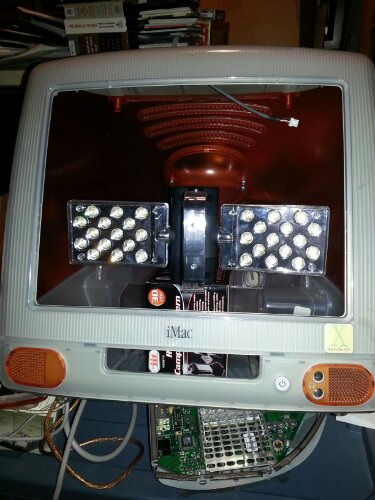
- Took the old tangerine iMac apart, setting aside the electronic components for later use as/if needed.
- Started mapping out the sculpture’s “face” using a camping lantern and controllable LED strips.
- Looked at converting the battery-powered camping lantern to AC-power.
Still on the to-do list:
- Creating the metal framework for the arms.
- Creating the arms with keyboards and computer mice.
- Creating the body armor using old floppy disks.
- Incorporating an 18-foot LED rope light.
- Deciding how much animation to put into a yard art sculpture exposed to the weather 24/7 —
- Phase/Version 1: easy, wind-activated response
- Phase/Version 2: moderate, motion-activated response
- Phase/Version 3: time-consuming, animatronic interactive response
Offline
Today is a work day away from the computer. Enjoy the weather, whatever it is, wherever you are!
Talking the walk
During tonight’s walk, checking out new construction in a hilltop subdivision (well, in Alabama they call them mountains if they’re over 200 feet higher than surrounding soybean fields, so let’s call it Little Mountain Estates), the phrases “Peter Principle” and “The Singularity” combined in my thoughts.
Meaning?
That the singularity already happened.
The rest of what people hope for is to improve themselves magically through technology, overcoming their Peter Principle tendencies in the social hierarchy of life.
Time to chuck that concept out with yesterday’s recyclables.
The outdoor sculpture shapes up!
Guten tag!
Lesson for the day
If there’s only one thing you take away from this blog today, it’s this:
When giving a presentation to the military about new technological advances, make sure you first show how you’re protecting the lives of military personnel on the ground, in the air and/or on/under the water — technology is replaceable stuff, expendable, but people are not.
Sandbagging
How to maximise the local resources?
That question dogged us for many years as we planned our electromech construction crew that would “set up house” on Mars before we got there.
The mechs were fully capable of building adobe houses on Earth.
Water, though, was a key missing factor.
That encouraged us to find liquifying alternatives because we wanted to minimise the material we sent with the mechs.
We could have sent tonnes of sandbags and had the mechs build dry adobe huts under which our habitation modules would fit, providing extra protection in the Martian atmosphere, like parking an RV or caravan in a garage.
We challenged ourselves to create a solution that was both energy-efficient and easy to build.
Then, one day, after we had received the list of common chemical elements in Martian soil samples tested by the first wave of mech probes sent in the early 21st century to find suitable colonisation sites and entered it into our lab network, our semi-autonomous 3D printer on a mobile robot base started constructing an extruded Martian home.
Watching the 3D printbot create its own construction scaffolding was fun as it built a two-story structure that hinged and opened up to accept our current working version at the time of the habitation module that also served as transportation ship and landing craft.
Our Test and Evaluation department set to work calculating the wear-and-tear on the 3D printbot, estimating how many spare parts would be needed as the bot coordinated with the mechs to excavate Martian surface for the right ingredients, processing the Martian soil and then feeding the bot or its future equivalent the “right stuff” for habitation module protective shells.
To verify their theories, they drove the printbot and several prototype mechs out into the high desert, skipping a Martian landing simulation in order to focus on the printbot/mech adobe house construction techniques.
One of our lab personnel proposed commercialising the process, which later helped fund many of our side projects that we encouraged in case a crazy idea panned out and led to better procedures and/or understanding of settling Mars — whole desert communities were 3D-printed, followed by sustainable neighbourhoods in temperate zones around the world.
Gratitude is not for breakfast anymore

 treetrunkdings