Tag Archives: politics
Daring to let go of past illusions
Are nation-states an illusion to you? If so, read on…
[from the NY Times]
Garry Davis, Man of No Nation Who Saw One World of No War, Dies at 91
By MARGALIT FOX
Published: July 28, 2013
On May 25, 1948, a former United States Army flier entered the American Embassy in Paris, renounced his American citizenship and, as astonished officials looked on, declared himself a citizen of the world.

Carl Gossett/The New York Times
Garry Davis, dean of the One World movement, in 1956. He had his own flag and passport, and often his own jail cell.

The New York Times
In 1948, five years before starting an agency to issue passports, Garry Davis distributed handbills in Paris. A stateless man, he was a relentless force behind a movement to erase national borders.

In the decades that followed, until the end of his long life last week, he remained by choice a stateless man — entering, leaving, being regularly expelled from and frequently arrested in a spate of countries, carrying a passport of his own devising, as the international news media chronicled his every move.
His rationale was simple, his aim immense: if there were no nation-states, he believed, there would be no wars.
Garry Davis, a longtime peace advocate, former Broadway song-and-dance man and self-declared World Citizen No. 1, who is widely regarded as the dean of the One World movement, a quest to erase national boundaries that today has nearly a million adherents worldwide, died on Wednesday in Williston, Vt. He was 91, and though in recent years he had largely ceased his wanderings and settled in South Burlington, Vt., he continued to occupy the singular limbo between citizen and alien that he had cheerfully inhabited for 65 years.
“I am not a man without a country,” Mr. Davis told Newsweek in 1978, “merely a man without nationality.”
Mr. Davis was not the first person to declare himself a world citizen, but he was inarguably the most visible, most vocal and most indefatigable.
The One World model has had its share of prominent adherents, among them Albert Schweitzer, Jean-Paul Sartre, Albert Einstein and E. B. White.
But where most advocates have been content to write and lecture, Mr. Davis was no armchair theorist: 60 years ago, he established the World Government of World Citizens, a self-proclaimed international governmental body that has issued documents — passports, identity cards, birth and marriage certificates — and occasional postage stamps and currency.
He periodically ran for president of the world, always unopposed.
To date, more than 2.5 million World Government documents have been issued, according to the World Service Authority, the group’s administrative arm.
Whether Mr. Davis was a visionary utopian or a quixotic naïf was long debated by press and public. His supporters argued that the documents he issued had genuine value for refugees and other stateless people.
His detractors countered that by issuing them — and charging a fee — Mr. Davis was selling false hope to people who spent what little they had on papers that are legally recognized almost nowhere in the world.
What is beyond dispute is that Mr. Davis’s long insistence on the inalienable right of anyone to travel anywhere prefigures the present-day immigration debate by decades. It likewise anticipates the current stateless conditions of Julian Assange and Edward J. Snowden.
Mr. Davis, who spoke about the One World movement on college campuses and wrote books on the subject, seemed impervious to his critics. In a voice trained to be heard in the last balcony (he was once a Broadway understudy to Danny Kaye), he would segue with obvious relish into a series of minutely reasoned arguments concerning the need for a world without nationalism.
“The nation-state is a political fiction which perpetuates anarchy and is the breeding ground of war,” he told The Daily Yomiuri, an English-language newspaper in Japan, in 1990. “Allegiance to a nation is a collective suicide pact.”
The quest for a unified earth was an objective on which Mr. Davis had trained his sights very early. It was born of his discomfort with a childhood of great privilege, his grief at the loss of a brother in World War II and his horror at his own wartime experience as a bomber pilot.
Sol Gareth Davis was born in Bar Harbor, Me., on July 27, 1921, a son of Meyer Davis and the former Hilda Emery.
Meyer Davis was a renowned society orchestra leader known as the “millionaire maestro”: at his height, he presided over an empire of 80 ensembles — employing more than a thousand musicians — which played at debutante balls, national political conventions and White House inaugurations.
Garry was reared in Philadelphia in a glittering milieu in which the family car was a chauffeured Rolls-Royce and family friends included Bob Hope and Ethel Merman. As a young man he was considered unserious, he later said, known for roguish wit but lacking direction.
After studying theater at the Carnegie Institute of Technology in Pittsburgh, Mr. Davis made his Broadway debut in October 1941 in a small role in “Let’s Face It!,” the musical comedy. He was also the understudy for its star, Mr. Kaye.
Then the United States entered the war. Mr. Davis and his older brother, Meyer Jr., known as Bud, went overseas — Bud with the Navy and Garry with the Army Air Forces, flying B-17 bombers. Bud Davis did not return: he was killed in 1943, when his ship, the destroyer Buck, was sunk off the coast of Italy by a German submarine.
That, and a dark epiphany during a bombing run over Brandenburg, Germany, Garry Davis later wrote, would alter his life’s course.
“Ever since my first mission over Brandenburg, I had felt pangs of conscience,” Mr. Davis wrote in a 1961 memoir, “The World Is My Country.” (The volume was later reissued as “My Country Is the World.”) “How many bombs had I dropped? How many men, women and children had I murdered? Wasn’t there another way, I kept asking myself.”
The other way, he came to believe, was to eradicate conflict by eradicating borders.
In November 1948, six months after renouncing his citizenship in Paris, Mr. Davis stormed a session of the United Nations General Assembly there.
“We, the people, want the peace which only a world government can give,” he proclaimed. “The sovereign states you represent divide us and lead us to the abyss of total war.”
His act, reported worldwide, earned the support of the intelligentsia, including Albert Camus, and of the French public, so recently racked by war. Less than two weeks later, speaking at a Paris auditorium, Mr. Davis drew a crowd of 20,000.
In 1949, Mr. Davis founded the International Registry of World Citizens and was soon inundated with requests to join from around the globe. “We’re bigger than Andorra,” he told The Boston Globe in 1981, when the registry was a quarter-million strong.
Today, more than 950,000 people are registered world citizens, according to the World Service Authority, based in Washington.
Mr. Davis, who lived for long periods in France, appeared on Broadway a few more times in the early 1950s, including in a revue called “Bless You All” and “Stalag 17,” the prisoner-of-war drama. But the One World imperative occupied him increasingly.
In 1953, he founded the World Government of World Citizens. The demand for its documents proved so brisk that he established the service authority the next year.
More than half a million world passports have been issued, though there are no statistics on the number of people who have successfully crossed borders with them. A half-dozen countries — Burkina Faso, Ecuador, Mauritania, Tanzania, Togo, Zambia — have formally recognized the passport. More than 150 others have honored it on occasion, according to the service authority.
Fees for the passport range from $45 (valid for three years) to $400 (for 15 years). The passport has text in seven languages, including Esperanto, the artificial international language.
Carrying world passport No. 1, Mr. Davis spent decades spreading his message, slipping across borders, stowing away on ships, sweet-talking officials, or wearing them down, until they let him in. The newspapers charted his comings and goings:
1949: “Garry Davis Arrested in Paris”; 1953: “Garry Davis Held Again: Arrested When He Camps Out Near Buckingham Palace”; 1957: “France Expels Garry Davis”; 1979: U.S. Court Rules ‘World Citizen’ Davis Is an Alien and Rejects His Passport; 1984: “Japan Expels American ‘World Citizen’ ”; 1987: “ ‘World Citizen’ Announces Presidential Bid.” (It was the United States presidency this time.)
In 1986, Mr. Davis ran for mayor of Washington, receiving 585 votes.
Mr. Davis was arrested dozens of times, usually for attempting to enter a country without official papers. He had canny ways of circumventing authority.
In the 1950s, when France was trying to deport him, he conspicuously shoplifted items from a Paris department store. (His haul, United Press reported, was “$47 worth of peach-colored lace panties, black-silk brassieres, black garter belts, lace petticoats and pink slips.”) He made certain he was arrested.
As a result of his arrest, Mr. Davis was legally enjoined from leaving the country.
Mr. Davis was married two or three times, depending on how one counts. His first marriage, to Audrey Peters, an American whom he courted by mail while detained in France and whom he met for the first time two weeks before their wedding in 1950, ended in divorce. In 1954, the newspapers reported his “marriage” at sea to Gloria Sandler in a ceremony he performed himself; that union, too, was dissolved. His marriage to Esther Peter in 1963 also ended in divorce.
Survivors include a daughter, Kristina Starr Davis, from his marriage to Ms. Peters; two sons, Troy and Kim, and a daughter, Athena Davis, who confirmed her father’s death, from his marriage to Ms. Peter; a sister, Ginia Davis Wexler; a brother, Emery; and a granddaughter.
His other books include “World Government, Ready or Not!” (1984) and “Dear World: A Global Odyssey” (2000). He was the subject of a short documentary, “One! The Garry Davis Story,” released in 2007.
In old age, Mr. Davis was far from idle. Last year, he had a world passport delivered to Mr. Assange, the founder of WikiLeaks, who has been holed up in the Ecuadorean embassy in London.
Just weeks before he died, Mr. Davis had a world passport sent, via Russian authorities, to Mr. Snowden, the fugitive former national security contractor accused of violating espionage laws, whose United States passport was revoked in June.
Mr. Snowden could not be reached for comment.
Speaking of falsely planted memories!
Wally Gee Willacres
Sometimes I forget the simple phrase like “a member of Congress who threatens sanctions will now be designated an official international economic terrorist and subject to prosecution to the full extent of the law” is more than the sum of the numerology values of its words.
I forget a lot of things.
I forgot that I left a bunch of scientists stranded in a subsubsubbasement corridor during reconstruction and then got their last laugh by posting a satirical blog entry called “My selfie.”
And here I thought I was hacked. Hacked off is more like it.
They also got their next-to-last laugh by rigging a Leap Motion device in front of my neglected Robosapien, connecting its movements to the RS Media mechs in the streets of your town such that, sometime in the next few days, there will be a worldwide flash mob dance performed by what you always ignored as homeless alcoholic beggars.
The scientists promise complete chaos as it will appear they have hacked the minds of ordinary citizens, turning regular people into dance-happy zombies.
I mean, what’s next? An uncontrollable orgy covering every home, school, office, hospital and farm?
If humans can be overtly convinced that they’re under the influence of hidden forces, dancing to the beat of invisible choreographers as seen on global TV/Internet channels…well, what’s to stop them from thinking about the subtle, subliminal, subversive influences that control their lives?
Remind me never to lose track of my scientists again.
The head of an ISP I recently talked with said she is thinking about running a background check on all her customers. Instead of turning over email and account information to the government, she plans to delete the accounts of customers who work for the government, turning the power back over to the people.
I wished her luck. “Live Free or Die” is a great motto but so is “United We Stand, Divided We Fall.”
Others worth considering:
- Commerce with all nations, alliance with none, should be our motto.Thomas Jefferson
- Be Prepared… the meaning of the motto is that a scout must prepare himself by previous thinking out and practicing how to act on any accident or emergency so that he is never taken by surprise.Robert Baden-Powell
- My motto was always to keep swinging. Whether I was in a slump or feeling badly or having trouble off the field, the only thing to do was keep swinging. Hank Aaron
- I have encountered riotous mobs and have been hung in effigy, but my motto is: Men’s rights are nothing more. Women’s rights are nothing less. Susan B. Anthony
Thanks to Abi at Madison Ballroom; Harold at KCDC; the head cowboy and his cowpokes (congrats to the one whose wife just had a 6-lb baby girl named Chloe) at Chuck Wagon BBQ.
The deciduous forest is buzzing and chirping today
A yellow jacket, a sweat bee and a fly are chasing each other in the slit of sunlight that passes over the rubbish bin this late Friday morning.
Getting permission to import them to Mars was no easy task.
I could not import dragonflies.
Vibratoids, the equivalent of speakers or earphones embedded in my body, give me the sensation that I’m in a deciduous forest as I walk through the greenhouse that serves as our meeting room, food growth chamber and place for general meditation.
The vibratoids make me think that insects are buzzing in treetops and birds are chirping as they fly from limb to limb looking for food. The sound of wind through tree limbs and the small blasts of air on my arms, neck and face add to the immersion algorithm’s programmed goal of acclimating me to Mars with occasional reminders of what Earth must feel like, what we jokingly call the decompression chamber effect.
But I have work to do. I cannot dwell too long on the memories of a planet I get to visit less and less often as the Martian colonies mature, requiring my attention, not to mention my declining health — I don’t know if I can endure many more trips.
I remember my last night on Earth.
But before I do, I’ll tell you a joke repeated to me by a fellow traveler to Mars, a tourist named Adyer Xedif. A juvenile joke but one I’ve heard more than once from first-time visitors — Q: If men are from Mars and women are from Venus, where are politicians from? A: Uranus.
I hear the rapid flutter of the wings of a hummingbird pass before my eyes but I see only the bird’s green body and white-tipped tail in my imagination. Oh, how the immersion algorithm can be so cruel without knowing it!
We are a small set of colonies here, able to manage ourselves without the need for the professional political class of workers so, needless to say, we get a lot of jokes about politicians when tourists and new settlers begin to realise they won’t have politicos to blame for inefficiencies and errors that occur because, as we know, we want a perfect world and we train for a perfect world but we don’t live on a perfect world.
Our customer complaint system is a throwback to the time when “free market capitalism” was the rule of the day, including some societies on Earth.
We call it the customer complaint system for tourists and visitors although we know it locally as the PS or ProbSolv department.
Solving problems. Rewriting algorithms, correcting databases and reconfiguring hardware.
As quantum computing devices that closely resemble the humans we used to be, we are able to adapt and adjust to changes on a colonywide scale much more rapidly than the old mass media socioeconomic shifts that often took generations, or Earth-based decades, to accomplish — within milliseconds, software updates will rewire our central nervous networks to accept the change from decentralised ant colony system to an interconnected but independent system of birds flocking during migration as programmers test the currently-accepted best practices method for colony survival.
But I digress.
The last night on Earth…sigh…
The cheerful look on Guin’s face after her trumpet performance with the Comet Plasma band playing big band tunes of the 1940s, her purple-and-black eye shadow, her…eyeglasses?
Why, in this day and age of implanted autocorrecting lenses did Guin wear eyeglasses?
Hmm…good question.
Anyway, Guin reminded me again she needs a new dance partner.
While watching the couples competing on the dance floor, I thought about what Guin and I have been through, our first trip to Mars, her decision to stay when I left, her decision to return to Earth for one more grand tour, talked into playing her trumpet again, with me now back on Mars and her still on Earth.
Why do I sense a vulture flying overhead? How can a bird at an altitude hundreds of feet above me affect the vibratoids and air blowers such that I feel rather than see such a creature? Is it because I know a vulture rides thermals and the wind effect around me is that of a thermal rising above and passing through the imaginary forest?
My, my, my imagination is overactive today. Next thing I know I’ll hear an aeroplane fly by. Ah, there it is.
Good for the immersion algorithm to know what my life was once like, in my previous body, back home.
I don’t miss mowing lawns or the smell of cut grass but I do miss the old solid-metal and solid-rubber tyred hand-pushed mower that sat in my garage.
There was a time, in a previous life, in my previous body, when I had a wife I wanted to learn to dance in order to improve her health. I also wanted her to become proficient at dancing so that she and I were comfortable switching dance partners at big social dance events, because I wanted to overcome the habit of walking off to dance with other partners, leaving my wife alone at parties without dance partners to share momentary joy with. That’s who I was — a seeker of increasing levels of joy when the occasion presented itself.
You know, one thing this immersion algorithm can’t simulate is the appearance of a column of gnats rising and falling in a dance all their own.
I smell rather than see a citronella candle burning nearby, simulating the feel-good effort to keep mosquitoes away from humans.
I barely recall the sound of slamming car doors and squealing brakes when my neighbours on Earth would return to their domiciles. I know there was a time when the smell of burning cow and pig flesh was an indication that my neighbours were enjoying themselves in their backyards.
Now, I’m just as happy with the smell of recharging batteries or Martian “snake oil” treatments.
That last night on Earth, I stood next to one of the winners of the dance contest. She wore the traditional outfit we still call “Rosie the Riveter.” On her face she wore light peach coloured makeup that we of Mars no longer see as fashionable, able to change our face colour through skin tone circuitry like chameleons blending in or clashing with our environments as we see fit.
Will Guin return to Mars? Will I dance with her again? Will she and I ever be dance partners?
Although I have been outfitted with the latest in future forecasting capabilities, some futures I can only calculate, not predict with accuracy due to the influence of emotion-based algorithms I insist on keeping intact.
Do I miss Guin? Sure I do, even if my work here at the colonies “needs” me and would miss me more if I left Mars for Earth.
Well, the chirps of cardinals and the warning hisses of a squirrel are like an alarm clock, telling me it’s time to leave the greenhouse and go back to the lab where I hope our latest in the new line of beings created from our imaginations will come to life, making our colonies more productive, more happy and prosperous in the longterm.
Talk to you kids of the past and the future again soon!
Note to self
Do I have it in me to give myself freely, free of fear of rejection, free of resorting to stereotyping, and permit myself to dance with others, let alone my wife, letting go of inhibitions without resorting to the intake of substances to remove barriers that protect my internal nervousness and general fear of the world at large ingrained in me during my formative years?
Sometimes, my fear is so great I relish the thought of eating a slug of lead rather than look in the nearly-fearless faces of live human beings.
The anonymity of an Internet connection is very safe, that’s for sure.
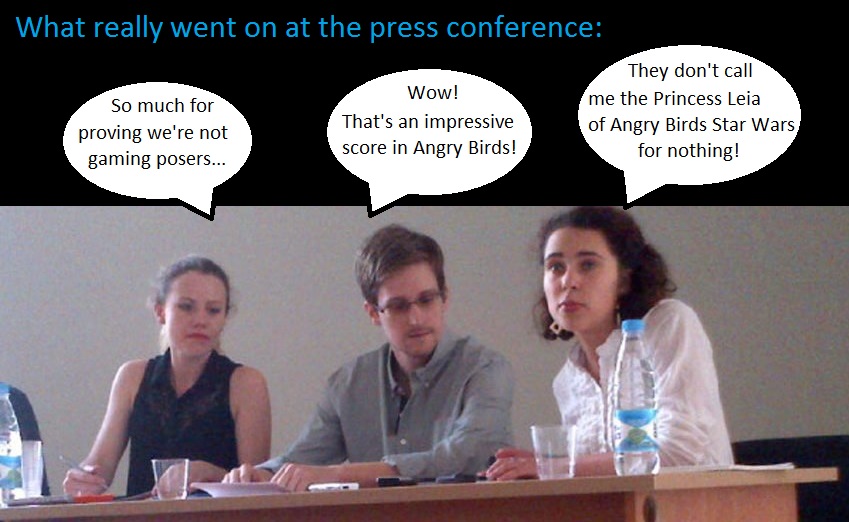
Russia grants asylum to gaming fanatic disguised as whistleblower
Just when you thought you really knew what was going on in the news…instead, we discover that Russia wants to groom an American as its next Angry Birds champion, now that chess winners live in the the realm of computer algorithms.
All categories most used uncategorized
A new online friend has shown me the “bucket list” of accomplishments she achieved, so far, in her short life — very exciting for her, and fun for us to read and learn.
However, I don’t even know what a bucket list is except as a title of a film released in the past few years.
I am neither a high nor a low achiever — my philosophy has been to treat every moment the same as the next moment, regardless of change of state of the set of states of energy that is me, because illusion is a tricky business.
Imagine you are accused of being a vampire, then executed and buried in that manner.
The power of the tribe, the clan, the subculture is the power of illusion at its most pivotal, both uplifting/supportive and scary/deadly.
I am trapped on this planet with bunches of subcultures in transition.
All I want is to explore another celestial body, to discover that which no other person has seen or touched, far from this solar system that our extended electromechanical cultural limbs have photographed and sampled.
Yet, I set my sights on a slightly more realistic goal for my lifetime — to die and disintegrate on Mars — just this close to reality, if the subcultures I track and follow give any indication of beating more-than-impossible odds.
My calendar shows 13,435 days to go until a major milestone is reached, with or without me.
I am beginning to learn that the more fragmented our social media allows our general culture to become, the less I have to satisfy the implied hidden gods and ruthless leaders of that general culture for us who boundlessly and abundantly value ourselves and our subcultures more than the imaginary general culture that exists in mass media.
In other words, I can indulge my wants and desires, not caring about anything or anyone but the moment in which this set of states of energy is, for want of a better word, alive.
I can sit here, dance in front of a bunch of strangers, sleep, eat, read, walk, change the bedsheets, play with electronics, drill holes in wood, whatever.
The future is nonexistent. For me, being childless, our species is thus unimportant — I can stop worrying about recycling, living a “green” lifestyle, or using more resources than seems reasonable for one person.
In the end, it doesn’t really matter — there is no punishment living solely for my own enjoyment and edification — history is an illusion so history cannot judge my [in]actions, I have no reputation in mass media to protect; I am, as I believe, a set of states of energy in constant flux.
There is only one tie that binds me to my childhood subculture of the Christian denomination called Presbyterianism — the holy act of matrimony, which means I am to pledge my body to one person for the rest of our lives. Of that, in practical terms, there is much to be said for providing a safe haven against the transmission of diseases via bodily fluids. How much does dancing with others interfere with that freedom from an invasive change to one’s medical condition — is air pollution or the potential for a car smashup more likely to kill or maim me and my wife than having dancing partners other than ourselves?
The luxury of asking these questions!
Relative wealth puts me here in front of this notebook PC, a level of freedom bought by giving years of my life toward others’ goals that we call socioeconomic accomplishments.
Do I have what it takes to build more wealth convincing others to give years of their lives toward my goals? My financial portfolio certainly answers that question.
Total anarchy does not pay my bills — the talent of strangers built through skills training does.
Therefore, regardless of my supporting the philosophy, “eat, drink and be merry,” there are those of our and other species who devote themselves solely to implementing well-honed habits that allow me to be here doing nothing but tapping my fingertips on tiny blocks of plastic.
Am I, then, also displaying a talent/skill combination that is enriching the lives of others who are enriching my life, too?
How is this set of states of energy going to exist in the next moment or moments to come, rectifying the direction of midlife habits established in early life?
Where am I going? What’s it all about? If the universe is here solely for my entertainment, then I’ve answered the second question. Question is, what shall I do about the first?
That pale blue dot (no, not the DOT (dept. of transportation) that keeps us going)
“Look again at that dot. That’s here. That’s home. That’s us. On it everyone you love, everyone you know, everyone you ever heard of, every human being who ever was, lived out their lives. The aggregate of our joy and suffering, thousands of confident religions, ideologies, and economic doctrines, every hunter and forager, every hero and coward, every creator and destroyer of civilization, every king and peasant, every young couple in love, every mother and father, hopeful child, inventor and explorer, every teacher of morals, every corrupt politician, every “superstar,” every “supreme leader,” every saint and sinner in the history of our species lived there — on a mote of dust suspended in a sunbeam.
The Earth is a very small stage in a vast cosmic arena. Think of the endless cruelties visited by the inhabitants of one corner of this pixel on the scarcely distinguishable inhabitants of some other corner, how frequent their misunderstandings, how eager they are to kill one another, how fervent their hatreds. Think of the rivers of blood spilled by all those generals and emperors so that, in glory and triumph, they could become the momentary masters of a fraction of a dot. From Carl Sagan’s “Pale Blue Dot: A Vision of the Human Future in Space.”
What did you do the day Earth smiled?
Liken likin’ lichen like in lye kin
Our mailbox at the street resembles a small wooden house, a look similar to our main house.
On the “chimney” of the mailbox house grows a small patch of lichen.
Do you like lichen the way I do?
Lichen falls onto our driveway almost everyday, attached to bits of tree — twig, branch, bark — that break away and follows gravity’s path onto the concrete surface.
One species of beard lichen in particular, but not this one.
As our climate gradually warms, lichen is migrating north, bringing symbiotic organisms along.
As with the variety of tree species in our yard, we have a multitude of lichen species.
Same with mushrooms, algae, bacteria, ants and other organisms I won’t encounter together on Mars.
What will migrate with us when we live off-Earth?
What will survive without us and adapt to new environmental conditions?
How many organisms on Earth didn’t originate on our planet?
I owe our next-door neighbours a copy of books on trees and edible wild plants so they can identify which plants not to kill in their yard to protect their curious one-year old child from eating less-than-nutritious green stuff.
I see the Trees book in front of me, under a pile of “French Idioms,” “Russian for Everyday,” “The New College French & English Dictionary,” “Peterson Field Guides to Stars and Planets,” “The Associated Press Stylebook and Libel Manual,” “2004 Far Side Desk Calendar,” and “The Yale Book of Quotations;” on top of “Gödel, Escher, Bach: an Eternal Golden Braid,” “RE/SEARCH #8/9: J.G. Ballard,” “The Complete Cartoons of The New Yorker,” and a spiral-bound copy of my book, “The Mind’s Aye,” not to forget issue #500 of MAD magazine.
Speaking of books, I have a few to finish reading, including “The Big Questions” by Steven Landsburg and a hyperreality book, “Travels in Hyperreality,” by Umberto Eco.
I wonder, which set of beliefs, particularly in the realm of religion, makes one more likely to approve of government/private industry spying? In Christianity, God is always watching, just like Santa Claus, ready to mete out rewards and punishment for our behaviours/thoughts.
Does our general culture encourage us to believe in seeking our fifteen minutes of fame, even if it’s only on a hidden security camera or set of IM chat logs?
Does lichen care about our meme-ridden upper brain functions or our labyrinthine specialty tasks and hobbies that spin out of a growing economy?
Likely not.
That’s why I like lichen — symbiosis that doesn’t require ritual or dogma.
Cultural scientists today argued their proof that silicon-based organisms such as computers are living beings.
I thank my living being for letting me write this blog entry on its plastic key skinned surface.
Enough meditative humour for the day — time to eat lunch and read a couple of books loaned by the public library.
 treetrunkdings