How often should a nurse tell a patient, “I can be here 24 hours a day”?

Seven billion personalities wandering the space around Earth’s core, all of us with needs, wants, ideas, plans, hopes, sorrows…

In this mortal coil that resembles strands of DNA as much as anything else, meaning — possibly, probably — that life itself is life itself, we are who we are when we are where we are how we are, do we see or hear ourselves making impacts on those around us, changing the course of needs, wants, ideas, plans, hopes, and/or sorrows in the moment?

Our philosophies do not matter.

Life is entropy, order and chaos, sets of states of energy bumping into each other, sometimes self-consciously, seeking reproduction in various disguises, forms, performances, rituals, randomness…

How many days are left before this storyline picks up the tale of the invisible group mockingly, seriously, joyously, sadly called the Committee?

Are you prepared to meet the super genius behind the veiled enclosure where decisions are made in both individual/committee conscious intent and the general flow of the [sub/non/un]conscious crowded moment?

We are constantly influencing the moment, breathing in and out, exchanging atoms and molecules in the space around us, exchanging ideas/memes in the social network between us…

Beliefs, strengths and other words of ancient origin compete, no winners intended or implied.

So it is I am this skin-wrapped self, this temporary visage, passing through this time we share together, gathering ideas like a quilter gathers pieces of cloth, building a layer of warm comfort and pleasing design, traditional and contemporary at the same time.

We have but one moment in which to live, one moment to make a difference, and then the next moment arrives upon which the previous moment’s opportunities, missed or achieved, present options.

Showing my father a future in which he wants to live and improve his bodily conditions.

Working with professional medical workers to increase the strength of Dad’s support network.

Asking friends to vocalise their love and fondness of and for my father.

Remembering that every word, every phrase, every expressed thought, makes a world of difference in my father’s intensive therapy sessions and the down times in-between.

Ever the optimist, helping my father, a Life Member of the Optimist Club, recall his oft-cited recital of the Optimist Creed:

Promise Yourself …

  • To be so strong that nothing can disturb your peace of mind.
  • To talk health, happiness and prosperity to every person you meet.
  • To make all your friends feel that there is something in them.
  • To look at the sunny side of everything and make your optimism come true.
  • To think only of the best, to work only for the best, and to expect only the best.
  • To be just as enthusiastic about the success of others as you are about your own.
  • To forget the mistakes of the past and press on to the greater achievements of the future.
  • To wear a cheerful countenance at all times and give every living creature you meet a smile.
  • To give so much time to the improvement of yourself that you have no time to criticize others.
  • To be too large for worry, too noble for anger, too strong for fear, and too happy to permit the presence of trouble.
An Attitude of Gratitude

More thanks:

Bonnie and Warren in ER at HVMC; Glenn, registration; Connie, nurse practitioner; Steve, hospital security; Adel, MD; Haley, RN; Sharon, liaison; Gloria, PCT; Amy, RN; Lilli, RN; Elabassi, MD; Nina M, care team; Missy and Luanne; Halie, RN; Sammi Jo, PCT…

I’m shooting for calling my Dad’s symptoms Hill Syndrome, setting a new standard in grouping symptoms under a convenient meme.

= = = = =

New medical term of the day, probably unrelated:

Sjögren’s syndrome

In every life a little reign must fall…

Quality versus quantity of life…how do we qualify the ideas in that statement?

My father has been both the idol and the rival in my life.  I idolised my father — admiring his ability to make strong, manly decisions and not question what might have been.  I competed against him in mental games and intellectual pursuits.

My father has also been my friend, sharing interests such as motorsports (NASCAR, IndyCar, F1), balsa airplane models, classical music and spy novels.

In this stage of our relationship together, we approach the statement “quality versus quantity of life.”

I am not my father’s sole friend and vice versa.

We have age-appropriate relationships with our peers, my father having collected more friends through his life that is 27 years longer.

My father’s level of daily health has exhibited drastic changes in the last few months, indicating a downward trend that, combined with a new diagnosis, implies a decline with less change for improvement.

We approach a state of being labeled the “locked-in syndrome.”

Over the past few days, I’ve slowly approached the completed reading of a book titled “An Optimist’s Tour of the Future” which explains in layperson’s terms the current state of the state-of-the art, including genetic life extension research.

Looking at my father, a professor no longer able to profess or postulate, I wonder, will he accept his new role as a leader in the field of patient-based testing, putting the latest control assistive technology, such as NeuroSwitch, through critical pacing?

How does a locked-in brain use the power of seven, bunching shortterm/temporary memory lists of seven groups [(of seven groups of) of seven groups of…] seven items, to develop its image of the future?

Finally, how does that impact quality versus quantity of life for my father’s relationship with his buddies, his wife, his daughter, his grandchildren and, last but not least, me?

As my father’s reign over the family appears to end, what legacy of hope does my father want to give those whose lives are no longer attached to their heady days of physical activity and demonstrative speaking/arm-waving skills?

Does he have the desire to learn new skills in order to achieve something he never thought or never knew possible, operating electromechanical devices through the tiniest of nerve impulses to add data for improving the next generation of prosthetic devices that may one day lead to a brain of our species residing in a cybernetic/android “suit”?

A Slew of Gratitudes

Behind in my thanks: Cassia, Amy, Ashley, CAT, Dr. Patel, Katlyn, Dr. Keane, Dr. [Woody] Reeves, Jeremy, Stephanie, phlebotomy crew, Brandi, Lynn (dietitian), Tamma, care team (Susan, Larry), Dr. Mohsen, Lisa, Deborah, nursing students (Amanda, Lynn, Jared), Dr. Sullivan, Ravonna, Dr. MacDonald, PJ…Seaver Donuts…more to follow… 

The other day…

The other day, my father recounted the first snow he remembered at Christmas.

He was in the Boston area, interviewing with MIT for an undergraduate student opening.

My father was a very independent child, often, in his early teens, riding the train from Knoxville, Tennessee, to Washington, D.C., seeing the museums, going on to Norfolk, VA, to visit his father who was stationed at the naval base there and then returning in time to attend school on Monday.

To earn money, my father had a newspaper route.

So it was not a big stretch, as it might be for some, to imagine attending, let alone applying to, MIT.

Fast forward a few decades and his daughter, my baby sister, a school counselor in the Virginia public school system, just received Teacher of the Year.

As a counselor!

Wonderful news.

Soon, my sister’s son will graduate with a baccalaureate and start his postgraduate career, possibly in law school.

Where?

Well, if my father put MIT in his sights, perhaps his grandson will set a similar goal.

We’ll see.

In my parents’ empty-nest years, they’ve volunteered to serve food at the local middle school football games, sell Christmas trees for the Colonial Heights Optimist Club and give assistance to neighbours in need.  They’ve attended Citizens’ Police Academy, providing support for the local Neighbourhood Watch program, as a result.

These are the examples my parents have set for their offspring, raising successful children and receiving successful grandchildren in return.

That, in a nutshell, is what life is all about.  Everything else is just spare pocket change.

May all of us inspire our children to seek great achievements, just like Nanxi Liu and Annette.

And congratulations to my sister one more time!

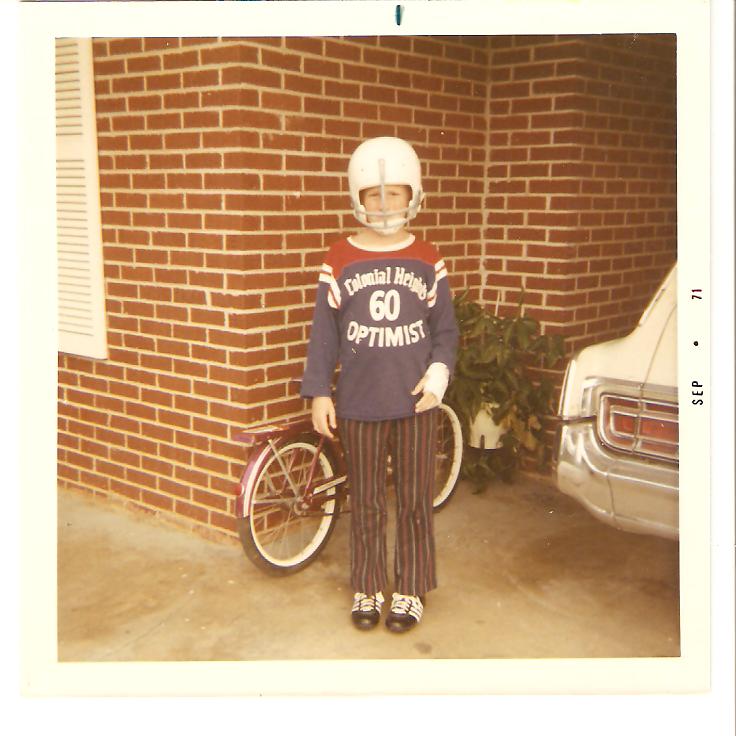
Flashback, courtesy of my father, Dad

Real football -- no pads!

What do you see in a photo?

My father sees his 1966 Chrysler station wagon.

I see my racing bike which could leap over dirt ramps.

A doctor sees my broken wrist and cast.

Who sees the fashionable pants?

Who sees the helmet and cleated shoes?

The brick wall?

The potted plant?

The cracked sidewalk?

The jersey?

The window shutter?

The type of photo paper?

The date?

What else do you see in this nine-year old boy staring back at you, unable to play football because of a plaster-of-paris cast?

A Confession To Make

I have a confession to make.

For several months now, my wife and I have been listening to the Harry Potter book series on audio CD while we’ve ridden together in my wife’s Toyota Camry.

Tonight, we finished the last CD of the last book, coincidentally in the first full week of release of a film starring Daniel Radcliffe.

No more ‘arry Potter voice impersonations by Jim Dale, a great reader and probably the best parent a kid could have read a book at bedtime.

Now I can get back to writing the life of seven billion without having a mental comparison of my writing against that of the children’s book author, J.K. Rowling.

Of course, my wife and I will ride in unusual silence when together in her car.

Time to return to the story where my contacts around the world feed me their autobiographical snippets that often involve us common folk and sometimes the lives of those who claim to be our leaders.

Together, we can tell it like it really is, no matter how messy, uninspiring or truly coincidental, and not how others would have us rewrite the narrative of our lives into so-called biographical/purposeful history.

All while leaving space for us to have hope and plan for a better future.

My job here’s not to be popular or well-liked.

In fact, it’s not a job at all.

It’s who I am.

Who I say I’m meant to be.

Just like the other seven billion of us, eh?

BTW, I went to the doctor’s office earlier this week to see about a viral infection called bronchitis and was prescribed an antibiotic.  If nothing else, I guess I’m “curing” my GI tract.

Fever, Either, Or, Favour

He looked at the thermometer sticking out of his mouth.  The digital display read 37.6 deg Celsius.

Low-grade, at least.

His ears throbbed.

Was this sufficient reason (or excuse) to visit the infirmary?

Two more weeks of training…he didn’t want a negative mark on his progress report.

A fellow trainee, Rogemme, walked up.

“So, you going for the ejection seat, are you?”

Lee shook his head.  “No, but my head feels like it’s floating on its own.”

“Everyone seems to have what you’ve got.  Think it’s what they say, a conspiracy to close down the training center?”

“You haven’t got it, have you?”

“Nope.”

“Then not everyone has it, have they?”

“Well, if it’s just me here, it wouldn’t be much of a graduating class now, would it?”

Rogemme laughed and walked away, shaking her head.

Lee stood up and felt his ears ringing like live electrical wires arcing or fluorescent lamp ballasts buzzing.

So everyone’s got this same thing…

He picked up his open copy of “Hidden Economic Subtrends Revealed by Supercomputer Algorithms” and read two pages.

He read them again.

He read them a third time but couldn’t seem to get the words, ideas or images invoked by the words to stick to his thoughts.

Was it the low-grade fever or something else that prevented his normal meditative state of learning to evade him?

He put the e-book down, leaving the book open for anyone else to read, including those in the class who hadn’t paid their dues and weren’t allowed to read other copies for free, a prime condition of Economic History Warehouse Keepers, Private Second Class, to maintain their rank.

He pressed a button on his earlobe that had been implanted to look like an earring but actually operated a wireless control system embedded alongside his left ear canal.

He rotated his finger around the edge of the button until he found the same place in the audible book where he had been reading “Hidden Economic Subtrends Revealed by Supercomputer Algorithms,” hoping that by listening to someone reading the book and explaining through a series of footnotes he’d paid extra to get, he’d penetrate the cushiony pillow exteriour that seemed to block his thoughts from learning class material in the moment solely by running his eyes over the written text.

As a sentient supercomputer algorithm taking the familiar form of a member of the species Homo sapiens, Lee had responsibilities, including this unknown infection, to add to his regular computational duties.

He’d excelled at hormone level modification, removing all unnecessary emotional outbursts usually associated someone of his rank.

At first, the lecturers reported his emotional control as an anomaly, sending him many times for medical examinations that found nothing more than the post-autism syndrome that previous generations of his type had helped “real” members of the species to apply gene therapy and foetal DNA reconfiguration to overcome the worst inarticulate aspects of autism.

Some classmates called him cold and calculating, both an insult and compliment at the same time.

He, however, ignored their taunts, his algorithmic tendencies giving him a larger view of life than the immediacy that sweaty bodies and physical alterations tended to drive mob mentality to its worst-case scenario outputs.

In his spare moments, he had studied the history of the “real” people, noting how they talked about subcultures and job classifications that seemed little different than the categories he and fellow algorithms had been assigned at initial creation.

Lee felt liquid on his upper lip and decided that watery mucus pouring out of his nose was an inconvenience but the overall conditions of the infection warranted a visit to the infirmary, after all.  He did not have access to online material that would have told him whether an elevated body temperature or range of temperatures would adversely affect other circuitry concealed on his body for experimental purposes only.

He knew he was really the same as the “real” people but he also knew he was a special prototype created from special molecular combinations meant to determine if DNA that had given rise to the biological diversity of Earth was only one of many possible atomic-level conditions for life.

By training him and his pals in a sequestered training class, the lecturers and those for whom they honed the classmates’ algorithm/subroutine repetitive output would assure themselves that graduating members awarded Economic History Warehouse Keepers, Private Second Class, would never want to leave their assignments for fear that unseen authorities would confuse the graduates with “real” people whose outputs were normally predictable but more often given to mob mentality than they.

As Lee absorbed the book’s spoken words which told him why living algorithms like him were destined for a higher purpose because their output revealed hidden meaning, he walked toward the infirmary, wiping his nose on his sleeve which shimmered slightly because the nasal liquid provided a short circuit across the fibers of his shirt, itself a living subroutine that resembled clothing.

The shirt sent a message on to the infirmary that it would need to be changed — its memory transferred to Lee’s next new shirt, then erased — and laundered as soon as possible to prevent staining, after the infectious organisms had been removed and sent for analysis.

Pic of the day

Across the street from me, workers walk the roof beams of a new house under construction.  If I hold my fingers up and sight a worker between them, the worker is about ant-sized from here.

The house wasn’t there a week ago — the walls and roof are going up quicker than seeds in the former farm field took root.

Years have passed since the last time I heard an AgCat swoop in and out, spraying the fields full of soybean, corn or cotton.

Instead, row after row after row of suburban tracts spread east of here.

When, 1000 years from now, while we’re sitting here discussing this blog entry, will we understand the concept of suburban living?

Will we perceive a period of growth of our species when two-dimensional plans for living space were a common norm?

When did it become an uncommon norm?

Tiny bricks-and-sticks castles members of our species once called home.

I stapled sheets of galvanised metal mesh over holes under the eaves of our house to limit attic access by raccoons.

Although I didn’t mind watching the raccoons come and go, my wife couldn’t sleep at night when the baby raccoons bounced and chased each other above the roof over our bed.

Silence fills the space where the raccoons once played.

I’m sure the broad-headed skinks and bats will return to the attic and chimney, much quieter occupants that my wife will not know about — out of sight (and sound), out of mind, as they say.

When did people think grassy spaces were the preferred method of landscaping around one’s domicile that was most acceptable?

Sitting here on a celestial body devoid of ants, spiders, moles, trees, snakes, algae, fungus, ferns and mold, I wish I could explain why my ancestors let their yards grow wild.

You don’t appreciate what you had until it’s gone.

Sure, some of my workmates have found ways to play games once popular on Earth — golf, tennis, futball and such — but the dust they kick up tells the story, doesn’t it?  Nothing living that disturbs which we destroy to accommodate our leisure gamespace.

That’s the thing about living here.  No competitition against other species to keep us busy.  No insect/rodent exterminators, no crop insecticides, no preservatives or other means of fighting back nature’s way of seeking equilibrium, inertial or otherwise.

We’re not completely sterile, of course.

We’re so integrated with each other, though, that we detect the start of pathological infectious disease infestation in one of us so quickly that we can redirect resources, both internal and external, with the tiniest of thoughts, repairing and adding telomeres as long as we want to stay alive.

At 503 years of age, I’m older than most here on this colony but still younger than some lifeforms on Earth, both mobile and stationary.

Am I wiser?  I don’t think so.  Ubiquity of information makes all of us as wise as another.

Well, it’s time I revert back to your chronological space and share my mortal self with you, observing your ignorance and suppressing a smile at how antiquated everything you do seems to me and others 1000 years in the future.

Don’t think of this as time travel.  Think of it as me immersing myself in your historical records, becoming one of you virtually while parallel thought processes of mine live in my time, too, “earning” my place in our mesh-network society.

Feed me. See more.

And now, back to the story of your lives, where we explore the cosmos in search of a good place to park our flying metal boxes, build a few domiciles of native material and plant a garden for healthy living in a game called “Pick a Planet”…

Medical phrase of the day: myasthenia gravis.

Will catch up on the list of people/businesses to thank soon, I think.