Although Dobyns-Bennett was my rival high school when I was a teenager, a worthy project I supported nonetheless:
Tag Archives: education
If David Lynch had been a medical student…
A gravity situation
Clarification from Caron St. John, PhD
Entrepreneurship definition clarified via email from Dr. Caron St. John, dean of the College of Business Administration, UAH:
Our definition is a common one, used by Harvard and many other universities — entrepreneurship involves recognizing an opportunity and then, in spite of uncertainty and scare resources, organizing a response. Taking action. We don’t define it as “starting a new business” — because it doesn’t have to be wholly new and it doesn’t have to be a business (could be a not-for-profit).
Square pegs at a rectangular roundtable in a box
Chan Auditorium — 4th Entrepreneurs Roundtable: Innovation and Change in the Non-Profit Sector
Guest speakers:
- Dr. Deborah Barnhart — as of December 2010, CEO of U.S. Space and Rocket Centre
- Stephen Black — founder and president of Impact Alabama (and grandson of Senator Hugo Black)
- Chad Emerson — CEO of Downtown Huntsville, Inc.
Moderators:
- Caron St. John, PhD — Dean of College of Business Administration, UAH
- John R. Whitman, PhD — Associate Professor of Entrepreneurship
- ICE Lab (Innovation in Commercialisation and Entrepreneurship Lab in College of Business Administration, UAH)
Before program began, an introduction video played on a big screen behind the podium, the video contents flipping between quotes by and photos of the guest speakers, giving the impression of a camera zooming in on newspaper/magazine articles/headlines.
By the time the program began, the audience was composed of about half business people (as characterised by their clothing/fashion choices — men in suits and women in business blouses/slacks/skirts) and about half college students (as characterised by their age and casual dress codes); note: attending students received college credit for attending the roundtable program.
What is entrepreneurship?
Paraphrasing Dr. St. John, it is, in a nutshell, recognising an opportunity and, despite adversity and risks, taking action to seize the opportunity.
Let us read what the guest speakers of the roundtable (who were actually seated at a rectangular table) had to say for themselves and their organisations…
Chad Emerson, CEO of Downtown Huntsville, Inc.
Think of a city that doesn’t have a strong downtown and is otherwise thriving. The key to most successful cities is revitalisation of their downtown districts.
Chad helped revitalise Montgomery, Alabama, and now is tasked with turning downtown Huntsville into a go-to location for both city residents and tourists, despite the usual entrenched interests that prevent change.
He helped kick off the view of downtown Huntsville a couple of months ago with a food truck “war.” To showcase not only downtown but also their new Internet website/portal, Downtown Huntsville, Inc., plans a big party on Halloween night.
Chad’s vision for downtown Huntsville includes getting a diversity of ideas — basically, you shouldn’t like more than 75% of the ideas implemented in any downtown because there’s always 25% that appeals to someone else, such as hosting a zombie walk.
His challenges include people who want everything that they like and nothing else — a typical resistance to change.
As a trained lawyer, Chad has no regrets about his career path. He could have stayed on the law firm track, with a beach house but enjoys what he does.
Chad asked the audience to send him constructive feedback about downtown Huntsville. He wanted evidence of emotional connections people felt toward the area, not just functional transaction (like getting that red convertible instead a vanilla family sedan as a rental car). Contact him at chad@downtownhuntsville.org.
Dr. Deborah Barnhart, CEO and executive director of the U.S. Space and Rocket Centre
Deborah recalled the origins of the rocket centre. Wernher Von Braun wanted the world to know that it was the people of Alabama who were about to put people on the Moon; thus, the U.S. Army deeded part of the local military base to NASA to explain its mission, which has expanded through the years to include other missions such as U.S. military developments and government/private sector contributions to energy developments.
In the same vein, Space Camp opened in 1982 because of the perception there are summer outdoor camps, math camps, etc.
Today, Space Camp hosts students from all 50 U.S. states and 62 countries, with tens of thousands of students having passed through, including five astronaut graduates.
The Space Camp concept has expanded, with Adult Space Academy, Aviation Challenge and more recently, Robotics Camp (with programs for air, land and water robotics).
Space Camp has an outreach program which has seen an uptick in international students — 600 students from China, 500 students from India and even some from Libya as part of peaceful cooperation between peoples of all nations.
Deborah’s 10-year objective is to tell the story of the technical achievements and innovation spinoffs of the space program from the local perspective, turning the U.S. Space and Rocket Center into a centerpiece museum inside a large park, similar to Balboa Park in San Diego, California. She wants to increase the education opportunities for Alabama children — she noted that China and the state of Georgia sent more people through Space Camp or visited the museum than did Alabama-based adults and children last year.
Ultimately, Deborah wants the museum to be the repository for a National Space Library, which would set the cornerstone for the establishment of the U.S. Space Academy as a training ground for astronauts and grounds crew in the public/private space community.
The main obstacles to achieving these goals is the will of the people as exemplified by the support for space programs by the U.S. presidential administration.
As a self-sustaining organisation with an annual budget around $22M, the U.S. Space and Rocket Centre is positioned for growth, having advised museum directors for museums established by Paul Allen, cofounder of Microsoft.
As a retired U.S. Navy captain, Deborah relishes the daily intellectual challenges of running a large organisation.
Stephen Black, president of Impact Alabama
Stephen’s organisation operates with a current annual budget of $2M. The purpose of his organisation is serve the underserved. His version of the idea is that everyone deserves access to higher education but to get there, it requires social support of children and families in poverty.
Americans spend less and less time amongst people different than themselves, with diversity especially tough for middle and southern U.S. citizens who, more and more, are sequestering themselves in suburban and urban enclaves.
To change this, ethics and community involvement is the key.
A junior at an Alabama university will be more educated than 72% of Alabamians; reaching out to all people with something as simple as tax preparation for poverty-level Alabamians by trained college students is good way to bridge the gap between those who have benefited from higher education and those who have not.
Typically, a low-income working family with children (often a single-parent household) pays $350 for tax preparation due predatory practice of unscrupulous/unethical people; those with higher incomes pay an average of $200 for tax preparation.
Impact Alabama provides tax preparation training for college students and recent college graduates who must take a test to be able to serve — last year, about 6200 mainly low-income mothers at or near $20K income were helped; most importantly, the tax preparers were amazed at the hard work the low-income people appeared, often showing up with three W2 forms, very few who have any interest in welfare, despite headlines that purport that citizens in states like Alabama are lazy welfare recipients.
Thirty-two employee of Impact Alabama are college students or one year out of college, with a GPA of 3.75, earning less than $1K per month. Impact Alabama attracts the best and brightest because they want to make a difference in people’s lives besides their own, be part of the story and recipe for success of the organisation.
Impact Alabama also provides vision care — it screened 32000 children for vision care, which has set an example, teaching this vision care program to Silicon Valley, expanding to Tennessee and other parts of northern California.
Stephen stressed that social entrepreneurship must be held to the same high expectations of any entrepreneurial venture such as Facebook or Twitter — building five-year plans, and showing the same initiatives of professional for-profit organisations.
There are 4.7 million people in Alabama, which has at least 12 schools which reached the torchbearer’s list, honouring the schools with the poorest districts that have gone on to exceed educational standards, let alone expectations; however, 99% of Alabamians are unaware of these great achievements but should know about this great story if Alabama is going to climb out of the bottom of national educational rankings.
Stephen asked the audience, “What do you want your legacy of life to be?” The story of progress is not a slow multigenerational change; it usually has a tipping point phenomenon thanks to thoughtful, engaged people who work rapidly for change. We need practical solutions, not politics, for positive social benefits.
Half the population
If you could only fund one science project, what would it be?
Can prioritisation guarantee the success of pure science?: http://www.nature.com/news/specials/impact/index.html
Tomorrow’s entertainment: nonprofit entrepreneurs — oxymoron?
Join Us Tomorrow!
Fall 2013 Entrepreneurs Roundtable
Social Entrepreneurship:
Innovation and Change in the Non-Profit Sector
On Thursday, October 17th at 5:30 p.m., the College of Business Administration will host our Fall Entrepreneurs Roundtable. Join us for a discussion of entrepreneurial leadership in the non-profit sector. These three leaders will tell us about their organizations – and share how they have overcome challenges, pursued new growth initiatives, and met the expectations of stakeholders.
Our expected panelist include:
Deborah Barnhart, CEO, U.S. Space & Rocket Center
Stephen Black, Founder & President, Impact Alabama
Chad Emerson, CEO, Downtown Huntsville, Inc.
If you are able to attend, please click here to RSVP.
I am looking forward to seeing you soon.
Caron St. John, Dean
College of Business Administration
___________________________________
Thank you if you have already RSVP’d to our event.
October 17th at 5:30 p.m. with reception following.
Chan Auditorium, UAH College of Business Administration Building.
256-824-4725
301 Sparkman Drive BAB 350 | Huntsville, AL 35899 US
This email was sent to rick@treetrunkproductions.org. To ensure that you continue receiving our emails, please add us to your address book or safe list.
Today’s Arduino lesson
To record my self-education in progress, I’m going to post what I learn as I go along.
Today’s lesson: programming an Arduino to flash LEDs.
There are so many tutorials on the Web (and on the Internet, too, of course) that I’m not here to teach the general reader the art/science of programming.
Instead, I’m going to record how I learn in order to help my future self should I suffer a debilitating mental setback and need information about how my brain used to work in case it assists me in rewiring my mental circuitry.
First of all, I’ll record the recent purchase of equipment from RadioShack (thanks to Tim at the Huntsville Commons location!) I added to my pile of stuff in the study/lab:
- ARDX – the Experimenter’s Guide for Arduino (product number 276-252)
- PIR Motion Sensor by Parallax Inc (product number 276-135)
- RadioShack standard server (product number 2730766)
- RadioShack micro server (product number 2730765)
For today’s lesson, I’ll only use the ARDX.

Since I’ve already played with the Arduino lighting up a single LED, I’m jumping ahead in the ARDX to the second experiment — playing with eight LEDs!
Yes, I know this is too much fun for one person, let alone an Internet full of them!
Anyway, here’s the circuit diagram we’re going to use:

Next order of business — getting the parts bags out so I can be ready to pull parts as needed:
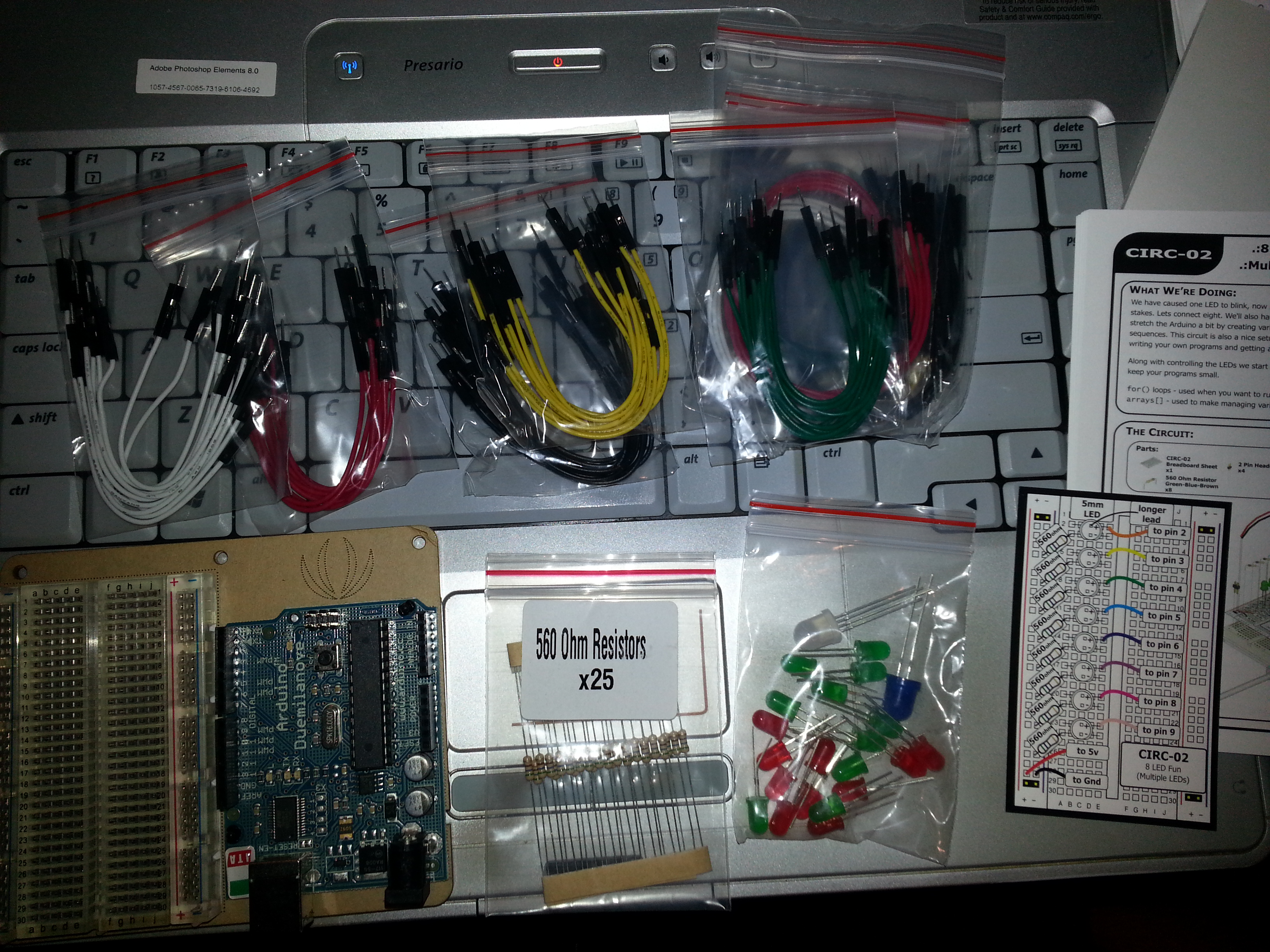
Okay, now’s it the old plug-n-pray that my big fumble fingers and half-blind eyes can see to place the parts in the right holes on the breadboard.
Do a visual double-check (and a triple-check of the double-check) and I’m ready for the software side of things:

It’s off to the Arduino programming environment I go!
I grabbed the code for this experiment off the company’s website, http://ardx.org/CODE02, and pasted it into the Arduino coding section, naming the “sketch” CIRC02:

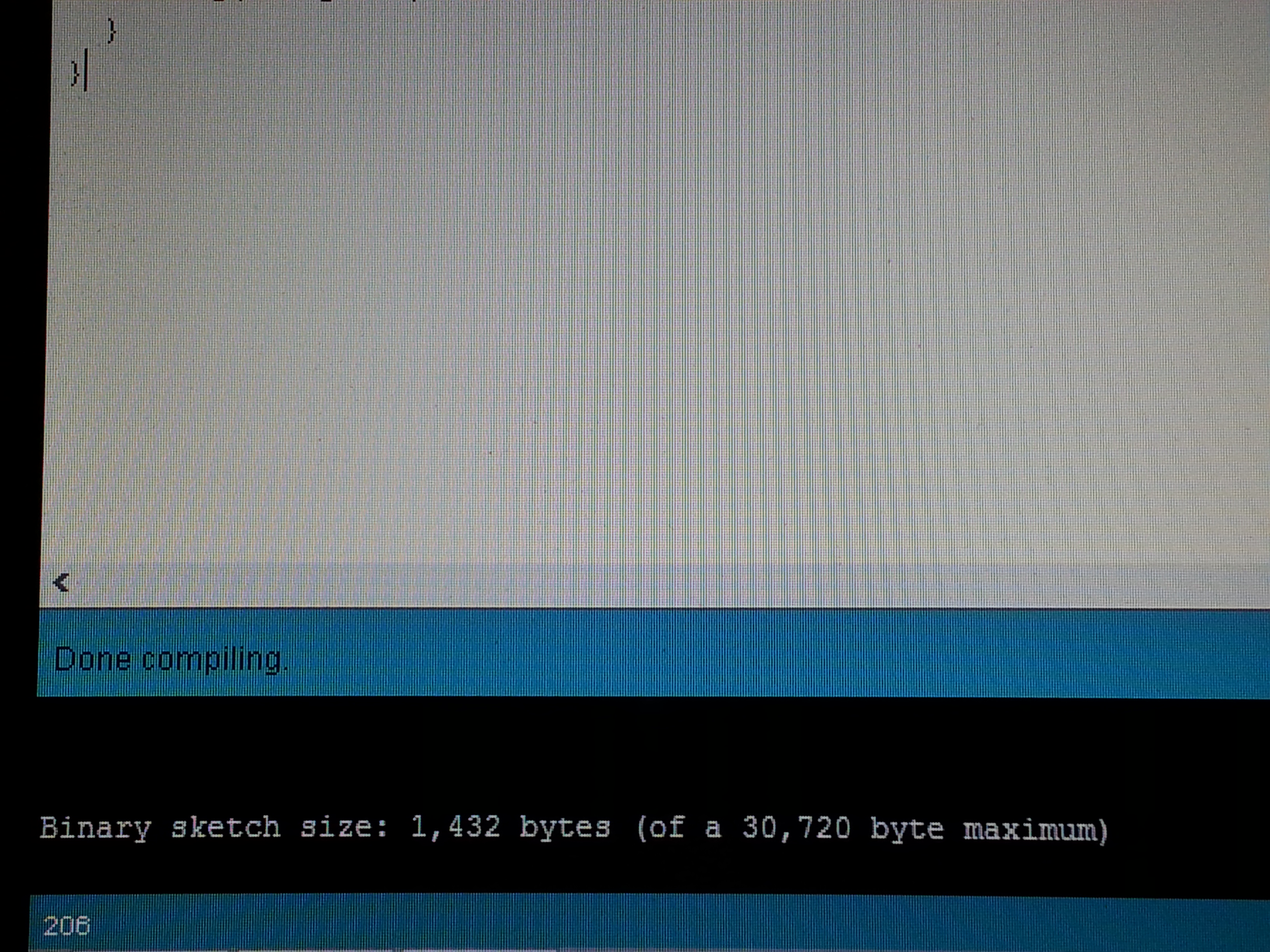
I verified that the code is functional by compiling it — successful!:
I then plugged the Arduino to my notebook PC via USB cable and let it boot up:
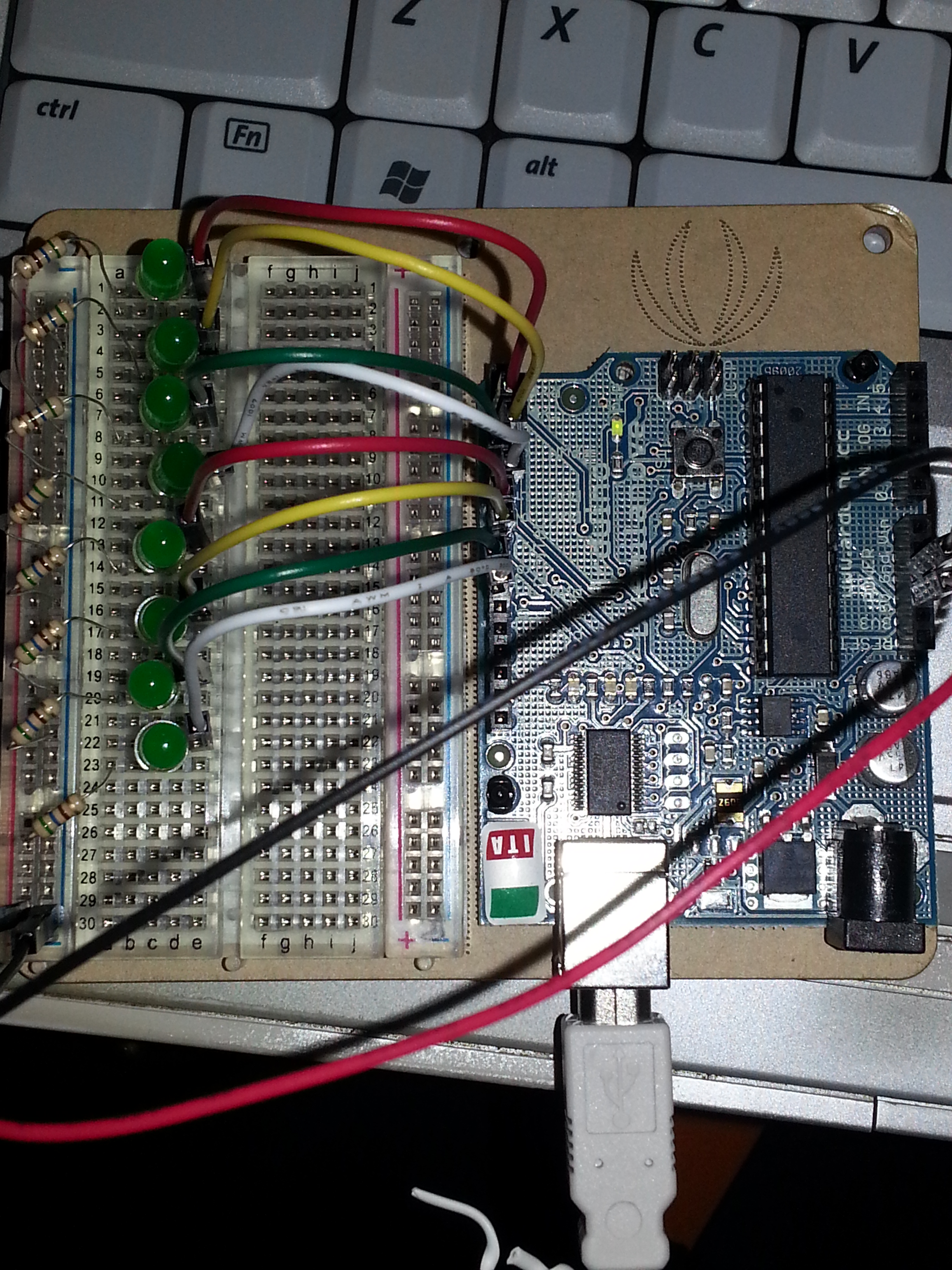
Finally, I uploaded the code from the notebook PC to the Arduino:

And here’s what the code produced.
On to the next task — figuring out what this code can do for my yard art sculpture!
 treetrunkdings