Advice from philanthropists

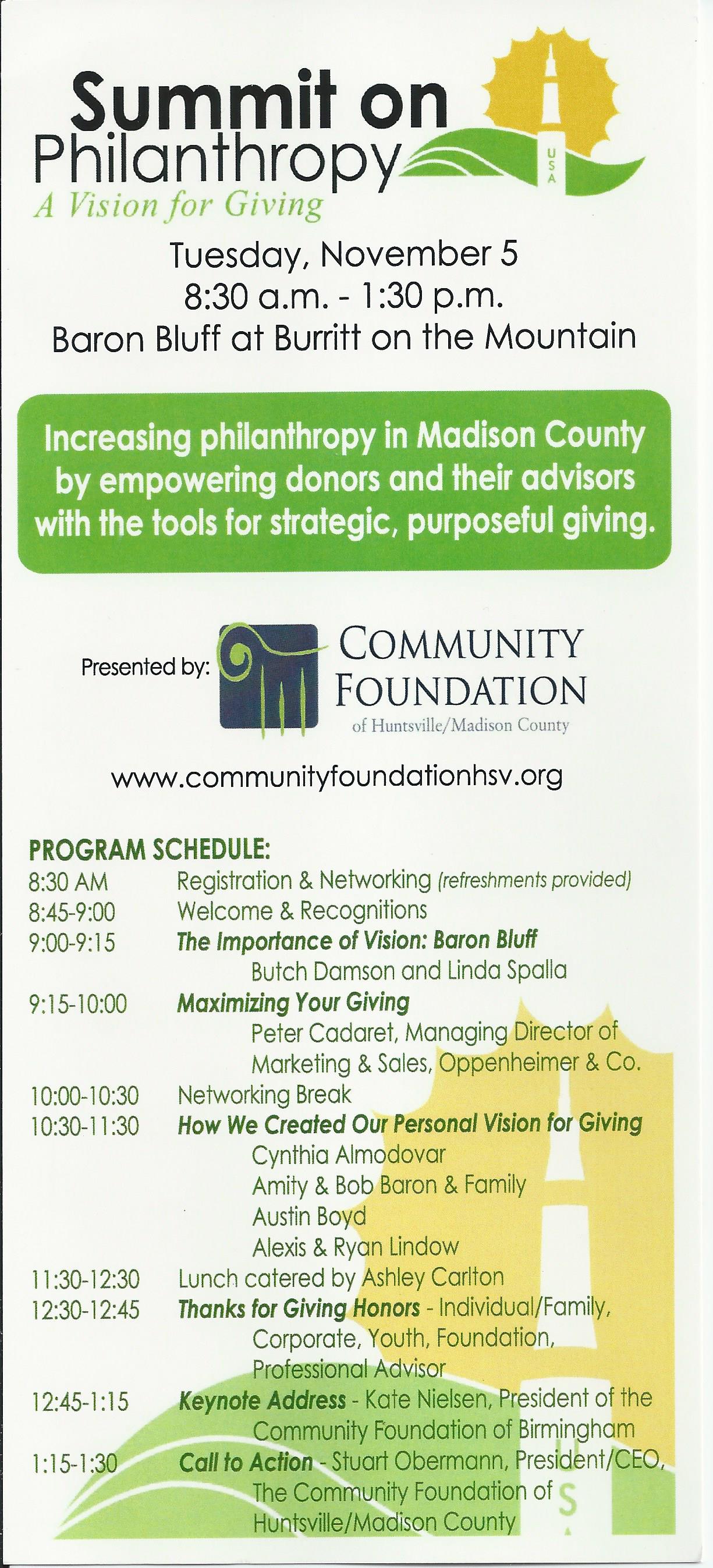
Some words of wisdom from the speakers at the Summit on Philanthropy:

  • If you have a vision, things flow along and follow that vision
  • Vision without execution is hallucination
  • A good project needs a strong emotional component
  • Protect your capital and grow your investment wisely over time
  • Philanthropy equals exercise and promotion of values — in other words, what are your passions?
  • Philanthropy is about investment of your time first (volunteer hours) and then your financial resources
  • To live, we must give back to others using our skills and talents in service
  • Philanthropy is a way of life, a way of thinking, not just a series of events — be willing to give the clothes off your back and help individuals become better people
  • Giving starts with us — diverting our daily discretionary funds (e.g., giving up our snacks/Cokes for a week and convincing others to do the same) toward community efforts
  • The way to build a charity is to start one
  • The best philanthropic project starts with your family — talk to your spouse/kids and get them involved; remember that “no” is just as important as “yes”; make sure it fits into your strategic life plans/vision
  • Nonprofit organisations must know the cost of raising funds
  • “Don’t sign up — show up!”
  • You don’t have to be Mother Theresa to have a positive impact on your community
  • Be civically obsessed and keep the spirit of giving alive and well
  • Projects successful because they came out of what the community wanted for itself
  • “If you want to go fast, go alone; if you want to go far, go together.” — African proverb
  • Your mission is to increase giving.  Why?  To strengthen the community.

Industrial Musicals: While I let Abi torture me with love…

…or did she love me with torture?

Yeah, it’s that recurring theme again — the love of mine for a woman I’d spend more time with if I could afford the torture.

Afford?

Oh, indeed.

Today, I sat through several hours of people up on a dais dazzling me in a daze about their love and passion for philanthropy.

The only factor that kept me awake and alert during their entertainment of financial advisors, their clients and nonprofit organization representatives, other than seeing some familiar faces, was knowing that my reward for creating a derriere falling fast asleep would be getting Abi’s hands, wrists and elbows on me.

And boy, did she ever!

I’ve never been one of those sadomasochists who gets a certain thrill from pain.

Well…I mean, sure, I do get a certain thrill from pain but…is it getting hot in here?

Where was I?

Seriously, with my body supine and then prone, either way, Abi worked her magic on me.

That beautiful woman has a spell on me that I can’t describe.

I’m just glad she’s still in love with her man and I’ve got a steady woman of my own.

Otherwise…growl!

She is the only woman, and I mean the only one, not even my wife, who I would let touch me the way she does, working on knots in my back, neck and chest muscles that almost make this grown man cry.

I still don’t know if I’ve experienced the level of pain I’ve endured under the careful, delicate surgical procedure of Abi’s massage work.

I don’t know if I want to ever again.

Yet, somehow, I go back for more, letting the special love of my life have her way with me.

In those moments, alone on the massage table, my thoughts adrift on puffy clouds in a blue sky, just her and me in her flat, a crime drama on the tellie, her elbowing me while texting with clients for upcoming weekend massages at dance competitions, I ask myself how special is our love.

She doesn’t let me drive my elbows into her back or twist my fingers into her biceps.

She knows I love her even if I hate her when she’s sending me into Dante’s deepest levels of hellish pain.

For her, I would hunt animals, killing for meat bare-handed.

She has opened up my body for new experiences, giving me the happiness and courage I sought to feel confident on the dance floor, adding Jessica to the list of new dance wives.

Jenn, Abi, Jessica…and, of course, my wife…and Kelly…the list of fun dance partners grows.  Is Naomi next?  And, after her, who will look me in the eyes and want to have fun like there never was any fun before?

I was distracted most of the day today from work on the desktop robotic art sculpture that serves as a scale model for a yard art sculpture piece I’ve been slowly working on between daydreaming about the imaginary life this set of states of energy has convinced itself is real.

I returned this evening to program four LEDs and some sensors after working out the design details on dancing mannequins.

Abi, I’ll miss you desperately while you’re physically out of my life for the next two weeks.  You torture me in so many ways I’ve got to add sadomasochist to the list of adjectives in front of my name, or does the acronym S&M get added afterward like “Esq,” “PhD” or “MD”?

Thank goodness, there’s Jenn still teaching dance lessons.  And Naomi.  And maybe even Jessica.

Jenn the mechanical/rocket propulsion engineer inspired me to create a robot.  Abi the creative/artistic dance instructor/massage therapist inspired me to create robotic dancing mannequins.  My wife the rocket test engineer inspired me to create dancing snake charmers.  Naomi the hair stylist inspired me to colour my hair and let loose on the dance floor.  Jessica has inspired me to have chaotic fun while remembering to dance the West Coast Swing style.  And now Kelly has inspired me to see that not only can a person be a fiduciary advisor by day but dance “Sexual Healing” with a financial client at night and say it was good fun!

Thanks to the folks at Baron Bluff for hosting the philanthropy summit today; The Ledges for hosting Fred Lanier of JP Morgan who gave an economic seminar tonight on wealth management; Mandy at Club Rush.

I was happy to see the core group of Rocket Westies work out organizational problems tonight — without you guys, I wouldn’t be here right now.

And Jessica, darling, I’ll miss you, too, while you’re gone.

Now, time for some shuteye — I’m already a day behind on my coding but we’re a day ahead on our dancing mannequin design schedule!

Death missed me last night…

Death missed me last night.
I should laugh or cry?
Matters not.
I love everyone equally,
Desire them,
Wish to devour them,
Eat every drop of sweat,
Regardless of skin category,
Regardless of thought set pattern embodiment.

As far as I’m concerned,
If you can’t say “fuck” on network television
Then the illusion of subcultural restraint
Is no more reassuring than the government spying
That our local/national cultures condone.

Thank goodness for random acts of violence.

Thank goodness that my thoughts are in contradiction…

My thoughts say that I am omnisexual,
Yet my actions say I am celibate and live in a monogamous relationship.

I take interest in local subcultures in order to show interest in individuals
With whom I cannot express directly to them my thoughts for them
That contradict the legal obligations I made in front of a crowd of friends and family years ago.

I live in this luxury of contradictory thought patterns,
Unable to care about starving kids anywhere,
Regardless of “income inequality” that is a substitute phrase for saying people are unable to form their own local economies
(i.e., lack initiative to create money out of thin air which buys the necessities of life and more).

I lack sympathy for [pick your favourite ailment] survivors.
What did you survive?
What do you say you survived for?
Not for me, you didn’t.
One less survivor means more for the rest of us!

There is nothing I can give anyone that I haven’t already tried once and failed to get my point across,
Or succeeded in proving I am a total fuckup.

Yes, I am part of a financially-successful family living in a suburban-based rotting hull of a house,
Waiting to die.

I say I want certain things, certain people to hold, certain phrases to say, places to see,
But then I do what I say and I am still left at the end of the day with me as I am,
New experiences notched on my old, stained leather belt falling apart.

Fuck this world.
It doesn’t matter anymore.

Let me figure out how to backup this blog to my local hard drive,
Erase the online contents,
Delete the website,
And slip into oblivion from whence I came,
Just as I did with myself on a popular social media site.

We humans have such a tiny view of existence,
Measuring life in revolutions around our local star, the Sun,
Thinking that adding words like millions and billions somehow gives us added [in]significance.

No matter.
No matter what.

Death missed me last night…
Again!

I laugh because I cried for no reason,
The reason being the death of a ten-year young girl,
And I’m still here for no reason that a subculture couldn’t quickly twist into eternal purposes to sustain itself.

“No” and “not” and double-negatives,
Double-entendres and doublespeak.

Matters not.

I believed I loved two women at once,
More than once,
This time the pain is just as great,
The sorrow greater,
The distance closer yet farther away in age.

How much more, how much longer, can I survive myself?

I want to start a new charity,
It’s called “I’m a self survivor and I’m in remission, if not remiss.”

Time for another vacation from myself.

Time to start a paper “blog” and say goodbye to cultural affirmation of paranoid government spying,
Say goodbye to texting,
Say goodbye to social media updates;
Say hello to a new self that sits in public and meditates upon the meaningless mystery of dark matter,
Get power from dark energy,
Disregard the need for pop culture references to tie myself to the artificial construct of zeitgeist time.

Square pegs at a rectangular roundtable in a box

Chan Auditorium — 4th Entrepreneurs Roundtable: Innovation and Change in the Non-Profit Sector

Guest speakers:

  1. Dr. Deborah Barnhart — as of December 2010, CEO of U.S. Space and Rocket Centre
  2. Stephen Black — founder and president of Impact Alabama (and grandson of Senator Hugo Black)
  3. Chad Emerson — CEO of Downtown Huntsville, Inc.

Moderators:

  1. Caron St. John, PhD — Dean of College of Business Administration, UAH
  2. John R. Whitman, PhD — Associate Professor of Entrepreneurship
  3. ICE Lab (Innovation in Commercialisation and Entrepreneurship Lab in College of Business Administration, UAH)

Before program began, an introduction video played on a big screen behind the podium, the video contents flipping between quotes by and photos of the guest speakers, giving the impression of a camera zooming in on newspaper/magazine articles/headlines.

By the time the program began, the audience was composed of about half business people (as characterised by their clothing/fashion choices — men in suits and women in business blouses/slacks/skirts) and about half college students (as characterised by their age and casual dress codes); note: attending students received college credit for attending the roundtable program.

What is entrepreneurship?

Paraphrasing Dr. St. John, it is, in a nutshell, recognising an opportunity and, despite adversity and risks, taking action to seize the opportunity.

Let us read what the guest speakers of the roundtable (who were actually seated at a rectangular table) had to say for themselves and their organisations…

Chad Emerson, CEO of Downtown Huntsville, Inc.

Think of a city that doesn’t have a strong downtown and is otherwise thriving.  The key to most successful cities is revitalisation of their downtown districts.

Chad helped revitalise Montgomery, Alabama, and now is tasked with turning downtown Huntsville into a go-to location for both city residents and tourists, despite the usual entrenched interests that prevent change.

He helped kick off the view of downtown Huntsville a couple of months ago with a food truck “war.”  To showcase not only downtown but also their new Internet website/portal, Downtown Huntsville, Inc., plans a big party on Halloween night.

Chad’s vision for downtown Huntsville includes getting a diversity of ideas — basically, you shouldn’t like more than 75% of the ideas implemented in any downtown because there’s always 25% that appeals to someone else, such as hosting a zombie walk.

His challenges include people who want everything that they like and nothing else — a typical resistance to change.

As a trained lawyer, Chad has no regrets about his career path.  He could have stayed on the law firm track, with a beach house but enjoys what he does.

Chad asked the audience to send him constructive feedback about downtown Huntsville.  He wanted evidence of emotional connections people felt toward the area, not just functional transaction (like getting that red convertible instead a vanilla family sedan as a rental car).  Contact him at chad@downtownhuntsville.org.

Dr. Deborah Barnhart, CEO and executive director of the U.S. Space and Rocket Centre

Deborah recalled the origins of the rocket centre.  Wernher Von Braun wanted the world to know that it was the people of Alabama who were about to put people on the Moon; thus, the U.S. Army deeded part of the local military base to NASA to explain its mission, which has expanded through the years to include other missions such as U.S. military developments and government/private sector contributions to energy developments.

In the same vein, Space Camp opened in 1982 because of the perception there are summer outdoor camps, math camps, etc.

Today, Space Camp hosts students from all 50 U.S. states and 62 countries, with tens of thousands of students having passed through, including five astronaut graduates.

The Space Camp concept has expanded, with Adult Space Academy, Aviation Challenge and more recently, Robotics Camp (with programs for air, land and water robotics).

Space Camp has an outreach program which has seen an uptick in international students — 600 students from China, 500 students from India and even some from Libya as part of peaceful cooperation between peoples of all nations.

Deborah’s 10-year objective is to tell the story of the technical achievements and innovation spinoffs of the space program from the local perspective, turning the U.S. Space and Rocket Center into a centerpiece museum inside a large park, similar to Balboa Park in San Diego, California.  She wants to increase the education opportunities for Alabama children — she noted that China and the state of Georgia sent more people through Space Camp or visited the museum than did Alabama-based adults and children last year.

Ultimately, Deborah wants the museum to be the repository for a National Space Library, which would set the cornerstone for the establishment of the U.S. Space Academy as a training ground for astronauts and grounds crew in the public/private space community.

The main obstacles to achieving these goals is the will of the people as exemplified by the support for space programs by the U.S. presidential administration.

As a self-sustaining organisation with an annual budget around $22M, the U.S. Space and Rocket Centre is positioned for growth, having advised museum directors for museums established by Paul Allen, cofounder of Microsoft.

As a retired U.S. Navy captain, Deborah relishes the daily intellectual challenges of running a large organisation.

Stephen Black, president of Impact Alabama

Stephen’s organisation operates with a current annual budget of $2M.  The purpose of his organisation is serve the underserved.  His version of the idea is that everyone deserves access to higher education but to get there, it requires social support of children and families in poverty.

Americans spend less and less time amongst people different than themselves, with diversity especially tough for middle and southern U.S. citizens who, more and more, are sequestering themselves in suburban and urban enclaves.

To change this, ethics and community involvement is the key.

A junior at an Alabama university will be more educated than 72% of Alabamians; reaching out to all people with something as simple as tax preparation for poverty-level Alabamians by trained college students is good way to bridge the gap between those who have benefited from higher education and those who have not.

Typically, a low-income working family with children (often a single-parent household) pays $350 for tax preparation due predatory practice of unscrupulous/unethical people; those with higher incomes pay an average of $200 for tax preparation.

Impact Alabama provides tax preparation training for college students and recent college graduates who must take a test to be able to serve — last year, about 6200 mainly low-income mothers at or near $20K income were helped; most importantly, the tax preparers were amazed at the hard work the low-income people appeared, often showing up with three W2 forms, very few who have any interest in welfare, despite headlines that purport that citizens in states like Alabama are lazy welfare recipients.

Thirty-two employee of Impact Alabama are college students or one year out of college, with a GPA of 3.75, earning less than $1K per month.  Impact Alabama attracts the best and brightest because they want to make a difference in people’s lives besides their own, be part of the story and recipe for success of the organisation.

Impact Alabama also provides vision care — it screened 32000 children for vision care, which has set an example, teaching this vision care program to Silicon Valley, expanding to Tennessee and other parts of northern California.

Stephen stressed that social entrepreneurship must be held to the same high expectations of any entrepreneurial venture such as Facebook or Twitter — building five-year plans, and showing the same initiatives of professional for-profit organisations.

There are 4.7 million people in Alabama, which has at least 12 schools which reached the torchbearer’s list, honouring the schools with the poorest districts that have gone on to exceed educational standards, let alone expectations; however, 99% of Alabamians are unaware of these great achievements but should know about this great story if Alabama is going to climb out of the bottom of national educational rankings.

Stephen asked the audience, “What do you want your legacy of life to be?”  The story of progress is not a slow multigenerational change; it usually has a tipping point phenomenon thanks to thoughtful, engaged people who work rapidly for change.  We need practical solutions, not politics, for positive social benefits.
If it works, quote it; if not, diss it with humour and style points

Amazonian principles:

Whether you are an individual contributor or the manager of a large team, you are an Amazon leader. These are our leadership principles and every Amazonian is guided by these principles.

Customer Obsession
Leaders start with the customer and work backwards. They work vigorously to earn and keep customer trust. Although leaders pay attention to competitors, they obsess over customers.

Ownership
Leaders are owners. They think long term and don’t sacrifice long-term value for short-term results. They act on behalf of the entire company, beyond just their own team. They never say “that’s not my job.”

Invent and Simplify
Leaders expect and require innovation and invention from their teams and always find ways to simplify. They are externally aware, look for new ideas from everywhere, and are not limited by “not invented here.” As we do new things, we accept that we may be misunderstood for long periods of time.

Are Right, A Lot
Leaders are right a lot. They have strong business judgment and good instincts.

Hire and Develop the Best
Leaders raise the performance bar with every hire and promotion. They recognize exceptional talent, and willingly move them throughout the organization. Leaders develop leaders and take seriously their role in coaching others.

Insist on the Highest Standards
Leaders have relentlessly high standards – many people may think these standards are unreasonably high. Leaders are continually raising the bar and driving their teams to deliver high quality products, services and processes. Leaders ensure that defects do not get sent down the line and that problems are fixed so they stay fixed.

Think Big
Thinking small is a self-fulfilling prophecy. Leaders create and communicate a bold direction that inspires results. They think differently and look around corners for ways to serve customers.

Bias for Action
Speed matters in business. Many decisions and actions are reversible and do not need extensive study. We value calculated risk taking.

Frugality
We try not to spend money on things that don’t matter to customers. Frugality breeds resourcefulness, self-sufficiency, and invention. There are no extra points for headcount, budget size, or fixed expense.

Vocally Self Critical
Leaders do not believe their or their team’s body odor smells of perfume. Leaders come forward with problems or information, even when doing so is awkward or embarrassing. Leaders benchmark themselves and their teams against the best.

Earn Trust of Others
Leaders are sincerely open-minded, genuinely listen, and are willing to examine their strongest convictions with humility.

Dive Deep
Leaders operate at all levels, stay connected to the details, and audit frequently. No task is beneath them.

Have Backbone; Disagree and Commit
Leaders are obligated to respectfully challenge decisions when they disagree, even when doing so is uncomfortable or exhausting. Leaders have conviction and are tenacious. They do not compromise for the sake of social cohesion. Once a decision is determined, they commit wholly.

Deliver Results
Leaders focus on the key inputs for their business and deliver them with the right quality and in a timely fashion. Despite setbacks, they rise to the occasion and never settle.

Postscript side notes

In a postscript side note, it is interesting to observe fearmongers say the sky is going to fall should the government of the United States of America default.

Speculation is an interesting art, if not a science.

In today’s global economy, how important is a government, even one like the U.S.’s, to the average person who doesn’t think in terms of national identity anymore?

What if we let one government default on its loan payments?

What if we prove that a government’s debt obligation is not a necessary component, a relic of the days of the nanny state?

I look forward to the U.S. government defaulting, showing the economic celebrities like Warren Buffett and Christine Lagarde that life goes on, regardless.

People are resilient.

We change, sometimes slowly, reluctantly, complaining bitterly, and sometimes happily, embracing the temporary chaos that change causes.

We shall see, won’t we?  hehehe

Sandbagging

How to maximise the local resources?

That question dogged us for many years as we planned our electromech construction crew that would “set up house” on Mars before we got there.

The mechs were fully capable of building adobe houses on Earth.

Water, though, was a key missing factor.

That encouraged us to find liquifying alternatives because we wanted to minimise the material we sent with the mechs.

We could have sent tonnes of sandbags and had the mechs build dry adobe huts under which our habitation modules would fit, providing extra protection in the Martian atmosphere, like parking an RV or caravan in a garage.

We challenged ourselves to create a solution that was both energy-efficient and easy to build.

Then, one day, after we had received the list of common chemical elements in Martian soil samples tested by the first wave of mech probes sent in the early 21st century to find suitable colonisation sites and entered it into our lab network, our semi-autonomous 3D printer on a mobile robot base started constructing an extruded Martian home.

Watching the 3D printbot create its own construction scaffolding was fun as it built a two-story structure that hinged and opened up to accept our current working version at the time of the habitation module that also served as transportation ship and landing craft.

Our Test and Evaluation department set to work calculating the wear-and-tear on the 3D printbot, estimating how many spare parts would be needed as the bot coordinated with the mechs to excavate Martian surface for the right ingredients, processing the Martian soil and then feeding the bot or its future equivalent the “right stuff” for habitation module protective shells.

To verify their theories, they drove the printbot and several prototype mechs out into the high desert, skipping a Martian landing simulation in order to focus on the printbot/mech adobe house construction techniques.

One of our lab personnel proposed commercialising the process, which later helped fund many of our side projects that we encouraged in case a crazy idea panned out and led to better procedures and/or understanding of settling Mars — whole desert communities were 3D-printed, followed by sustainable neighbourhoods in temperate zones around the world.