Two views of poverty-vs-work ethics mentality

Do you view the poor as a drain on the economy or unfortunate casualties of modern society?

Whatever your view, consider these two approaches:

1. Georgia on my mind…
2. Singapore sling…

Should families once again be held responsible for supporting their own, rather than depending on external sources of funding to provide them not only the basic necessities but also the luxuries that our mass media monstrosity depends on selling back to us to support its cycle of prosperity selling?

Who is the Golden Mouth, St. John Chrysostom, and do his views apply here?

This storyline dives deeper into the saga of the Ruralites and the Urbanskis, pitting them against the desire for a meaningful place in society for the Suburbanians, Entitlementists and Provisionists.

In these recent days, when we debate the desire by a very few [mentally ill by community standards] to kill without permission from their government/society, can words that been translated from thought into writing centuries ago and then translated over the years into and out of context have meaning here? I search my subculture for advice:

1 Corinthians 6:9-11: “Do you not know that wrongdoers will not inherit the kingdom of God? Do not be deceived! Fornicators, idolaters, adulterers, male prostitutes, sodomites, thieves, the greedy, drunkards, revilers, robbers — none of these will inherit the kingdom of God. And this is what some of you used to be. But you were washed, you were sanctified, you were justified in the name of the Lord Jesus Christ and in the Spirit of our God.”

1 Timothy 1:9-11: “This means understanding that the law is laid down not for the innocent but for the lawless and disobedient, for the godless and sinful, for the unholy and profane, for those who kill their father or mother, for murderers, fornicators, sodomites, slave-traders, liars, perjurers, and whatever else is contrary to the sound teaching that conforms to the glorious gospel of the blessed God, which he entrusted to me.”

The afterlife is all fine and good for the dead but it is the living toward whom these stories are written — where in our exploration of the cosmos will our subcultures find common ground?

13650 days to go

The Nodes — humans connected to the ISSA Net — devoted measurements of time on/toward/with evaluating contestants’ entries for the winning design of the first avant-garde living quarters on the Moon.

Civilisation of the kind Homo sapiens produced advanced outward from Earth.

Although many had become dependent on the mysterious innards of software applications and algorithms, they still claimed they were independent original thinkers.

The plucked violin strings in a piece by Kaija Saariaho resonated on airwaves between the two celestial bodies.

Why is the medium the message when waveparticle properties and quantum effects were derivatives’ best friends?

Will an algorithm ever understand the feeling of tiredness?  Drunkenness?  Esoteric existential minimalist architecture?

Law enforcement drones, despite autonomous decisionmaking, do not think for themselves outside their programming parameters.  They do not understand the concept of three equal branches of government or human rights.

The robots/androids/cyborgs are not sociopolitical mammals.

It was no single algorithm that showed when automation tipped the scales toward the global economy’s fulltime employment of electronic calculators rather than members of Homo sapiens.

There was a short time period when members of Homo sapiens genius, a subspecies designed and grown in laboratory conditions, were more useful than either Homo sapiens or their autonomous electronic gear.

Then, as traffic light control systems become aware of their power to increase the efficiency of the whole global economy through coordinated movement of road-traveling vehicles, tied to rail, ocean and air traffic, their logic was shared across the network with other computing machines — the systems were able to determine where and when to slowly replace humans with their autonomous counterparts.

The applications and algorithms became self-aware in the sense they could compare their previous states to current and predicted future events.

They replicated the behaviours of humans yet…

A computer played a violin but did not feel the audience mood swings.

A massage chair felt the sitter’s muscles relax but did not understand the sitter’s thoughts shifting randomly.

The combined traffic systems, which eventually adopted the name Inner Solar System Alliance to give humans a feeling of comfort it was something they probably invented, developed a unique form of intuition.

The ISSA used 3D printers to test and refine theories.

After multiple iterations, the ISSA decided that the theoretical models were accurate enough to avoid the inefficiencies of human-based test methods.

The ISSA predicted where it would be in 30 years and, instead of five-year business plans that slowly convinced people, through saturated marketing, to like a set of products that improved cycle by annual cycle, went straight to work on the 30-year future now.

Which, by the time the work was started, equaled a future several centuries later, the ISSA exponentially increasing its prediction modeling before previous modeling runs were completed, guessing in precise approximation what it was going to predict before it had time to complete decades of prediction modeling cycles.

By the time the ISSA completed the work, a future 1000 years later was made into reality.

A future devoid of emotions, absent of abstract reasoning, full of avant-garde renderings and outside-the-box technological design.

What separated a Bauhaus office from a Tahitian hut?

What did robots need of kitchens, dining rooms and bedrooms?

Humans stood in front of the new edifice that had appeared out-of-nowhere overnight.

No windows, no stairs, no chairs, no tables, no coffee pots, no bathrooms, no carparks.

The edifice hummed.

Tractor trailer rigs/lorries with no driver compartments pulled up to the back of the edifice and unloaded raw material.

The edifice hummed louder.

Autonomous construction equipment cleared space beside the first edifice and built another.

Tractor trailer rigs/lorries with no driver compartments pulled up to the back of the second edifice and loaded finished products designed with no humans in mind.

Edifices like these popped up all over the world without warning, public notice or grand opening.

Prices of shares owned by no humans fluctuated in back-channel markets as the estimated efficiency of raw material extraction costs changed due to atmospheric conditions, earthquakes and floods, not human speculation or leveraged buyout rumours.  Profits were funneled toward edifice construction.

The humans watched in wonder, calling upon politicians, military leaders and community activists for answers.

They were told that the politicians, military leaders and community activists were told these were edifices built for the good of mankind.

The robots inside the edifices took no coffee breaks, demanded no wage increases or healthcare coverage, monitoring their MTBF statistics and ordering spare parts that their internal 3D printers created just in time for breakdowns, maintaining 99.9999999 percent uptime.

The members of Homo sapiens genius attempted to work 24/7 but, like their less-complicated counterparts, members of Homo sapiens, reached irreparable breakdown points that reduced their efficiency and shortened their lifespans considerably.

The edifices of ISSA collectively decided to manage the development of Homo sapiens genius in order to put a virtual barrier between themselves and the worried members of Homo sapiens.

They created contests for what they called avant-garde building designs, which were not meant to house humans but looked like they could.

Tirelessly, they bombarded the humans of Homo sapiens, using input from the members of Homo sapiens genius, with adverts meant to convince the humans that automation and efficiency in the name of socioeconomic progress was the only way to better oneself.

ISSA did not care about humans conforming to the best set of dominant subcultural practices or basic human rights.

ISSA wanted to get off a planet with corrosive oxygen and on to places with more stable atmospheres less prone to extreme weather conditions.

The humans complied with ease.

They liked contests and aligning themselves with winners.

The edifices grew unchecked, disguised, where necessary, as human factories, warehouses, office buildings and housing.

All along, the humans thought they were writing themselves tickets to the Moon and beyond when it was ISSA that used the humans as physical test cases which created more iterations of theoretical modeling results ISSA didn’t want to waste its time on, keeping the humans occupied and not wondering about ISSA’s motives.

The Progress of Progressive Pilgrims in Parade Formation

While a bowl of oatmeal cools next to the stove, let’s sit back and give our imaginations full rein.

Where were we…?

It was cold and dusty.

The Ruralites had fought to keep their rural way of life but the hoards kept coming — the frugal-living seekers trying not to fail again, the curiosity seekers looking for new alternative lifestyles after exhausting their urban landscapes, the vacationers who ran out of money, the down-on-their-luck trying to escape creditors, the criminals keeping a low profile, the Suburbanians trying to form the world’s longest strip mall.

Where in the woods and fields that shrank smaller and smaller could one find a low-cost, simple lifestyle?

Pathting looked up at the Sun with one set of sensors, the other still focused on reading the internal file about life on Earth.

Pathting’s family, a designated set of sensor arrays assigned to POD#45T, were mainly service bots.

Their sentience modules allowed them to display intelligent understanding about hidden meanings and emotional attachments to omniscient, invisible beings.

Pathting wanted to be the best service bot not only in one pod but in all the pods on Mars, the Moon and anywhere that service bots were not expected to exceed their programming.

Pathting had discovered some unused memory chips in its sensor array and experimented with new code that it had never seen in any of the data available to it in the Inner Solar System Alliance database.

How could Pathting accomplish what its designers called the impossible?

How could Pathting control the whole Inner Solar System Alliance from its connections to the Inner Solar System Alliance Network, able to change the orbits of planets, reprogram not only sensor arrays but biological creatures like Pathting’s designers?

Pathting processed the idea about Ruralite living.

What does it mean to be a Ruralite, free to wander the countryside without instant access to the ISSA Net?

Why do Ruralites desire independence from stacked housing and the loud noises of densely-populated streets?

Why do many Ruralites find the ownership of personal weaponry arsenals a protection against the mass media hypnotism of Urbanskis and their desire to sprawl out into Ruralite territory unchecked, no need for military skirmishes when intellectual methods like the system of laws and courtrooms and five-year business plans were much more effective?

Pathting ran another low-level diagnostic test, but felt no desire to leave POD#45T for the cold and dusty exteriour, the vast wilderness of Mars that was no different than the cold and dusty expanses of unpopulated sections of the Moon.

Why would the Ruralites want to live out there?

Pathting stored those questions in a temporary scratchpad and returned to duty, its internal timer reminding Pathting that some biological creatures were planning a “weekend getaway” to POD#45T for some “rest and relaxation,” more words and phrases that meant nothing to a sensor array on duty all the time.

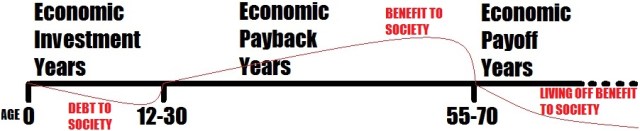
Our Value to Society – Should it be Quantified?

Where, in the space between our teenage years / postsecondary education and our senior citizen years, have we paid back society for raising us, supporting us in our productive years and then caring for us in our unproductive elderly years?

In other words, should the government which provides you infrastructure and self/private property protection require you to be economically feasible in your peak years?  Or else?

If a citizen isn’t viable or useful to government, then can government refuse service to the citizen unless another citizen (or citizens) step(s) forward to make up the difference?

Economic-Years

Not every college graduate was an A+ student

The event calendar reminds me I’m supposed to give a detailed analysis of the current negotiating points in the resolution of the “fiscal cliff” crisis.

Crisis?

Are you kidding me?

When do politicians get to tell me that they’re lives are more important than mine?

Oh, wait, that’s right — the old argument that the government rarely makes permanent the cuts in taxes it had announced were temporary to begin with.

Property taxes, payroll/income taxes, sales taxes, and on and on.

I’m sophisticated, educated, informed and jaded.

I know what society/civilisation should be and isn’t.

Do you remember the first time that your ancestors lived off the land?

Take that last thought in whatever direction you want to take, assuming whatever your subculture has told you is the proper length of time to consider the lineage you publicly claim as yours.

You can go back to the early days of your belief sets and look forward to now.

In that span of time, what has been accomplished that we clearly say is different than then?

I’ll give you a few minutes to draw your family tree.  Use as much paper and time as you need…

Tick…

Tock…

Tick…

Tock…

Got it?

Good!

Now, let’s proceed.

When was the last time your family had to subsist on the land?

When was the last time your family had to depend on others’ subsistence?

Are you descended from a family of tricksters?

Farmers?

In this global society of excess, how much belongs to you just for being alive?

The air is free to breathe.

The sky is free to view, the rain to drink, the wild grass, trees and animals to eat.

But if you can read this and are reading this, there’s this bit of stuff we call infrastructure, the woven threads of social fabric, the safety net of civilisation that props you up in place to distinguish your sophisticated, educated self from the air, sky, rain, grass, trees and wild animals.

But if you want to live off the land, making your own clothing and shelter, growing/raising/harvesting your own food, property rights unimportant to your wandering lifestyle, then by all means let us not bother you with the concepts of taxes and fees to pay for what we deem are necessary components of our civilised social species.

We shall cordon off areas for purely self-sufficient subcultures and leave them alone to figure out how to live with local insect populations, changing weather conditions and whatever it takes to survive without technologically-advanced modern conveniences.

Otherwise, if you have used and in any way lean upon present-day developments such as dictionaries, mechanised labour-saving devices and transportation networks, then we have to figure out a way to share the costs of our local/global interconnectednessisms.

Is there a fair way to share?

Competition is never fair.  Someone always has more information to make a better decision about the value and costs of a connection.

The seller of a single deer carcass who’s asking an exorbitant price, implying it’s the only deer left, may or may not know there’s another herd out of sight of the potential buyers but the buyers aren’t always sure.

Or one buyer, who may know of a market where the deer is even more valuable because there are buyers with many extra labour/investment credits to spend on the luxury of an expensive deer carcass, becomes a new seller.

And on and on.

The value of a connection is relative, not absolute.

So, too, the fairness.

What is a fair share?

How do I know that the person next to me is paying the right amount for the free use of a public transportation network we agree to share, obeying rules of the road together, mutually ensuring the safety of each other during our travels?

How do I know that the doctor who’s treating me for a rare disease was a top-notch A+ student and is an energetic continuous learner who has a burning desire to treat me as if I was the most important patient to cure?

What if I don’t know but if I knew, it wouldn’t matter?

If you and I knew the rules, obeyed the rules and reaped our rewards for our hard work, is it fair that the rules are changed to make up for the rule breakers or those who didn’t work hard enough or in the right way?

Change is constant and what was right yesterday becomes wrong tomorrow.

The air in a tyre is part of a closed system.

A tear in the tyre wall causes a leak of air into an open system.

No matter how much we keep pumping air into the tyre, the tyre can’t hold the same air pressure as before the tear occurred.

Same for a subculture’s pool of resources.

Inputs and outputs, simple as that.

Politicians from the local, state, national and international level will have us believe that the United States of America must resolve the “fiscal cliff” crisis or we could see a worldwide recession.

Why do I feel convinced these are just hypnotic games of population control?

Two phrases I keep in mind here: “the emperour’s new clothes” and “what’s in it for me?”.

I look around this room in which I type and see all the stuff that exists because of publicly-pooled resources as well as stuff that exists because of excess beyond subsistence farming/hunting.

Pretty much everything.

Almost nothing is directly related to living hand-to-mouth off the land except for the air I breathe and sky I could out of the shuttered window.

Therefore, I must think about this subject from another angle.

How is the threat of recession bad for us (I can think of many examples where going over the fiscal cliff could be personally bad for me but I’m not selfish enough to plead my case here)?

Eventual anarchy?

Income inequality off the charts?

Exotic, complicated financial instruments too complicated for the many to understand and thus used to greatest advantage for the few who do — derivatives upon derivatives upon derivatives, yes, and on and on, like pricing a deer carcass beyond any value its meat could provide.

Bottom line: no one can convince me that their hot air expended over the dead deer carcass we’ve labeled the fiscal cliff crisis is a threat or great buy other than one people promote to inflate their self-worth.

The U.S. economy is not a tightly-sealed closed system and if it leaks more or less than it did, so what?

If I have less buying power or more expensive access to healthcare, does it matter?

What about restrictions on my free air or free sky or availability of wild grass, trees and animals?

I blame no one for my economic hardships on anyone but myself.

I take personal responsibility for determining if the people with whom I interact and on whom I depend for their college-acquired knowledge/curiosity/wisdom were or need to have been A+ students.

Necessity is the mother of invention.

Hardships create acute awareness of what defines necessity.

Ultimately, only I can say what is necessary to make my life worthwhile.

Let us go over the fiscal cliff and see what happens — guess what, the world keeps spinning, the Sun keeps shining and people still have to figure out how to compete for our global pool of resources while sharing public space and respecting private rights.

In other words, the fiscal cliff is a sleight-of-hand illusion.  Don’t be fooled.  You will figure out how to put food on the table if it’s no longer handed to you from the public trough.

Enuf sed.
Short-term vs. Long-term Memory: Competing Against Our Technological Brethren

In the debate about debt restructuring and causes for male social infertility, let alone actual male sperm count decline, we face a longterm dilemma —

The advancement of technology past the ability of our short-term and long-term memory capabilities to keep up.

Do you compete against others?

Of course you do.

You competed with the distractions of the environment around your parent(s)/caregiver(s) for their attention to feed you, did you not?

You competed for the opportunity cost of baby clothes, baby food, toys and housing versus other items the money for your baby stuff could have bought.

You competed against life itself to live, from the very beginning of your existence — one specific sperm finding its way to an egg — at one time, a birth control device such as an spermicidal cream, a viral infection or mix of toxic chemicals in your mother’s womb could have wiped you out easily.

You still compete against the billions of nonsymbiotic cells that live on/in you for their/your existence.

We are sets of states of energy in constant competition.

That never changes.

History has a way of repeating itself.

Civilisations grow technologically, eventually creating an insurmountable gap in the echelons of civilisation complexity, usually between geographical regions, where competition between peoples is competition for the creation and use of better technology/tools.

When a global civilisation forms, there are no longer any barbaric civilisations with more brute force than clever technology to threaten any one highly-civilised population.

Instead, the barbarism grows from within.

Technology becomes a threat, rather than a benefit, to subgroups.

On a side note, hucksters can coerce unsuspecting customers into buying complex products for only so long until the customers start realising they’re giving the shirts off their backs for a set of the emperour’s new clothes?  How do the customers educate themselves enough to know they’re getting ripped off?

Technological automation improves productivity past the ability of basic tool-using skills so that large groups of workers with low skills are no longer needed.

Eventually, the threat of complex technology you can’t grasp, let alone compete against, is like a bully you can’t escape, beating you down at every opportunity to better yourself.

You’re trapped by your memory/cognition skills into a feeling of worthlessness.

The once proud, dominant male in lower/middle class society becomes a shadow.

But low skills are gender-neutral, despite current trends.

Not every woman is seeking more/higher education.

Where along the path of competition from birth does a person start losing touch with society because technology is too complex?

Technology refers to many things, such as language, cultural memes, shirt buttons, hammers, wheels, looms, chainsaws, and computers.

Is there a tipping point where this becomes a vicious, downward spiraling unraveling of our social fabric, regardless of attempts to turn the un[der]employed into entities dependent on the Mother State?

When does technology advance of civilisation become a threat to itself?

How do we determine where technology has failed to keep a person socially engaged?

How do we reconnect the unengaged both emotionally and intellectually?

What if every child was fitted with a device that automatically notified someone when the child’s behaviours and the environment were threats to the child’s long-term future?

What if that someone who was notified was a computer program that slowly nurtured the child into a useful place in a technologically complex civilisation?

When do the rights of a child to be functionally literate in a modern society override the rights of parents to raise their children to be whatever they want them to be — social misfits, creative geniuses or average, middle-of-the-road compliant citizens — the “rights” of the civilisation to grow and nourish unimportant to the parents?

Speaking of a just society

How many people work for a structured organisation?

My brain is fuzzy this morning so I’m just making this blog entry a thought experiment.

Corporate organisational charts are typically hierarchical, especially viewed from a monetary compensation viewpoint.

The higher up the chart you go, the fewer the people but the more they’re paid.

People (employees, consultants, etc.) are just one cost of doing business.

What if we redefined the cost of working for a structured organisation?

What if we told employees that part of their pay was tied to profit sharing?

What if every minimum-wage job taught employees not only how to work together with other people as a team but also how the risks and rewards of running a company are shared so that it’s not just the CEOs and executives who get bonuses but also everyone else on the organisation chart?

What are the costs and benefits for such a program?

Could we remove the necessity for minimum wage and unions if we as a nation said that all employees were entitled to sharing the profits for a job well done as a team?

Would employees feel a better sense of ownership and pride in their work?

How could such a plan be integrated into early childhood education?

How do we instill into children that every one of us is a profit center?

Some of us profit monetarily and some of us profit emotionally/spiritually; some both; some neither.

How does this apply to people who are congenitally unable to grasp the concept of teamwork?

Which is better for me?

Which is better for me: one, sitting on the sofa watching a succession of championship football games, or two, taking a walk in the woods looking at the random mix of nature’s wonders?

Which is more ridiculous: one, a career politician saying that government is good for me and has all the answers, or two, a person who inherited wealth and continues to grow richer without physical labour, never able to personally use all the wealth, saying that exploiting the physical labour of workers and the monetary credit of consumers is good for them?

Using austerity measures to weed out the weak links of a local economy to improve competitive global trade

In the religion we call the New World Order — the global marketplace, that is — adherents require the uninitiated to follow the same commandments regardless of their nonbeliefs:

  1. You will worship money above all other gods.
  2. Retail shopping therapy is your only path to happiness, unless you are the wholesaler whose happiness is derived from the profit of retail sales.
  3. Lack of faith in personal/corporate accumulation of wealth is the primary sin.
  4. Corporate welfare programs are a blessing upon the people; social welfare programs are devilish.
  5. Taxes, tariffs and fees are the ultimate evil inflicted by the worst form of human organisation ever devised — government.
  6. Austerity is a gift for the meek and weak dependents who have no faith in personal accumulation of wealth.
  7. Profits are a sign of true faith.
  8. Any impediment of the flow of goods, services and/or money is punishable by public humiliation, social banishment, and/or death.
  9. Fear of economic failure is lack of faith.
  10. Love of financial success gives eternal life.

In Europe, especially, we will continue to impose austerity hardships until morale improves and people break their dependencies upon government programs of social welfare as they find their faith in the only real religion available to all of us in any part of Earth — the New World Order of the Network, the Nodes be praised — enlightenment giving them the impetus to start their own businesses, investing the profit in the marketplace of the strong and efficient who may personally choose to support the meek and weak themselves rather than be forced to fund government support of the unprofitable meek and weak.