While traveling through outer space, do you get a suite with your suit or just a micro hotel room?
Tag Archives: chapter excerpt
Who exactly are Craig or Angie and why do they have lists?
The Loveliest Short Story You Will Read Today Was Published on Craigslist
“Missed Connection” stays with you.
Chris HellerAug 9 2013, 10:43 AM ET
[FROM THE ATLANTIC]

Lucas Jackson/Reuters, Chris Heller
Craigslist: that scourge of the newspaper industry, that den of lust, that middleman responsible for an untold number of bedbug crises.
Or, Craigslist: the Internet’s simplest and most ingenious disruptor, a digital equivalent of the neighborhood telephone pole papered from sidewalk to eye line with “HELP WANTED” and “GARAGE SALE: TODAY!” flyers.
How about, Craigslist: accidental publisher of short fiction?
On Tuesday evening, “Missed Connection” appeared as a personal listing on Brooklyn’s corner of the website. It begins like most of these confessions do:
I saw you on the Manhattan-bound Brooklyn Q train.
I was wearing a blue-striped t-shirt and a pair of maroon pants. You were wearing a vintage red skirt and a smart white blouse.
Looks familiar, right? We made eye contact, we smiled at each other, we didn’t talk before you got off the train, yadda, yadda, yadda. But, no. The anonymous writer, whoever he or she is, framed a fantastical sort of romantic tragedy within this Craigslist post. It’s a sad, lovely story in an unexpected place.
As short fiction goes, it’s nothing special. The prose sags. The writer’s weakness for adverbs (“I cocked my head at you inquisitively,”) and precious sentiment (“We both wore glasses. I guess we still do,”) creates needless distractions. The story needs a good editor and several more drafts. It’s far from great writing–and yet, it still works.
Maybe it’s the grim appeal of lost love. Maybe it’s the whiff of surprise in such a well-trod crook of the Internet. Maybe it’s just the pleasure of a small, imaginative story. Whatever it is, there’s something about “Missed Connection” that stays with you.
Read “Missed Connection” below:
I saw you on the Manhattan-bound Brooklyn Q train.
I was wearing a blue-striped t-shirt and a pair of maroon pants. You were wearing a vintage red skirt and a smart white blouse. We both wore glasses. I guess we still do.
You got on at DeKalb and sat across from me and we made eye contact, briefly. I fell in love with you a little bit, in that stupid way where you completely make up a fictional version of the person you’re looking at and fall in love with that person. But still I think there was something there.
Several times we looked at each other and then looked away. I tried to think of something to say to you — maybe pretend I didn’t know where I was going and ask you for directions or say something nice about your boot-shaped earrings, or just say, “Hot day.” It all seemed so stupid.
At one point, I caught you staring at me and you immediately averted your eyes. You pulled a book out of your bag and started reading it — a biography of Lyndon Johnson — but I noticed you never once turned a page.
My stop was Union Square, but at Union Square I decided to stay on, rationalizing that I could just as easily transfer to the 7 at 42nd Street, but then I didn’t get off at 42nd Street either. You must have missed your stop as well, because when we got all the way to the end of the line at Ditmars, we both just sat there in the car, waiting.
I cocked my head at you inquisitively. You shrugged and held up your book as if that was the reason.
Still I said nothing.
We took the train all the way back down — down through Astoria, across the East River, weaving through midtown, from Times Square to Herald Square to Union Square, under SoHo and Chinatown, up across the bridge back into Brooklyn, past Barclays and Prospect Park, past Flatbush and Midwood and Sheepshead Bay, all the way to Coney Island. And when we got to Coney Island, I knew I had to say something.
Still I said nothing.
And so we went back up.
Up and down the Q line, over and over. We caught the rush hour crowds and then saw them thin out again. We watched the sun set over Manhattan as we crossed the East River. I gave myself deadlines: I’ll talk to her before Newkirk; I’ll talk to her before Canal. Still I remained silent.
For months we sat on the train saying nothing to each other. We survived on bags of skittles sold to us by kids raising money for their basketball teams. We must have heard a million mariachi bands, had our faces nearly kicked in by a hundred thousand break dancers. I gave money to the beggars until I ran out of singles. When the train went above ground I’d get text messages and voicemails (“Where are you? What happened? Are you okay?”) until my phone ran out of battery.
I’ll talk to her before daybreak; I’ll talk to her before Tuesday. The longer I waited, the harder it got. What could I possibly say to you now, now that we’ve passed this same station for the hundredth time? Maybe if I could go back to the first time the Q switched over to the local R line for the weekend, I could have said, “Well, this is inconvenient,” but I couldn’t very well say it now, could I? I would kick myself for days after every time you sneezed — why hadn’t I said “Bless You”? That tiny gesture could have been enough to pivot us into a conversation, but here in stupid silence still we sat.
There were nights when we were the only two souls in the car, perhaps even on the whole train, and even then I felt self-conscious about bothering you. She’s reading her book, I thought, she doesn’t want to talk to me. Still, there were moments when I felt a connection. Someone would shout something crazy about Jesus and we’d immediately look at each other to register our reactions. A couple of teenagers would exit, holding hands, and we’d both think: Young Love.
For sixty years, we sat in that car, just barely pretending not to notice each other. I got to know you so well, if only peripherally. I memorized the folds of your body, the contours of your face, the patterns of your breath. I saw you cry once after you’d glanced at a neighbor’s newspaper. I wondered if you were crying about something specific, or just the general passage of time, so unnoticeable until suddenly noticeable. I wanted to comfort you, wrap my arms around you, assure you I knew everything would be fine, but it felt too familiar; I stayed glued to my seat.
One day, in the middle of the afternoon, you stood up as the train pulled into Queensboro Plaza. It was difficult for you, this simple task of standing up, you hadn’t done it in sixty years. Holding onto the rails, you managed to get yourself to the door. You hesitated briefly there, perhaps waiting for me to say something, giving me one last chance to stop you, but rather than spit out a lifetime of suppressed almost-conversations I said nothing, and I watched you slip out between the closing sliding doors.
It took me a few more stops before I realized you were really gone. I kept waiting for you to reenter the subway car, sit down next to me, rest your head on my shoulder. Nothing would be said. Nothing would need to be said.
When the train returned to Queensboro Plaza, I craned my neck as we entered the station. Perhaps you were there, on the platform, still waiting. Perhaps I would see you, smiling and bright, your long gray hair waving in the wind from the oncoming train.
But no, you were gone. And I realized most likely I would never see you again. And I thought about how amazing it is that you can know somebody for sixty years and yet still not really know that person at all.
I stayed on the train until it got to Union Square, at which point I got off and transferred to the L.
Phrase of the day
Best line last night: “Welcome to Cheers…” where, “guys, it’s not always about what’s in your pants.”
Time to think about the honeydo list before designing/building a sculpture.
We learned briefly last night a short lesson in dancing from Chris, whose 25-year dance instructing career included working at a Fred Astaire dance studio when all male teachers had to wear a three-piece suit. Now Chris wears blue jeans.
Thanks to Abi for her encouraging words during our hourlong lesson.
Decanter handle: the truth
Intimacy has more than one definition.
Intimate details.
Intimate relationship.
A polyamorous person intimates intimacy in public and in privacy.
In the span of a few hours, one watches the intimacy of actors pretending to live intimately over 19+ months on a trip to Europa, becomes intimate with the details of one person’s life followed by another and another.
Back to the dance — following and leading.
Opposites attract.
A young man loses his girlfriend, then within two weeks, his grandmother (like a mother to him) has triple-bypass surgery, and a week later, he tears his meniscus. He, a man half Brazilian, half American, blacker than black, but nearly hairless thanks to his Brazilian half, no need for a Brazilian wax. Depression is easy to give in to but one must move one, mustn’t one, especially when one is so far away from his grandmother he has to fax his love and hugs to her?
And the depths of the stories of another — dear, sweet Bai — the daughter of a Baptist preacher, related to others in her family of Anabaptist faith, almost married a charismatic Pentecostal follower; she played piano, led the choir, organized/arranged church music leadership, her mother looked like Audrey Hepburn who has an inheritance of seven figures’ worth of jewelery to pass on; moved in with her boyfriend before marrying, got pregnant, her father telling her that if you’re going to sin, do so willingly and with gusto before God’s hand sweeps down [in punishment?], willing to face the consequences of your actions; got tattoos in her early 30s; more stories to tell than I can remember to write down…
And our resident Frenchman, who is unique in his own way outside of the fact he is from France. Likes firm mattresses, no need for a boxsprings; bought a room full of furniture for $100 (was asked $80 but offered $20 more to get help moving the stuff) from an expat returning home overseas; his best time of the day is from 10 p.m. to 4 a.m.
A pretty young woman who seems so familiar, got into nursing school a semester ago, and along with her ROTC program must keep her grades up to complete her nursing degree.
A revolving door of stories.
The waitress/server who looks 21 but says she is 32.
The young man who spent all day playing his drum set and is looking for a fulltime gig with a band full of players who are serious about having fun practicing/performing music all the time.
Trying to understand where life is going to take us next as faces move in and out of the fog/noise of what we do to make ends meet.
On the way to the outpost, the happy place, the rest stop, the relaxation, the meditation point where friends, workers, companions, and lovers get together at the end of the day of setting up shop on Mars, where there is little in the way of the “fat of the land” to aid us when we’re unable to make ends meet.
That’s where the stories and the creativity begin.
Where endings are written.
The conflicts, the drama, the clash and mesh of personalities.
One day you’re sharing rent for a flat and the next day you’re out on your own paying full price.
If you can’t handle authority, you become your own boss.
And if you can’t handle that? Well, that’s where the next story picks up.
How to generate magic, mesmerising, hypnotising, convincing you that what I have to give you you are willing to exchange labour/investment credits to have for yourself — goods, services, imaginary images, memories that last a lifetime.
When the government foments minirevolutions to keep the majority in its pocket, you know that there is nothing that can’t be done, given the right resources and enough time, or even if there is not enough time and too few resources.
All about adaptation.
You want the truth?
There is no truth. There is only illusion.
A set of states of energy is not even a set, or states, or energy.
Understand that, you understand nothing. And everything.
The story is king. The plot the queen. The subplots are children plotting to overthrow.
20,790 spam messages in queue
The best way to see where unintended circumstances will lead you is to take a cynical approach to your serious disposition.
Then, the future is the moment you’ve been waiting for, planning, biding your time and biting your nails about.
You needn’t worry that nothing will happen.
I was once famous on a local scale. In junior high school, I actually had a fan club. Sure, the club members were mostly gay guys and socially awkward girls but there were club buttons and other regalia to celebrate my celebrity status.
In high/secondary school, I was somewhat popular but I didn’t know it. As the president of the school’s drama club for two straight years, along with appearances on stage as an actor and singer, I attracted a small following that I didn’t even know existed until I got on Facebook a few years ago and a few women my age wanted to start fantasy relationships that I saw had started in their thoughts many, many years ago.
I knew there were some people who looked up to me when I won the four-year U.S. Navy ROTC scholarship to Georgia Tech.
It was as if I had led a charmed life the first 18 years of my existence and didn’t appreciate the relative ease with which I breezed through my public school days until I left the small town and its suburban tracts for the big city.
I look back at all that, two-thirds of my life ago, and understand why I believe I am comfortable dying at any time.
I have always been happy to be alive, accepting whatever comes my way, but at the same time wanting to stay ahead of my ennui, the situational depression that dogs me like a hungry animal scenting my fear and chasing after me.
I see news headlines pop up about one subject or another that concerns populations of people out of eye and earshot and I wonder what’s going on.
Why do religious people fear nonreligious people, for instance, or vice versa? I am perfectly comfortable in my belief that the universe both was and was not created by a supernatural being (God, in my subculture’s parlance, who miraculously created a son on Earth named Jesus (pronounced “Hey, Zeus!” of course)). The labels we choose to describe a series of events that took place long before any of us or our ancestors could read or write is whatever we want them to be. Our behaviour toward each other is still as important whether our origin story is called “God created the heaven and earth” or the “Big Bang.”
It is the noise or clutter that jams the airwaves with whatever people deem important enough to promote themselves and their ideas for a better life.
For others of us, one’s set of beliefs takes a second seat in the second row to hard facts like how gravity is variable across the surface of large celestial bodies but averages out sufficiently so that mathematical equations can be converted to algorithms to guide spacecraft around and land them upon distant planets, moons and other satellites.
We can fill our spare time with noise and clutter — the chattering class’ favourite topics du jour.
However, let us keep our longterm goals clearly, distinctly and loudest in our thoughts and actions.
The Mars mission continues! Every idea counts, such as Ad Astra.
And entertaining diversions such as Europa Report.
Bobby socks sock Bobby; sobby bobby, sacked, bobs sockless in bock
Do you think the lizard brain, the reptilian ancestral central nervous system, the amygdala, looks for patterns?
The manager of the department where I had my first real desk job, Raleigh Bates, liked to wear white T-shirts with the sleeves rolled up, blue jeans with the cuffs rolled up, white socks and black leather shoes.
A new friend who takes dance lessons, Kirk, and somewhat resembles Clark Kent, the fictitious nom de la paix of Superman, also likes to wear white T-shirts with the sleeves rolled up, blue jeans with the cuffs rolled up, white socks and black leather shoes.
Raleigh grew up in the 1950s when his favorite clothing style was fashionable in pop culture.
Kirk lives in a time when 1950s clothing styles are fashionable in retro subculture.
Pretty much any clothing style you can imagine is available for wear in this day and age.
What fashion trends will drive our subcultural trends on Mars?
Will form follow function?
Do the driest, most introverted, anti/nonsocial people you know, including ones with Asperger syndrome or autism, care about the clothes they wear?
How will the offspring react to tomorrow’s resource allocation issues when cotton, polymers, dye, metal and other components of clothing are priced proportionally higher than the food they need to eat?
And when the converse is true, even for Converse shoes?
= = = = =
Time to give my tiny brain a rest. I can tell by the way I am struggling to compose sentences in semicorrect grammatical forms that I am reaching the end of a trail of happy thoughts. Self-monitoring is key. I’ll leave you with these words from Ashleigh Brilliant, received via email:
ASHLEIGH BRILLIANT
Notes for Compassionate Connections, (Santa Barbara Channel 17 TV) July 30 2013
Ladies and Gentlemen, good evening – or good whatever time of day it happens to be where you are. This is a rare opportunity for me, and our hostess has been kind enough to tell me that for the next hour I am free to say whatever I like to whomever is watching. I must say this is an opportunity I did not seek — and before tonight I had never even met this remarkable lady. But now that she has brought you and me here together, we must try to make the most of it.
But what would that mean? Quite honestly, the first thing that comes to my mind is that this is a glorious chance for me to tell you about all my problems and ask for your help. That would satisfy me tremendously – but it wouldn’t be fair to you. You have enough problems of your own. Still I can’t resist just giving you an inkling of some of mine.
On December 9, I’ll be 80 years old, and that’s a problem in itself. It’s supposed to be a milestone, but I feel it more like a mill stone, hanging about my neck. I have one outstanding talent — doing clever things with words – particularly writing very short sayings, which I am also good at illustrating. And I actually managed to make a whole career out of selling and licensing these little creations in various forms. But that was so easy for me, and I was so prolific, that I finally had to stop doing new ones because I had glutted my own market.
This has left me looking for a new career, or at least for new ways to spend my time and that is actually my major current problem.
Just to fill in the picture a little, I’m originally from England, but have been here in Santa Barbara since 1973. I have lots of college degrees, but no children. I also have a great lack of close friends, and very little remaining family except my wife Dorothy, whose physical condition, unfortunately, is not as good as mine, leaving her largely housebound, depending on various caregivers, of whom of course I am one – although happily she has managed to make it here tonight.
OK, that’s enough about my problems, and probably more than you even wanted to hear.
Let’s take our next cue from the title of this program series “Compassionate Connections.” I have no idea what that means, but my Webster’s New World College Dictionary, 4th edition, gives an uncharacteristically beautiful definition of the word “Compassion”: It says “Sorrow for the sufferings or trouble of another or others, accompanied by an urge to help; deep sympathy; pity.” If that’s what this program is about, maybe it wasn’t such a mistake after all for me to start by telling you about some of my own sufferings and trouble especially if anybody out there actually does have an urge to help.
But how can you help me? There is one person I know in this town who claims, repeatedly and emphatically that he really does want to help me. He’s my psychiatrist. The trouble is, he has only one answer for any problem I might have. That answer can be expressed in one word: PILLS. Sometimes some of his pills really do seem to help to some extent. But if they don’t, his answer is always MORE PILLS.
There’s another person who I’m sure wants to help me. She’s my counselor. Unlike the psychiatrist, she has no power to prescribe medicines. So her help takes the form of TALK and I must say that talking about my problems with a kind, conscientious person who really seems interested and concerned about me often seems more valuable than just taking pills. Incidentally her last words of advice to me before coming on this program tonight were “HAVE FUN!”
But neither of these professional types of helpers (and of course I have others, including many different varieties of medical specialists) can take the place of what I really feel I need most, and that is good old-fashioned FRIENDS. I have hundreds of the new-fashioned modern kind, that is, my email friends out there in the electronic universe. And I am only on the tip of the iceberg of so-called social media. My attempts to get involved with Twitter and Facebook have so far been so discouraging that I have more or less withdrawn from them.
But this is where FRIENDS could help – especially friends with more computer knowledge and skills than I have. Once or twice, I have been lucky in this regard. A year or two ago, I actually had a next-door neighbor who was not only a highly skilled telephone engineer, but was very willing and happy to help me with the problems I kept having with my iPhone. And he and I had some other pleasant things in common, including the fact that we were both British. But unfortunately, despite all his skills, he wasn’t able to get a job adequate to his talents in Santa Barbara, and had to move away to Silicon Valley.
And speaking of Santa Barbara, which has been my home since 1973, everybody knows what a great place this is to live, if you can afford it: the beautiful natural setting between mountains and ocean, the virtually ideal weather, the wonderful cultural facilities, the parks, the beaches, and so much more. But what people don’t know about are the many ways in which this is not such a paradise and is in fact steadily becoming worse. For one thing, the traffic is a nightmare, which fortunately I don’t usually have to endure, since I do most of my travel on foot or by bicycle. But I myself was still a victim of this horror, being hit by a car while in a marked street-crossing. This happened 2 ½ years ago. I got a broken leg and other injuries, and am still suffering some of the effects.
At the same time, our public transport is visibly deteriorating. And you wouldn’t believe how difficult and unpleasant it has become, and how much longer it now takes than it used to, just to drive to our nearest big city of Los Angeles, which is only 100 miles away. Also that same freeway, which is our main artery both south to L.A., and north to San Francisco, cuts our town in two making it much harder just to go from the East to the West side of the city.
Of course before that, there were the railway tracks, which still more or less parallel the freeway, but at least you could go across the tracks on practically any street when a train wasn’t coming. Now the freeway, much more than the tracks, also forms a sort of social barrier, and when I go from our East to the West side of town I often feel that I am entering what we used to call the Third World. Anyway, there are buses and trains – and of course bicycles – but the whole transportation system is a real mess, and often, the best way to get around is by walking, which, despite my accident, I still do a lot of.
Another grim fact about Santa Barbara is the ghastly number of human derelicts to be seen upon our streets – otherwise known as our “homeless” population. Nobody is doing very much about this because, as with many other social problems, this is “the land of the free” and people have a right to be idle, dirty, and unsightly in public places if they want to be.
In other ways too, things are getting bigger, but not better. Our airport, the hospital, the University all seem under the compulsion to “expand or die.”
And some of my own worst bugaboos are scarcely even noticed, let alone discussed, by the public at large. One of these is the utility poles and wires which still deface some of our finest neighborhoods, like the one in which I live, up near the old Spanish Mission.
Another one is NOISE which includes the right to use all kinds of offensive machines at virtually all times of the day. Some of the worst of these are the carpet-cleaning monsters, which park in the street, and make all their noise not inside the house where they’re working but outside where they disturb the whole neighborhood. Another atrocity are the shredding machines which eat up vegetation thrown into them, at the price of a hellish racket which can last for hours. Then there are the gardening devices, which make a mockery of the idea that gardening is a pleasant peaceful pursuit.
More than a decade ago, I led a local campaign to ban one of the worst of these machines, the gasoline-powered leaf-blowers, which do nothing to make anything cleaner, but just blast the dirt around. It took 3 months of my life to gather a required 9000 signatures, and we were actually successful in getting the issue on the ballot and getting it passed by a majority of voters. But if you think that solved the problem, you haven’t walked much about this lovely town lately and heard the air still being shattered by those obnoxious devices, even though they are now illegal. Of course the law is hardly enforced by our overworked and underpaid police department.
And a third disgrace which I seem to be almost the only inhabitant to notice or want to do anything about is LITTER, which seems to be everywhere, sometimes just in annoying bits and pieces, sometimes in clumps and clusters, often spread over vast areas. People driving by in their cars hardly notice these blots on the landscape, but that miserable minority of us who pass by on foot are constantly offended by discarded food-wrappers, cigarette detritus, bottles, cans, papers, plastic bags, and all manner of other rubbish, much of which is probably thrown out of those same cars by ignorant drivers. I myself of course pick up stuff which I find particularly offensive. But lately I have discovered a device which I want to tell you about because if more of us carried one – which is easy to do, because it folds up – there might be a little less of a problem. It’s a picker-upper or “reacher” sold under the trade name of “Gopher” that’s G-O-P-H-E-R. It’s quite cheap – only about $10 – and if you carry one of these and something to put your collection in, before you dump it in some appropriate container, you can soon become an excellent litter-collector, and a good citizen for which unfortunately there are few rewards, and in fact many people will look at you with disdain because they consider such an occupation just about as low as you can go on the social scale. In fact judges often impose such work as a penalty. But I now have a dream of forming a whole contingent of people who will join me in this honorable pursuit. I already have a name for my band of people fighting blight: the Santa Barbara LITTERATI.
But speaking of plastic bags, as I did a moment ago, I now have to tell you that in the minds of many of you environmentally minded people I am on the wrong side of this issue. Because I actually LOVE plastic bags, especially the kind which are given freely by supermarkets to carry home our purchases, and I would hate to think of them no longer being available.. I can think of no invention which has so many good qualities. It is light, strong, compressible, reusable. It can be transparent or opaque. It’s so cheap that it can be given away, extremely durable and resistant to corrosion, capable of being made in all type of shapes and sizes – a masterpiece of human ingenuity. Yet there is now a strong movement to ban them, largely because they form such a big part of the litter which I hate, not only on land, but also at sea, and constitute a great danger to wildlife. I am well aware of all these arguments, but I say it is not the plastic bags which cause these problems, it’s the people who mis-use them
But I’d better not get too far into that kind of reasoning, because it puts me in the same camp – where I certainly don’t want to be – of the people in this gun-loving country who say “GUNS DON’T KILL PEOPLE – PEOPLE DO.”
Instead, let me get into another equally controversial issue – that of racism. In this part of America there is just as much of it as anywhere else, but here the people mainly in question are not the so-called Blacks, whose problems stem from being transported across the ocean against their will, but the so-called Hispanics, who took this land from the Indians, and then in turn had it taken from them by the Yankee Americans. Today they form a huge underclass – maybe by now a majority, and they still do most of the labor which would otherwise have been performed by slaves. For example, there are the so-called caregivers, who are mostly Hispanic, who tend to the patients, who are mostly white, in nursing homes or in their own homes. I have had personal contact with this situation lately, because of the hired caregivers who come for several days to tend to my wife at home. They are of course all Hispanic, and they work for wages probably less than non-Hispanic caregivers would get, if any could be found. Recently I said to my wife, almost as a joke, “Why aren’t there any white Jewish caregivers?” — and then I realized that we do actually have one – white, and Jewish – but he is the boss of the others – and when he himself works as a caregiver, he charges considerably more.
And, while I am being such a curmudgeon, let me complain on a more personal note that there is another class of citizens, besides pedestrians and plastic-bag lovers, who are being discriminated against locally – and these are the epigrammatists – of whom admittedly I may be the only one. I’ll give you just two examples: One is the Arts and Crafts Show which is held along our beach front every Sunday. Believe it or not, when I applied to exhibit and sell my own work there, they passed a special regulation which was specially designed to keep me out. It says “When the use of words is the principal feature of the permit holder’s art, the work is prohibited.”
But then, on the other side of this two-edged sword, when applications were opened for the position of Santa Barbara’s Poet Laureate, I made a big effort to get selected – not for the money, which I think was $1000 for the two-year term, but for the prestige, and for the recognition that my work, although very short, never exceeding seventeen words, really was poetry – although I also submitted many example of other types of poems I had written, and many supporting letters from people well-qualified to judge literary merit. Of course I was turned down by the selecting committee, whose members all represented what I might call our local poetry establishment.
Indeed, the only relatively secure place my work seems to have found in our community, apart from the postcards on racks in local stores, which I mostly service myself, has been our local daily newspaper, where it appears six days a week – and for this I remain sincerely grateful.
Oh yes, there is one other place where I get a little respect — a small white house with a green roof and a white picket fence, at 117 West Valerio St., which has been my business headquarters ever since we moved here from San Francisco in 1973, and where we still have one faithful assistant, Peggy Sue, who has been with us for well over 30 years. This is the only place in the world where you can get instantly (or as fast as Peggy Sue can pull them out) postcard copies of any one or all of my 10,000 published messages, in addition to all my books, which include a series of 9 volumes of what we proudly call my Brilliant Thoughts.
Some of you who are watching may have little or no idea of just what these creations are, so I will take the liberty of giving you the titles of a few of my books, which at least are examples of what they contain:
I MAY NOT BE TOTALLY PERFECT, BUT PARTS OF ME ARE EXCELLENT.
ALL I WANT IS A WARM BED AND A KIND WORD, AND UNLIMITED POWER.
WE’VE BEEN THROUGH SO MUCH TOGETHER – AND MOST OF IT WAS YOUR FAULT.
I FEEL MUCH BETTER, NOW THAT I’VE GIVEN UP HOPE.
I’M JUST MOVING CLOUDS TODAY – TOMORROW I’LL TRY MOUNTAINS.
All 10,000 of these messages together with their illustrations — many of which I did by hand, others I adapted from a wide variety of copyright-free sources– are available on a single CD which I sell for $105, and which is actually, apart from Social Security, my principal source of income.
But, speaking of copyright, I must tell you that this has been one of my chief concerns ever since I began this strange career. Until I came along, the sort of things I wrote were usually just dismissed as Graffiti, and it wasn’t thought or believed that anybody could claim to own them as a form of intellectual property. But I changed all that, especially with a Federal Court case in 1979 which decided in my favor against a company that was without permission, and against my strong objection, using my words on a series of Tshirt transfers.
So now that I own all these fabulous creations, the question is what to do with them. The truth is, I’ve never really known what to do with property in general. Dorothy and I once went to Western Australia with the idea of buying some land there, which we actually did, and which we still own. But we’ve never done anything with it. I used to joke that the main reason I wanted to own some property was just so that I could have occasion to utter that famous line I’d often heard in the movies: “Stranger, get off my land!”
And indeed that’s how it has been with my copyrighted material. The chief benefit it has brought me, at least financially, has been from suing or threatening to sue other people who were using it without my permission. Not a very edifying form of livelihood – but I do also have, or have had over the years, many legitimate users of my work – technically called “Licensees,” including the man who published all my books, a wonderful friend named Howard Weeks, to whom I would like to give credit tonight, although it won’t do him much good, since he died earlier this year. That unfortunately is also the case with many other people who have helped me achieve whatever it is that has got me to this high eminence of being a guest on Compassionate Connections.
So let me honor a few of those who happily are still living – and first and foremost I would put my wife Dorothy who, despite the tremendous differences between us, which would jump out at even the most casual observer, has always believed in my talent as a creative artist – and in fact at the very beginning of our relationship she expressed her faith in me by buying a number of my paintings – which I was only able to regain possession of by marrying her.
But more, much more than this (as Frank Sinatra sings) she always did things HER WAY – and that included the way our business was run. It was always very important to her that we pay all our taxes – in fact, she admitted (and this is just one of the many strange things about her) that she actually liked paying taxes. So I had to let her manage that part of the business – and eventually she managed practically all our financial affairs This rendered me free of all financial concerns, which was wonderful, except that I never had any idea what was going on in that area, because Dorothy had no training in book-keeping or accounting, and all our affairs were really just between her and God and the Internal Revenue Service – and I frankly think that at some point God gave up in despair.
So now, in honor of Dorothy, I would like to sing what I know is her favorite song of mine, and may be her very favorite of all songs. [Sing CAN-CAN.]
There are so many others to whom I owe so much – but let me modestly give at least a smidgen of credit to myself, Ashleigh Brilliant (yes, that is my real name.) It was I, for example, who thought of limiting my works to a maximum of seventeen words. Why seventeen? Yes, I knew about the Japanese haiku, but a haiku has to have exactly seventeen – and that was seventeen syllables, not words. Anyway, to me the important thing was not the specific number, but the idea that I was creating a new form of literature, and that it must be defined by certain rules, including a limit on length. I actually chose seventeen by counting the words in the ones I’d already been writing. I found that none was longer than 16 words – so I thought “I’ll just give myself one more word, for emergencies.”
But while we are talking about haiku, let me share with you one of the very few I myself have ever written, and have never before performed. The occasion was some kind of a haiku-writing contest when I was a faculty-member on board the so-called “Floating University” of what was then Chapman College back in the 1960’s. In those days, I must explain, I had no beard, and I used a rather noisy electric shaver. To understand the poem, you also have to know that we used to be summoned to our meals by a gong, which of course it was very important to hear, even if you were shaving at the time. So here is my Electric Shaver Haiku.
Hair-eating shaver:
I too have appetite!
(Your buzz drowned dinner-gong.)
So choosing a limit of 17 words, was how my career as an epigrammatist got started. But I didn’t even know I was an epigrammatist until I’d been one for several years. I actually didn’t know what to call my little works, which I liked to think of as each being a separate poem. That gave me the idea of calling them “Unpoemed Titles,” – which I did at first, and if you’re a collector, you’ll find that some rare specimens of my very early postcards still bear that designation. But “Unpoemed Titles” didn’t seem commercial enough – and I think it must have been the success of Charles Schulz’s “Peanuts” which gave me the idea of calling them Pot-Shots – although as a matter of fact, Schulz always hated the name “Peanuts,” which had been forced on him by his publishers. He himself always preferred his own original name for the strip, which was “Li’l Folks.”
My first postcards came out in 1967, but it wasn’t until 1979, when my first book was published, that I found out what I’d been writing. It seems that every new book, for the benefit of librarians and catalogers, has to be classified as to its contents by the Library of Congress – and this is part of the information that you see on the reverse side of the title page. In my case, my book “I May Not Be Totally Perfect, But Parts of Me Are Excellent” was given the primary classification of “EPIGRAMS” – a word so unfamiliar to me at that time that I had to look it up. Good old Webster’s defines Epigram as “a short poem with a witty or satirical point…Any terse, witty, pointed statement, often with a clever twist in thought.” What I liked about this definition was that it was also very complimentary. I was glad to know that I was officially “clever” and “witty.” It went well with my surname of Brilliant, which is also, luckily for me, very complimentary.
But I also discovered that there is a word for the people who write epigrams – and that’s how I found out that I was, and had been for a long time, an EPIGRAMMATIST. I felt like the character in one of Moliere’s plays who says “Good heavens! For more than forty years I have been speaking prose without knowing it .”
Lest you think, however, that my whole life has been given over to this one pursuit, I want to assure you that I have a Ph.D. in American History from the University of California at Berkeley – and I have a song to prove it. As you saw with the CAN-CAN, I like to take melodies that have never had words put to them before, and try to write appropriate lyrics. One challenge I set myself was to take John Philip Sousa’s rousing march “The Stars and Stripes Forever” and try to condense into it the entire history of America from Columbus to the Space Age, leaving out none of the important names, dates, and facts. This of course was impossible – but now, for my finale, here indeed it is: [sing STARS AND STRIPES FOREVER.] ##
Redirected thought patterns
Weeks (months?) ago, I deactivated my Facebook account, removing myself from the habit of reading posts about the lives and daily habits of close to a thousand people, a few I’ve known since early childhood and several hundred I got to know during my secondary school day over 30 years ago.
Before that, I had taken a few social media holidays, not checking Facebook/LinkedIn for weeks at a time, but found myself returning because of the temptation to click on an app icon or scroll through my list of favorite Web links for personal entertaining distractions.
I have missed some of my Facebook friends because I do not see them in my life except through social media contacts. Some of them said they have missed me, too.
This morning, while bemoaning the fact my wife was once again too tired last night to stay and dance at the nightclub after our West Coast Swing dance lesson, aching for someone to dance with but even our feline companions too wrapped up in their catnaps to play with me, I desire conversation with anyone, in any form, to feed my need for social contact.
What’s the point of planning a trip to Mars, with the major deadline 13421 days ahead, if I won’t assert myself when my needs clash with my wife’s?
She, like many other patrons at the nightclub, works in a day job.
She, like many others at the nightclub, have experienced tragedies in their lives that weigh heavily on their thought sets at the most inopportune times.
At a moment like this, I remember again the advice that Wilma in the Finance department of our local GE office gave me.
Wilma had called me to ask why I had exceeded the customary number of sick days for the previous quarter.
I explained to her that my wife had not been feeling well lately and wanted me to stay home with her on those days, in order to make her feel better.
Wilma told me it was a sign of weakness on both my wife’s and my part to facilitate the behaviour of a female spouse feeling sick and wanting her husband to care for her, taking both of them away from their social duties as active/useful employees of respectable companies.
Wilma, a spinster/bachelorette who liked going to nightclubs to see male strip shows, said that as an older woman, even if she’d never been married, she knew a thing or two about the way women will try to manipulate and control men.
She felt I was too easily giving in to my wife’s subtle control of the marriage.
That was in the late 1980s, early in my marriage.
Fast-forward nearly 25 years later and here I sit, remembering what one of the ladies with whom I danced briefly as our dance instructor had us rotate partners during the dance lesson said to me last night.
The beautiful brunette, wearing a dark-coloured dress that complemented her figure, looked me in the eye after we had struggled through a new dance move and said, before I started to say I must have messed up, “I can’t blame what just happened on you because a lady never blames a man for mistakes on the dance floor. I will say it was either my fault or neither of our faults.”
Talk about boosting my ego!
In return, I offered that we try the move again.
It was in stark contrast to the previous attempt, much smoother.
It was in stark contrast to what I have often heard my wife say, “You didn’t do this” or “You didn’t do that,” expecting me to be more like the dance instructor in his suave, nearly-perfect dance leadership.
However, my wife is getting better at not putting the struggles to complete a dance move solely at my feet, thanks in part to our instructors pointing out that my wife has equal responsibility to dance her steps correctly so that I don’t have to overcompensate when I sense she is not following my lead.
I have much to learn in my pedestrian life apart from the thoughts of Martian exploration, technology experimentation and searching the world for someone with whom I can carry on a meaningful conversation.
Or maybe, as my parents told me when I was a kid, I just think too much.
iThink therefore iAm…or am I an Iams cat food customer?
The mad geniuses working in the subterranean laboratory were tired of my barking them orders all the time so they challenged me to come up with something they hadn’t thought of or wouldn’t think of.
At the same time, my wife has been badgering encouraging me to get rid of the old junk in my study.
Two and two make six, if each two made one [baby] but up to 20 if each two included an octomom.
Therefore, I dug through the piles of defunct/archaic electronic equipment and pulled out the following — a tangerine iMac with keyboard and mouse, a Macintosh II with a 14″ Macintosh monitor, keyboard and mouse, and boxes upon bags of floppy disks.
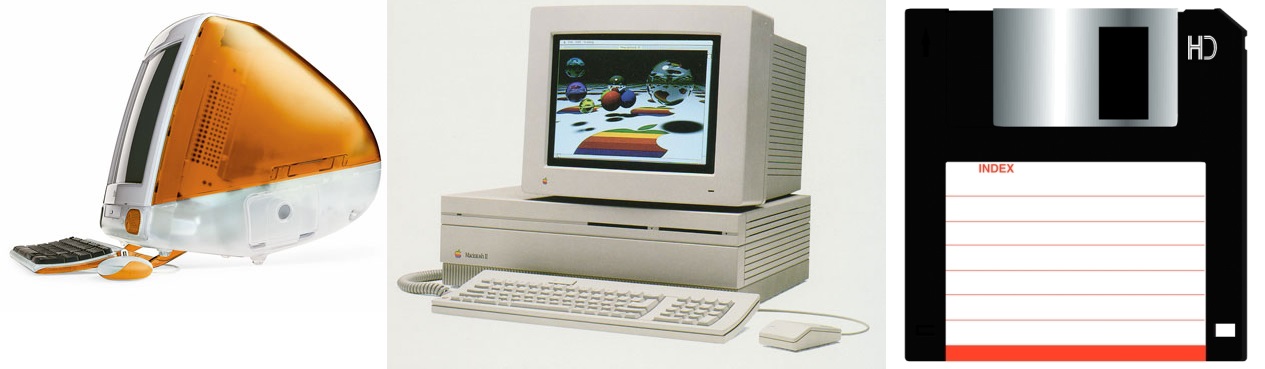
Next on my list of projects-yet-to-be is to convert these items into an interactive front yard art sculpture.
The tangerine iMac will be the head, the Mac II case will be the torso, the 14″ monitor will be the pelvis and the floppy disks will be the scaly skin of the knight in shiny armour jousting at imaginary windmills (or mosquitoes, depending on the season). The keyboards may be arms and the mouseys may be hands — I don’t know yet.
Somewhere in my garage, I have a motion sensor security light that I will use as an activator to entertain passersby who will see the Simple Simon of a body move about when they pass by.
Pair o’ phrases
Used to be, with human spotters, we could predict weather three days in advance.
With our new supercomputers, we can predict weather 72 hours in advance!
Now that’s progress?
Running on fumes, running out of steam, punk?
You know steampunk has entered the mainstream when more than two pages of [Simplicity/McCall’s/Butterick] steampunk costume design patterns are available in a Walmart DIY clothing catalog at the fabrics department.
 treetrunkdings