Schedules — ugggh! However, we are defined by our habits.
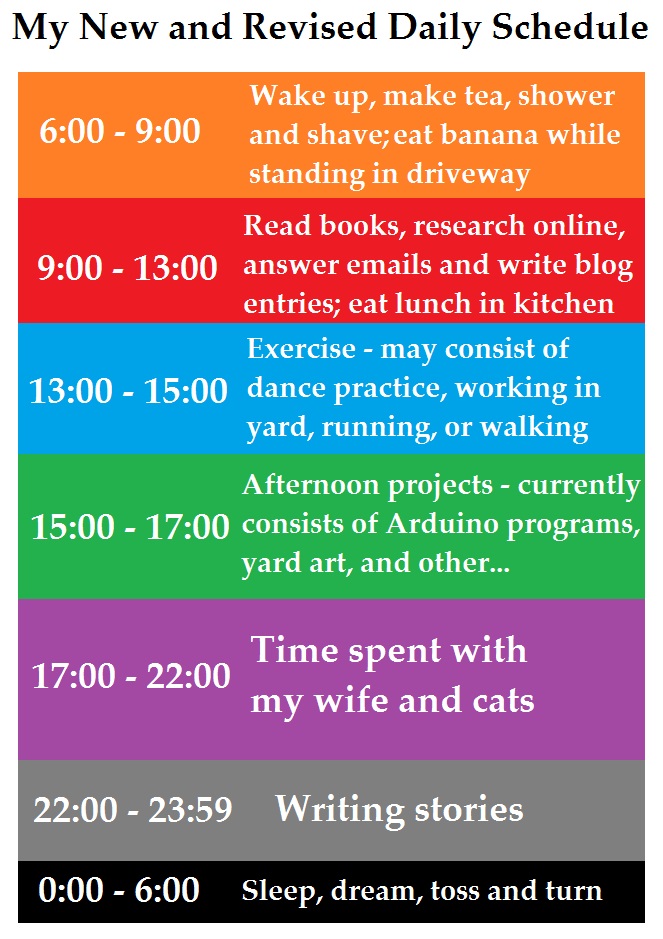
Schedules — ugggh! However, we are defined by our habits.
I write because i exist.
What about you?: http://www.newyorker.com/online/blogs/books/2013/10/t-coraghessan-boyle-apologia.html
“Tom, how are you doing, this fine day?”
“Not bad, Huck. Not bad ‘tall. Haven’t seen you in a cat’s nine lives. Where are you living now?”
“Why do you ask?”
“No reason, reason ‘tall. I’ve been solving mysteries of all-seeing eyes for many years, though, I can tell you.”
“Private inspecturating, are you?”
“Private investigator!”
“Private eye is what you are.”
“And you…what are you going about?”
“Me? Well, haven’t you heard? I’m a politician’s politician. Head of the City Council. They want me to run for governor.”
“Are the you Sean Finnegan what’s holding up headlines?”
“The very same, I am. Yes, indeed.”
“The one with an honest wife and three little ones?”
“So the Good Lord has made it out for me in His own sweet time, yes.”
“Lord a’mighty. Who woulda thunk it, you and I, two successful businessmen.”
“Busy is the word for it, Tom. Do you think our tales are any better with age?”
“Maybe. Maybe not. But they sure pay a lot more per word than they used to, don’t they?”
“Paid…or stolen?” Huck winked at Tom and nudged his shoulder with an outstretched hand. “Would you be interested in joining my campaign. I could use a good man on the team, one who knows his way with the ladies, especially the little old ladies like your aunt. They say I’m a shoo-in if I can nab the elderly vote.”
Tom motioned Huck over to a bench next to the entrance of the corner druggist’s shop.
“Huck, I’m not the man you once knew.”
“Aww, don’t be modest. Your reputation is as good as gold, assuming we can keep a gold standard in this wonderful country of ours.”
Tom dropped his elbows on his knees and lowered his head, his shiny boots reflecting the passing carriages.
“Tom, it’s not like you to be silent. What gives?”
“Huck, have you ever heard of Edgar Allan Poe or Victor Hugo?”
“Of course.”
“Do their stories appear as anything other than a child’s tale?”
“No, of course not. These are troubled men, men in whom the light of God’s love is distorted, good for scaring kids and twisting an old morality tale into troubled plots, but they are not stories meant for good, law-abiding adult citizens. Certainly not a decent voter like you or I!”
Tom wiped the back of his hand across his forehead, wiping off a day’s worth of worry written in sweat and road dust.
“Huck, in my job…well…there’s more than conspiracies in what we see. The rawness, the open wounds, the lies…”
“Tom, Tom, it’s all in a day’s work for an elected official like myself. I completely understand where you’re coming from. Have you been backed into a corner and forced to take a bribe to look the other way before a certain someone in a prominent position will let you loose?”
“That I have, yes, but…”
“Well, there you have it. Nothing to worry about. A job’s a job and you’re the man for it. If you weren’t yourself, I wouldn’t be offering you this job, now, would I?”
Tom pushed himself to his feet. “Huck, what say we find a saloon and talk this out some more?”
“You sayin’ you’re thirsty?”
“Yes.”
“Why didn’t you say so?”
They agreed to meet a few hours later after they both finished business for the day, joining each other at the Red Lion Inn, an old hotel famous for its saloon that sold ‘genuwyne’ moonshine in bottles labeled “Grandma’s Secret Recipe Cough Medicine.”
TO BE CONTINUED…
As if commercially-successful professional scripts are good?:

Our mailbox at the street resembles a small wooden house, a look similar to our main house.
On the “chimney” of the mailbox house grows a small patch of lichen.
Do you like lichen the way I do?
Lichen falls onto our driveway almost everyday, attached to bits of tree — twig, branch, bark — that break away and follows gravity’s path onto the concrete surface.
One species of beard lichen in particular, but not this one.
As our climate gradually warms, lichen is migrating north, bringing symbiotic organisms along.
As with the variety of tree species in our yard, we have a multitude of lichen species.
Same with mushrooms, algae, bacteria, ants and other organisms I won’t encounter together on Mars.
What will migrate with us when we live off-Earth?
What will survive without us and adapt to new environmental conditions?
How many organisms on Earth didn’t originate on our planet?
I owe our next-door neighbours a copy of books on trees and edible wild plants so they can identify which plants not to kill in their yard to protect their curious one-year old child from eating less-than-nutritious green stuff.
I see the Trees book in front of me, under a pile of “French Idioms,” “Russian for Everyday,” “The New College French & English Dictionary,” “Peterson Field Guides to Stars and Planets,” “The Associated Press Stylebook and Libel Manual,” “2004 Far Side Desk Calendar,” and “The Yale Book of Quotations;” on top of “Gödel, Escher, Bach: an Eternal Golden Braid,” “RE/SEARCH #8/9: J.G. Ballard,” “The Complete Cartoons of The New Yorker,” and a spiral-bound copy of my book, “The Mind’s Aye,” not to forget issue #500 of MAD magazine.
Speaking of books, I have a few to finish reading, including “The Big Questions” by Steven Landsburg and a hyperreality book, “Travels in Hyperreality,” by Umberto Eco.
I wonder, which set of beliefs, particularly in the realm of religion, makes one more likely to approve of government/private industry spying? In Christianity, God is always watching, just like Santa Claus, ready to mete out rewards and punishment for our behaviours/thoughts.
Does our general culture encourage us to believe in seeking our fifteen minutes of fame, even if it’s only on a hidden security camera or set of IM chat logs?
Does lichen care about our meme-ridden upper brain functions or our labyrinthine specialty tasks and hobbies that spin out of a growing economy?
Likely not.
That’s why I like lichen — symbiosis that doesn’t require ritual or dogma.
Cultural scientists today argued their proof that silicon-based organisms such as computers are living beings.
I thank my living being for letting me write this blog entry on its plastic key skinned surface.
Enough meditative humour for the day — time to eat lunch and read a couple of books loaned by the public library.
First time reading a romance novel May 30, 2013
My exposure to tales of heroines and damsels in distress comes from Disney movies, my sister telling me about the books she read as a child (“Anna Karenina” and “Nancy Drew” series), and my wife watching books-adapted-to-cinema such as “Sense and Sensibility.”
I suppose in some of the science fiction and fantasy books I’ve read, there were the heroines as damsels in distress, although, for the most part, the women in the stories were just as strong and technically proficient as their male counterparts.
Working my way into the storyline of “How to Pursue a Princess,” learning about a matchmaking duchess intent on pairing a woman in financial straits with a man of financial means, I made it to page 69 of the 383 pages in the paperback edition, having in my thoughts a clear picture of 18th 19th century Scottish upper-class society — to that, I credit the author with painting sufficient pen strokes to describe the countryside, mannerisms, architecture, fashion and food of the times that I need not have worried about how much she researched 18th 19th century Scotland and the accuracy of her portrayal of the times that I might accidentally remember as history I would mention in casual conversation (but the written dialogue made me wonder if Scottish aristocracy spoke with an English accent or with a bit of Scottish brogue [e.g., http://www.youtube.com/watch?v=Khrpy4V0-U4%5D).
Page 69 is as far as I got.
I tried to imagine this story being told on Mars in the 24th century, in 20th century wartime Europe, or in another galaxy far, far away (a la “Star Wars,” substituting Princess Leia for Lily Balfour, for example) to see if I would have read this story in the science fiction or military history genre.
But I could not.
I cannot say whether the author’s writing style influenced my decision to stop reading.
I can say that the plot was not of interest to me — a woman, manipulated by another, having to decide between two men to marry, who would then be expected to support her and her family financially — it’s like having to sit through a marathon viewing of the television reality show “Say Yes to the Dress” with my wife…zzzz…getting sleepy…think I’ll go outside, trim the hedges and earn my mancard points for the day.
= = = = =
[Disclosure: Karen Hawkins was in the same high school together with me. We were not close friends but were acquainted with each other so this review is biased even if I want to pretend it wouldn’t be.]
Karen, I wish you continued success in your writing career. My wife has asked to read this book and provide her own review from an unbiased woman’s viewpoint. I’ll then pass it on to my mother, who enjoys romance novels, and get her opinion for you.
Objects from an epigrammatic life:


 treetrunkdings