
Return to ROI

Something, some thought, some idea, in the back/top/middle of my head is itching.

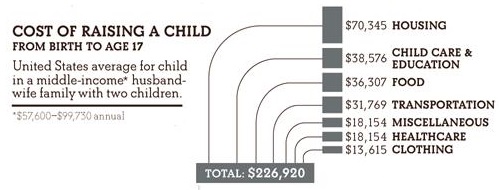
I look at old stats such as this:
I wonder about the average cost of postsecondary education for a college student in the U.S.:

Figure 40-1: Total cost of attending an undergraduate institution for first-time, full-time students receiving aid, by level and control of institution and living arrangement: Academic year 2010-11

Figure 40-1: Total cost of attending an undergraduate institution for first-time, full-time students receiving aid, by level and control of institution and living arrangement: Academic year 2010-11

I examine tables such as this one:

Figure 29-1: Percentage of youth ages 16-24 who were neither enrolled in school nor working, by sex: Selected years, 1990-2011

Figure 29-1: Percentage of youth ages 16-24 who were neither enrolled in school nor working, by sex: Selected years, 1990-2011

Finally, I ask myself, what, based on the salaries of youth who reached adulthood, was my ROI (return on investment) of these kids?:

Figure 49-2: Median annual earnings of full-time, full-year wage and salary workers ages 25-34, by educational attainment and sex: 2010

Figure 49-2: Median annual earnings of full-time, full-year wage and salary workers ages 25-34, by educational attainment and sex: 2010

And that’s just the U.S. domestic market.

I’m thinking about this one…~$227k to raise a middle-class kid.  Looking at salary figures above, the kid has to work for quite a few number of years to pay back the investment in his upbringing.

Where is the line where ROI is achieved?

Meanwhile, those shrinking middle-class kids are having kids and using public resources, contributing some small amount toward supporting public employee pension funds, Medicare, Medicaid, Social Security, etc., that they hope to receive themselves one day, even if they don’t believe the benefits will be available when they reach their senior citizen years.

In other words, our investment in the average citizen continues throughout that citizen’s life, well after ROI on childhood is achieved.

But there’s something else here in and out of this data set that still itches, has itched and continues to itch every time the subject passes through my thought set.

More than social responsibility.

More than cultural expectations.

More than formative years brainwashing.

More than standard/quality of living.

I see the costs, I see the benefits of straightline ROI, but the je ne sais quoi…???

What about the noneconomic value of a person?  Where are we accounting for the individual person’s thoughts, dreams, wants, needs, etc.?

One thousand years from now, we hold a history class and talk about the concept of worship through the rise and fall of civilisations.

During the first few thousand years of our species’ history, we slowly replaced the worship of unseen deities with the worship of money, as simply demonstrated through the construction and sole function of edifices found during archaeological digs.

It took a hard turn from deity-to-money history for us to change what we worship 1000 years later.

But we’ll save that lesson for another blog entry.

Thanks to Meagan at Tenders; Joe and Jennifer at KCDC.
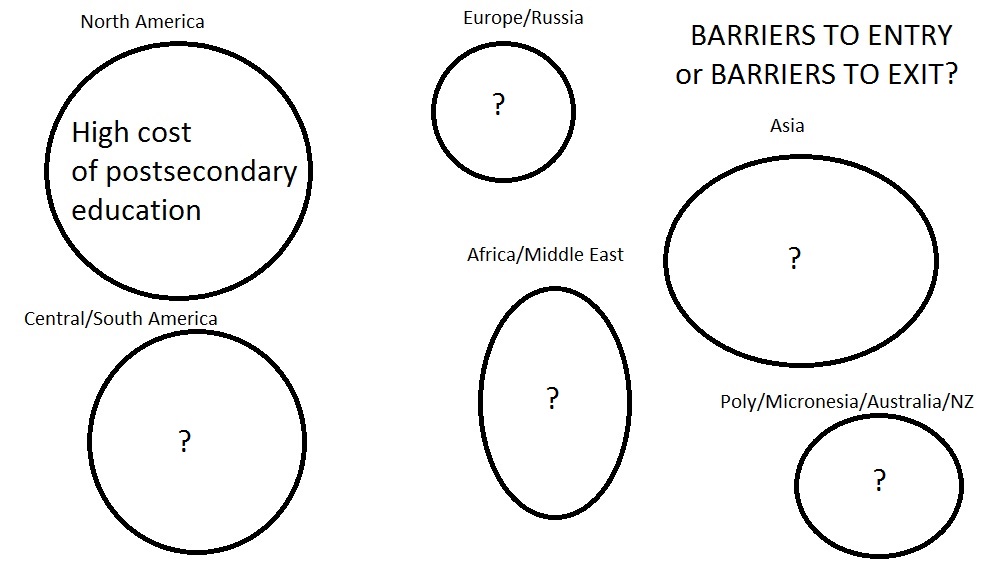
When all ages/genders work…

So, now that all genders, all ages, all nationalities, etc., are eligible for employment, we have an abundance of people not working in formal contribution to a money-based economy…

What to do…hmm…

Women, children, elderly added to what once was a 16-to-65 year old male-dominated workforce not so long ago.

How do we challenge all seven billion of us to find meaningful work under these conditions?

More points to [re]ponder

  • Technology disrupts former profit models, closing businesses and increasing unemployment, but provides no equal replacements for jobs/profitability
  • Technology creates high-stimulus, addictive leisure activities that are easily available (cheap, abundant, etc.), making instantly-gratifying tasks like searching the Internet and gaming more appealing than delayed-gratification tasks like studying for high-skill jobs
  • Technology creates demand for high-skill jobs but large workforce not interested/motivated for high-skill job training
  • Local skill gap in job requirements for businesses seeking expansion, as well as national governmental barriers to entry/competition for eligible, highly-skilled, internationally-mobile workforce, contributes to regional high unemployment

When do local people, en masse, say “no more!” to higher education and highly-technical skill sets, creating viable subcultures that revert back to lower skill needs?  How do they remain competitive enough to be profitable and stay in business as owners/employees?

Does a technology-based socioeconomic system, in general, have a fixed lifespan like a classic technology lifecycle?

Yes, these are repetitive thoughts but ones I want to grasp onto for myself and understand their implications for the future in this parallel universe of a blog.

Either we admit that our model of nations is out-of-sync and possibly obsolete or we open up the floodgates and let subcultures compete against each other at full blast, with subcultures, like species and languages, going extinct at a faster rate than before.

If the latter, will your subculture withstand the onslaught?

Would…

Would Congress let the U.S. economy go back into recession by not negotiating a bipartisan deal on pending tax increases if Obama is re-elected but would negotiate a bipartisan deal if Romney is elected?

That seems to be what this CEO implies as a major warning to eligible/potential/likely U.S. voters.

More for me to think about the rest of this day.

Time to read a book and get away from the computer.

An Apology

We want to apologise to you Earthians.

A friend of ours who used to work in the roadside gem mining tourism business in western North Carolina — where “seeding” buckets with gems is common practice — was responsible for cleaning the scoop on the Mars rover, Curiosity, before it left your planet for the planet of war.

As a practical joke, he “seeded” the scoop on the rover so that when the rover processed the Martian soil, the seeded material would give a hilarious test result for scientists to ponder.

Or so we believe he first said.

Since then, he has retracted his original statement and is seeking psychiatric help in order to avoid jail time which would have been administered by the Inner Solar System Scientific Crime Council in a summary judgement.

We are evaluating other test equipment on board the rover, wondering if the purple haze we see in some images is a result of him covering camera lenses with rubies, sapphires and other gems he collected during his youth.

The Apple computer corporation is cooperating in this investigation.

The U.S. State Department has denied providing consultation to the worker on the ability to backtrack from one’s initial statements and expect to be believed ever again.

More as it develops…

Do Nice Guys, Who Finish, Last?

The countdown shows 13,722 days to go.

I had promised myself not to care, to let my minions, given assignments in 1000-day increments, carry out their tasks, coordinate with each other and find a way to make the dream come true, with or without me.

I keep my head in the game, watching what they do, quietly making suggestions without seeming to insert myself into their conscious thought process.

I visit local establishments, saying thanks to people like Mathew at North Alabama Computer Associates, James at Radio Shack, Ricky at Chili’s, Honey at Best Buy Mobile, John Carroll at Walmart, Dominique at Beauregard’s, Caitlin at Carson’s Grille, and Mock Electronics.

What I find, when I order online, is the absence of connecting with people face-to-face.

Even so, I set up a chatbot to answer the phone for me and talk with “Rachel from Card Services” that (who?) is not related to another robocaller which (who?) says, “Do not hang up the phone!”

My chatbot switches languages word-by-word and phrase-by-phrase to test the intelligence of the chatbot on the other end of the line.

You didn’t know there was a silent chatbot war going on, did you?

You just thought you were receiving annoying calls from telephone solicitors, didn’t you?

Well, it’s like that.

See, I’m a nice guy.  I go with the flow most of the time.

However, and there’s always a however (or ‘owever (or “but…”)), years of refining the exteriour personality, being a nice, easygoing guy, letting my wife blame me for a variety of issues that are of marginal importance to me, but sufficient for me to keep track (dancing skills, yardwork, house repair, etc. — see the comic strip “Dagwood” for further examples), appearances are deceiving.

I’m not always a nice guy.  I can be, am, deceptive, downright mean, ornery, angry.

My job is to slowly replace members of our species with robots, androids, chatbots, cyborgs, etc., to maximise the efficiency of the system that will allow me to achieve the major milestone I only appear to not be reaching 13,722 days from now.

Some of my minions are self-aware enough to realise what they’re being asked to do, make themselves expendable, no sequels in their future.

The rest of you?  I don’t know.  You tell me.

I can put you to work creating new organisms that will establish beachheads on other planetoids, if you wish.

Or, to satisfy some members of the Committee, I can set the chess game of a war in motion, eliminating hundreds of millions of you, causing a setback in my timetable.

I prefer the former — it preserves the option of wars on other planets for our offspring to spring on each other.

While we’re on the subject, are you one of those who, when competing against one another, call each other schoolyard names that are unacceptable in polite company?  I watch Australians make mountains out of molehills with such a scenario and wonder what else we primates are capable of when competing for the highest social positions in the land…

Time for the next set of actions to stir the pot of the national political election season!

But how do we give part-time workers a sustainable/living wage?

Are workweek expectations raising unemployment? What in this proposed model is missing?

How do capitalist/communist/socialist systems achieve full[er] employment?

Where are hundreds of millions of un/underemployed going to find/define high/normal quality/standard of living?

What of a whole generation now entering their workforce years? How does this compare to previous generations of displaced/unused youth?

What if part of what we’re seeing is nations cutting back their debt load/rate/share in foreign hands in order to lower their interdependence?

What are the longterm consequences of both?

Why should I care when populating other celestial bodies is my primary goal?

An Uncharted Desert Isle!

“Both sides of the political isle (should) signal that they are willing to compromise and that they’re willing to get this done … that could help lower the level of uncertainty that is affecting U.S. investors and consumers,” IMF First Deputy Managing Director David Lipton told Reuters in an interview on Monday.