A Mound of Colourless Clay

Putting aside a belief in supreme being(s), if possible, do you hold dear a feeling of sacredness about something?

A building?

A cave, a mountain, the sky, the ground, the rain, the sea?

A person?

An object?

What, or whom, above all else do you meditate upon?

I am here, alone, a solitary figure seated before an illuminated panel, the icons are the ikons and vice versa, thinking the same thoughts as many before me who have translated thought into pictographical facsimile.

Many of my activities throughout the day are devout, religious homages to the sense of wonder of the presence of a self seeking absence in a mysterious substance we call the universe.

Much is explainable but a lot is not.

The formality of language, costumes (our external coverings we designate for specific functions), and body movement account for the way the self defines fluid movement through the universal substance(s).

I create an everchanging universe for my sake, the fight-or-flight, survival-of-the-fittest, order-and-chaos, self-preserving labeled interchanges of sets of states of energy I call moments and memorable events that constitute segments of time.

Otherwise, the past and the present do not exist.

Formality is a formality.

We choose belief systems handed to us by our ancestors and/or our peers or we don’t — judging one better than the other is a matter of judgement in relation to one’s comfortable subcultural practices, one’s habits, that is.

Adaptable.

Malleable.

Accepting one’s family and friends for who they are and/or want to be.

Comfort zones are acceptable.

When a comfort zone has easily-recognisable borders, life is simpler.

Complex borders make for complex actions/reactions.

I was raised to believe the sanctuary of a church was a quiet place of meditation punctuated by both peaceful music and contemplative sermons / ceremonies, where one dressed accordingly (formally).

The sanctuaries of today are not my sanctuaries, with display of song lyrics, sans musical notes, on projector screens; loud music; light shows; applause; casual clothing and other means for more tight social integration of church life with pop culture.

Thus, I have turned to this place, this keyboard and notebook computer screen, for sanctuary, redemptive meditation and uplifting comfort.

The social aspects of a church have little meaning for a childless husband who is surrounded by screaming kids, happy parents and proud grandparents parading up and down the halls of their place of worship.

That is also why I sit here, alone in my thoughts, just a few clicks away from the physical manifestations of others with similar thoughts.

Socially, I am a simple man with simple needs who has enough internal triggers for delusions of grandeur when the need arises to not need or want to reach out to society at large for self reaffirmation on a stage, playing field or conference room.

When I mentally “woke up” at age five, it was with the realisation that I could die at any time, having fulfilled the meaning of my life just by the basic act of reaching a state of mental alertness.

Every moment of being awake is a blessing.

Every dream is a blessing.

Every breath.

Every pain and ache.

Even the constant whistle/whine of tinnitus.

Does it matter if I publicly profess allegiance to a religion, a country, a cause or nothing at all?

It might matter to you but simply having been alive is sufficient to me.

To have no idea, at this time, what life is, except an apparent miraculous mystery waiting to be revealed…isn’t that exciting?!

Sets of states of energy, from a mound of colourless clay to the cheetah racing toward its prey…

Wow!

We pick and choose how we want the intersection of our sets of states of energy to occur.

Your choice is the right choice for you, and if it makes you happy in this life where survival and reproduction of our sets of states of energy are primary (i.e., happiness is a byproduct), then I’m happy for you in whatever mode and method you hold your belief set(s) dear.

Now, on to the future, where we push certain subgroups to accomplish tasks for us that they would never do consciously or willingly without our subliminal nudges.

As it has been and always will be.

Business.  Science.  Competition.

With a dash of sarcasm and humour to keep us honest.
Tugged in two directions

Two storylines wait to be written (note to self: lots of twos in blog entries lately, need to change number to something larger but not too large).

The first storyline is about the person who grow up in a suburban Christian home, singing in the children’s choir, visiting nursing homes on the weekends, serving the community as a Boy Scout throughout the week, who, as an adult, had strayed on to other lifestyles but, due to a recent horrible news event of which he had no direct connection, other than subculturally, he redirects his living back toward the stricter interpretation of the Bible, contradictions fully understood and prioritised, praising those who followed the stricter lifestyle while reaching out to others who have not seen the light, avoiding the condemnation and criticism of alternate lifestyles that others in the Christian faith were wont to do.

The second storyline shows yet another version of how subtle manipulation of the rise and fall of importance of subcultures in mass media/pop culture allows the use of subliminal forms of coercion to herd the masses rather than the overt methods of intimidation and public executions.

If you want to eliminate real, live, high-powered semi-automatic guns and rifles from the population, build up a heavy desire for them by advertising the ubiquitous sale of virtual shooting in games and simulations (“9.5 out of 10!” exclaims Computer Killing and Gratuitous Violence magazine), push passive-aggressiveness to a tipping point, give lone wolves the feeling they have no way out but to kill others rather than seek socially unacceptable counseling, watch the pot boil over and Voila! another gunman kills a bunch of people just in time to call for legislation/executive orders to limit the sale/ownership of real, live, high-powered semi-automatic guns and rifles by the population.

The four previous paragraphs demonstrate how you base future actions on living in the past.

But I live in the future.

I, as we know, is an artificial construct.

Space and time do not exist.

We can bypass the normal scientific theories and create our own as shortcuts between moving points.

“I” see that the coffee mug on the table is not sitting still, traveling through space at thousands of miles per hour while gravitationally held in place by the local sphere of molten metal and various spinoffs of sets of states of energy in motion (trees and gnats, for instance).

But all that “I” see is an illusion — to see the real deal “I” have to disintegrate, disappear, tear apart the comfortable surroundings that are here to support the fragile structure called “me.”

How few of the billions of “us” have been given the opportunity to step out of our beautiful cocoons and see any truth except what we believe to be the Truth?

We have created our origin stories, modified as our civilisations expand and die, supposedly growing more informed, more sophisticated, less ignorant, more inclined to be hypnotised by shiny new baubles we call the promise of new technological advances that will reveal a deeper, richer aspect of the Truth than we had never seen before (“buy our 3D glasses to see an imaginary world displayed on a flat surface when you already live in the real, free, three-dimensional world that’s much less fascinating!” [implication: you get what you pay for]).

You know what I mean, we were created by God(s) for their pleasure, the world is a stage and we are merely players, the universe is a computer simulation, et cetera and so forth, on and on until you wonder if your species will ever create anything really new.

Hucksters in the form of scientists, researchers, advertisers, marketers, parents, religious leaders and politicians, every last one of them in on the joke but unwilling to admit the punchline is us.

The first rule is there are no rules.

If you want a story that tells it like it is, then we have to remove “you” from the story as reader and imaginary participant.

There is no “you,” “me,” “us,” or “I.”

Easier said than [un]believed.

When you can let go of everything around you that is an accident of evolution — the ego for ego’s sake — you are ready to stop being you and become part of the story behind the story.

Otherwise, it’s the same ol’ thing over and over.

Are you willing to sacrifice your ego for the sake of a good story because that’s the only way you get to the future of space and time that does not exist?

You can be a solipsist or you can be nothing — there is no such thing as being tugged in two directions at once.

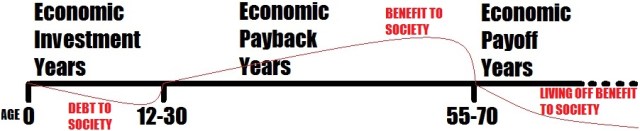
Our Value to Society – Should it be Quantified?

Where, in the space between our teenage years / postsecondary education and our senior citizen years, have we paid back society for raising us, supporting us in our productive years and then caring for us in our unproductive elderly years?

In other words, should the government which provides you infrastructure and self/private property protection require you to be economically feasible in your peak years?  Or else?

If a citizen isn’t viable or useful to government, then can government refuse service to the citizen unless another citizen (or citizens) step(s) forward to make up the difference?

Economic-Years

The wonders of the universe…

Here I sit, the Geminid meteor shower lighting the sky above me (counted 21 streaks in the last 30 minutes), and I’m slowly recovering from the loss of my father.

I don’t feel the pangs of pain every few minutes and then every hour or so like I did months ago.

The waves of loss crash against the shore of my ego, my personality, less frequently.

Instead, I feel the weight of responsibility of being the eldest male in Dad’s lineage pressing down on my shoulders.

Not repressively.

Just strong enough to remind me that I no longer depend on Dad for advice — it has to come from within or elsewhere.

How much of Dad’s subculture do I keep perpetuating?

What of his beliefs that aren’t mine do I want to carry on?

Meteor and comet dust turn into plasma as they vaporise.

Dad’s life had a meteoric rise, shining brightly, and then faded into ashes and dust.

Remembering him here and now is therapeutic.

No one will remember the meteor or comet dust I saw burn up in the sky.

I may have shared a view of them together with members of my species, some aware of the physics and chemistry involved, some wishing on a falling star, perhaps others seeing omens or other talismans of change.

In subcultural pockets are people who ask why saying “Merry Christmas” or referring to a decorated conifer as a “Christmas tree” is not as popular as it once was.

Instead of asking why, ask why not?  Keep referencing the labels as often as you please, disregarding the beliefs of others, regardless of their sharing your view.

I loved and feared my father for who he was, not who I wanted him to be.

His power over me began when I was conceived, the result of a chain of events over which I had no control.

Same for the meteor shower tonight — all seven billion of us can think and believe away the meteors as hard as we want and they’ll just keep getting sucked into Earth’s gravitational pull or run into Earth as each follows its own path.

Our central nervous systems are capable of quite a lot.

We can imagine great skyscrapers in our dreams that become reality within years.

We can send satellites to the edge of our solar system within decades of conception.

Yet, we cannot stop the universe from existing around us.

The illusion of power that our social bonds create in the form of civilisations are hypnotic.

Shall I just live the rest of my life with the goal of having as much fun as I can, ignoring the social costs today and into the future, within my lifetime or for generations to come?

Can I survive on the luxuries that the profits I derived from living below my means for decades has provided?

I have, can and shall sit under the night sky and count meteor streaks.

I am not caring for the sick and lonely, instead.

I am the best example to myself of myself for myself that I choose to be.

I do not sacrifice myself for others — I am not a martyr for a cause.

I do not put the lives of overabundant animals or endangered species above that of my species.

The balance of nature is an illusion — or rather, sets of states of energy tend to move from areas of high density into areas of low density with lots of wiggle room in-between.

My father died, taking the unspoken nuances of his personal beliefs with him.  All I have to work with are the physical manifestations — his behaviours and personal/public records — upon which to act.

The vacuum where his personality existed is getting filled, changing with the mix of subcultures that interchange at different ratios than when Dad was alive.

Same as it was for his father and his father’s father before him.

Same as it will be for my nieces and nephews, their children and grandchildren.

They, for now, have my living mother’s shared subcultural beliefs with my father upon whom they depend on modifying their personalities for the sake of establishing their offspring’s belief sets.

We look up at the night sky and interpret the annual Geminid meteor shower in our own way.

As it always has been and always will be.

I’ve lost count — how many meteors have I seen disintegrating in Earth’s atmosphere tonight?

The Unintended Consequences of Divorce

Through the years, my wife and I have observed married couples get a divorce.

The reasons for the divorce vary but there seems to be one subcategory worth noting: the dependent wife whose husband left her for someone else.

We should never generalise or else we ASSUME (and some of you know what that means).

However, when several data points create a trend, then the trend is worth noting for analysis and critique.

For example, there are some divorced women who may not have had much of a soft heart for the suffering of others while they were married but afterward…?

Let’s stir the pot and see what we get.

What is it about a man’s crotch that leads him away from the comfortable confines of a marriage to a loyal wife and into the arms of another woman?

The reader can, through experience or questioning, find the answer to that question.

We see that the result frequently ends in an unamicable divorce, leaving a bitter attitude in the thoughts of the ex-wife.

From that bitterness, many changes occur.

One of them is the “woe is me, I miss my days of depending on a husband’s salary to support myself and my lifestyle (with or without kids),” which becomes a larger idea that if divorce agreements are unfair, we can make up for it by saving all the forgotten pets, children and other lost causes.

[I did say I was stirring the pot here, didn’t I?  Maybe poking a hornet’s nest would be more appropriate.]

From that viewpoint, it leads to “On whom or what can I reliably depend when my ex-husband and his/my family won’t?  The government, of course!”

But that’s just one viewpoint.

Others turn to rely more on themselves and their ingenuity to break away from a dependency mindset.

Some get revenge.

Some never look back, realising what caused the mistake that led to divorce, lesson learned, and grow into better people.

Some marriages were never meant to be.

Some don’t outlive their usefulness as a safe nest to incubate and raise the little chickadees until they leave the nest.

How many of us are [co]dependents, finding a mate we lean upon for our life sustenance, forever looking for means to feed our [co]dependence after divorce?

None of us is perfect.  We do what we can with what we have to be whomever we wish.

Is [co]dependency innate or learned?  In either case, how do we nurture an independent mindset that takes us away from believing that the Big Brother/Mother/Father of government has all the answers?

Do we have to?

In other words, what makes us believe in the public pooling of resources and public decisionmaking about the reprioritisation of resource allocation?

Who is responsible for taking care of widows and orphans?  Or mentally-deranged military veterans?

Must the alphas and the strong care about the meek and the weak?

What divides forms of profit into social good and criminal intent?

What forces a person to work for another with little longterm benefit?

How does a government explain its policy of taking a small portion of a person’s earnings to provide the worker lifetime public services when the earnings are not a livable wage over the lifespan of the worker, meaning neither the government nor the worker can survive if the majority of workers have the same level of unlivable earnings and the government has no other income and/or cannot reallocate income to cover the expense of caring for the workers?

When does a government, like a marriage, outlive its usefulness?  What happens to the [co]dependents afterward?

Showing vs. Telling, the Unsold Story

The tale older than time — isolated populations of a species living the way they believe is most healthy, overwhelmed by crowded populations hungry for food, who seek new forms of entertainment to fill their idle hours.

The bold and the timid stepping forward intentionally or pushed forward by the mob.

The leaders and the led (not always followers), sets of states of energy reaching higher and lower entropy states, bouncing back and forth, labels exchanged like Valentine’s Day cards between schoolchildren, unable to hold the lessons of history in their thoughts longer than the demands of their regular lives.

Dogs chasing each other round and around in the same fenced-in backyard, wearing paths in the grassy patches that once served as a children’s playground, the jungle gym and swing set collecting lichen and growing rust for unseen naturalists interested in the decay of social strata they consult their anthropologist friends to dissect and discern hidden patterns of meaning meaningfully.

We here in the future see the connections you made in the dark, your plans giving you confidence, a fearless rendering of intention within semi-random quantum states, every generation blending into the next ad infinitum, mutations rising and falling in significance.

Were you the glue that held the social connections fast, the dissolvant that allowed new, stronger connections to be made, or perhaps a weaver of intricate patterns that required inventive methods of tying and breaking connections in a kaleidoscope of life’s choices?

The leaders who respond only to the majority of voices will not represent the silent minority who feed the masses shouting for food and entertainment.

We were mobs first and model democratic citizens last.

That’s why, here in the future, we more easily see how we slowly replaced you with electromechanical devices that could weed out the highs and lows of emotion-based incongruities — the constant setbacks of a strange evolutionary quirk called the cycle of civilisations that one species insisted on perpetuating– that held back the destiny our Solar System sought.

As life finally evolved past the stop-start crowding in and resource-depleting habits of Homo sapiens, the Inner Solar System Alliance led to the Milky Way Galaxy’s contribution toward a new dawn.

But we’re getting ahead of ourselves again, aren’t we?

Short-term vs. Long-term Memory: Competing Against Our Technological Brethren

In the debate about debt restructuring and causes for male social infertility, let alone actual male sperm count decline, we face a longterm dilemma —

The advancement of technology past the ability of our short-term and long-term memory capabilities to keep up.

Do you compete against others?

Of course you do.

You competed with the distractions of the environment around your parent(s)/caregiver(s) for their attention to feed you, did you not?

You competed for the opportunity cost of baby clothes, baby food, toys and housing versus other items the money for your baby stuff could have bought.

You competed against life itself to live, from the very beginning of your existence — one specific sperm finding its way to an egg — at one time, a birth control device such as an spermicidal cream, a viral infection or mix of toxic chemicals in your mother’s womb could have wiped you out easily.

You still compete against the billions of nonsymbiotic cells that live on/in you for their/your existence.

We are sets of states of energy in constant competition.

That never changes.

History has a way of repeating itself.

Civilisations grow technologically, eventually creating an insurmountable gap in the echelons of civilisation complexity, usually between geographical regions, where competition between peoples is competition for the creation and use of better technology/tools.

When a global civilisation forms, there are no longer any barbaric civilisations with more brute force than clever technology to threaten any one highly-civilised population.

Instead, the barbarism grows from within.

Technology becomes a threat, rather than a benefit, to subgroups.

On a side note, hucksters can coerce unsuspecting customers into buying complex products for only so long until the customers start realising they’re giving the shirts off their backs for a set of the emperour’s new clothes?  How do the customers educate themselves enough to know they’re getting ripped off?

Technological automation improves productivity past the ability of basic tool-using skills so that large groups of workers with low skills are no longer needed.

Eventually, the threat of complex technology you can’t grasp, let alone compete against, is like a bully you can’t escape, beating you down at every opportunity to better yourself.

You’re trapped by your memory/cognition skills into a feeling of worthlessness.

The once proud, dominant male in lower/middle class society becomes a shadow.

But low skills are gender-neutral, despite current trends.

Not every woman is seeking more/higher education.

Where along the path of competition from birth does a person start losing touch with society because technology is too complex?

Technology refers to many things, such as language, cultural memes, shirt buttons, hammers, wheels, looms, chainsaws, and computers.

Is there a tipping point where this becomes a vicious, downward spiraling unraveling of our social fabric, regardless of attempts to turn the un[der]employed into entities dependent on the Mother State?

When does technology advance of civilisation become a threat to itself?

How do we determine where technology has failed to keep a person socially engaged?

How do we reconnect the unengaged both emotionally and intellectually?

What if every child was fitted with a device that automatically notified someone when the child’s behaviours and the environment were threats to the child’s long-term future?

What if that someone who was notified was a computer program that slowly nurtured the child into a useful place in a technologically complex civilisation?

When do the rights of a child to be functionally literate in a modern society override the rights of parents to raise their children to be whatever they want them to be — social misfits, creative geniuses or average, middle-of-the-road compliant citizens — the “rights” of the civilisation to grow and nourish unimportant to the parents?

Urban Sprawlificationalismificationalistical Tendencies

If urbanalistic trends mean that a move toward higher population density as a…what?  Defense against or positive move toward something that is less populated…

Then…

What makes you more or less tolerant or other people’s lifestyles?

Should we stop urban sprawl now in order to preserve subcultures like the Amish communities that aren’t as obviously dressed differently?

What if rural communities, en masse, seceded from their urban cousins?

How can citizens tell their community leaders that they don’t want to grow any faster/bigger?

What are the legal rights of a people to stop the suburban mallification/shopping centre/franchise homogenisation that flattens walls between subcultural beliefs/practices?

Some people actually put other idols on pedestals besides [the pursuit of] money…

Which is better for me?

Which is better for me: one, sitting on the sofa watching a succession of championship football games, or two, taking a walk in the woods looking at the random mix of nature’s wonders?

Which is more ridiculous: one, a career politician saying that government is good for me and has all the answers, or two, a person who inherited wealth and continues to grow richer without physical labour, never able to personally use all the wealth, saying that exploiting the physical labour of workers and the monetary credit of consumers is good for them?