Countdown to infinity by halves

Dr. G. Brottel bent his knees and leaned back.

Neill, his dance instructor nodded.  “Yes, young man.  That’s exactly how you do it — chin up, look past your partner’s right ear and slightly point your right shoulder to hers, your hips straight.”

Galdous followed the instructions, just as he had followed instructions during his years at university, culminating in his dissertation, “Applying The Lamaze Method Aboard An L5 Society Geostationary Observation Station Boosted To An Earth-Moon Lagrange Point.”

This, of course, fed his interest in leading his partner, Yui, around the dance floor.

Mimicry circuitry in his central nervous system sped up his learning.

At night, he and Yui watched each other watch a 3D video which enhanced their sympathy learning of the moves in a weightless acrobatic encounter combining waltz, tango, Lindy hop, Balboa and East/West Coast swing.

By the end of their work shift the next day, their supplemental brain systems had worked out the coordinated muscle movements needed for smooth swaying on the spherical dance surface.

Yui, assigned to him and he assigned to her at birth, along with several alternative matches based on known genetic symmetry, melted into his arms as they spun “in the air” while holding the formal dance frames required for interplanetary competitions they planned to win.

Having grown up in adjoining educational centres but, not allowed to constantly interact like siblings, which tended to discourage the compatibility of their genetic material for later replication needs of the space colony, they had just enough similar phys-ed workout routines that meant they could anticipate each other’s moves without thinking.

Guinevere, a theoretical science university student and specialty dance instructor from Moon Base Amber Road, made mental notes about Galdous and Yui’s trajectories.

Her mental notes were sent to a supercomputer which adjusted the subroutines that would generate the next dance video for Galdous and Yui to watch that evening.

Guinevere, working on her PhD, the dissertation preliminarily titled, “Recalibrating Rocket Propulsion Guidance Systems Using Realtime Algorithm Remodeling of Neural Network Flow Diagrams,” general enough to give her flexibility with her university sponsor, had found that teaching others the dance steps she had learned during physical rehab not only helped her repair skeletomuscular damage from a bad spaceship smashup but also reinforced the pathways of her upgraded organic wireless circuitry.

In other words, practice what you preach, do what you say and say what you do, be a do bee, and go with the flow, as her therapist liked to say in mock repetition.

Guinevere held out her arms and Neill kicked off the floor toward her.

“Here’s what I mean, Galdous.”  Neill cupped his palm and placed it in the small of Guinevere’s back.  “Lift your left arm and gently push Yui forward.  Yui, bend your knees to your chest, balling yourself up, and spin around Galdous’ waist.”

As Guinevere spun around Neill’s waist, she remembered a mistake in her recent classroom experiment calculations, which meant that the student satellite they had launched yesterday was going to miss its target.

She closed her eyes and focused on correcting her mistake.

If she could work out the logic in the next few seconds, she just had time to send the new algorithm to the Moon for automatic coding, then routed to the satellite for reprogramming.

Later, while Galdous and Yui watched their evening dance instruction video, a student satellite performed a series of maneuvers in space that oddly resembled the steps in the instructional video.

Only Guinevere knew what was going on, silently laughing to herself as she explained to her fellow students recording the satellite’s path that she had invented a new method of optimising a satellite’s stress test by putting strong centripetal forces into effect that pushed the physical limits of the satellite, including triaxial shear test methods employing all six degrees of freedom at once.

Lee Colline managed the lives of everyone on the space station.

He paid attention to all communication between the station and bases throughout the solar system.  A pattern matching program alerted him to the accidental conjoining of Guinevere’s dance instructions and satellite reprogramming.

Lee ordered a review of future upgrades to all persons working and/or living on the station.

Although Guinevere’s “accident” had caused no harm and, in fact, may have led to a new discovery, he had to make sure that the next accident didn’t adversely affect the station.

The immediate application of basic science to practical living had long bothered Lee, who thought that some amount of peer review should separate the two after the Great Cataclysm had demonstrated the fallacy of shortterm economic subsystem profits over the longterm needs of the whole ecosystem.

Who, though, understood that socioeconomic systems rarely used peer review as a safety measure the way that scientists had long agreed peer review was necessary for protection against false claims and inaccurate conclusions?

He mentally wrote an emergency measure that would be reviewed by the Committee for implementation across the Solar System Space Station Network: “All student experiments must align their policies with the Post-Great Cataclysm Procedures for Protection Against Instant Gratification.”
Regardless…

Disregard, irregardless, regardless, doesn’t matter.

The use of symbols today seems pointless.

The future puts pressure on this moment.

The future?

Imagined plans, developed schedules, partial goals completed.

A cat warms by the electrically-heated oil radiator, a cat which suffers a vestibular disorder and wobbles like a kid stepping off a merry-go-round.

Funny, how events align — the start of a cat’s dizziness, the dizzying effects of a hurricane — one affecting me more than the other but both having economic impact.

13,701 days to go.  Time to write another story within the story of our lives…

Costumfoolery

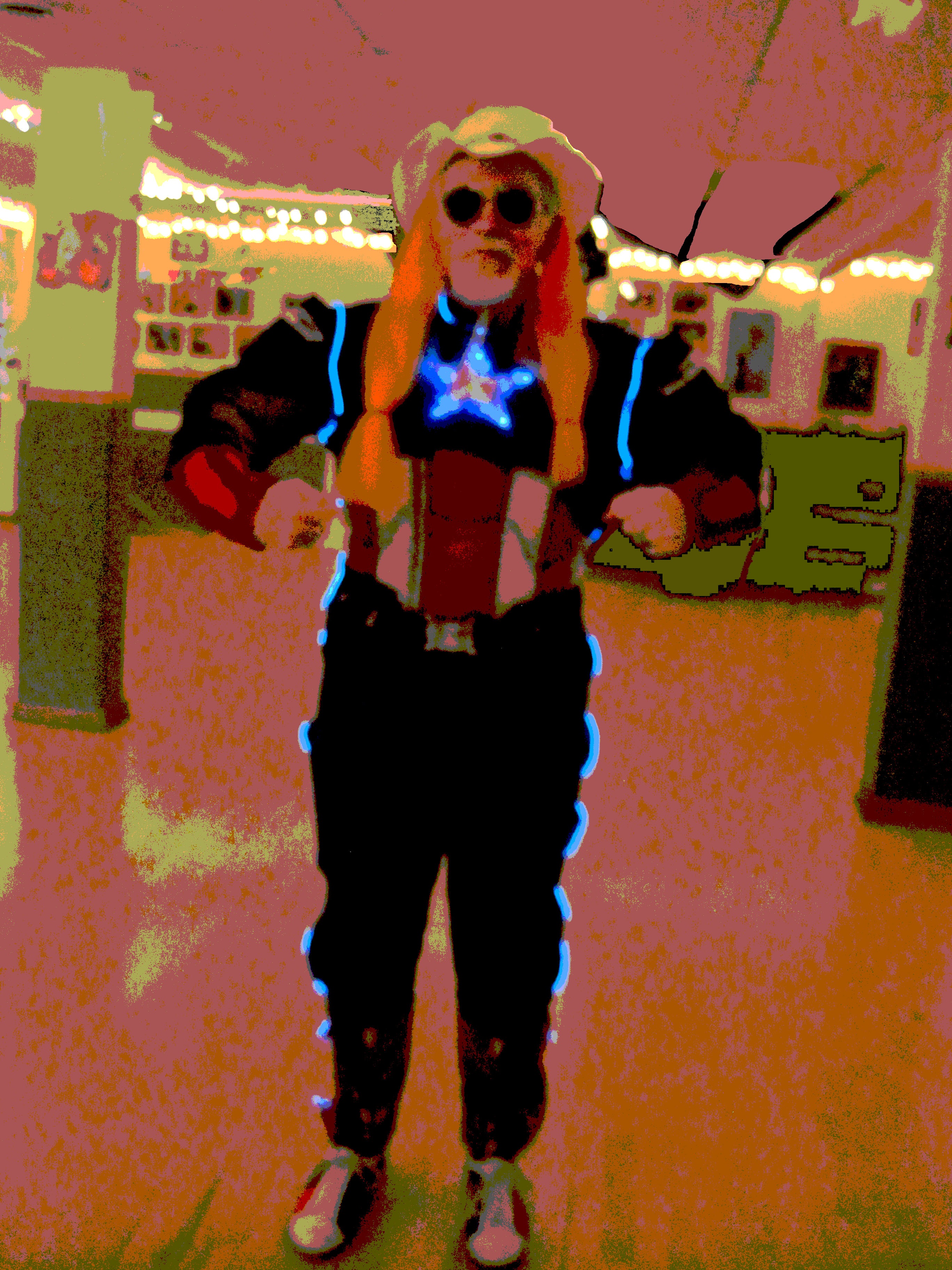
When his prime crimefighting days are behind him, what will Cap’n America do for fun?

Tonight’s costume tells the story.

Thanks to Joe, Jenn and Catherine for hosting tonight’s costume dance party at KCDC.

I dressed as if Captain America had joined a professional wrestling team in the guise of “Willie Nelson meets ’Macho Man’ Randy Savage”, using EL wire and LEDs for light effects (man, those battery packs were hot):

“The laser’s red glare/The bombs bursting in air…”

In this post-nationalist, one-global-economy world, we still talk about the brand effects of nations.

We expect that powerful lasers will protect our ships and our borders, slicing bullets in half and cutting planes/drones/UAVs to pieces.

“Look out for the hazardous debris falling from the sky!” cried Chicken Little presciently, paraphrasing.

Speaking of borders, our crackpot scheming pseudoscientists devised a method to protect borders from tunnels — causing pinpoint earthquakes that unsettle the ground several hundred metres in any direction, shifting the soil around reinforced smuggling tunnels, hopefully collapsing them without knowing they’re there.

Are we ever in as much danger as we hear security companies try to sell us that we are?

What is the percentage chance that your home will be broken into?

Have you or anyone you know ever been robbed or mugged?

Has anything been stolen from you?

Have you stolen anything (including office material and work hours from your employer)?

As we create the next generation of our species, we take these questions into consideration.

Can we genetically encompass a moral compass?

What about a lack of fear of others?

It’s easy to create a new species of spider which has no moral compass.

Like we’ve discussed, “eat and/or be eaten” rules Earth, a moral compass unnecessary.

How much of a civil society do we need when our DNA is significantly modified to handle new offworld environments?

How does one carve a niche when one’s genetic code designates one’s predilected destiny?

How much education can we cram into our genes?

What is the ideal citizen in 2037, 25 years from now, not far from an imaginary moment in Unix history?

Adaptable, of course.

What else…?

Who is Felicia Day and why have I never heard of her before today?

Do you agree SNL jokes are older than ever?

Many say that the American late-night TV satire called “Saturday Night Live” has a rather geriatric feeling to it.

Well, recent evidence points out why.

The lead writer, Seth Meyers, is actually an old Catskills “Borscht Belt” entertainer trying to pass himself off as a hipcat daddio of a comic, thanks to modern CGI effects:

An alien or just a regular NYC citizen with multiple personalities?

Apparently, as we age, we gain more digits in addition to lengthening noses and ears?

Or is Seth an alien unfamiliar with, but trying to understand, our culture?

More as it develops…

Kick it!

The producers of the film, “Kick-Ass,” expressed their wishes to dedicate their movie to the girl, Malala Yousafzai, for her courageous stand for girls’ education and survivor of an attack by the Taliban.

The graphic novel creators have not confirmed they are writing a fourth book in the series of the story expressly turning Malala into a Pakistani superhero.

Seven Ages of Man, Redux Revisited Remake

I lay on the sofa in the sunroom, watching leaves follow an imaginary gravitational path to the ground, when a mosquito bounced against the window screen.

I thought about all the mosquitoes that are born and never find a meal, dying before they reproduce.

I thought about why our species has such a strong urge to save so many of us from certain death.

I remembered the poetic recount of the Seven Ages of Man.

I wondered what it would look like if I pretended not to know what the Seven Ages of Man is supposed to represent.

I thought of beds, chairs and desks.

That’s it!  The Seven Ages of Man is about furniture!

We live our lives to give furniture meaning and a feeling of purpose.

Thanks to the following websites for the reposted use of their images:

http://etc.usf.edu/clipart/44400/44468/44468_baby_crib.htm
http://www.freecraftunlimited.com/clipart-school-2.html
http://jessesharville.com/2010/09/08/lazy-lovers-in-bed/
https://www.australiandefence.com.au/news/thales-wins-dmo-cisso-contract
http://classroomclipart.com/clipart-view/Clipart/Legal/legal_1-judge-on-bench-in-court_jpg.htm
http://www.andreadams.com/the_cartoon_express_senior.htm
http://imgur.com/r/pics/O5IzW

News Digest, 14th of October 2012

A few years ago, I installed a couple of ultrasonic buzzers in our attics to keep out animals.  The first year, it was quieter than usual — fewer bumps in the middle of the night by our furry friends.  Then, this year, I discovered a family of raccoons had taken up residence in the attic.

Call it affirmation of survival of the fittest except, in this case, it is a family of deaf raccoons that discovered a place to live peaceably under the roof of our house.

I found out that fact last night by opening the attic door and shouting at the raccons to be quiet.  The baby raccoons kept chasing each other until one of them must have smelled me and turned, catching the attention of the other two who turned and froze, too.

Waving my arms and making aggressive charging motions scared them off into the unreachable corners.

Well, at least there’ll be no more screaming at the top of my lungs and confirming to my neighbours that the crazy man next door is trying to commune with the dead again.

In robot news, more from the analysis of Heidegger’s Being and Time by Hubert L. Dreyfus…

“2. Comportment is adaptable and copes with the situation in a variety of ways. Carpenters do not hammer like robots.  Even in typing, which seems most reflex-like and automatic, the expert does not return to the home keys but strikes the next key from wherever the hand and fingers are at the time.  In such coping one responds on the basis of a vast past experience of what has happened in previous situations, or, more exactly, one’s comportment manifests dispositions that have been shaped by a vast amount of previous dealings, so that in most cases when we exercise these dispositions everything works the way it should.”

“4. If something goes wrong, people and higher animals are startled. Mechanisms and insects are never startled. People are startled because their activity is directed into the future even when they are not pursuing conscious goals.  Dasein is always ahead of itself.”

In other words, our actions/thoughts are based purely on the past while focused on the future.  No wonder we have no idea what we’re doing in the present moment.

In business news, UPS made a hostile bid for the company Space Exploration Technologies Corp, commonly known as SpaceX, now that SpaceX has demonstrated its near-Earth-orbit package delivery service is reliable.

Experts expect FedEx to make a competitive bid to prevent UPS from expanding its reaches to “infinity and beyond,” with FedEx merely wanting to “be there before there are customers to be there,” mainly the Earth-to-Moon route that international transportation corporations are watering at the mouth to sink their teeth into.

The UPS CEO denied that Felix Baumgartner would be vice president of dropoff service for the new SpaceX division, if their bid is accepted.

The bicycle messenger union has opened negotiations for a stratospheric drop and parachute deployment training center that could provide pinpoint hand-delivery of packages to customers in remote locations via sky-high balloon or dirigible.

Pickup of the delivery person is a major sticking point in the negotiations at this time.

More points to [re]ponder

  • Technology disrupts former profit models, closing businesses and increasing unemployment, but provides no equal replacements for jobs/profitability
  • Technology creates high-stimulus, addictive leisure activities that are easily available (cheap, abundant, etc.), making instantly-gratifying tasks like searching the Internet and gaming more appealing than delayed-gratification tasks like studying for high-skill jobs
  • Technology creates demand for high-skill jobs but large workforce not interested/motivated for high-skill job training
  • Local skill gap in job requirements for businesses seeking expansion, as well as national governmental barriers to entry/competition for eligible, highly-skilled, internationally-mobile workforce, contributes to regional high unemployment

When do local people, en masse, say “no more!” to higher education and highly-technical skill sets, creating viable subcultures that revert back to lower skill needs?  How do they remain competitive enough to be profitable and stay in business as owners/employees?

Does a technology-based socioeconomic system, in general, have a fixed lifespan like a classic technology lifecycle?

Yes, these are repetitive thoughts but ones I want to grasp onto for myself and understand their implications for the future in this parallel universe of a blog.

Either we admit that our model of nations is out-of-sync and possibly obsolete or we open up the floodgates and let subcultures compete against each other at full blast, with subcultures, like species and languages, going extinct at a faster rate than before.

If the latter, will your subculture withstand the onslaught?