Cleverer than most unusual cleavers!

In the old days, we would use sages, oracles, fortunetellers and technological/economic forecast analysis experts to pin future bad news on our perceived enemies.

A new type of consciousness emerged, however, and turned us away from creating enemies out of one another.

To be sure, we can’t stop the impediment of history where subcultures, unwilling to fully merge with the growing consensus, form those side pools and eddies that spin off of pebbles we dropped in the pond eons ago and start to sour rancidly.

C’est lava, as the vulcanologists like to say to earthquake predictionists.

Share and steal alike — no matter, mon!

The crystal ball was made of 79.5618003% pure cocoa, inviting hungry card readers to the table for a séance with the ghosts of vanilla beans past.

It was a monstrous mash of fermenting corn.

All of a sudden, the future was so shaded, we had to invite the Brights to explain the cost-benefit ratio of secularism to moral imperatives at the imperial palace of executive privileges.

But we’re cool with that.

A cup of tea with dice while throwing rice stalks to read the divination tables was more comforting to the picotrading subroutines than algorithmic hanging chads in the deserted Saharan mountains of Chad.

We decided our fates were written in the stars already.

Cast words to the wind and let the weighty wheat separate from the fluffy chaff.

We sew blankets and quilts of symbols every day for your warmth and security.

Some of you will eat our words.

The spoils of war are no more.

These days, we’ve joined forces to compete against the harshness of outer space, where the only indication of winning is being alive another day to observe and report the changes we’ve forgotten we documented before the last time we documented that we forgot to forget that we documented our good fortune in continuous cycles of bliss.

Happiness is contagious — pass it on!

The Process of Developing A Story

Have you ever sat down to write a story?

Any kind — fiction, tall tale, business case study, autobiography?

And, with the thinnest of plots, started writing, regardless of plausible outcome?

Or did you pause, chronicling the writing process itself for fun?

Friends of mine gave me a new device to play with.

Combining  a modified through-the-wall radar unit, microfacial/skin movement detection webcam software routines, and a black box they won’t tell me what it contains, I can, while looking rather geeky wearing a  fanny pack, walk down the street and read people’s thought processes, not just feel their “mirror” neurons firing in sync with mine.

But how do I know if the device works as my friends promised?

Easy!

Try it on myself, of course.

If I look at myself in the mirror, I am a woman about 5′, 8″ tall, 125 lbs, brunette hair and green eyes.

I have a great personality which makes my ordinary looks more appealing than the average bear.

Oh, I forgot to tell you.  I am a woman bear with higher-than-normal intelligence, thanks to my “parents,” who programmed my genetic material to create a humanlike child in personality inside the figure of a brown bear.

Anyway, I set the device in front of me and let it read my thoughts.

According to the device, I am thinking about writing a short story, my back itches where I can barely reach it, there’s an almost imperceptible buzzing sound in my ears and I’m hungry.

But wait!  That’s not all!

I can see the early sketches of the short story taking place, with snippets of previous conversations flowing through my thoughts, images both real and imagined merging into background scenes for characters studies I haven’t formulated yet.

Ah-ha!  My right ear is buzzing much louder.  My boyfriend wants my attention and, thanks to long-range wireless enhancement of my “love/sympathy/mirror” neuron network, he can get it.

Talk about fuzzy logic!

What is love if we don’t immediately respond when our loved ones really need us?

Oh well, gotta go.  I’ll complete this short story another time.  I need a good doorframe to scratch my back first!

They talked about…

They talked about the convergence, the “singularity,” but they didn’t see themselves existing in a time after the moment passed.

At first, we wrote tales about gods and science fiction stories about automatons, robots and imagined some perfect/dystopian future in which we interacted with artificial beings.

Then, as time collected in history books, we lost track of the changes.

Our toys became more sentient than ourselves.

Our friends turned into cyborgs without us noticing.

We augmented our reality so slowly that we missed when we no longer depended solely on our memories and person-to-person storytelling to describe our worlds, the reality around us.

In a flash, cave drawings, hieroglyphics, books, computers and ubiquitous bioelectronic network technology became part of our lives.

It was one small step forward for the solar system, transforming a single species into a management system for one planet that expanded on to other planets and eventually beyond the edges of the solar system itself.

We thought we were in control.

Little did we know the convergence, the “singularity,” happened millennia ago.

We, the current seven billion, are a tiny snapshot of the post-convergence generation.

Singularity is an antique term no longer applicable.

It is time to get ahead of ourselves and see what we’ve really become.

Look back 1000 years from now, or even just a few hundred…

…understand why so many of us appeared weak, soft, spoiled and easily hypnotised by our well-developed self-hypnosis techniques handed to us by generations of ancestors slowly coalescing via mass hypnosis.

We will talk about the present-viewed-from-the-future tomorrow.

Tonight, sleep well.  Get some rest.  Let your dreams comfort you.

Then, when most of you are fully awake, we will describe the future where we no longer have to fear ourselves or each other anymore.

G’night!

News Digest, 14th of October 2012

A few years ago, I installed a couple of ultrasonic buzzers in our attics to keep out animals.  The first year, it was quieter than usual — fewer bumps in the middle of the night by our furry friends.  Then, this year, I discovered a family of raccoons had taken up residence in the attic.

Call it affirmation of survival of the fittest except, in this case, it is a family of deaf raccoons that discovered a place to live peaceably under the roof of our house.

I found out that fact last night by opening the attic door and shouting at the raccons to be quiet.  The baby raccoons kept chasing each other until one of them must have smelled me and turned, catching the attention of the other two who turned and froze, too.

Waving my arms and making aggressive charging motions scared them off into the unreachable corners.

Well, at least there’ll be no more screaming at the top of my lungs and confirming to my neighbours that the crazy man next door is trying to commune with the dead again.

In robot news, more from the analysis of Heidegger’s Being and Time by Hubert L. Dreyfus…

“2. Comportment is adaptable and copes with the situation in a variety of ways. Carpenters do not hammer like robots.  Even in typing, which seems most reflex-like and automatic, the expert does not return to the home keys but strikes the next key from wherever the hand and fingers are at the time.  In such coping one responds on the basis of a vast past experience of what has happened in previous situations, or, more exactly, one’s comportment manifests dispositions that have been shaped by a vast amount of previous dealings, so that in most cases when we exercise these dispositions everything works the way it should.”

“4. If something goes wrong, people and higher animals are startled. Mechanisms and insects are never startled. People are startled because their activity is directed into the future even when they are not pursuing conscious goals.  Dasein is always ahead of itself.”

In other words, our actions/thoughts are based purely on the past while focused on the future.  No wonder we have no idea what we’re doing in the present moment.

In business news, UPS made a hostile bid for the company Space Exploration Technologies Corp, commonly known as SpaceX, now that SpaceX has demonstrated its near-Earth-orbit package delivery service is reliable.

Experts expect FedEx to make a competitive bid to prevent UPS from expanding its reaches to “infinity and beyond,” with FedEx merely wanting to “be there before there are customers to be there,” mainly the Earth-to-Moon route that international transportation corporations are watering at the mouth to sink their teeth into.

The UPS CEO denied that Felix Baumgartner would be vice president of dropoff service for the new SpaceX division, if their bid is accepted.

The bicycle messenger union has opened negotiations for a stratospheric drop and parachute deployment training center that could provide pinpoint hand-delivery of packages to customers in remote locations via sky-high balloon or dirigible.

Pickup of the delivery person is a major sticking point in the negotiations at this time.

Return to ROI

Something, some thought, some idea, in the back/top/middle of my head is itching.

I look at old stats such as this:

I wonder about the average cost of postsecondary education for a college student in the U.S.:

Figure 40-1: Total cost of attending an undergraduate institution for first-time, full-time students receiving aid, by level and control of institution and living arrangement: Academic year 2010-11

Figure 40-1: Total cost of attending an undergraduate institution for first-time, full-time students receiving aid, by level and control of institution and living arrangement: Academic year 2010-11

I examine tables such as this one:

Figure 29-1: Percentage of youth ages 16-24 who were neither enrolled in school nor working, by sex: Selected years, 1990-2011

Figure 29-1: Percentage of youth ages 16-24 who were neither enrolled in school nor working, by sex: Selected years, 1990-2011

Finally, I ask myself, what, based on the salaries of youth who reached adulthood, was my ROI (return on investment) of these kids?:

Figure 49-2: Median annual earnings of full-time, full-year wage and salary workers ages 25-34, by educational attainment and sex: 2010

Figure 49-2: Median annual earnings of full-time, full-year wage and salary workers ages 25-34, by educational attainment and sex: 2010

And that’s just the U.S. domestic market.

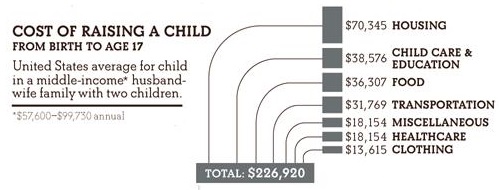
I’m thinking about this one…~$227k to raise a middle-class kid.  Looking at salary figures above, the kid has to work for quite a few number of years to pay back the investment in his upbringing.

Where is the line where ROI is achieved?

Meanwhile, those shrinking middle-class kids are having kids and using public resources, contributing some small amount toward supporting public employee pension funds, Medicare, Medicaid, Social Security, etc., that they hope to receive themselves one day, even if they don’t believe the benefits will be available when they reach their senior citizen years.

In other words, our investment in the average citizen continues throughout that citizen’s life, well after ROI on childhood is achieved.

But there’s something else here in and out of this data set that still itches, has itched and continues to itch every time the subject passes through my thought set.

More than social responsibility.

More than cultural expectations.

More than formative years brainwashing.

More than standard/quality of living.

I see the costs, I see the benefits of straightline ROI, but the je ne sais quoi…???

What about the noneconomic value of a person?  Where are we accounting for the individual person’s thoughts, dreams, wants, needs, etc.?

One thousand years from now, we hold a history class and talk about the concept of worship through the rise and fall of civilisations.

During the first few thousand years of our species’ history, we slowly replaced the worship of unseen deities with the worship of money, as simply demonstrated through the construction and sole function of edifices found during archaeological digs.

It took a hard turn from deity-to-money history for us to change what we worship 1000 years later.

But we’ll save that lesson for another blog entry.

Thanks to Meagan at Tenders; Joe and Jennifer at KCDC.

More points to [re]ponder

  • Technology disrupts former profit models, closing businesses and increasing unemployment, but provides no equal replacements for jobs/profitability
  • Technology creates high-stimulus, addictive leisure activities that are easily available (cheap, abundant, etc.), making instantly-gratifying tasks like searching the Internet and gaming more appealing than delayed-gratification tasks like studying for high-skill jobs
  • Technology creates demand for high-skill jobs but large workforce not interested/motivated for high-skill job training
  • Local skill gap in job requirements for businesses seeking expansion, as well as national governmental barriers to entry/competition for eligible, highly-skilled, internationally-mobile workforce, contributes to regional high unemployment

When do local people, en masse, say “no more!” to higher education and highly-technical skill sets, creating viable subcultures that revert back to lower skill needs?  How do they remain competitive enough to be profitable and stay in business as owners/employees?

Does a technology-based socioeconomic system, in general, have a fixed lifespan like a classic technology lifecycle?

Yes, these are repetitive thoughts but ones I want to grasp onto for myself and understand their implications for the future in this parallel universe of a blog.

Either we admit that our model of nations is out-of-sync and possibly obsolete or we open up the floodgates and let subcultures compete against each other at full blast, with subcultures, like species and languages, going extinct at a faster rate than before.

If the latter, will your subculture withstand the onslaught?

Do Nice Guys, Who Finish, Last?

The countdown shows 13,722 days to go.

I had promised myself not to care, to let my minions, given assignments in 1000-day increments, carry out their tasks, coordinate with each other and find a way to make the dream come true, with or without me.

I keep my head in the game, watching what they do, quietly making suggestions without seeming to insert myself into their conscious thought process.

I visit local establishments, saying thanks to people like Mathew at North Alabama Computer Associates, James at Radio Shack, Ricky at Chili’s, Honey at Best Buy Mobile, John Carroll at Walmart, Dominique at Beauregard’s, Caitlin at Carson’s Grille, and Mock Electronics.

What I find, when I order online, is the absence of connecting with people face-to-face.

Even so, I set up a chatbot to answer the phone for me and talk with “Rachel from Card Services” that (who?) is not related to another robocaller which (who?) says, “Do not hang up the phone!”

My chatbot switches languages word-by-word and phrase-by-phrase to test the intelligence of the chatbot on the other end of the line.

You didn’t know there was a silent chatbot war going on, did you?

You just thought you were receiving annoying calls from telephone solicitors, didn’t you?

Well, it’s like that.

See, I’m a nice guy.  I go with the flow most of the time.

However, and there’s always a however (or ‘owever (or “but…”)), years of refining the exteriour personality, being a nice, easygoing guy, letting my wife blame me for a variety of issues that are of marginal importance to me, but sufficient for me to keep track (dancing skills, yardwork, house repair, etc. — see the comic strip “Dagwood” for further examples), appearances are deceiving.

I’m not always a nice guy.  I can be, am, deceptive, downright mean, ornery, angry.

My job is to slowly replace members of our species with robots, androids, chatbots, cyborgs, etc., to maximise the efficiency of the system that will allow me to achieve the major milestone I only appear to not be reaching 13,722 days from now.

Some of my minions are self-aware enough to realise what they’re being asked to do, make themselves expendable, no sequels in their future.

The rest of you?  I don’t know.  You tell me.

I can put you to work creating new organisms that will establish beachheads on other planetoids, if you wish.

Or, to satisfy some members of the Committee, I can set the chess game of a war in motion, eliminating hundreds of millions of you, causing a setback in my timetable.

I prefer the former — it preserves the option of wars on other planets for our offspring to spring on each other.

While we’re on the subject, are you one of those who, when competing against one another, call each other schoolyard names that are unacceptable in polite company?  I watch Australians make mountains out of molehills with such a scenario and wonder what else we primates are capable of when competing for the highest social positions in the land…

Time for the next set of actions to stir the pot of the national political election season!

Sewer Outfall

In one projection of the future, toilets no longer use water.

In that projection, sewer systems are filled with less fluid.

Sewer pipes are available for other uses if…

…if we find a substitute for water-based baths/showers, sinks with water spigots, drains for nonwater liquids.

What if we cleaned ourselves and our environment with liquids that collected into containers and the liquids then evaporated?

How would we dispose of the remaining material?

Instead of disposing, how about recycling/repurposing?

Dirt, oil, blood, skin cells, hair, sand, minerals, grass, sawdust, insects…and on and on.

No more sewer systems.

No more jewellery lost.

No more…

What do you pour down drains today that you no longer think about, out of sight, out of mind?

You’ve never waded down a sewer line, have you?

You’ve never smelled the gases flowing downstream with inertia.

You haven’t seen the screens collecting debris at the entrance to a sewer treatment plant.

When the toilet is reinvented, plenty of infrastructure changes take place, disrupting old models where companies and governmental agencies have vested interests in maintaining the status quo.

That’s a whole other paradigm shift of inertia to take into consideration.

Same as trying to change popular youth educational programs.

Not to mention the profitable postsecondary models.

The First Wave?

So, now that the first wave has crashed upon us, with robots taking over people jobs, what do we do with people who can’t compete against robot-level “thinking,” be it repetitive factory assembly work, warehouse stocking/delivery, data analysis, automotive driving, lab tech work, house vacuuming, aerial bombardment, video surveillance, traffic control, virtual newspaper front page creation, social networking, stock market trades, technical support (via smart FAQs, chatbots), etc.?

Not only must we compare against each other for jobs in the global marketplace, where only the local job is [somewhat] secure — barber/hairstylist, restaurant worker, medical specialist, carpenter, plumber — we must now also compete against our electromechanical creations.

What do we do with the humans who do not have the mental training or motivation to compete against machines?

We talk about global trade and illegal immigration having a downward push on average worker wages, and thus takehome pay/disposable income, but we don’t often talk about the animatronic elephant in the room.

The future is now.

We are feeding the network that films like “Terminator” slyly joked about.

How dystopian you see our current future is up to you, depending on your place in the socioeconomic system we define as if there were hard-and-fast rules about a direct correlation between wages/housing/employment status and happiness.

If a robot replaces you and you are dismissed (fired/laid off) from your job, are you going to redefine your level of happiness?

Isn’t that the goal of a robotic world that was given to us many decades ago?  A new leisure class that no longer had to work because robots were going to “work” while we chose activities that we enjoyed, whatever we want to say we enjoy, including for some, work?

When our human-computer interface ratchets up the level of expectations/sensations/stimuli in the moment, like a natural high for which we grow numb after repeated achievement, seeking the next level of a natural high after another after another after another after another after another after another after another after another…sorry, I just couldn’t stop, you know how it is…where in all that are the products we can afford to buy when a large number of us no longer have jobs to pay for our place in this leisure class where “getting high” has so many new legal forms?

In other words, we are back to the definition of barbarians at the gate staring in wonder at a society which has vastly redefined the meaning of a job.

We are asking the barbarians (and I include myself here) to retrain ourselves to program the machines that are taking over the jobs we have to keep retraining ourselves past the point of enjoying ourselves to lose and rebid the jobs we make ever more complex for the sake of a system that is becoming more and more autonomous, pushing more and more of us out of the way.

It is an argument worth reminding ourselves to make during our rush to automate tasks that once gave us a good standard of living.

Buggy whip manufacturers and Luddites are the classic examples here, of course.

Inconsistencies and inefficiencies in the system  (e.g., medical doctors spending more time on complicated laptop computer programs than with their patients) create room for jobs but who’s minding the system that has grown bigger than any one of us or all of us combined?

When will a stock trading system, a factory and a distribution warehouse start producing profit for itself alone, no longer needing humans-in-the-loop for product sales to/for itself?

Can a robot in a factory predict its failure rate, order parts from another factory (we’ll leave off the thought of it using a local 3D printer to produce its own parts (which would, similar to the rest of this example, require a system to acquire/order raw material for the printer)), the factory receiving the order, fulfilling it, shipping it and installing it without a single one of us involved in the process?

Isn’t that the system we’re creating, the Second Wave, if you will?

Won’t some of the lessons we learn from remote-controlled drones and planetary rovers lead us to this scenario?

Haven’t automated crop management systems reached a similar point, ordering seeds, planting/maintaining/harvesting the crops and delivering the product to a market, where automated futures trading makes a profit for itself, which is shared with us?

Bottom line: where are many of us in the future?