
Tag Archives: family
What does the crystal ball say today?
Only the Internet knows for sure!


Coaxial axioms
Thanks to Mike, 5-year veteran of Comcast, a 27-year old graduate of Sparkman High School, with three kids and three cats, for installing new RG6 coax cable under the house, replacing a broken cable converter box with a new one (the Motorola DCH70). May management recognise the need for Sunday-Thursday 10am-7pm shifts.
Our living room TV is broadcasting cable TV programs again.
Wife happy = husband happy.
Life goes on…
Back-to-school

Shopping with my marital partner during tax-free weekend. At Burke’s (not burqas) Outlet. Thx to the hardworking staff and mgmt here.
On our way here, we saw a large edifice going up that I could only call a nondenominational entertainment center (i.e., a new megachurch).
Stacks of bound wood fibre
[notes to self stored here for posterity]
If nothing is guaranteed, when even death and taxes are illusions, then what’s next for me?
I use seven billion data points for references as to the types of behaviour I am capable of emulating.
What I don’t always have is the set of previous behaviours and environmental changes which led to the current behaviour that every one of the seven billion is exhibiting in this moment.
Am I or am I not a caged beast?
As a caged beast receiving food, clothing and shelter, what am I getting now that I wouldn’t get if uncaged?
And the opposite, what am I not getting now that I would get if uncaged?
All the objects in this room contribute to me and my set of memories, the result of previous behaviours and environmental changes which led to the current behaviour, writing here in this blog instead of something else like finishing a fence, sealing the crawlspace, going out for lunch with coworkers or reading a book bought at full retail price.
I use police/military/government/authority references as a form of self-flagellation, punishing myself for thoughts of actions I have not taken.
I do know who am I, sometimes in forethought, sometimes in hindsight, often as I am in the moment.
How many of us treat our lives like a Disneyland ride, pretending to be alive, teasing ourselves with the idea of dangerous adventure, looking at photos of ourselves pretending, and are completely satisfied?
I have the fortune of a good, working body, unfamiliar with the different levels of “caged beast” feelings like a quadriplegic, extreme schizophrenic or locked-in syndrome person would describe.
I, I, I. When it’s not about me, it is about me. Altruism is a guilt complex, not necessarily always a default position to take.
These words fall on the deaf ears of history, repeating the works of both the great and the famous, the insecure and the infamous.
Either I am going to break the stitches of bound stacks of wood fibre and get outside the books within which I hide myself or I am not.
It is not so much the risks I fear as it is overcoming the lazy habits of a caged beast that would require working more constantly to secure my uncaged state that keeps me here.
What is happiness and does it have anything to do with what I’ve written so far?
What about these musings from Lady J?: [How much am I like her husband? I need not ask my wife. I already know I am.]
We talked. Yet again. This time, however, we chatted casually in the kitchen. It wasn’t intense. This conversation needed to happen though, and I didn’t know how to have it without sounding like a nagging harpy. I really want to believe the best about people, and I make a point to look for what is good in others. That was my starting point.
I don’t know how the conversation got started, but I do remember this:
“I have two choices. I need your help in telling me what is true. From where I’m standing it either looks like you don’t care, or it looks like you are forgetting to do what you said you would do. I want to believe that you care, but I also want the truth. So, I need you to be honest with me.”
He looked shocked. “Of course I care! I love you!”
“Okay…So, you care. Then, I want you to explain to me why you don’t keep your promises. Are you forgetting?” I asked him this question very calmly in an almost friendly manner. I had to feel almost as if I wasn’t invested in his answers so that he wouldn’t feel accused or cornered because I had a theory regarding his forgetfulness.
“What promises?”
“Well, have you read Dr. Amen’s book? Have you called your internist for a referral to a psychiatrist so that your medication could be changed? You said you would do that last December. It’s July.” He blanched. “Have you taken care of the backyard?” I gently asked him.
“Well, I went to Home Depot today to look at some products…” he explained.
“We went to Home Depot almost three weeks ago and already bought something for the backyard. Do you remember that? It’s out back.” He looked mystified. “It sat on the kitchen floor in the Home Depot plastic bag for a few days. The cat started sniffing around it. She got her head caught in the bag. It scared her. She thought the weed killer was chasing her so she ran around the house with the bag around her neck and hid under the couch. Does any of this ring a bell?” He looked up in an effort to jog his memory.
“God, why can’t I remember these things?!” he exclaimed with frustration.
“Do you really want to know? I have an idea.” I asked him. He nodded.
“Well, I think you have a working memory problem much like three of our daughters do. It’s often inherited. I’ve watched you struggle for years when it comes to planning things. I think your executive planning is impaired a bit. I don’t think it’s anywhere near where Grace’s is, but I do think it’s a problem for you. People with ADHD have executive planning problems. You will function much better in your relationships if you acknowledge that this is an issue for you and make allowances for it. You have more technology than you can shake a stick at. Start using it. Put reminders in your laptop or phone to remind you when you have something to do. Don’t count on your memory to remind you. It won’t. If you really care about me, then you need to start putting an action plan together that will help you keep your promises. As it stands, you are not able to do that. It’s affecting your credibility.”
He made his thinking face. “I’m sorry. I got distracted by work, and I was working last weekend, you know.”
I planned for this response. “You worked while we went to the movies on Saturday, but then you were done. Am I correct?” He nodded. ”You remained on your laptop for hours after that. You were reading Gizmodo and other sites. This tells me that you had time to read Dr. Amen’s book. You had time to close your laptop and engage your family. You had time to close your laptop and do something else. This is about choices, and this is about a habit or a lifestyle. You need to hear me when I say this to you. You are a husband, a father of four, and a homeowner. Technically, there is never a time when you have nothing to do. If you sit down in your room with your laptop to kill time, then it’s because you are deliberately choosing to ignore your parental responsibilities, spousal responsibilities, and homeowner’s responsibilities. When you say ‘yes’ to your laptop and killing time with that machine, you are saying ‘no’ to everyone and everything else, and you are placing your responsibilities on me in addition to my responsibilities. That is, in fact, the lifestyle that you have chosen to pursue for the majority of our marriage. You cannot continue to live like that if you want your daughters to respect you because they are beginning to figure some things out about gender roles. It’s simply not morally right for you to take your happiness at my expense. Have you ever seen me sit around and do nothing? Think about that before you answer. Have you? Why do you think it’s so hard for me to read the books for book club? When do I have time to even sit down and read a book? Where do you think that Fibromyalgia diagnosis came from?”
He pinched the bridge of his nose. “You’re right. I…” he sighed. I swept the floor while he processed my words. It was a lot to take in, but I’ve said all those words before. There was nothing new in what I said, but sometimes you have to continually speak to a person’s identity repeatedly before the truth sticks. I don’t know how my husband sees himself. I can only tell him how I see him. He is my husband. He is the father of our children. He is my partner in life, and yet he lives as a bachelor who occasionally shows up to help. This is an identity problem. I’m not suggesting that we don’t need to take a break and recharge. We do, but he tends to take a break from his individualism to participate rather than taking a break from fatherhood and being my husband.
I have to stop here and explain something about expectations in marriage or even in relationships. We all have expectations–hidden expectations. If two people married, rented an apartment, maintained their own jobs and separate checking accounts, socialized in their own circle of friends, and only maintained relationships with their respective families, then what would they be? Roommates and fuck buddies. They don’t own a home together so the expectations on how to split home maintenance responsibilities don’t exist. There are no children so the stress and responsibilities that come with raising children not to mention the expectations for dividing those responsibilities and what mutual collaboration might look like aren’t on the table. At some point, there comes a time when we either invest ourselves in our relationships or we don’t. We are either people that can be counted upon or we are not. Some things have to be constant in relationships, and I am beginning to wonder if the masculine idea of “father” and “husband” is distinctly different from what women imagine and expect.
I spent some time with a friend recently, and we shared our marital experiences. There was a lot of pain in both of us. Disappointment. She told me that all of her girlfriends were in the same boat. She didn’t know one woman who wasn’t struggling with the same issues. Then she went on to tell me something that caused my heart to ache. An older woman in her life shared that her husband told her that she was the best thing that had ever happened to him. This older woman quietly smiled and said, “I wish I could say the same thing about him.” I didn’t want to understand that. I really didn’t, but I did. My friend explained, “He just refused to grow up and mature. He wouldn’t deal with his issues. He would never be a real partner to her.” A forty year marriage…
I don’t want to feel like that in twenty years, but I don’t have control over my husband. What is his idea of masculinity? What does he imagine when he thinks of the word ‘husband’ or ‘father’ or ‘partner’ or even ‘man’? I often imagine that men imagine Teddy Roosevelt and his Rough Riders when I think of American men–the rugged individualist. The character of Don Draper from “Mad Men” has certainly made an impact on men. Women revile him, but I’ve heard more than a few men speak of him with great admiration–“Oh, to be Don Draper..” What is the definition of 21st. century masculinity? Most of the women I know are working more than ever, but their husbands appear to be clinging to a warped view of the role of the female. They accept that their wives are working and leading full lives. They even encourage it, but they don’t pick up the slack. This is where expectations and communication come in. What do we really expect from our partners even down to grocery shopping and preparing meals? What do we really expect when it comes to cleaning a house and taking care of a yard? What about pulling weeds? Who’s going to do that? Who is going to take out the trash and recycling? Who is going to do laundry? Who is going to fold it? What are the expectations around HOW to fold towels? Does it matter? What about the expectations around making a bed and changing sheets? Do the sheets get changed after sex and, if so, who will be doing that since sex is usually a shared activity? Who will wash the sheets? Believe it or not, these expectations matter because these tasks are what make up daily life–cooking, cleaning, and errands. This defines the quotidian moments. The quotidian matters far more than those milestone moments because we live our lives out in the mundane. It’s in the mundane that life happens. You share your life while you’re changing sheets and doing dishes, and if you’re doing all these things alone while your partner is making little to no contribution then you’ve invested your entire self for two people while your other half has invested nothing. It’s really a form of thievery, and it can’t last.
The best way I can think to describe how small actions have large consequences in the grand scope of life is through this 14th century proverb:
For want of a nail the shoe was lost.
For want of a shoe the horse was lost.
For want of a horse the rider was lost.
For want of a rider the message was lost.
For want of a message the battle was lost.
For want of a battle the kingdom was lost.
And all for the want of a horseshoe nail.
Relationships live and die by the small actions we take every day. Why? Because we do not live in a vacuum. Call it the butterfly effect if you like. A butterfly flits it wings in Argentina and somehow a taxi runs into a telephone pole in Manhattan two weeks later. Our actions affect others. More to the point, so does our inaction. When I choose to do nothing with my life and my time, I’m also communicating something. I’m also contributing something. I’m contributing to the void of empathy, kindness, and goodness in my sphere of influence. I’m making a statement about the kind of person I want to be. I’m saying clearly that I am passive and selfish. Even if I am simply forgetting to keep my promises. When I know that I have a problem with remembering important things yet I do nothing to help myself remember, my passivity is still an active contribution.
This is one of the biggest relational issues I see currently in my life and in the lives of many women I know. The women are overcompensating for the passivity of the men in their lives which results in codependency. In the end, this male passivity is rewarded through what ends up being enabling. I’ve been engaging in this relational pattern of behavior for a long time. I’m trying to put a stop to it.
It’s very uncomfortable around here for all of us, but I didn’t stand up in front of God, my husband, and the witnesses at my wedding almost 18 years ago and vow to make my husband comfortable. I vowed to love him.
Sometimes love is uncomfortable. You know what love is not? Passive.
A man of men
Sometimes I am humbled by the people I know.
One prime example is a great guy I ran into at the movie theatre with his family (his son is starting his college career at Auburn in the fall? Oh, we age quickly!), with whom I worked at Avocent Corporation, a wonderful software engineer and former football star, Tracy Kendall.
Cinematique
Thx to Melody at Carmike; Casey at PetsMart; Colleen at Hobby Lobby
Stepping forth through the fourth wall with [in]formal steps
“It is not the critic who counts; not the man who points out how the strong man stumbles, or where the doer of deeds could have done them better. The credit belongs to the man who is actually in the arena, whose face is marred by dust and sweat and blood; who strives valiantly; who errs, who comes short again and again, because there is no effort without error and shortcoming; but who does actually strive to do the deeds; who knows great enthusiasms, the great devotions; who spends himself in a worthy cause; who at the best knows in the end the triumph of high achievement, and who at the worst, if he fails, at least fails while daring greatly, so that his place shall never be with those cold and timid souls who neither know victory nor defeat.” — Citizenship in a Republic, speech given by the former President of the United States, Theodore Roosevelt at the Sorbonne in Paris, France on April 23, 1910.
I sit back down in the studio at home, leaves of a Japanese redbud outside the window reflecting raindrops from a light rain shower.
During our long ride home last night, my wife and I talked about the range of emotions and thoughts we shared the past few days as newb (not n00b) dancers.
The self-deprecating downers:
- “I’m just this [guy/gal] who doesn’t deserve to be on the dance floor with such great dancers. It would be a waste of their time to dance with inexperienced me.”
- “I don’t dance much because I’m not that good.”
- “What am I doing here? Who do I think I am competing against better talent?”
- “Watching everyone on the dance floor having so much fun is tiring and depressing. Why can’t I be as good as them? Well, I know at least a few of them have been dancing since they were three so it must be innate talent that I don’t have that makes them so fantastic, which is even more depressing that I’ll never be like them.”
- “I’m too nervous to dance well in this competition. I’m going to mess up, trip and fall or miss a step. What if I don’t demonstrate musicality or get off the beat of the music? The judges will score me in last place, I know it!”
- “What’s going on? The competition is about to begin, I’m in line to go out on the dance floor in front of the judges, the crowd and video cameras, making me so nervous I could scream. I’m confused by the instructions because I’ve never seen a competition in person, let alone competed as an ignorant newcomer. I feel so stupid and scared.”
The self-confidence -building uppers:
- “I just learned a new move without it taking weeks to understand the steps. This is more fun than I thought.”
- “People, some of them the best dancers here, are actually interested in dancing with me.”
- “It’s like being inside a TV show or movie about dancing and I’m the ‘star’ of the moment with my dance partner. ME!”
- “Not only did I survive the competition, I was so focused on having fun dancing I didn’t even see what my competition was doing. I actually competed against the strong belief that I would surely fail and I won because I didn’t fall down and didn’t feel like I made a fool of myself even though I know I made a few mistakes!”
- “Everyone cares about me and how I danced — their praise and constructive criticism was so good to hear because they paid attention to me, a mere beginner, and wanted me to be a better dance partner with them.”
- “Can you believe that I went from not wanting to attend this competition or anything like it ever again to wondering when’s the next competition we can go to and repeat the exhilarating fun?”
- “At football games and car races, there’s too much negativity amongst fans who spent so much of their energy yelling at or putting down others. Here at this dance competition, we encourage each other, especially our competition. At our age, maybe we should say goodbye to the ‘boo birds’ and spend our money more wisely with people who support their competitors to get better.”
There were several times after watching some of the competitions that I was sick and tired of dancing because the weight of negative thoughts that I’d never be a dreamy dance partner killed the good mood of the moment.
But then I’d get out on the dance floor, connect with a new partner, enjoy the brief flirtatious friendship and instantly restore my self-confidence regardless of whether I was in perfect sync with my partner the whole time.
As more than one person said, the first is not always the best dance with someone — it may take one, two or three songs for you and your partner to find your commonalities — but you are helping each other improve yourselves that drives you to keep going.
It’s that giving up of one’s ego for the sake of the dance that is amazing to me. Abi often reminds not to stop dancing because sometimes I would just stop and watch her dance, swept up in the amazement of how great her dancing made me feel. Same for many other partners, too. I forget that they’re feeding off me for the sake of the dance.
You mean this little ol’ kid in me is an inspiration for others?
I worked hard all weekend to give myself permission to have fun dancing, clearing my thoughts of guilty feelings that I’m having a great time while people around the world are suffering and my niece is in the hospital recovering from a difficult birth of her baby son.
In fact, I had so much fun that I didn’t constantly split myself into multiple personalities, including the diarist/journalist/blogger who observes and reports everything he saw and felt.
Therefore, I don’t remember the names or personal stories of everyone I met.
Sensory overload was an issue that I didn’t want to get in the way (which triggers crowd anxiety) so I shut off the internal critic, the judgmental elder who uses criticism to build up barriers, and let myself live timelessly in the moment.
I first suppressed and then let pass through me the jealousy/envy of better male dancers who were making the women with whom I wanted to dance look like goddesses, especially after those very same goddesses wanted a song or two with me.
Memories of grade school sockhops welled up from out of nowhere, recalling when I stood like a statue fixated on girls I liked, occasionally getting up the nerve to ask a popular girl for a dance, where I first learned to dance awkwardly with equally-awkward partners, no matter how popular they were, sharing a laugh at the realisation we both felt embarrassed for no reason; high school dances where I was known as a guy to have fun flailing about on the floor, literally, doing jumping jacks, pushups and other shenanigans because I was the wild-and-crazy president of the drama club who had a reputation of outlandishness to maintain; college years full of sorority formals and punk rock mosh pits, often on the same evening; then, 25 years generally devoid of dancing.
And now this, the post Dance Mardi Gras euphoria, where, interestingly enough, a dance form that has no rules or formality — turning into The World Swing Dance Council, with scoring and a points system — inspired me to dance without thinking, letting my whole body speak and learn a new language all over again, while I sit here trying to describe what I felt rather than directly thought with the formal labeled sounds/memes we call words.
Thanks again to everyone of all ages such as the dance groups like Newsies and Tortilla Chips who put on an entertaining show for us during the masquerade ball. The celebrity J&J contest was just as exciting!
Last, but not least, a big shoutout to the crew who made it all happen.
When is a street a canal?
After a seven-hour return trip driving from the Big Easy to Rocket City, I relax for a few minutes before going to bed.
So many people to thank, I hope I remember most of them: Eric, Kevin, Kenneth, Greg, Chris and extraordinary room-cleaning staff at the Astor Crowne Plaza; Seth and friends/coworkers at Chesterfield’s; Kam and the volunteers who made Dance Mardi Gras a success; the enthusiastic workers at PJ’s; state troopers; street beggars; traffic light engineers; skyscraper window washers; polite tractor-trailer operators…
A weekend of adrenaline/endorphin rushes watching/competing/dancing.
…like a rare, old (“aged”) and delicious wine — one sip of a memory at a time.
…like the miracle of a newborn child — every move analysed for signs of progress.
If I had known what I was going to face on the dance floor, I might/shoulda/coulda practiced more, if not more seriously.
I definitely should have danced with more partners during social dance times.
The past has passed, the awards given.
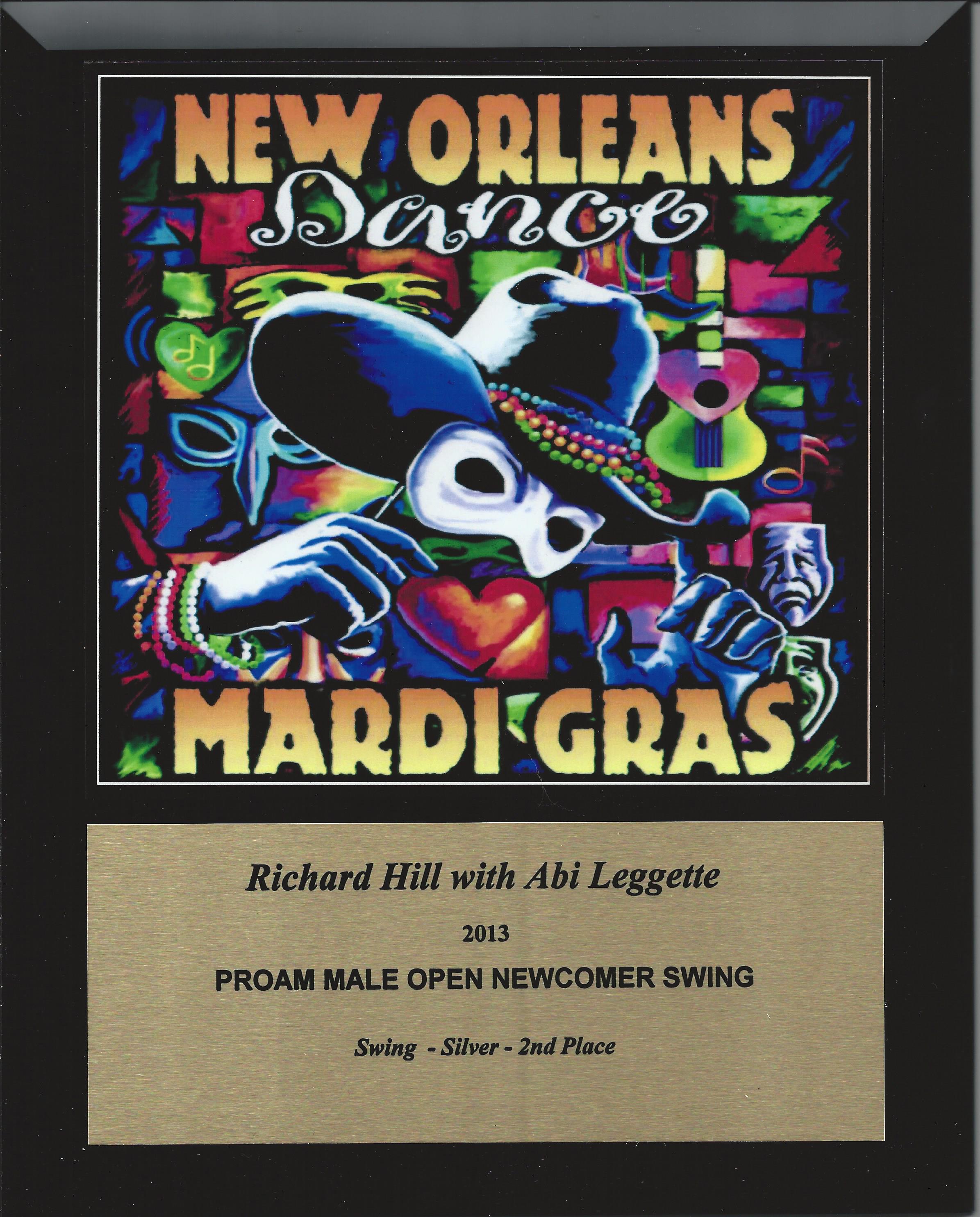
Let the dreams carry me into the light of Monday morning…dreams of flirting in two-minute stretches with beautiful dancers…

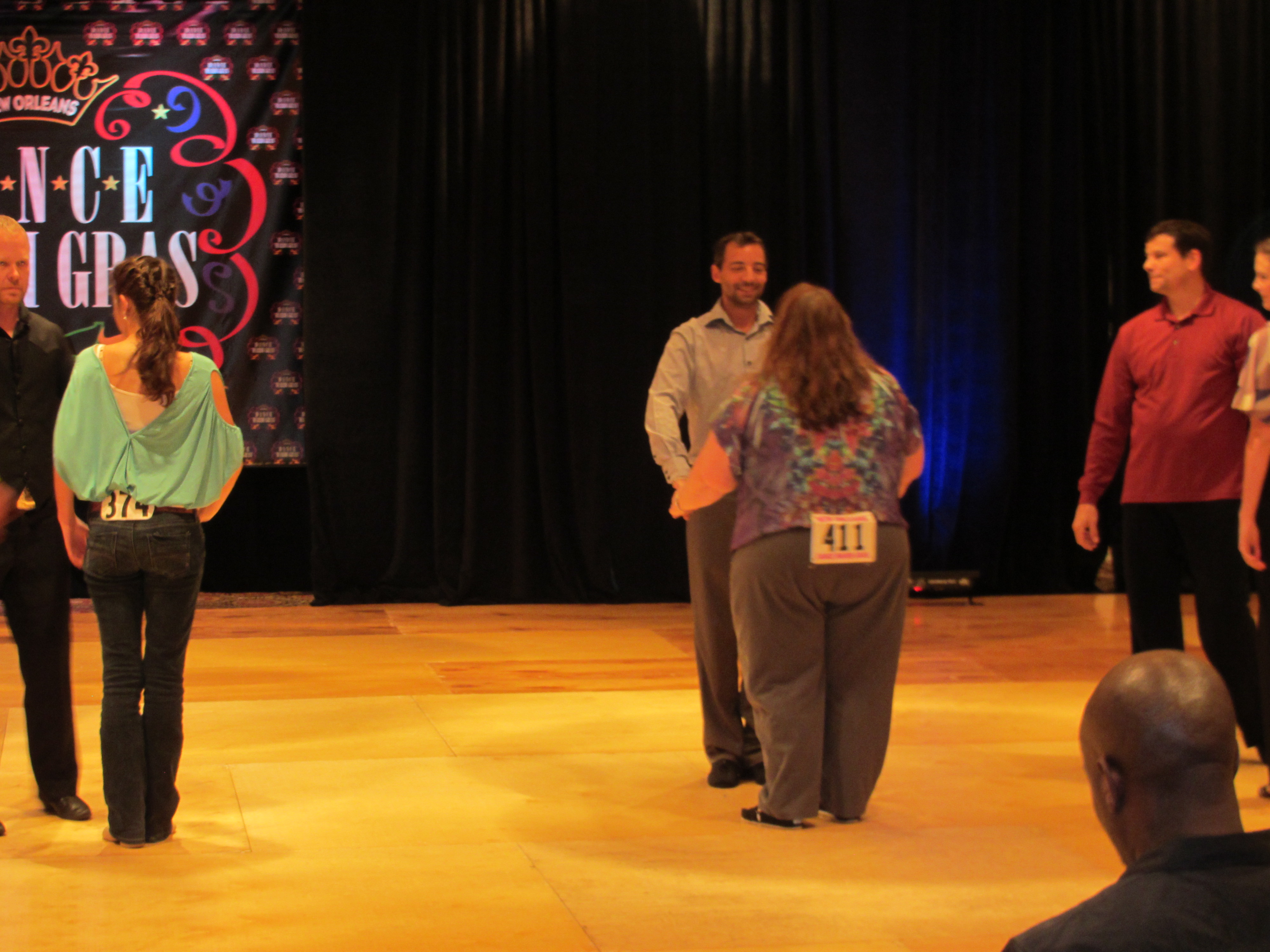
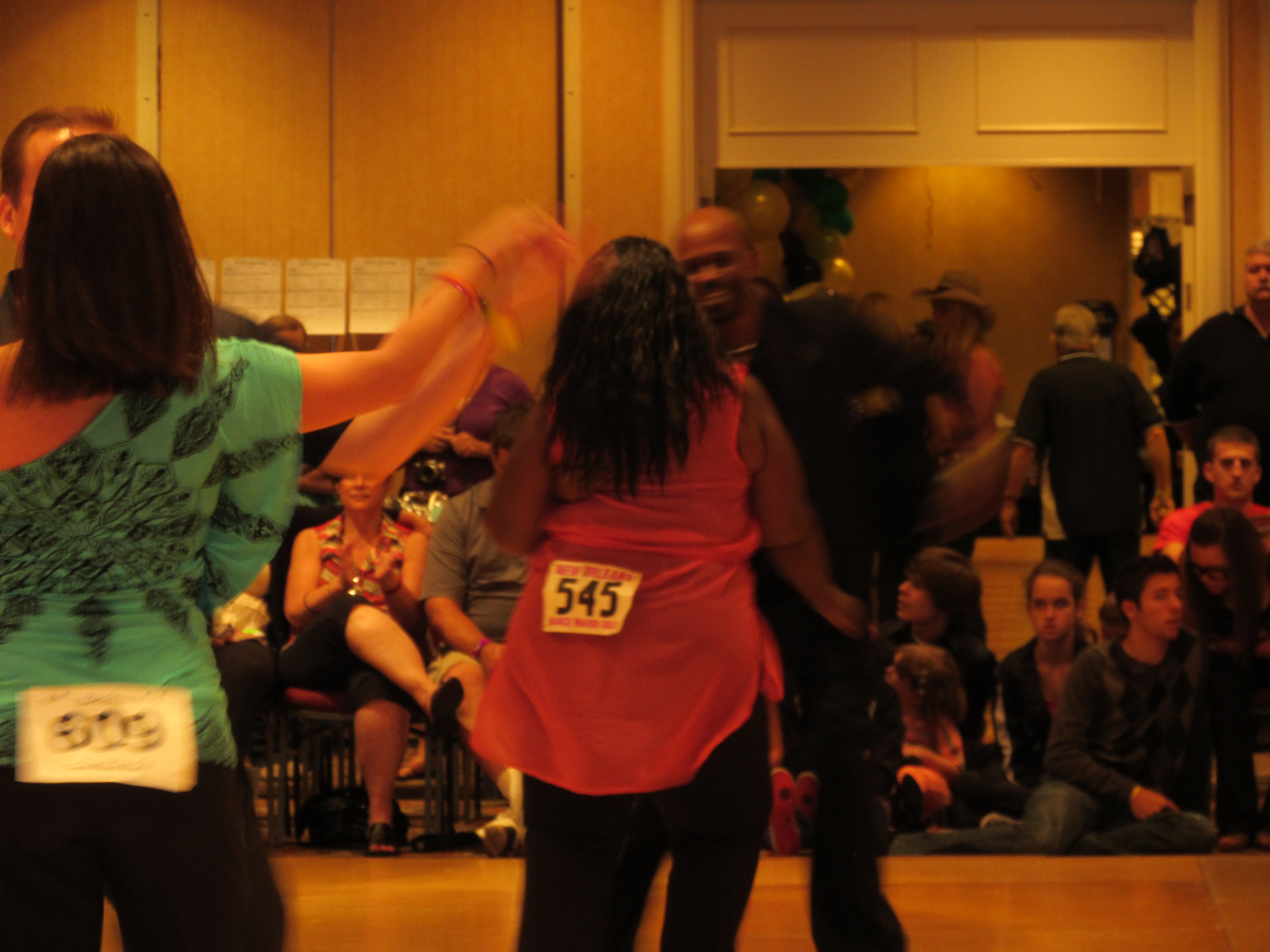
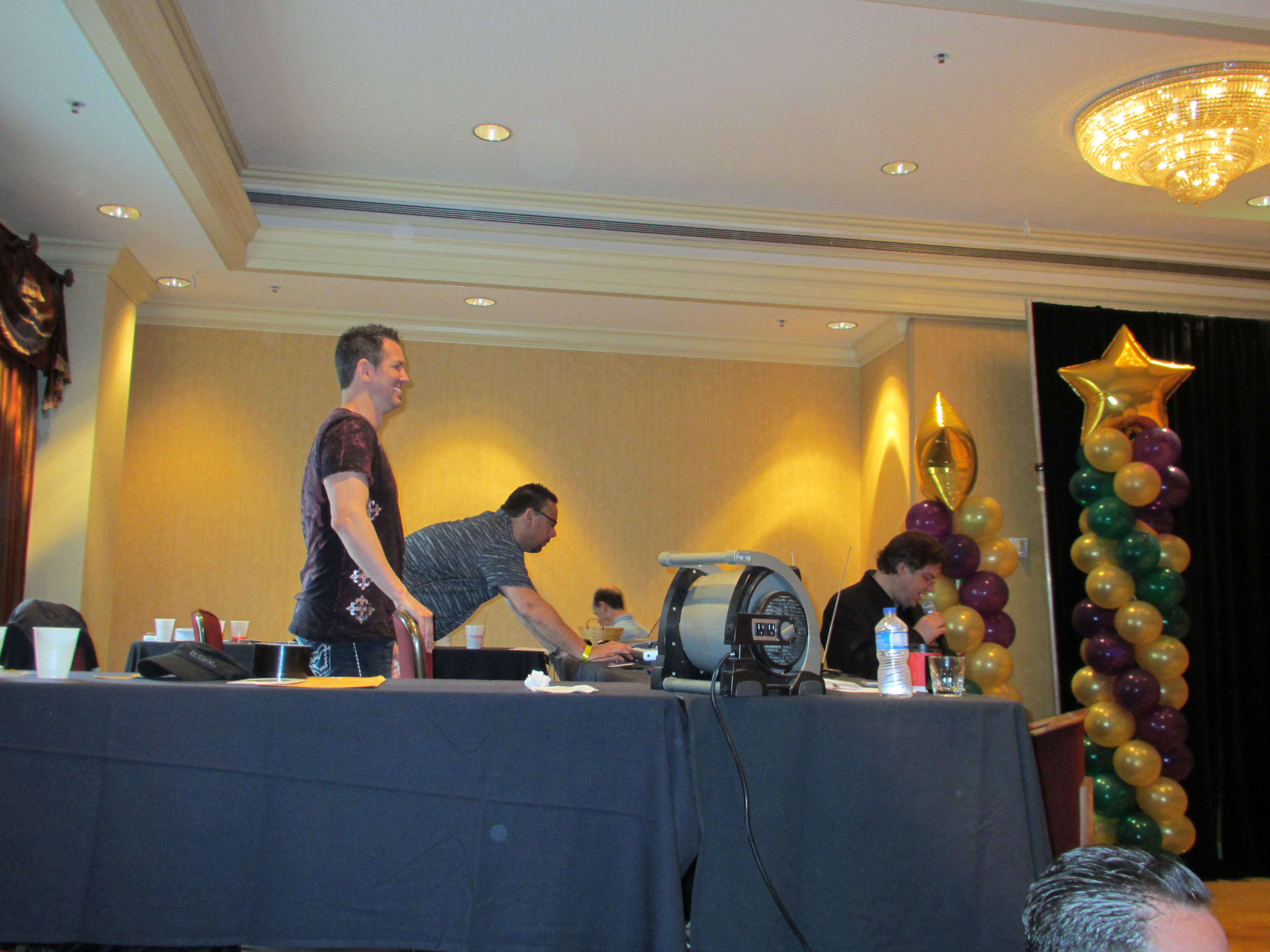
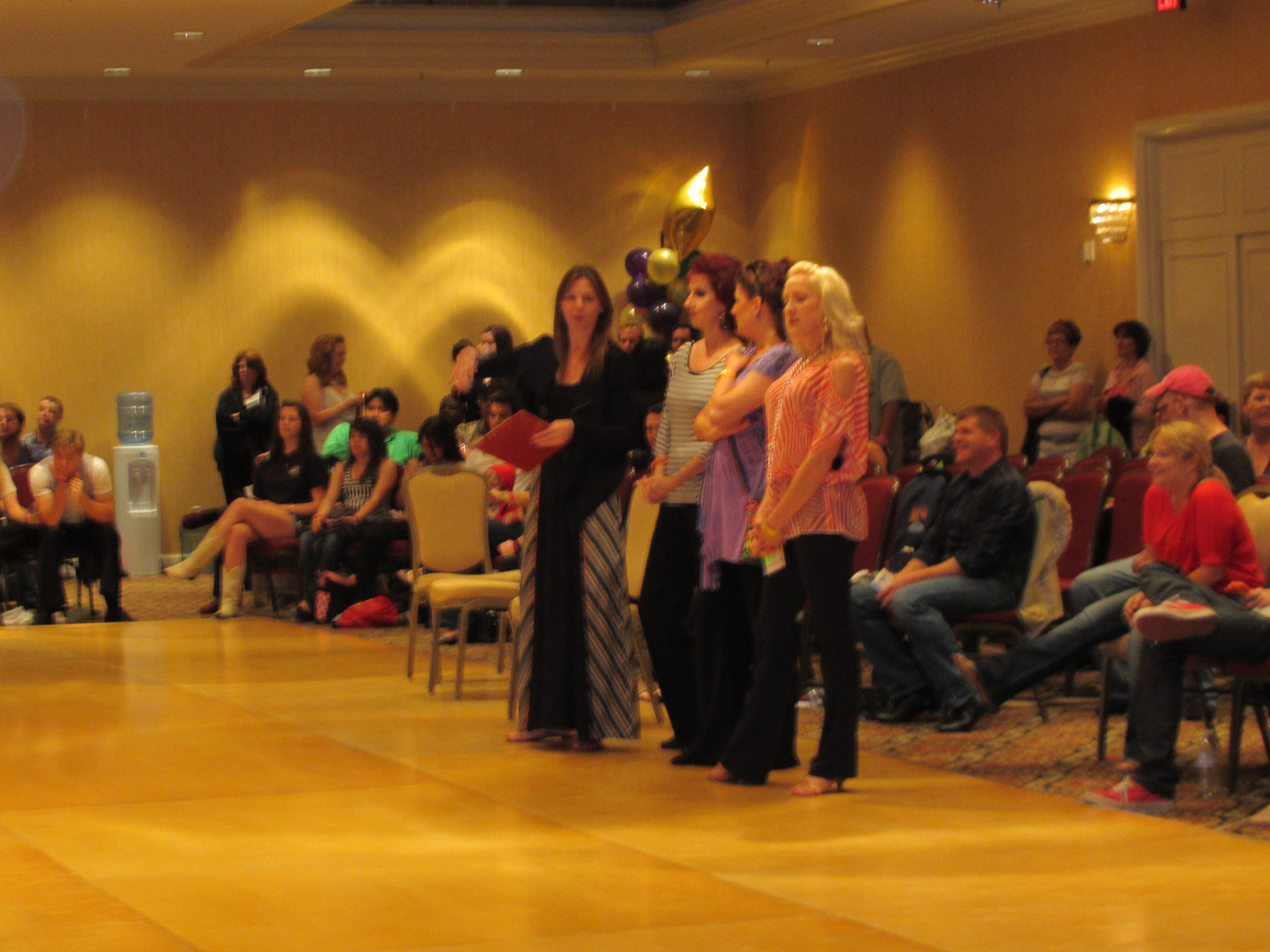
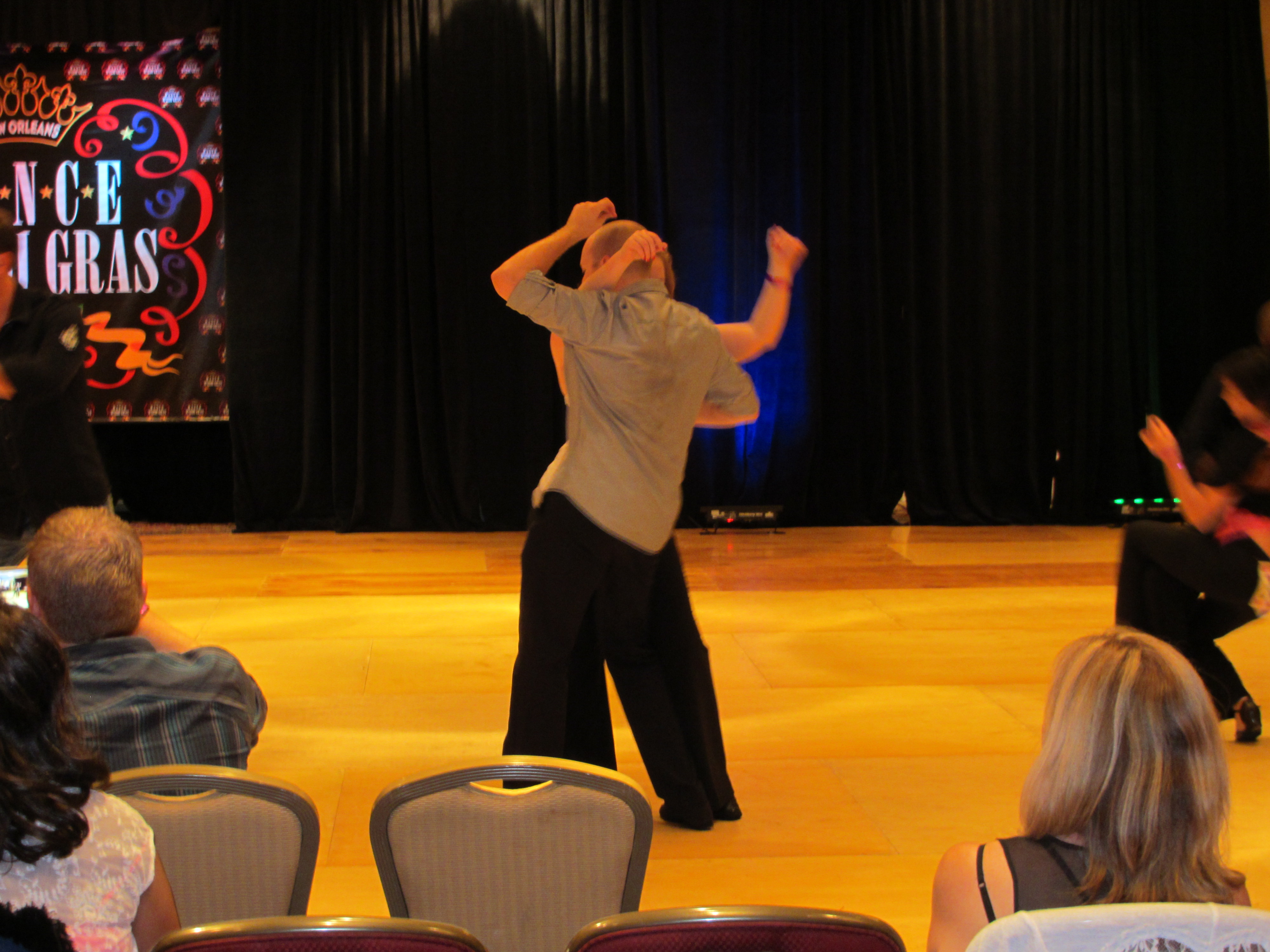
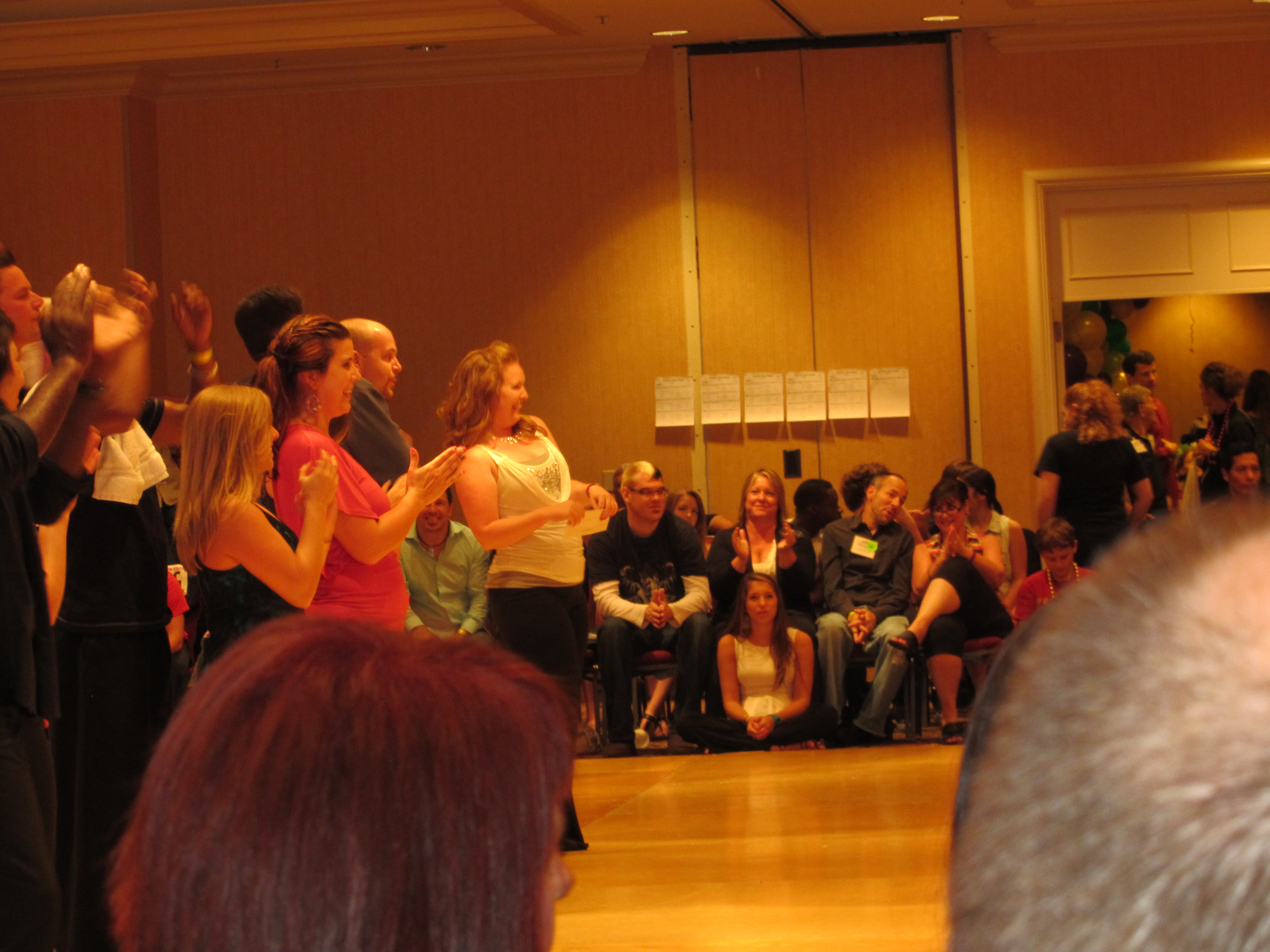

Abi was the female pro dancer of the event.
…and I need another memory card for my camera phone for the next one of these great events.
It’s a boy in swaddling clothes

Not yet waddling.
 treetrunkdings