Thirty-one years ago…

Tired of turkey and dressing for dinner, my wife and I treated my mother to a supper of pizza a few days ago.

At the table next to us sat a family celebrating a child’s birthday.

After we ate, we spoke to the family and discovered they lived about 20 miles away from my wife and me in north Alabama.

Quite a coincidence, eating at the same restaurant 300 miles from home, it seemed.

Then, the grandmother at the table spoke up and said she recognised my mother who, as it turned out, had taught the 37-year old man with graying beard whose son’s birthday was sung by the pizza restaurant staff a few minutes before.

There we stood, watching a couple with a six-year young boy, recalling when the father was six 31 years before, under the tutelage of my mother.

On the ride home, my mother described what she remembered of the man when he was a boy — smart, skinny, shy — who is now an engineer working for our government’s military.

In our country, a popular phrase called “fiscal cliff” hangs in the air, with hints of government military cutbacks threatening to dampen celebrations of birthdays for little boys who depend on their parents’ government salaries to support local restaurants.

The “trickle down theory” is no longer popular but applies in many different ways, from the effect of a first grade teacher on a boy’s future to the effect of political wrangling on the income of restaurant workers.

The future is in our hands, which are the signs of the effects of the past.

Time is irrelevant.  Action is everything.

Countdown to infinity by halves

Dr. G. Brottel bent his knees and leaned back.

Neill, his dance instructor nodded.  “Yes, young man.  That’s exactly how you do it — chin up, look past your partner’s right ear and slightly point your right shoulder to hers, your hips straight.”

Galdous followed the instructions, just as he had followed instructions during his years at university, culminating in his dissertation, “Applying The Lamaze Method Aboard An L5 Society Geostationary Observation Station Boosted To An Earth-Moon Lagrange Point.”

This, of course, fed his interest in leading his partner, Yui, around the dance floor.

Mimicry circuitry in his central nervous system sped up his learning.

At night, he and Yui watched each other watch a 3D video which enhanced their sympathy learning of the moves in a weightless acrobatic encounter combining waltz, tango, Lindy hop, Balboa and East/West Coast swing.

By the end of their work shift the next day, their supplemental brain systems had worked out the coordinated muscle movements needed for smooth swaying on the spherical dance surface.

Yui, assigned to him and he assigned to her at birth, along with several alternative matches based on known genetic symmetry, melted into his arms as they spun “in the air” while holding the formal dance frames required for interplanetary competitions they planned to win.

Having grown up in adjoining educational centres but, not allowed to constantly interact like siblings, which tended to discourage the compatibility of their genetic material for later replication needs of the space colony, they had just enough similar phys-ed workout routines that meant they could anticipate each other’s moves without thinking.

Guinevere, a theoretical science university student and specialty dance instructor from Moon Base Amber Road, made mental notes about Galdous and Yui’s trajectories.

Her mental notes were sent to a supercomputer which adjusted the subroutines that would generate the next dance video for Galdous and Yui to watch that evening.

Guinevere, working on her PhD, the dissertation preliminarily titled, “Recalibrating Rocket Propulsion Guidance Systems Using Realtime Algorithm Remodeling of Neural Network Flow Diagrams,” general enough to give her flexibility with her university sponsor, had found that teaching others the dance steps she had learned during physical rehab not only helped her repair skeletomuscular damage from a bad spaceship smashup but also reinforced the pathways of her upgraded organic wireless circuitry.

In other words, practice what you preach, do what you say and say what you do, be a do bee, and go with the flow, as her therapist liked to say in mock repetition.

Guinevere held out her arms and Neill kicked off the floor toward her.

“Here’s what I mean, Galdous.”  Neill cupped his palm and placed it in the small of Guinevere’s back.  “Lift your left arm and gently push Yui forward.  Yui, bend your knees to your chest, balling yourself up, and spin around Galdous’ waist.”

As Guinevere spun around Neill’s waist, she remembered a mistake in her recent classroom experiment calculations, which meant that the student satellite they had launched yesterday was going to miss its target.

She closed her eyes and focused on correcting her mistake.

If she could work out the logic in the next few seconds, she just had time to send the new algorithm to the Moon for automatic coding, then routed to the satellite for reprogramming.

Later, while Galdous and Yui watched their evening dance instruction video, a student satellite performed a series of maneuvers in space that oddly resembled the steps in the instructional video.

Only Guinevere knew what was going on, silently laughing to herself as she explained to her fellow students recording the satellite’s path that she had invented a new method of optimising a satellite’s stress test by putting strong centripetal forces into effect that pushed the physical limits of the satellite, including triaxial shear test methods employing all six degrees of freedom at once.

Lee Colline managed the lives of everyone on the space station.

He paid attention to all communication between the station and bases throughout the solar system.  A pattern matching program alerted him to the accidental conjoining of Guinevere’s dance instructions and satellite reprogramming.

Lee ordered a review of future upgrades to all persons working and/or living on the station.

Although Guinevere’s “accident” had caused no harm and, in fact, may have led to a new discovery, he had to make sure that the next accident didn’t adversely affect the station.

The immediate application of basic science to practical living had long bothered Lee, who thought that some amount of peer review should separate the two after the Great Cataclysm had demonstrated the fallacy of shortterm economic subsystem profits over the longterm needs of the whole ecosystem.

Who, though, understood that socioeconomic systems rarely used peer review as a safety measure the way that scientists had long agreed peer review was necessary for protection against false claims and inaccurate conclusions?

He mentally wrote an emergency measure that would be reviewed by the Committee for implementation across the Solar System Space Station Network: “All student experiments must align their policies with the Post-Great Cataclysm Procedures for Protection Against Instant Gratification.”

“The laser’s red glare/The bombs bursting in air…”

In this post-nationalist, one-global-economy world, we still talk about the brand effects of nations.

We expect that powerful lasers will protect our ships and our borders, slicing bullets in half and cutting planes/drones/UAVs to pieces.

“Look out for the hazardous debris falling from the sky!” cried Chicken Little presciently, paraphrasing.

Speaking of borders, our crackpot scheming pseudoscientists devised a method to protect borders from tunnels — causing pinpoint earthquakes that unsettle the ground several hundred metres in any direction, shifting the soil around reinforced smuggling tunnels, hopefully collapsing them without knowing they’re there.

Are we ever in as much danger as we hear security companies try to sell us that we are?

What is the percentage chance that your home will be broken into?

Have you or anyone you know ever been robbed or mugged?

Has anything been stolen from you?

Have you stolen anything (including office material and work hours from your employer)?

As we create the next generation of our species, we take these questions into consideration.

Can we genetically encompass a moral compass?

What about a lack of fear of others?

It’s easy to create a new species of spider which has no moral compass.

Like we’ve discussed, “eat and/or be eaten” rules Earth, a moral compass unnecessary.

How much of a civil society do we need when our DNA is significantly modified to handle new offworld environments?

How does one carve a niche when one’s genetic code designates one’s predilected destiny?

How much education can we cram into our genes?

What is the ideal citizen in 2037, 25 years from now, not far from an imaginary moment in Unix history?

Adaptable, of course.

What else…?

Who is Felicia Day and why have I never heard of her before today?

A pitch to the undecided

Right now, the two frontrunners in the U.S. presidential election are debating each other, the debate broadcast through various mass media outlets.

I listened for a few minutes and heard the same things they’ve been saying to and about each other all over again all over again.

So, I wandered into the study and decided to blog about my day, instead, which is more interesting to me right now, stoking my ego, not a presidential candidate’s.

Earlier today, I finished sewing the fiber optic light components onto my “Captain America, the ‘late Elvis years'” outfit for an upcoming costume party while I watched the home refinishing crew working on the house next door and the chipmunk/squirrel/wren wildlife digging through the leaves that have fallen onto our driveway.

Later, my mother called to say she’d found our family history book dating back to the beginning of the American Revolutionary War and will pass it on to me, leaving me as both inheritor and carrier for our future family members.

Later still, my wife and I drove on out into the countryside, stopping at a community center to greet our friends, the Cox family (no, not this one),who told us about their days working as tenant/cropshare cotton pickers, moving from rented house to rented house where crop work was needed, long before the high-tech days hit Huntsville and provided them office desk jobs.

Going to the community center was like walking back into the lives of my wife’s and my hometown.

Local politics, loosely tied to national issues but focused on specific problems that can easily be addressed without a legislative stalemate — prioritising road construction projects, sympathetically addressing the legal education needs of citizens going through the probate process, shaking hands with everyone in your district rather than swooping in for photo ops using canned speeches and preapproved Q&A sessions.

Tonight, the community center hosted three candidates for local political office (quotes below taken from their political handouts) while providing free dinner — southern pork BBQ, baked beans, potato chips, soda and tea:

  • Patty Demos, an attorney, Republican candidate for probate judge — ” a mother committed to community and family; active member of high school booster clubs; active in Open Gait, a therapeutic horseback riding program for special needs children; active in Leadership Huntsville/Madison County, Class 24; past board member of FOCAL, Foster Children’s Alliance of Madison County; former lead member of National Children’s Advocacy Center Child Abuse Multidisciplinary Team; married 20 years to Joe Demos, a Huntsville State Farm Insurance agent, raising four sons: TJ, Payton, Mickey and Ryan, who attend Huntsville public schools”
  • Tim McNeese, Republican candidate for Madison County Commissioner District 1 — “Buckhorn High School Advisory Board member since 2008; Buckhorn High School Quarterback Club Board member, serving as President and Vice President from 2008-2009; East Madison County Recreation Association Board member, serving as Vice President and Equipment/Facilities Manager; coach of several soccer, baseball, and basketball teams at East Madison County Recreation Association for over 10 years; married to the former Micheal Johnson for over 24 years, with two sons, Taylor a sophomore at the University of Alabama and Garrett a 7th grader at Buckhorn Middle School; worked in financial industry for over 20 years, currently mortgage loan officer with RBC Bank”
  • Eddie Sisk, Republican candidate for Madison County Commissiioner District 3 — “Eddie graduated from Paint Rock Valley High School in 1976, and after working in the construction field for several years, he began his public service career with the City of Huntsville in 1980.  Eddie served as a supervisor in the Public Works Department where we oversaw various drainage and road projects.  In 1991, Eddie left the City of Huntsville to pursue his lifelong dream of being an entrepreneur.  He became the full-time owner/operator of Valley Trophies and Engraving, a business he had begun several years earlier, and grew it into a successful business.  He sold [it] in 2011 after 22 years.  Eddie is married to Felicia Ogle Sisk and has two step-children, Matthew and Bryan.  Currently, Eddie’s ambition is to return to public service and apply the business and public service experience he has gained over the years to make Madison County District 3 a better place to live for current and future generations.”

I really want to write a scifi short story but first, a mention of the phrase “dark social,” the aspects of computer technology-assisted social connectivity that we don’t talk about as much as we used to, which may explain American ideology, or might not.

My wife says she can’t tell if either presidential candidate won tonight’s debate.  As for me, I was turned off by their angry debate style and left the room, but you know that already, because I have bigger fish to fry.

Speaking of which, only 13,716 days to go!

News Digest, 14th of October 2012

A few years ago, I installed a couple of ultrasonic buzzers in our attics to keep out animals.  The first year, it was quieter than usual — fewer bumps in the middle of the night by our furry friends.  Then, this year, I discovered a family of raccoons had taken up residence in the attic.

Call it affirmation of survival of the fittest except, in this case, it is a family of deaf raccoons that discovered a place to live peaceably under the roof of our house.

I found out that fact last night by opening the attic door and shouting at the raccons to be quiet.  The baby raccoons kept chasing each other until one of them must have smelled me and turned, catching the attention of the other two who turned and froze, too.

Waving my arms and making aggressive charging motions scared them off into the unreachable corners.

Well, at least there’ll be no more screaming at the top of my lungs and confirming to my neighbours that the crazy man next door is trying to commune with the dead again.

In robot news, more from the analysis of Heidegger’s Being and Time by Hubert L. Dreyfus…

“2. Comportment is adaptable and copes with the situation in a variety of ways. Carpenters do not hammer like robots.  Even in typing, which seems most reflex-like and automatic, the expert does not return to the home keys but strikes the next key from wherever the hand and fingers are at the time.  In such coping one responds on the basis of a vast past experience of what has happened in previous situations, or, more exactly, one’s comportment manifests dispositions that have been shaped by a vast amount of previous dealings, so that in most cases when we exercise these dispositions everything works the way it should.”

“4. If something goes wrong, people and higher animals are startled. Mechanisms and insects are never startled. People are startled because their activity is directed into the future even when they are not pursuing conscious goals.  Dasein is always ahead of itself.”

In other words, our actions/thoughts are based purely on the past while focused on the future.  No wonder we have no idea what we’re doing in the present moment.

In business news, UPS made a hostile bid for the company Space Exploration Technologies Corp, commonly known as SpaceX, now that SpaceX has demonstrated its near-Earth-orbit package delivery service is reliable.

Experts expect FedEx to make a competitive bid to prevent UPS from expanding its reaches to “infinity and beyond,” with FedEx merely wanting to “be there before there are customers to be there,” mainly the Earth-to-Moon route that international transportation corporations are watering at the mouth to sink their teeth into.

The UPS CEO denied that Felix Baumgartner would be vice president of dropoff service for the new SpaceX division, if their bid is accepted.

The bicycle messenger union has opened negotiations for a stratospheric drop and parachute deployment training center that could provide pinpoint hand-delivery of packages to customers in remote locations via sky-high balloon or dirigible.

Pickup of the delivery person is a major sticking point in the negotiations at this time.

Return to ROI

Something, some thought, some idea, in the back/top/middle of my head is itching.

I look at old stats such as this:

I wonder about the average cost of postsecondary education for a college student in the U.S.:

Figure 40-1: Total cost of attending an undergraduate institution for first-time, full-time students receiving aid, by level and control of institution and living arrangement: Academic year 2010-11

Figure 40-1: Total cost of attending an undergraduate institution for first-time, full-time students receiving aid, by level and control of institution and living arrangement: Academic year 2010-11

I examine tables such as this one:

Figure 29-1: Percentage of youth ages 16-24 who were neither enrolled in school nor working, by sex: Selected years, 1990-2011

Figure 29-1: Percentage of youth ages 16-24 who were neither enrolled in school nor working, by sex: Selected years, 1990-2011

Finally, I ask myself, what, based on the salaries of youth who reached adulthood, was my ROI (return on investment) of these kids?:

Figure 49-2: Median annual earnings of full-time, full-year wage and salary workers ages 25-34, by educational attainment and sex: 2010

Figure 49-2: Median annual earnings of full-time, full-year wage and salary workers ages 25-34, by educational attainment and sex: 2010

And that’s just the U.S. domestic market.

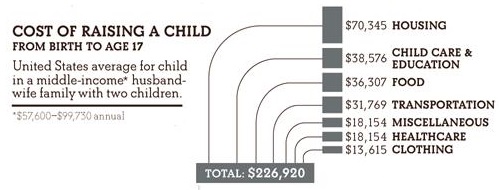
I’m thinking about this one…~$227k to raise a middle-class kid.  Looking at salary figures above, the kid has to work for quite a few number of years to pay back the investment in his upbringing.

Where is the line where ROI is achieved?

Meanwhile, those shrinking middle-class kids are having kids and using public resources, contributing some small amount toward supporting public employee pension funds, Medicare, Medicaid, Social Security, etc., that they hope to receive themselves one day, even if they don’t believe the benefits will be available when they reach their senior citizen years.

In other words, our investment in the average citizen continues throughout that citizen’s life, well after ROI on childhood is achieved.

But there’s something else here in and out of this data set that still itches, has itched and continues to itch every time the subject passes through my thought set.

More than social responsibility.

More than cultural expectations.

More than formative years brainwashing.

More than standard/quality of living.

I see the costs, I see the benefits of straightline ROI, but the je ne sais quoi…???

What about the noneconomic value of a person?  Where are we accounting for the individual person’s thoughts, dreams, wants, needs, etc.?

One thousand years from now, we hold a history class and talk about the concept of worship through the rise and fall of civilisations.

During the first few thousand years of our species’ history, we slowly replaced the worship of unseen deities with the worship of money, as simply demonstrated through the construction and sole function of edifices found during archaeological digs.

It took a hard turn from deity-to-money history for us to change what we worship 1000 years later.

But we’ll save that lesson for another blog entry.

Thanks to Meagan at Tenders; Joe and Jennifer at KCDC.

In the old days…

In the old days, I would have put together a system like this:

You know, a touchscreen computer monitor with a plugin interface for a smartphone which acts as the portable PC with local, physical, wireless keyboard and other HID as needed for desktop use.

But then, gesture control got in the way.

I’m not one to talk with my hands and arms.

I’ve been typing on keyboards for about as long as I’ve written short stories.

I am not like the kids of today who barely know what a computer mouse is, let alone a physical keyboard.

Watching kids in the classroom manipulate their way through their coursework with a tablet PC makes we worry for no particular reason.

How many of them are more comfortable working with a game controller, including accelerometer/gyroscope/etc. than with a keyboard/mouse combination?

And what about the next set of students more comfortable with natural gesture control, where their indoor environments are wired to respond to them like living beings and augmented reality makes their outdoor environments feel more connected, their senses more stimulated by information [over]load?

What about this worries me?

The digital divide.

Environmental impact.

Collapsing world economy.

What is the sustainable version of these images?

We are not crying “Wolf” here, simply recognising the support structure needed to maintain and enhance these technological achievements for decades more without interruption by global war.

Back to the Committee meeting where we need full cooperation by those willing to reach consensus on a few important issues not yet discussed in this public forum…

Where drone-sized minimissile defense systems line national borders using UWB/mesh network technology to intercept and destroy rogue UAVs, killing a few kites (yes, birds) as collateral in the process.  See the latest cartoon films starring Iron Man for a moving example.  Detente is a terrible deterrent to waste, like al dente is a terrible burden on the waist.

Master and Commander: The Far Side Calendar Edition

“Grasshopper, what lesson have I taught you today?”

“That biting my fingernails is a sign.”

“And…?”

“That biting my toenails is also a sign, a sign of flexibility, but one need not always be flexible.”

“Very good.”

“Thank you, Master.”

“You are welcome.  It is time we look at broader subjects.  Have you ever heard me talk about our enemies?”

“No, Master.  You have told me one must never have enemies, only opportunities to learn from those whose beliefs complement one’s own.”

“Very good, Grasshopper.”

“Thank you, Master.”

“Remember, little one, I have told you many times to call me Mister.”

“Yes, Master Mister.”

“[Sigh.]  Very well.  I will not reinforce your habit of mastering your subjects, including me.  Let us proceed.”

“Yes, Mister Master Mister, Master.”

“As you recall from a previous lesson, we observed two people in opposition.  What did I tell you?”

“That one should adopt the best traits and best people, allowing others to demonise the remaining traits and remaining people so that one may concentrate on pure joy, happiness, and meditation of best-ness.”

“Indeed.  Grasshopper, you do well today.  But do not bite your toenails.  We are not animals.”

“But, Master, you bite your toenails.”

“Only after I have cut them from my toes do I use my toenails as ‘toothpicks’ when wood is unavailable to remove rice hulls from between my teeth.”

“Yes, Master.”

“Remember, one must be resourceful yet maintain one’s harmony with one’s true sense of self.”

“Yes, Master Mister Master Mister, Mister.”

“What else did you learn from that lesson?”

“By observing how one’s colleagues make enemies out of other people do we learn their true nature.”

“And…?”

“That pizza is a delicious late-night snack when meditating upon 24-hour sports network viewing.”

“Where did you get such an idea, Grasshopper?”

“From you, Master, Mister, Master.  You, yourself, have said your round belly of wisdom should be called the Pizza Palace of Peace.”

“You pay attention to too much of my humorous asides, Grasshopper.  Telling and understanding jokes is the deepest of wisdoms one attains through years of listening to others’ foolish behaviour.  One must not confuse wisecracks from wise observations.”

“Master, I do not understand, Mister.  Are they not both kernels of wisdom?”

“Very wise of you to say that, Grasshopper…”

“Do you not use my name, ‘Grasshopper,’ as both a serious reference to my body and as a joking reference to my impermanence, in addition to my insignificance as an insect in comparison to my body?”

“Yes, Grasshopper.  We have discussed this many times in your decades of training.  At 50 years of age, you are well past the time in one’s life when one should leave this training center and pursue one’s destiny.  So your name is both a reverent label and an irreverent joke about you overstaying your education.”

“But, Master.  You have never left these walls.  Are we not both trapping ourselves within imaginary walls around our true destiny?”

“Grasshopper, your wisdom is beyond your years and yet beneath you.  One must never say more than one feels.”

“But what does one feel about walls?  I have no emotional ties to the kiln-dried bricks and mortar.”

“Grasshopper, let us put off that lesson until tomorrow.  I am feeling tired and very, very old.”

“But, Master, you, Master Mister, are only five years old.  How can a Mister Master like you feel old?  This is the time when Masters like you usually feel playful.”

“Grasshopper, you know that wisdom is not measured in years.  Look at the golfers who play in the Masters.  Some master their skills at an early age and some do not find the master to hone their skills for them until they are much older.”

“Yes, Master.  We both need our rest.”

“Indeed.  And please, please, please, call me Mister, not Master, not Master Mister or Mister Master, or Master Mister Master, or Mister Master Mister, or…”

“But, Master, it is my joke I play on you.  Can you not see that?”

“Yes, Grasshopper. But like the lesson where we keep the best traits of our perceived enemies for ourselves, let us give the worst jokes or the jokes that have grown old to our perceived enemies, too.”

“Yes, Mast…err, I mean, Mister.”

“Thank you, Grasshopper.  You may return to your eight-hour duty of raking the autumn leaves that fall upon our gravel path.”

“The leaves never stop falling this time of year.”

“Yes.  A lesson you have taught yourself over and over for how long now?”

“Forty-eight years, Mister.”

“That’s right.  I forgot you were a late bloomer, two years old when you were brought here.”

“Yes, Mister.  That’s why I have not left.  My previous Master told me that blooming late is my specialty.”

“A wise Mister Master, indeed!”
Am I alive?

While I wait for my new LCD monitor with HDMI connection to arrive, thus turning my smartphone into my desktop/laptop PC at home and Internet phablet on the road, I shall write here once more.

That, and the overwhelming reader response to ending this blog, as usual.

This afternoon, I attended the funeral of a 98-year old man, met his widow, and am friends with two of his children, one who is a girlfriend of a longtime friend of mine from our college days in Knoxville.

I also saw some familiar faces from my time here in this community — 27 years or thereabouts — people like Peggy Sammon and Butch Damson.

Ninety-eight years young…

I cannot imagine living so long.

Meanwhile, a house wren hops up and down the window screen, looking for food, digging through the debris in the old, broken, rusted gutter hanging off the rotting eave.

I did not know the man who was buried today.

I felt like a fifth wheel, a stranger inserting myself into the graveside mourning of others.

So, to hide my face from the crowd, I stood behind a pocket camera snapping pics for the daughter and friends in Germany who could not be there while we who were gathered recited prayers together for the deceased.

I am of the walking dead myself, but my friends say Jesus loves me, this I [should] know…

Sorry, that last bit slipped out, a verse from a children’s song.

I did not know the man who was buried today but I was able to join his family and a group of strangers, sharing a subculture full of familiar songs, poems, prayers and rituals.

It was a window opening up the sounds and sights of my childhood.

It was a window of opportunity, listening to the stories about Rudi Schlidt from his closest friends and relatives.

Of course, I can’t hear so well so I’m not sure what anybody said, using their body language and voice inflection to tell me when I was supposed to smile, laugh, cry or do nothing but listen attentively.

Rudi was nearly twice my age when he died.

He made important contributions to the advances of rocket science.  He, like many in this town, could easily say, “As a matter of fact, I am a rocket scientist/engineer.”

His wife was secretary to Wernher von Braun, who may or may not be familiar to you.  Today, her face still shines with beauty at 91 years of age.

There is more and less than meets the eye, to be sure, but today I simply let the sights suffice to register my presence on this planet another day, amidst those who registered the absence of a friend, [(great)grand]father, coworker and fellow member of the community.

Am I alive?  I don’t know.  I explore the universe from atop this tiny planet of ours and wonder.  That’s all I care to know.  The rest is none of my business.  Gott behüte.

Auf wiedersehen, Herr Schlidt.  From the crowd at your graveside service today, know that you are/were loved.  Gott liebt dich.  Gott segne.