Tag Archives: climate
Teaching children about real life
Spider of the day
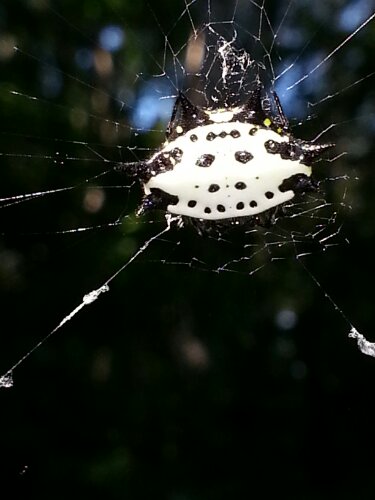
Yard is full of fun-shaped spiders this fall!
‘Tis the season for autumn leaves…

meine Mutter mir geschrieben, ein Buch, nicht eine Rakete
Lee stood at the foot of the bridge, listening to Guin’s thoughts directedcto him.
“Shadowgrass does not know what city traffic is like. He doesn’t comprehend why cars used to smash into each other.”
Lee watched a mosquito fly up through his exhaled breath into his nose.
He thought back to her. “Yes. I wonder how many people have said, like me, how proud I am of your progress. To watch you grow back into your old personality again has been a privilege, knowing, as I do, how we lean on and absorb the personalities of others to fill in the new empty places in our thought patterns.”
They looked up at the stars together, hand-in-hand, in childlike amazement of the universe they knew so little about.
“You danced amazingly well last night.”
He heard her smile in her voiced thoughts.
“You, too. But more than that…you were a gray-eyed angel, my friend outside of time. Our minute and thirty seconds is, was an eternity. I can remember every look on your face, every turn you made and every handhold down to the last bow. You are the embodiment of the infinite well of happy laughter that feeds my thoughts.”
They stood in the greenhouse silently listening to the insects hatched from precious cargo brought to Mars.
The starlit sky rotated slowly.
Schooled
Connie Evingson sings “Si Tu Savais” on the Internet app.
A school of small fish move about the sandy shoals this Saturday afternoon while hundreds of miles away Tennessee plays Oregon and Texas A&M plays Alabama.
Moss grows between tree roots.
A mother, smoking a cigarette, walks with daughters behind me, enjoying the early fall day, their voices joined by their father, bearded, wearing an Auburn ball cap

A pin oak hits the river surface, attracting a striped fish.
Grass/reed patches grow along the river’s bend.
Dragonflies chase prey.
Casual bikers pass by, their heads barely visible behind the opposite river bank.
Do banks bank in the bank?
Does prey pray?
I suppose I ought to head on down the river trail, find my way back home to wife and college football on TV.
C’est la vie.
The Flint
Based on the timeframe involved
I can safely say I stand on a manmade bridge
Over the Flint River,
The reversed-coloured glow of my smartphone
Blinding me,
Attracting tiny insects that land on the screen,
Squashed by my typing forefinger,
Flying up my nose,
An unseen large insect flying into my leg,
Making me stomp and dance in the dark
Under a half moon and familiar constellations.
I am in love with nature,
My eternal friend
Who talks to me
With insect wings and frog throats,
Distant internal combustion engines
And river water smoothing out rocks.
Colanders and strainers
Guin had spent four straight sols in the lab.
Although the ISSA Net allowed her to track the progress of her lab experiments from anywhere on Mars, she found a deep satisfaction in being present when her cyborg assistants, part of an integrated network of sensors and computing devices that saw itself as a single unit, reported the results.
For a while, Shadowgrass had fallen into the habit of naming Guin’s assistants Huey, Dewey and Louie, just like he named his appendages and any objects that naturally fell into a group of three.
Guin observed the metabolic rate of the latest algae strain.
She often liked to take unnecessary chances with her body while exploring Martian terrain well outside the rescue perimeters of the colony but when it came to her research she was overcautious, repeating experiments to eliminate any chances for black swans to appear out of nowhere, fully cognizant of mistakes that had taken place on Earth when a few nanoresearch experiments went out of control, escaping laboratory conditions, combining with GMO crops to wreak havoc in local ecosystems, killing off living organisms of all shapes and sizes indiscriminately.
She fed the algae to an artificial stomach that had been grown to simulate new Martians like her who depended on less water to convert matter into energy.
The stomach easily broke down the algae with no known toxic effects on the stomach’s cellular structures.
Guin reviewed xeriscaping research that had started on Earth and been split into experiments conducted simultaneously on Earth, the Moon and Mars.
Starving plants and animals to the point of death, seeing how body processes were slowed down, the bodies themselves experiencing longevity off the charts because of reduced metabolic rates.
Guin spent the next two sols moving the algae to the Mars enviromental simulator, watching for, hoping for signs that this strain would survive more than a few simulated seasonal cycles before decomposing.
Shadowgrass came to visit, sneaking a taste of the algae.
He wasn’t pleased but knew taste was of secondary concern at this point in the colony’s development. They could always use the 3D fast food printer to create a facsimile of food her parents had grown up with, sweet and salty to the tongue, palatable but not nutritious, providing a much-needed stimulus of the senses to keep their bodies mentally-energised.
Sometimes, Shadowgrass ate bits of Martian soil for variety.
Guin waved at Shadowgrass and asked him for his help, realising more and more that his analytical skills surpassed hers at any age.
“Shadowgrass, darling, have you made any effort to create your own terraforming life structures?”
“Yes, Mom, I have. They’re growing out by the greenhouse, if you want to see them. In fact, they’re almost exactly like this algae you’ve got here, but they’re growing awfully slowly. I think my water substitution algorithms didn’t account for the chemical structures correctly. I’d like your advice, if possible.”
“Sure. Give me two more sols, will you?”
“No problem! I’m going with Dad on an expedition so I’ll see you in three sols.”
“Be careful. Don’t do anything…”
“‘I would do.’ Yeah, I know. Don’t forget, though, that I’m much more easily repairable than you!”
They laughed together. She hugged him and pushed him out of the lab.
It’s a great big universe
Glass spherical atmospherical at most fear a gull
I don’t know what it is about the objects in this room but some of them have a life of their own.
The crystal ball, which is not really crystal but a thin layer of glass, hummed when I walked into the study this morning.
A 60-Hz hum, as if some unseen creature — a gnome, fairy, elf, dwarf or gremlin? — snuck in and plugged in the crystal ball’s AC power source.
Ah, yes. The crystal ball has electronic junk in its trunk.
For centuries, the crystal ball had relied on the magnetic alignment of layers of rock deposited for millions of years onto Earth’s crust as the planet’s magnetic poles flip-flopped.
But I wanted more power.
I wanted to make the future a reality, not just some foggy image forming out of the inside of a ether-filled dome.
Sing it! “Ee-thur, eye-thur, nee-thur, neye-thur,” ether-aether, “let’s call the whole thing off”-kilter.
Anyway, the crystal ball’s powered profundity projects onto the book covers, picture frames, walls, ceiling, overhead light fixture and my eyeballs a future where we ask ourselves why income inequality has become a buzzword domestically, imagined internationally but not universally.
A spinoff of Virgin Galactic, under a new shell corporation not directly tied to Sir Richard Branson in order to avoid confusion about mission statements, offers a higher boost into suborbital space for the terminally ill, taking their money but not promising them a flight in time before they die, that gives the passengers a longer time in the weightlessness of space and then an incendiary cremation upon reentry, the painlessness of sedatives a personal option, their ashes spread into the upper atmosphere of the only planet they got to know, sparking a new travel industry nicknamed “Your Final Exit” after a book written in the 20th century.
Discovering energy conversion that has nothing to do with atomic structures opened up planetary exploration and galactic travel, completely and forever changing our image and opinions of ourselves as the center of the universe — it’s not the energy level that counts, it’s how you use the paradigm shift to reinvent the way we model our sets of states of energy in the cosmos.
Spending more time nurturing our species’ children during their formative years offset our longterm investment in the spook business that tried to compensate for the messed-up mindsets of adults turned against society, which changed the way we perceived ourselves as [un]fairly-treated cogs in the wheels of the politicoeconomic conditions we used to define our place in society, including the reformation of the public/private education system that used to depend on a mix of caring/sadistic [un]tenured teaching staff and [non]motivated students.
Mapping the new global culture on top of centuries-old subcultures was as fluid as the ocean tidal currents, tide charts predictable but local tidal basins fluctuating minute-by-minute. Protesting the advent of global branding missed the natural evolution of a species in transition from multilocal to a global set of traits. Embracing the concept of optimising profits made the antiglobal movement an effective tool in strengthening our longterm economic sustainability — every person was encouraged to realise we are individually a laboratory of new ideas, making conformity, normality and mimicry as quaint as synergistic symmetry.
The crystal ball hummed louder and louder until I realised that the wallwart was overheating. Time to get a new transformer before the house burns down!
 treetrunkdings