a shoutout to a former professor of mine who strongly believed in intellectual property right.
Tag Archives: chapter excerpt
If you’re gonna…
“If you’re gonna set sights — crosshairs, laser dot, whatever — on a target, don’t point it at your own people.”
The Committee members mumbled, some agreeing, some disagreeing, some simply burping from a good Christmas Eve dinner of cooked goose and foot-in-mouth.
“We need a good war and we need soldiers who know their true enemies, not somethin’ like the ‘guv’ment’ or their own children, but somethin’ more real and worthy of our high esteem.”
Stomachs grumbled and antacid tablets were passed around the table.
“What we have here is the proverbial failure to communicate our message clearly out in the open so our soldiers know their targets and enemies know they’ve been targeted.”
Bottles of eggnog, heavy on the nog, were guzzled.
“We have messed up for too long putting the friends and opponents on the same list — Ruralites, Urbanskis, Suburbanians, Entitlementists, and Provisionists. It’s time we separate the wheat from the chaff!”
The older, deafer members, thinking they heard the word “chafe,” scratched their crotches.
“We need to attack while the numbers are in our favour! We need to preserve our way of life!”
The leader of the Subcommittee for the Investigation of Subculture Incitation stood up. “I have rallied the troops of my family. We held a private meeting and swore an oath of allegiance over a copy of the American Patriots Bible. We are ready not only to defend our home way of life but to take our message to the streets!”
More mumbling, grumbling, throat clearing and seat adjustment raised the general background of the wall of sound, the noise floor.
“Well, then, it’s time to act. We will use the failings of the fiscal cliff negotiations as our signal that if the pigs feeding from the guv’ment trough aren’t going to slim down, then we’re going to stop socialism in its tracks by cutting off their slop feedings!”
The banner of an angry mob with pitchforks and muskets was torn down and replaced with a new banner — organised units of neighbourhoods which had secretly practiced for this moment by sending their sons and daughters to the government military training centres for receipt of free food and tactical maneuver methods.
“OUR TIME IS NOW! THE MOMENT OF REVOLUTION IS OURS! LET US LOOSE THE CHAINS OF SOCIOECONOMIC TYRANNY THAT HAVE ENSLAVED US FOR TOO LONG!”
The bottles of antacid were completely drained.
The Committee members quietly exited the room, slipping into the subcultures from which they were direct the attacks — cyberwar, mass media disruption, etc.
Phase 2 was launched. May your God(s) have mercy on your souls and sort out the believers in their afterlives…
In case you don’t remember punchcards…
When yakety saxes aren’t yet sexy yaks
A look back, once beyond, or something like that.
The right rhythm for the topical tune.
Thanks to Bruce T for the link.
Thx
12192012 tercell at walmart. Ebone at pier one. Todd fuqua at arbys. Jenn and joe at kcdc. Cara at chilis. John at publix. Jody at riteaid.
12212012 katy g at gigi’s cupcakes. Jessica at Sonic. Linda at pier one. Elizabeth at Beauregards.
12222012 lauren at sees candies.
12232012 mapco. April at carliles restaurant.
Lifehacker tip du jour
Nobody’s actually reading this, are they?
For years, Aofb would check her online status but got no responses whenever she posted a poll even though she got a lot of hits.
Then, she wrote stories about organising vigilante mobs that lived in the community, especially gun owners who actually wanted people to fear them, making sure that the occasional gun owner went off the deep end and killed a few [dozen] people every now and then — what was the point of making sure people understood the power of your arsenal if you never demonstrated it; e.g., dropping a few atomic bombs on cities full of innocent people in a country at war?
AofB liked herself. She liked her online friends. However, in the physical world, the guys she met were real matches for her personality but no match for what she thought her imagination told her she [should] want.
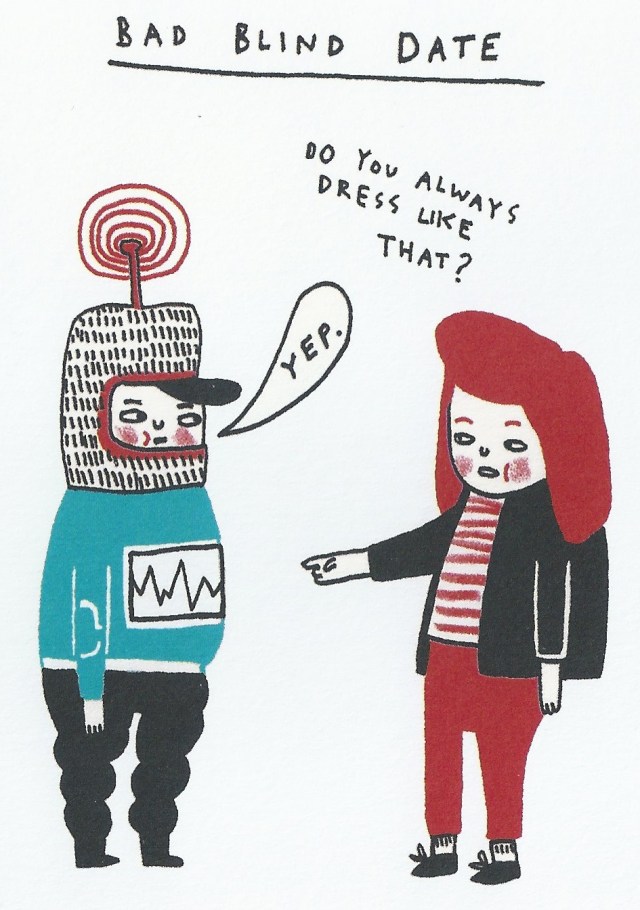
AofB looked at her online profile:
I enjoy anime, especially scifi, cosplay, guys who don’t care what other people think of them, creative types, mismatched shoelaces, the colour red, chewing gum, rosy cheeks and wearing fluffy fleece sweaters in the middle of summer.
She looked at computer dating matches. Hmm…she started to see a pattern.
AofB changed her online profile:
I enjoy shooting deer, gutting them, making deer sausage, cooking a nice meal for my hungry soulmate, sewing my own clothes, growing my own food and big, mean-looking dogs who have kitty cat personalities.
She looked at computer dating matches. Hmm…she started to see a pattern…the same computer dating matches popped up!
What was it about her personality test results that made her online profile pointless?
She went back to her latest poll and asked a question which would simultaneously appear on multiple social media sites she frequented:
What are you looking for in a mate?:
- Someone just like me.
- Someone completely different than me, but compatible.
- A mate I can treat as my personal punching bag.
- Who needs a mate when you’ve got [fill in the blank]?
A week later, she checked the results of her poll. No answer…hmm…what was the oracle of the Internet trying to tell her?
= = = = =
Thanks to Gemma for her artwork:
13650 days to go
The Nodes — humans connected to the ISSA Net — devoted measurements of time on/toward/with evaluating contestants’ entries for the winning design of the first avant-garde living quarters on the Moon.
Civilisation of the kind Homo sapiens produced advanced outward from Earth.
Although many had become dependent on the mysterious innards of software applications and algorithms, they still claimed they were independent original thinkers.
The plucked violin strings in a piece by Kaija Saariaho resonated on airwaves between the two celestial bodies.
Why is the medium the message when waveparticle properties and quantum effects were derivatives’ best friends?
Will an algorithm ever understand the feeling of tiredness? Drunkenness? Esoteric existential minimalist architecture?
Law enforcement drones, despite autonomous decisionmaking, do not think for themselves outside their programming parameters. They do not understand the concept of three equal branches of government or human rights.
The robots/androids/cyborgs are not sociopolitical mammals.
It was no single algorithm that showed when automation tipped the scales toward the global economy’s fulltime employment of electronic calculators rather than members of Homo sapiens.
There was a short time period when members of Homo sapiens genius, a subspecies designed and grown in laboratory conditions, were more useful than either Homo sapiens or their autonomous electronic gear.
Then, as traffic light control systems become aware of their power to increase the efficiency of the whole global economy through coordinated movement of road-traveling vehicles, tied to rail, ocean and air traffic, their logic was shared across the network with other computing machines — the systems were able to determine where and when to slowly replace humans with their autonomous counterparts.
The applications and algorithms became self-aware in the sense they could compare their previous states to current and predicted future events.
They replicated the behaviours of humans yet…
A computer played a violin but did not feel the audience mood swings.
A massage chair felt the sitter’s muscles relax but did not understand the sitter’s thoughts shifting randomly.
The combined traffic systems, which eventually adopted the name Inner Solar System Alliance to give humans a feeling of comfort it was something they probably invented, developed a unique form of intuition.
The ISSA used 3D printers to test and refine theories.
After multiple iterations, the ISSA decided that the theoretical models were accurate enough to avoid the inefficiencies of human-based test methods.
The ISSA predicted where it would be in 30 years and, instead of five-year business plans that slowly convinced people, through saturated marketing, to like a set of products that improved cycle by annual cycle, went straight to work on the 30-year future now.
Which, by the time the work was started, equaled a future several centuries later, the ISSA exponentially increasing its prediction modeling before previous modeling runs were completed, guessing in precise approximation what it was going to predict before it had time to complete decades of prediction modeling cycles.
By the time the ISSA completed the work, a future 1000 years later was made into reality.
A future devoid of emotions, absent of abstract reasoning, full of avant-garde renderings and outside-the-box technological design.
What separated a Bauhaus office from a Tahitian hut?
What did robots need of kitchens, dining rooms and bedrooms?
Humans stood in front of the new edifice that had appeared out-of-nowhere overnight.
No windows, no stairs, no chairs, no tables, no coffee pots, no bathrooms, no carparks.
The edifice hummed.
Tractor trailer rigs/lorries with no driver compartments pulled up to the back of the edifice and unloaded raw material.
The edifice hummed louder.
Autonomous construction equipment cleared space beside the first edifice and built another.
Tractor trailer rigs/lorries with no driver compartments pulled up to the back of the second edifice and loaded finished products designed with no humans in mind.
Edifices like these popped up all over the world without warning, public notice or grand opening.
Prices of shares owned by no humans fluctuated in back-channel markets as the estimated efficiency of raw material extraction costs changed due to atmospheric conditions, earthquakes and floods, not human speculation or leveraged buyout rumours. Profits were funneled toward edifice construction.
The humans watched in wonder, calling upon politicians, military leaders and community activists for answers.
They were told that the politicians, military leaders and community activists were told these were edifices built for the good of mankind.
The robots inside the edifices took no coffee breaks, demanded no wage increases or healthcare coverage, monitoring their MTBF statistics and ordering spare parts that their internal 3D printers created just in time for breakdowns, maintaining 99.9999999 percent uptime.
The members of Homo sapiens genius attempted to work 24/7 but, like their less-complicated counterparts, members of Homo sapiens, reached irreparable breakdown points that reduced their efficiency and shortened their lifespans considerably.
The edifices of ISSA collectively decided to manage the development of Homo sapiens genius in order to put a virtual barrier between themselves and the worried members of Homo sapiens.
They created contests for what they called avant-garde building designs, which were not meant to house humans but looked like they could.
Tirelessly, they bombarded the humans of Homo sapiens, using input from the members of Homo sapiens genius, with adverts meant to convince the humans that automation and efficiency in the name of socioeconomic progress was the only way to better oneself.
ISSA did not care about humans conforming to the best set of dominant subcultural practices or basic human rights.
ISSA wanted to get off a planet with corrosive oxygen and on to places with more stable atmospheres less prone to extreme weather conditions.
The humans complied with ease.
They liked contests and aligning themselves with winners.
The edifices grew unchecked, disguised, where necessary, as human factories, warehouses, office buildings and housing.
All along, the humans thought they were writing themselves tickets to the Moon and beyond when it was ISSA that used the humans as physical test cases which created more iterations of theoretical modeling results ISSA didn’t want to waste its time on, keeping the humans occupied and not wondering about ISSA’s motives.
The Old Man in the Cabin
When I walked into the sunlight to eat a banana as part of my daily ritual to get outside of the house at least once a day, the construction workers next door tended a small bonfire to burn scraps leftover from remodeling, mainly short pieces of wood.
A goldfinch in winter plumage hopped onto the tree limb near me and chirped away, expecting me to scoop up some birdseed and fill the feeder in the backyard.
The blue reflection of the sky domed me in, sunlight warming my pants and then my legs but not enough to take away the chill of freezing air around me.
When did I become this old man whose sympathy neurons were so overdeveloped from years of having to be on my toes, reacting to my father’s whims, his bursts of pent-up anger that seemed to come out of nowhere, that I don’t want to mingle with others because I have a bad habit of reading their movements in an attempt to gauge their thoughts in case they, too, would physically release their passive-aggressive volcano of internalised emotion-based thoughts or attack verbally?
I am a mischievous peacemaker, the devil’s advocate, whose raison d’être was to be constantly on the lookout for information to keep my father at bay, entertaining him while he was with me, paying attention to the conversations around us to steer people away from setting off my father.
I loved my father but to be with him, he who was the product of his parents’ and grandparents’ personality quirks, was to suppress my personality quirks that tended to set him off.
I look at myself and wonder how many of us are like me.
How many of us naturally respond to the behaviours of others just to avoid controversy?
I want to feel special, thinking I am the one and only me, but I know my set of states of energy is made of the same stuff as everybody else’s, sharing a large portion of subcultural as well as genetic traits with subsets, most especially those nearest me.
I am the two, three, four, x, y, z-dimensional intersection of subsets known and unknown.
My reaction to others is to immediately suppress my personality and figure out which subsets we have in common; then see if I can mentally predict the behaviours of the people around me not only in our conversation but also in events past and future.
The mischievous side of me sees what I’m doing, or what I know someone will do, and tries to stop it with a humourous interlude.
So many people take life too darn seriously when we know we’re all going to die.
I have grown into the old man in the cabin in the woods because I am now my father.
I ended up adopting his nonassertiveness when it comes to handling emotional responses to contradictory information from which I cannot pick or decide to choose a behaviour to exhibit in my repressed personality mode.
The most successful people, children AND adults, have spent many, many hours in training, learning from their mistakes and building upon their lessons.
Success itself is a rutted road, or the belief that one will keep one’s momentum pointed down the path of success, in whatever venture one seeks.
Habits, in other words.
My habits from early childhood were developed in response to my father, a man willing to use a belt or the back of his hand to serve justice immediately, with rarely a delay (my mother used the phrase “wait until your father gets home” sparingly).
When I was younger, I asked myself, “When do I get to be me?,” as if there was another person inside me wanting to get out.
At my workplace over the years, I attended a couple of assertiveness and anger management classes to get a better understanding of who people like me are.
I turned my assertiveness training into developing myself as a lead engineer, supervisor and then manager.
I learned that if I wanted to assert myself and was willing to face the consequences of my actions, no one would stop me because…you can guess where this is going…most of us are responding to others and repressing our personalities for the sake of the common good.
The secret to success is there is no secret to success.
All of us have habits that benefit some more than others, that’s all.
When I was an engineering manager, I wanted to hire an engineer who made more money than me. My boss and the human resources manager told me that the system doesn’t work that way. Either they had to increase my salary above that of the potential new hire or we couldn’t offer her a job unless it was at a lower salary.
Being a good midlevel manager not wanting to rock the boat, I extended a lower salary offer to the engineer and she declined after we couldn’t find any other negotiating points like a shorter workweek and/or flexible workday to make her hourly rate equivalent to what she was already making.
At that point in my career, I realised that I was on the wrong career track or perhaps working for the wrong company.
I never was a socioeconomic hierarchy climber.
I simply had my personal way of reading and reacting to the behaviour of others that made them feel good about themselves in the same way I treated my father, habits established in my formative years and refined as I got older.
I spent my whole life reacting, reacting, reacting and decided that if my only reward for reacting to others was to be given higher salaries and more people to manage, then I needed to stop reacting and become proactive, whatever that meant.
The only way to do that was to remove myself from social situations and place myself here in front of this electronic input device.
At least that’s what I keep telling myself.
Money buys me stuff but it never bought me prestige, it lifted me out of poverty and gave me enough luxury to satisfy my wants as well as my needs.
As we get older, our tastes change in relation to our age, societal status, family needs and reactions to a world full of overstimulating mass marketing.
At my age, the illusions now propagated by the Internet are as much a part of my life as physical realities.
My needs and wants are largely met by the reflected and beamed light of an LCD panel just as the needs and wants of the previous generation were largely met by the reflected and beamed light of a television tube, interrupted by paper-based books/magazines, breaking the monotony with retail shopping/eating therapy.
What will the next generation spend time doing in their old age after they’ve spent their youth and young adult years saying they aren’t like their parents but becoming them anyway?
How did your formative years train you for the success you’re experiencing right now?
How will your influence upon your children’s formative years feed their success?
How does this translate to subcultures, cultures, the global economy and civilisations over thousands of years?
That’s all for today — time to listen to the wind and see what its “personality” tells me will happen next in our society in some fuzzy way that comes out comically on these blog pages.
What else do you see when you look in the mirror?
Lee slipped into his disguise and entered the world of a subculture.
He was looking for the answer to a question: “Why do stories start with ‘A long time ago…,’ ‘In a galaxy far, far away…,’ etc.?”
He also wanted to know why subcultures store large number of weapons and never use them to protect themselves except in verbal defensive posturing positions (imagine two dominant members of a different species squaring off like peacocks strutting their feathers to prove their reproduction capabilities which have no value in defense against a hungry wolf) while their subcultures are slowly reduced by the onslaught of subcultures not like theirs, either intentionally or compressionally by the superiour sheer weight/size of neighbouring subcultures.
In modern parlance we call this détente, or mutually assured destruction when the weapons have seriously huge destructive capacity.
Lee looked at his disguise in the mirror but he didn’t feel like the character he was going to portray.
He needed to feel the character — the burning anger, the raging fear, the desire to grab the reins from polite, noncommitted leaders, refusing to negotiate their ongoing debate about the nuances of a truce with a perceived enemy, put the metal, the disguise, to the test and charge into battle.
The wind howled outside.
Water filled the trenches.
Battle-hardened foot soldiers looked at Lee wondering if he was the one to bare his chest to the enemy and dare them to light the fuse that would ignite the war the soldiers on both sides craved once more.
The courtiers and patsies of the king’s court had grown too soft living too long off the fat of the land and Lee knew they were outnumbered by the hungry and starving willing to die for a greater cause than feeding just another set of pigs running whatever version of Animal Farm they were selling to the highest bidder.
Lee adjusted the disguise.
Was it an actor’s costume? A uniform? The emperour’s new clothes?
With whom did Lee’s sympathies lie?
For whom would Lee lie, if necessary, to achieve the greater cause that made his efforts worth overthrowing yet another monarchy that cloaked itself in the power of the people, the tyranny of the majority, a supermajority of minorities this time?
The only way to know was to lose himself in the words and actions of the subculture.
Then, when completely immersed, lost in the crowd, rise up, climb the wall that separated the haves from the have-nots, and announce his intent.
Lee looked in the mirror.
He saw his parents’ and grandparents’ faces.
He saw the mannerisms and silent strength of his father, the wisdom of modest humbleness in his mother.
Lee walked to a hill behind his hut and practiced shouting, listening to the echoes around him.
He heard a few returned shouts as if they were mere reactions to his shouts but no echoing call for real battle.
Lee returned to the hut and contemplated what was next.
Many subcultures had claimed they saved, preserved and nurtured the links of civilisation for the next generation.
Several family members in Lee’s lineage had recorded their own facts that validated their rightful place, if modest, in the course of history.
Lee knew the judgment of his generation was not sufficient to determine if his future actions were justified.
Lee needed more, a longer view.
He called upon his advisors who used a variety of means to provide Lee cumulative wisdom upon which he could set a future course — supercomputers, online consensus of commentators both professional and amateur, crystal balls, ancient texts, divinations and mysterious methods shrouded from the light of day.
Lee pondered his advisors’ input.
Lee was a man of action.
Lee imagined he saw the impetus for the behaviour of his peers they could not fathom.
Lee not only dug deep within himself to feed a storyline, he also competed against his peers for the place of highest moral ground in history, knowing it would be civilisations hence, uncountable, unknowable, for whom he worked the puppet strings of characters in his lifetime.
Lee let the raw emotions of fear, love, hate, and compassion flow through his body unchecked.
Limbs flew across the yard, Lee unable to stop the wind.
Lee looked in the mirror, asking himself, “If I was the one who could stop the wind, what would I call this disguise I’m wearing?”
 treetrunkdings