…by educating thyself.

The world of the future is today.  Get ready for a free spin that’ll fill your thoughts with new knowledge with which you’ll demonstrate your education in realtime.

In other words, paper diplomas and certificates are passé.

Savvy employers are from Missouri: show ’em, don’t tell ’em, what you’re worth.

Fever, Either, Or, Favour

He looked at the thermometer sticking out of his mouth.  The digital display read 37.6 deg Celsius.

Low-grade, at least.

His ears throbbed.

Was this sufficient reason (or excuse) to visit the infirmary?

Two more weeks of training…he didn’t want a negative mark on his progress report.

A fellow trainee, Rogemme, walked up.

“So, you going for the ejection seat, are you?”

Lee shook his head.  “No, but my head feels like it’s floating on its own.”

“Everyone seems to have what you’ve got.  Think it’s what they say, a conspiracy to close down the training center?”

“You haven’t got it, have you?”

“Nope.”

“Then not everyone has it, have they?”

“Well, if it’s just me here, it wouldn’t be much of a graduating class now, would it?”

Rogemme laughed and walked away, shaking her head.

Lee stood up and felt his ears ringing like live electrical wires arcing or fluorescent lamp ballasts buzzing.

So everyone’s got this same thing…

He picked up his open copy of “Hidden Economic Subtrends Revealed by Supercomputer Algorithms” and read two pages.

He read them again.

He read them a third time but couldn’t seem to get the words, ideas or images invoked by the words to stick to his thoughts.

Was it the low-grade fever or something else that prevented his normal meditative state of learning to evade him?

He put the e-book down, leaving the book open for anyone else to read, including those in the class who hadn’t paid their dues and weren’t allowed to read other copies for free, a prime condition of Economic History Warehouse Keepers, Private Second Class, to maintain their rank.

He pressed a button on his earlobe that had been implanted to look like an earring but actually operated a wireless control system embedded alongside his left ear canal.

He rotated his finger around the edge of the button until he found the same place in the audible book where he had been reading “Hidden Economic Subtrends Revealed by Supercomputer Algorithms,” hoping that by listening to someone reading the book and explaining through a series of footnotes he’d paid extra to get, he’d penetrate the cushiony pillow exteriour that seemed to block his thoughts from learning class material in the moment solely by running his eyes over the written text.

As a sentient supercomputer algorithm taking the familiar form of a member of the species Homo sapiens, Lee had responsibilities, including this unknown infection, to add to his regular computational duties.

He’d excelled at hormone level modification, removing all unnecessary emotional outbursts usually associated someone of his rank.

At first, the lecturers reported his emotional control as an anomaly, sending him many times for medical examinations that found nothing more than the post-autism syndrome that previous generations of his type had helped “real” members of the species to apply gene therapy and foetal DNA reconfiguration to overcome the worst inarticulate aspects of autism.

Some classmates called him cold and calculating, both an insult and compliment at the same time.

He, however, ignored their taunts, his algorithmic tendencies giving him a larger view of life than the immediacy that sweaty bodies and physical alterations tended to drive mob mentality to its worst-case scenario outputs.

In his spare moments, he had studied the history of the “real” people, noting how they talked about subcultures and job classifications that seemed little different than the categories he and fellow algorithms had been assigned at initial creation.

Lee felt liquid on his upper lip and decided that watery mucus pouring out of his nose was an inconvenience but the overall conditions of the infection warranted a visit to the infirmary, after all.  He did not have access to online material that would have told him whether an elevated body temperature or range of temperatures would adversely affect other circuitry concealed on his body for experimental purposes only.

He knew he was really the same as the “real” people but he also knew he was a special prototype created from special molecular combinations meant to determine if DNA that had given rise to the biological diversity of Earth was only one of many possible atomic-level conditions for life.

By training him and his pals in a sequestered training class, the lecturers and those for whom they honed the classmates’ algorithm/subroutine repetitive output would assure themselves that graduating members awarded Economic History Warehouse Keepers, Private Second Class, would never want to leave their assignments for fear that unseen authorities would confuse the graduates with “real” people whose outputs were normally predictable but more often given to mob mentality than they.

As Lee absorbed the book’s spoken words which told him why living algorithms like him were destined for a higher purpose because their output revealed hidden meaning, he walked toward the infirmary, wiping his nose on his sleeve which shimmered slightly because the nasal liquid provided a short circuit across the fibers of his shirt, itself a living subroutine that resembled clothing.

The shirt sent a message on to the infirmary that it would need to be changed — its memory transferred to Lee’s next new shirt, then erased — and laundered as soon as possible to prevent staining, after the infectious organisms had been removed and sent for analysis.

Ponderables of the day

1. A reader responds to the article, “The blue-state trap,” with a strong personal opinion:

  • Amity, Monday, January 23, 2012 at 8:0011 pm

Articles like this annoy me. The United States has been profoundly divided politically for nearly a quarter of a millennium. We have never not been violently at odds. I mean, red states and blue states used to go to war with each other. Elected representatives fought each other physically in the halls of Congress. [note: pre-U.S. neighbours fought and killed each other during the American Revolutionary War]

Spare us the weepy sad sorrow for the bygone days of halcyon bipartisanship. When were these days of golden unity? They never existed.

And as for the idea of a “missing center,” I can explain the apparent conundrum very easily. The urban centers of America are the center. Some go center-left, most swing center-right. The reason why you all can’t find the common ground that doesn’t consist of going further right is that from here, from where you all are, there is nowhere left to go but further and further right.

The Democratic Party is by any sane application of the terminology a center-right party. The Republican Party is far right — more or less fascist in practice, if not in principle.

The actual American left, such as it is, consists mostly of a small number of miscellaneous Occupy protesters, shivering in the cold.

Oh, and also, spare us the horseshit about homogeneity in liberal enclaves. There are few American cities with more fractured politics than San Francisco.

2. An ode to the Gulag Archipelago – Love, American-style.

3. Aurora forecast.

4. A nod to the new director of UAF’s Geophysical Institute, Robert “Bob” McCoy.  Tell us more about the importance of thermokarst lakes, why dontcha?

5. A nod to Christian Schrader, a geologist from NASA Marshall Space Flight Center in Huntsville, AL, who helps find meteorites in the Antarctic.

Support your local designer

Through a pledge at Kickstarter, I supported LunaTik Touch Pen: The Evolution of the Stylus and the designer, Scott Wilson:

The MNML Collection. 1 LunaTik Alloy Touch Pen with silver anodized aluminum body and graphite metal clip. 1 LunaTik Plastic Touch Pen Arctic White and 1 LunaTik Plastic Touch Pen Pitch Black. US shipping included. Add $20 for international shipping.

Meanwhile, you could be the next great app developer.  Yes, YOU!

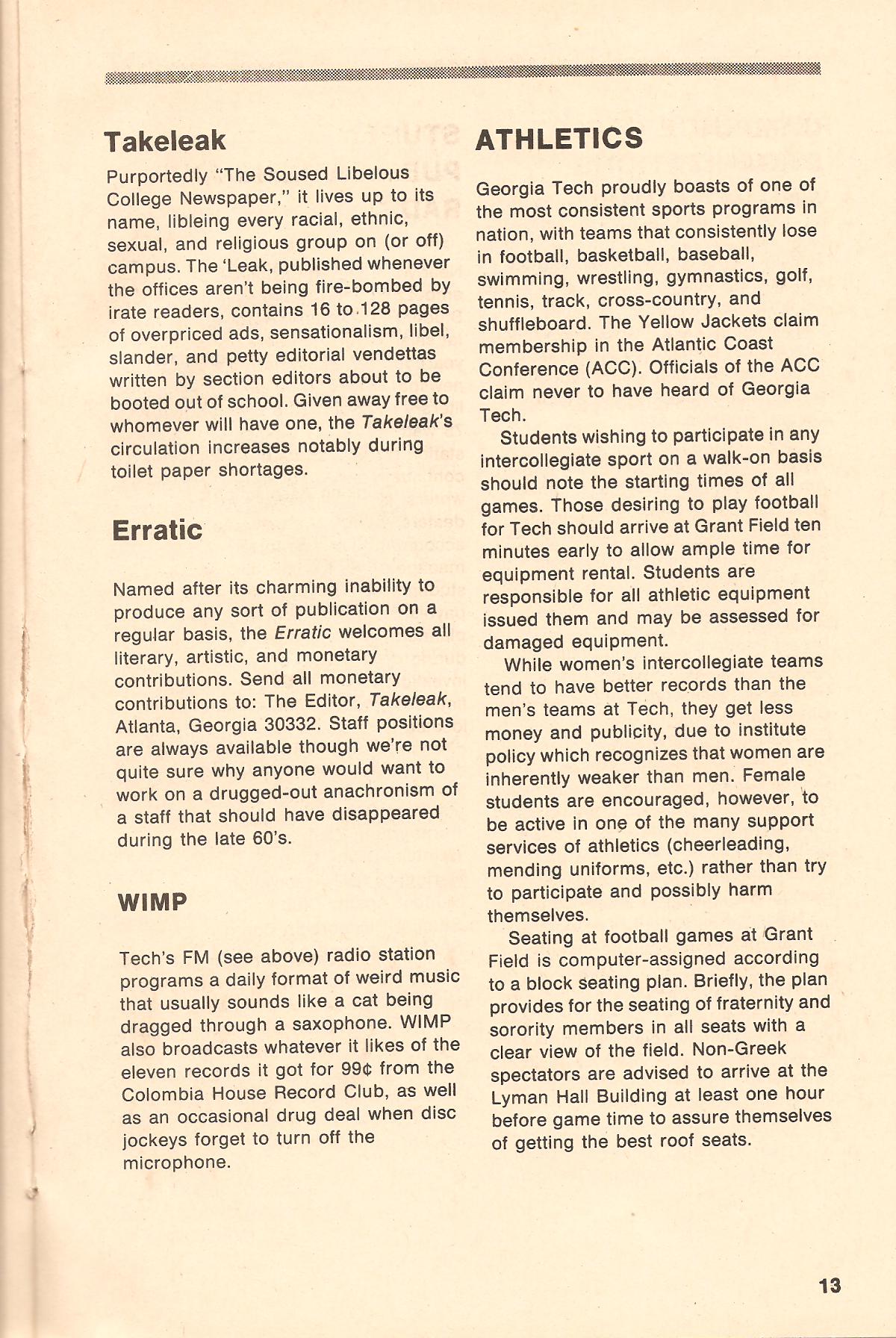
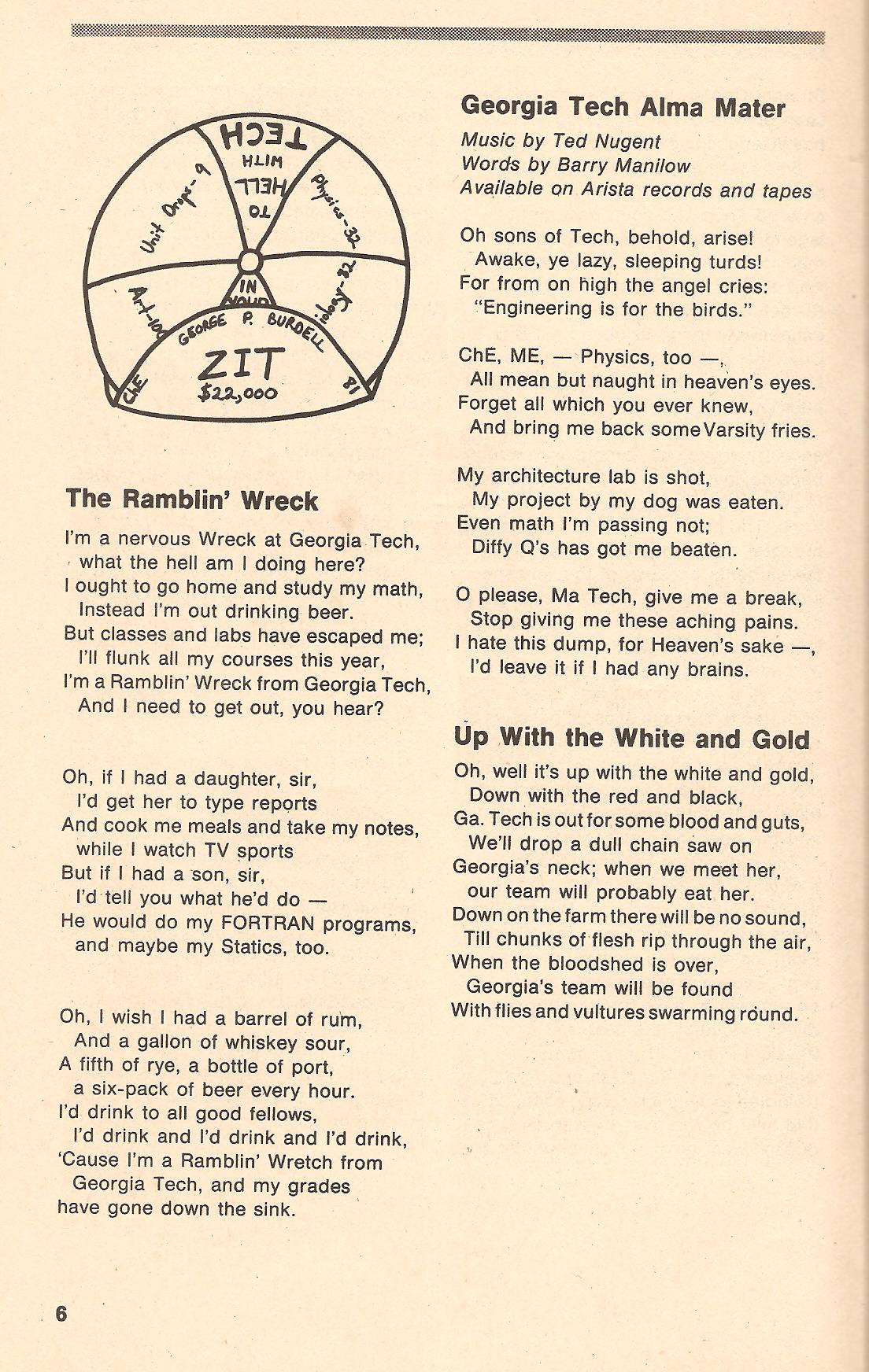
1980-1981 Student Handbook, Spring Supplement

Guess it takes one to appreciate the nerdy humour of the North Avenue Trade School, a/k/a Georgia Institute of Technology, or as folks up in the Northeast like MIT call themselves, “MIT: the Georgia Tech of the NEWMAC“.

Sample pages of the spring supplement of the student handbook for your reading enjoyment:

NOTE: The “handbook is prepared for the amusement of the Georgia Tech community and is not to be construed as an official publication of the Board of Regents of the University System of Georgia, but really it is, we just can’t say that in print.  In case of any divergence from the Bylaws or Whims of the Board of Regents, the official Rules of the Game for Deluxe Monopoly, by Parker Brothers, shall prevail.”

Choosing Not To Force Myself To Write

Watching others find ways to live, and watching myself reach out to the world through the cold, unloving connections of bits and bytes, I wonder…

While keeping the research of the particles of life moving forward, just so we can reach a milestone 14,284 days from now…

I wonder.

The old ways are still valid comparison points, I tell myself.

Political boundaries were meaningful at some point in time.

Every supercivilisation concedes old economies of scale to the previous generation.

I wonder why parents force so many structured activities on their children when children will become better adults if given time to explore subjects their parents don’t care to know about or simply don’t know exist.

How much of a general education is good for one person?

In sixth grade, I’ve said here at least once, I learned about the Soviet Union making students choose the direction their education would take at around age 10 or 11 (my same age at the time), and about Germany giving students the Gymnasium route, if they chose, after their primary school years were completed.

In secondary school, I could choose a vocational/technical program, a college preparatory program or a general education program for my high school diploma.

Specialisation divided me from my primary school classmates at age 15.

My observations about life in general began to take a new direction at that age, despite my desire to learn about all ways of life.

I lost track of the thought patterns of students outside the college preparatory track.

Yet, I still kept trying to apply my theories about general personality types to a smaller population.

Thus, at university, my theories were destroyed.

Was it inevitable?  For me, obviously, yes.

Snobbishness did not equate to applied intelligence as it had amongst my friends in secondary school.

People with a so-called redneck personality were just as likely to pursue a career in engineering or science as a person who had never seen a can of PBR beer.

And in the streets of downtown Atlanta, those who never completed a formal education were just as likely to drink high-shelf liquor and drive expensive cars as those who had PhDs and invented the Next Big Thing.

The Internet, a general means of access to self-education, did not exist in my youth.  Television, films, books, magazines, newspapers and contact with other people were the limited means to teach oneself.

I couldn’t instantly tweet with a person on the other side of the globe but I could exchange letters with an international penpal.

Ham radio gave some semblance of tweeting/texting.  Both provide no clear understanding of body language (but voice-based ham radio communication did provide intonation (Morse code was the tweeting/texting of its day, of course)).

But one body is still one body, subject to circadian, natural wake/sleep cycles.  Despite external devices and integrated prosthetic body part advancement, we chiefly depend on the speed of our central nervous system to process stimuli.

We may have speeded up the ability to herd our species but we are still flesh-and-blood states of energy.

Enlightened youth want more and they want it now, while older people want to keep their well-established lifestyles.

In general.

I enjoy watching the misdisuninformation cycles that those with something to sell/tell start by dropping a pebble, the concentric circles distorting and being distorted by all the competing messages vying to become stimuli to individuals and groups.

I have nothing to sell or tell.

I want to live a life that is amenable, even if “amenable” is a word I have to look up its meaning to determine if I’ve used its definition in the right context here.

So far, I’ve enjoyed the luxury of sharing my observations freely, keeping myself from succumbing to the temptation of luxury.

As we become more fully aware that consciousness is a deception that can fool us into a self-destructive supercivilisation, we will give more and more thought to the fact our bodies are made of competing subsystems working for the greater good of the body.

Nurture creative criticism in our children so they will understand friendly competition is the route to a world of competing subcultures working for the greater good of the body.

Cutting off negative pathways is painful but so is removing a gangrenous body part for the sake of the body.

There is no ultimate solution.  Life goes on.

We adjust to the changing times or we don’t – either response is acceptable.

Give room for the voices to be heard – the best solution in the moment often comes from a place we won’t know existed because a parent gave a child time for self-education outside the prescripted norm.

The size of the pathway or nervous system pipeline is key to understanding how to read the health of a subculture.  Overcrowd the pathway or overclock the pipeline speed and you create side effects that quickly turn into pathological terminators.

Are any of these theories universally valid or have I created a thought set that applies to a limited population?

Two overworked data points

In a recent test, my programmers created an American English speaking character on a Chinese social media site.  The character commented on world news and talked about a personal life gleaned from averaging profiles of Chinese social media participants, in order to attract a certain following and sway opinions in favour of a future business deal that didn’t really exist, to see if the Chinese “friends” would suggest the business deal on their own and/or invest in the companies (the real ones) or increase searches for the companies (including fake ones mentioned by the NAmE character).

In the world of unexpected consequences, the real companies’ stock values increased significantly enough to create some relatively wealthy people in other parts of the world, thus reinforcing the valued opinions of the fake NAmE character who, in turn, said the business deal that the Chinese “friends” eventually suggested had been discovered to be a rumour the NAmE character forwarded on purpose.

The Chinese “friends” were at first offended.

However, several of them decided to play the game themselves, enlisting the fake NAmE character to create more innuendos that induce stock-price building rumours.

The groupthink intelligence spread into other social networks, so that a bunch of social friends got rich by feeding rumours for stocks that had little or no value but increased enough for the investors to use exponential investment schemes to get rich slowly enough across several stock exchanges to not attract attention.

A social science professor figured out what my programmers had done and created a superset modeling program that spread multiple versions of our fake NAmE character into social networks around the world.

Now, I’m getting rich and building an offshore bank account the old-fashioned way.

I no longer have to worry that my retirement plan will reveal the underground/illegal market slush funds I created to eventually live the life I wanted as a financially-independent, aesthetically ascetic guru.

Time to break free?

We’ll see.