Return to ROI

Something, some thought, some idea, in the back/top/middle of my head is itching.

I look at old stats such as this:

I wonder about the average cost of postsecondary education for a college student in the U.S.:

Figure 40-1: Total cost of attending an undergraduate institution for first-time, full-time students receiving aid, by level and control of institution and living arrangement: Academic year 2010-11

Figure 40-1: Total cost of attending an undergraduate institution for first-time, full-time students receiving aid, by level and control of institution and living arrangement: Academic year 2010-11

I examine tables such as this one:

Figure 29-1: Percentage of youth ages 16-24 who were neither enrolled in school nor working, by sex: Selected years, 1990-2011

Figure 29-1: Percentage of youth ages 16-24 who were neither enrolled in school nor working, by sex: Selected years, 1990-2011

Finally, I ask myself, what, based on the salaries of youth who reached adulthood, was my ROI (return on investment) of these kids?:

Figure 49-2: Median annual earnings of full-time, full-year wage and salary workers ages 25-34, by educational attainment and sex: 2010

Figure 49-2: Median annual earnings of full-time, full-year wage and salary workers ages 25-34, by educational attainment and sex: 2010

And that’s just the U.S. domestic market.

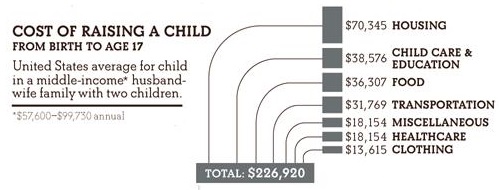
I’m thinking about this one…~$227k to raise a middle-class kid.  Looking at salary figures above, the kid has to work for quite a few number of years to pay back the investment in his upbringing.

Where is the line where ROI is achieved?

Meanwhile, those shrinking middle-class kids are having kids and using public resources, contributing some small amount toward supporting public employee pension funds, Medicare, Medicaid, Social Security, etc., that they hope to receive themselves one day, even if they don’t believe the benefits will be available when they reach their senior citizen years.

In other words, our investment in the average citizen continues throughout that citizen’s life, well after ROI on childhood is achieved.

But there’s something else here in and out of this data set that still itches, has itched and continues to itch every time the subject passes through my thought set.

More than social responsibility.

More than cultural expectations.

More than formative years brainwashing.

More than standard/quality of living.

I see the costs, I see the benefits of straightline ROI, but the je ne sais quoi…???

What about the noneconomic value of a person?  Where are we accounting for the individual person’s thoughts, dreams, wants, needs, etc.?

One thousand years from now, we hold a history class and talk about the concept of worship through the rise and fall of civilisations.

During the first few thousand years of our species’ history, we slowly replaced the worship of unseen deities with the worship of money, as simply demonstrated through the construction and sole function of edifices found during archaeological digs.

It took a hard turn from deity-to-money history for us to change what we worship 1000 years later.

But we’ll save that lesson for another blog entry.

Thanks to Meagan at Tenders; Joe and Jennifer at KCDC.

Master and Commander: The Far Side Calendar Edition

“Grasshopper, what lesson have I taught you today?”

“That biting my fingernails is a sign.”

“And…?”

“That biting my toenails is also a sign, a sign of flexibility, but one need not always be flexible.”

“Very good.”

“Thank you, Master.”

“You are welcome.  It is time we look at broader subjects.  Have you ever heard me talk about our enemies?”

“No, Master.  You have told me one must never have enemies, only opportunities to learn from those whose beliefs complement one’s own.”

“Very good, Grasshopper.”

“Thank you, Master.”

“Remember, little one, I have told you many times to call me Mister.”

“Yes, Master Mister.”

“[Sigh.]  Very well.  I will not reinforce your habit of mastering your subjects, including me.  Let us proceed.”

“Yes, Mister Master Mister, Master.”

“As you recall from a previous lesson, we observed two people in opposition.  What did I tell you?”

“That one should adopt the best traits and best people, allowing others to demonise the remaining traits and remaining people so that one may concentrate on pure joy, happiness, and meditation of best-ness.”

“Indeed.  Grasshopper, you do well today.  But do not bite your toenails.  We are not animals.”

“But, Master, you bite your toenails.”

“Only after I have cut them from my toes do I use my toenails as ‘toothpicks’ when wood is unavailable to remove rice hulls from between my teeth.”

“Yes, Master.”

“Remember, one must be resourceful yet maintain one’s harmony with one’s true sense of self.”

“Yes, Master Mister Master Mister, Mister.”

“What else did you learn from that lesson?”

“By observing how one’s colleagues make enemies out of other people do we learn their true nature.”

“And…?”

“That pizza is a delicious late-night snack when meditating upon 24-hour sports network viewing.”

“Where did you get such an idea, Grasshopper?”

“From you, Master, Mister, Master.  You, yourself, have said your round belly of wisdom should be called the Pizza Palace of Peace.”

“You pay attention to too much of my humorous asides, Grasshopper.  Telling and understanding jokes is the deepest of wisdoms one attains through years of listening to others’ foolish behaviour.  One must not confuse wisecracks from wise observations.”

“Master, I do not understand, Mister.  Are they not both kernels of wisdom?”

“Very wise of you to say that, Grasshopper…”

“Do you not use my name, ‘Grasshopper,’ as both a serious reference to my body and as a joking reference to my impermanence, in addition to my insignificance as an insect in comparison to my body?”

“Yes, Grasshopper.  We have discussed this many times in your decades of training.  At 50 years of age, you are well past the time in one’s life when one should leave this training center and pursue one’s destiny.  So your name is both a reverent label and an irreverent joke about you overstaying your education.”

“But, Master.  You have never left these walls.  Are we not both trapping ourselves within imaginary walls around our true destiny?”

“Grasshopper, your wisdom is beyond your years and yet beneath you.  One must never say more than one feels.”

“But what does one feel about walls?  I have no emotional ties to the kiln-dried bricks and mortar.”

“Grasshopper, let us put off that lesson until tomorrow.  I am feeling tired and very, very old.”

“But, Master, you, Master Mister, are only five years old.  How can a Mister Master like you feel old?  This is the time when Masters like you usually feel playful.”

“Grasshopper, you know that wisdom is not measured in years.  Look at the golfers who play in the Masters.  Some master their skills at an early age and some do not find the master to hone their skills for them until they are much older.”

“Yes, Master.  We both need our rest.”

“Indeed.  And please, please, please, call me Mister, not Master, not Master Mister or Mister Master, or Master Mister Master, or Mister Master Mister, or…”

“But, Master, it is my joke I play on you.  Can you not see that?”

“Yes, Grasshopper. But like the lesson where we keep the best traits of our perceived enemies for ourselves, let us give the worst jokes or the jokes that have grown old to our perceived enemies, too.”

“Yes, Mast…err, I mean, Mister.”

“Thank you, Grasshopper.  You may return to your eight-hour duty of raking the autumn leaves that fall upon our gravel path.”

“The leaves never stop falling this time of year.”

“Yes.  A lesson you have taught yourself over and over for how long now?”

“Forty-eight years, Mister.”

“That’s right.  I forgot you were a late bloomer, two years old when you were brought here.”

“Yes, Mister.  That’s why I have not left.  My previous Master told me that blooming late is my specialty.”

“A wise Mister Master, indeed!”

Sewer Outfall

In one projection of the future, toilets no longer use water.

In that projection, sewer systems are filled with less fluid.

Sewer pipes are available for other uses if…

…if we find a substitute for water-based baths/showers, sinks with water spigots, drains for nonwater liquids.

What if we cleaned ourselves and our environment with liquids that collected into containers and the liquids then evaporated?

How would we dispose of the remaining material?

Instead of disposing, how about recycling/repurposing?

Dirt, oil, blood, skin cells, hair, sand, minerals, grass, sawdust, insects…and on and on.

No more sewer systems.

No more jewellery lost.

No more…

What do you pour down drains today that you no longer think about, out of sight, out of mind?

You’ve never waded down a sewer line, have you?

You’ve never smelled the gases flowing downstream with inertia.

You haven’t seen the screens collecting debris at the entrance to a sewer treatment plant.

When the toilet is reinvented, plenty of infrastructure changes take place, disrupting old models where companies and governmental agencies have vested interests in maintaining the status quo.

That’s a whole other paradigm shift of inertia to take into consideration.

Same as trying to change popular youth educational programs.

Not to mention the profitable postsecondary models.

Am I alive?

While I wait for my new LCD monitor with HDMI connection to arrive, thus turning my smartphone into my desktop/laptop PC at home and Internet phablet on the road, I shall write here once more.

That, and the overwhelming reader response to ending this blog, as usual.

This afternoon, I attended the funeral of a 98-year old man, met his widow, and am friends with two of his children, one who is a girlfriend of a longtime friend of mine from our college days in Knoxville.

I also saw some familiar faces from my time here in this community — 27 years or thereabouts — people like Peggy Sammon and Butch Damson.

Ninety-eight years young…

I cannot imagine living so long.

Meanwhile, a house wren hops up and down the window screen, looking for food, digging through the debris in the old, broken, rusted gutter hanging off the rotting eave.

I did not know the man who was buried today.

I felt like a fifth wheel, a stranger inserting myself into the graveside mourning of others.

So, to hide my face from the crowd, I stood behind a pocket camera snapping pics for the daughter and friends in Germany who could not be there while we who were gathered recited prayers together for the deceased.

I am of the walking dead myself, but my friends say Jesus loves me, this I [should] know…

Sorry, that last bit slipped out, a verse from a children’s song.

I did not know the man who was buried today but I was able to join his family and a group of strangers, sharing a subculture full of familiar songs, poems, prayers and rituals.

It was a window opening up the sounds and sights of my childhood.

It was a window of opportunity, listening to the stories about Rudi Schlidt from his closest friends and relatives.

Of course, I can’t hear so well so I’m not sure what anybody said, using their body language and voice inflection to tell me when I was supposed to smile, laugh, cry or do nothing but listen attentively.

Rudi was nearly twice my age when he died.

He made important contributions to the advances of rocket science.  He, like many in this town, could easily say, “As a matter of fact, I am a rocket scientist/engineer.”

His wife was secretary to Wernher von Braun, who may or may not be familiar to you.  Today, her face still shines with beauty at 91 years of age.

There is more and less than meets the eye, to be sure, but today I simply let the sights suffice to register my presence on this planet another day, amidst those who registered the absence of a friend, [(great)grand]father, coworker and fellow member of the community.

Am I alive?  I don’t know.  I explore the universe from atop this tiny planet of ours and wonder.  That’s all I care to know.  The rest is none of my business.  Gott behüte.

Auf wiedersehen, Herr Schlidt.  From the crowd at your graveside service today, know that you are/were loved.  Gott liebt dich.  Gott segne.

Hardware-in-the-loop

The one area of intelligence that my wife and I agree on is the definition of X-in-the-loop.

A machine that requires input from a person is a human-in-the-loop device/system.

All commercial automobiles require a person to operate the automobile (but that is quickly going to change).

Is a road full of automobiles that require no human input a sign of intelligence?

What about the Curiosity rover on Mars?

What features can we list that show autonomous functions in one subset, intelligent functions in another and a set of features in the subset of the autonomy/intelligence junction?

What makes the autonomous functions of my central nervous system intelligent or conscious?

What about the automatic connection of my laptop computer’s WiFi radio subsystem in this room to the WiFi router in another part of the house and then on out to the Internet?

What is pure hardware-in-the-loop intelligence like, no HID required/allowed?

If a database is updated by a software program which seeks to maximise its collection of available knowledge, knowledge that it alone determines is valuable, is that intelligence?

And what about the age-old arguments of the conscious-vs-subconscious thought sets?

These words are just a few that pass through my thoughts before I make a last-second decision upon another upon another, etc., until I type these words in a coherent whole row called a sentence, in exclusion of and in competition within a finite possibility (you won’t find Croatian or Sanskrit here without the use of an online translator, for instance).

If the Internet is now an extension of my thought set, am I a human-in-the-loop extension of the Internet?

I sit here, taking an occasional sip of black label Irish whiskey (“Black Bush”), looking at the clock, which shows 22:38, and contemplate going to bed, where I will not be directly disturbed by the Internet, although my dreams (my subconscious?) may work through thought patterns I’ve had today about artificial machine intelligence which date back to my childhood days of the 1970s and the promise of LISP/ELIZA and other AI programs that relied on pattern-matching (why does the image of trees appear in my thoughts right now?).

…data structures…hmm…

On the floor next to me, in addition to “Dictionary of Quotations” by Bergen Evans, “Madame Bovary” by Gustave Flaubert and “The Schizoid World of Jean-Paul Satre and R.D. Laing,” are two books that captured my attention several years ago: “I, Cyborg” by Kevin Warwick, and “Natural-Born Cyborgs: Minds, Technologies, and the Future of Human Intelligence” by Andy Clark.

From them, I contemplated a novel I write using software agents in a database, with every word/phrase/sentence/paragraph/chapter hyperlinked/connected such that the story changed based on reading the reader’s online self, with a voiceover and accompanying 3D video that interjects based on the reader’s vital signs, the novel frequently switching to a series of random words to shake up the reader’s thought patterns, slipping in and out of the reader’s online life — social life, blog, game sequences, website, etc. — so that the reader soon could lose track of self completely in a world of half-plagiarism, half-homage collage.

As I write this blog entry, my software agent has jumped from suggesting the word I’m typing to suggesting the rest of the end of the sentence.

After hundreds of blog entries, my software agent has jumped from suggesting the rest of this sentence to write the rest of the blog entry for me.

Based on the research I perform on the Internet every day and the books I have lined up to read the rest of the week, as well as following my daily patterns, including eye movements, my software agent has written the rest of this week’s blog entries for me, suggesting that I skip using the Internet altogether today and go for a nice, relaxing hike in the cool autumn morning, using my “Internet of things” kitchen appliances to assemble a sandwich along with the rest of my meal/snacks to eat that my smartphone will remind me of when my vital signs show sign of hunger along the trail.

Readers of this blog can now no longer tell when I stopped writing these blog entries, or when I sometimes step in as a person-in-the-loop to tweak a blog entry as a surprise, because both I and the software agent use the trick of occasional misspellings and grammatical errors to give an ambience of authenticity to my/its speedy typing and lack of postcreation proofreading/editing.

Is this intelligence?

If all I do between computer programming gigs and life coaching, other than go out to eat, shop, attend football games, watch movies and travel with my wife, is write blog entries here, your only connection with me, could you say I am more or less intelligent than the output of my software agent?

What if my writing became more oblique and more full of interesting Internet links, would I (or, rather, my proxy) seem more intelligent?

When all of us depend on software agents to supplement or (perhaps) better yet, substitute for our online lives, is the Internet intelligent/conscious?

When software agents are interacting with software agents to create unique output that I and the other people who created their software agents would not have thought of, is that a sign that the Internet has become intelligent/conscious?

Is a “train” of autonomous automobiles traveling on a road an intelligent/conscious entity all its own, receiving stimuli from the environment and reacting as one just like a caterpillar or earthworm from our anthropomorphic view?

How can I say that my typing here is anything more than an autonomous response by my set of states of energy to the environment?

Am I really just a hardware-in-the-loop device like any other set of states of energy in the universe?

Why should I label “me” as a special condition of intelligence or consciousness?  Because I say I can see myself write this blog entry while I “see” thoughts that do not win the competition to make this blog entry a coherent sequence of symbols we call words?

The wooden mannequin on my desk has no autonomous functions, does it?

What about gravitational pull holding it down on the desk?

What about the photons interacting with its surface, indicating a series of paths from the incandescent light bulb inefficiently emitting more heat than light that reflects off the shiny surface of the mannequin into my eyeballs?

Obviously, I’d be more convinced if the mannequin started talking to me in a manner I could understand — arm gestures, leg movements, etc.

I shake the desktop and the mannequin shakes in responses.

We have a relationship with each other, if not an understanding between us.

Is that a sign of intelligence/consciousness?

I cannot assume that what I anthropomorphically or anthropocentrically want to call intelligence/consciousness is what I will see when the interconnected wires and fibers we call the Internet becomes more than an automatic response to our stimuli, which is really all I am in one view, aren’t I?

Never assume the event horizon hasn’t already been crossed just because your definition of the impossible is the only one you can envision.

Hindsight is mostly 20/20.

Symbiosis is asymptomatic, in my book (but that’s the whiskey talking, not me).

Good night!

New university study

According to the University for the Study of University Studies**, a compilation of studies on the investigation into the root causes of paedophilia has demonstrated that there is an indirect correlation between those who believe in and practice polygamy* and those who practice paedophilia.

When reached for comment, the academician in charge, who requested anonymity after receiving threats from people around the world who actively practice polygamy, said, “We can either legitimise and institutionalise polygamy, giving full rights and recognition to those who wish to mate with young women as soon as they reach puberty, or we can continue to find adults confessing they were abused as children by closet polygamists.  Either way, it appears to be not so much an individual mental problem, but a natural progression of a species that has refined social interaction into what cultural anthropologists currently call civilisation.”

To validate the study, the academician recommended hypnotising those accused of paedophilia, such as the Penn State assistant football coach, Jerry Sandusky, as well as those who assist in covering up paedophilia activities, such as Catholic priests and others up the Vatican’s chain of command, to reach their subconscious thoughts and see if they secretly believe in polygamy.

The release of this study has sent shockwaves throughout the community of “true believers” of the Mormon faith as well as orthodox Muslims.  Producers for the TV shows, “The Bachelor,” “The Bachelorette,” and “The Jerry Springer Show,” were not surprised.

Salman Rushdie refused to respond to requests for information regarding a book he is reported to have penned about this very subject years ago but never published.

*Note: there is a small, but not insignificant number of those who believe in and practice polyandry.  The same comments about polygamy above also apply to polyandry, according to footnotes in the university study.

**Due to a concern for their safety, the administration, faculty and staff of the online university that produced this study have also asked for their names and the name of the university to be withheld from this news article, pending approval of their acceptance into the Federal Witness Protection Program.

The Menace From Beyond The Grave Situation

While we set our supercomputers to analyse processes that heat our CPUs surreptitiously, we give you another list of books added recently to our old-fashioned library of paper-and-ink products:

  • Facts on Aviation For The Future Flyers Of Tennessee, (c) 1944 Tennessee Bureau of Aeronautics, Nashville, Tennessee
  • Submarine! The Story of Undersea Fighters, by Kendall Banning, illustrated by Charles Rosner, (c) 1942 by Artists and Writers Guild, Inc., printed in the United States of America
  • The First Book of Moses called Genesis, translated out of the original Hebrew and with the former translations currently compared and revised, set forth in 1911 and commonly known as the King James version, pocket edition by American Bible Society (instituted in the year 1816), New York
  • Stamp collecting book by Richard Hill, Sunset Trail, Knoxville 18, Tennessee, manufactured by U.S. Government Printing Office
  • History of America, by Carl Russell Fish, Professor of American History, University of Wisconsin, illustrations by Leon D’Emo and Will Crawford, (c) 1925, 1928 by American Book Company, Made in U.S.A., owned by Ralph Eldridge, Knoxville Central High School senior 1932
  • The Kingsport Strike, by Sylvester Petro, (c) January 1967, Arlington House, New Rochelle, NY
  • International Atlas and Gazetteer of the World, containing a new and complete Descriptive Gazetteer of the Principal Countries of the World together with a complete collection of up-to-date Political Maps of the World, Statististical [sic] Tables, Census Figures, Air Line Distances, etc., (c) 1935 by C.S. Hammond & Co., Inc., Map Engravers, Printers and Publishers since 1900

Meanwhile, our staff in the Department of Dastardly Deeds has developed a potential storyline for us to follow:

By experimenting with chemical formulae, scientists have perfected the ideal poison letter.  Soon, they will infiltrate the labs of laser printer cartridge manufacturers, change the ingredients of the cartridge contents and release the newest formula into the homes, factories, offices, Internet cafes, construction trailers and libraries of the world.

Then, when the time is right, they will activate the signal that tells the cartridges to print a special circuit on paper.

The circuit, combined with the special ink that, after being heated and fused to the paper, uses the release of heat as the paper cools to send a strong enough “charge” to a blob of ink in one corner of the paper to achieve a minor goal of the Department of Dastardly Deeds.

The scientists have asked us not to reveal their goal at this time.

We won’t, because we have to figure out if their goal aligns with our major milestones before we decide to increase or eliminate their department budget.

While that’s going on, we’ll let you know that the brain circuit reconfiguration we’re testing on Jesse Jackson, Jr., may work this time.  We have tried similar experiments on other members in the public eye (refrain from referring to our previous work as “lobotomy,” electroshock treatment, drug cocktail service, etc.), in order to keep them in line with our milestones.

Those who haven’t stayed on message have been moved aside (again, refrain from referring to our previous work as  “failing the newspaper test,” “assassination,” “drug overdose,” suicide, not seeking reelection, retiring unexpectedly, etc.).

Managing a planet is distracting, we admit, but, on days when we’re bored, it provides an entertaining respite from looking back at this time period 1000 years in the future while trying to live a fulfilling life 1000 years from now, too.

A Second Look at Female Suicide

Is it true more American military kill themselves than die in battle or perish in motorbike wrecks?  If so, what is the ratio of military men to women self-sacrificers?

Compared to the civilian population and, more specifically, civilian job categories, how much higher or lower are male military or female military likely to kill themselves than, say, dentists or cops?

Finally, is it because we’ve infested the military population with the same microorganisms that push cat owners into ending their ninth try at a nice life?

Could we look back at those of the female persuasion who left written records and killed themselves, analysing their literary output for clues as to the true cause of their desire for demise?

For instance, take this poem of Sylvia Plath.  Is it just me or is she perhaps using her poetic licence to drive home a point that it was secretly a creature of the feline persuasion that persuaded her to say goodbye to life, to children, to husband, to career?:

The Companionable Ills

by Sylvia Plath

The nose-end that twitches, the old imperfections—
Tolerable now as moles on the face
Put up with until chagrin gives place
To a wry complaisance—

Dug in first as God’s spurs
To start the spirit out of the mud
It stabled in; long-used, became well-loved
Bedfellows of the spirit’s debauch, fond masters.

Ship’s log

17 June 1987, 17:53

I have entered a new adventure in learning (for which my wife and I have given one hundred and seventy-seven American dollars).  This adventure is entitled Sociology 480 – Society of the Future.  The other members of this adventure will share the ideas we bring to the class and the ideas of the members of the Worldwatch Institute who have issued “A Worldwatch Institute Report on Progress Toward a Sustainable Society,” entitled State of the World 1987.

= = = = = = = = = =

17 June 1987

Dr. Donald Tarter, instructor, Sociology of the Future

  • For the next 25 years, NOBODY CAN PREDICT THE FUTURE!!!
  • Doesn’t stop us from asking, “What if…?”  “What can happen?”
  • Some have made bold predictions in science, literature and behavioural studies:
    • Carl Sagan
    • Arthur Clarke
    • B.F. Skinner
  • For instance, Sagan predicts that survival over the next 100 years for endangered species is less than 10%.

Analyzing the Pressures of Population, especially ours:

  • Population factors such as growth rates, supply and demand for resources
  • Energy alternatives — availability of supplies
  • Mineral resources
  • Agricultural resources — can we grow enough?

= = = = = = = = = =

29 June 1987 20:20

A visit by Dr. Carl Sagan to Huntsville, Alabama, to discuss “Star Wars or Mars.”

Leaving this planet

  • Application of rocketry
    – developed by Chinese
    – developed into instruments of death and destruction by Europeans
    60,000 nuclear weapons
    1 submarine can destroy 192 cities
    “A central exchange” – ~200 million to 2 billion killed on tight nuclear winter — destruction of agriculture; starvation, destruction of ozone layer would bring about equivalent of large-scale AIDS
    You cannot trust estimates of probability of failure when the stakes are high
  • Solutions
    “Star Wars” a/k/a SDI (strategic defense initiative)
    Render nuclear weapons “impotent and obsolete” — President Reagan
    If simultaneous deployment by both sides were possible then the shield would be feasible
  • Cons
    Porosity — one Senate group predicts 16% of Soviet weapons destroy
    10% getting through means 1000 Soviet weapons which would wipe out America
    U.S. is invaded daily by small aircraft carrying the weight but not the density of nuclear weapons
    Decoys and penetration aids, low flying (depressed) flight paths, increased number of warheads built by Soviets
    Computer program “battle management system” to detect and destroy the nuclear warheads would be too complex to design and debug
    If U.S. had first strike then Stars Wars could wipe out remaining Soviet nuclear weapons
    Would cost $2 trillion U.S. dollars
    Some scientists refusing to be involved in SDI — ~10,000 in number
    Estimated that $600M spent on SDI in Huntsville
    Not worth the cost even if money was available
    National security should be measured by wealth of economy, not by money spent on national defense
    Children should look forward to growing up
  • Alternative — bilateral decrease in strategic arms

Rocketry

  • Werner von Braun in Germany, Robert Goddard in U.S.
    After WWII in U.S., 1961-1978, the moment the human species (mainly the U.S.) explored all the planets known to the ancients
    Now many other nations have joined the exploration
  • Today, NASA is dis-spirited, in serious trouble
    Principle reason: NO GOAL
    IT NEEDS A GOAL AND ONE EXISTS:
    Systematic robotic exploration of Mars,
    followed by manned exploration of Mars around the turn of the century
  • If one or more nations combined, it could cost less than one strategic weapon
    Exploration could help show why the deterioration of the water on Mars…
    Send robots to Mars if science reason only
  • Should combine/cooperate with Soviets in some project on behalf of human species
    “Existence theorem” – high-tech cooperation is possible

    1. Cooperative unmanned exploration of Mars and its moons; Soviets plan to send six spacecraft to Mars 1988-2000
    2. Cooperate to build space station to build ships in space to make interplanetary travel for 9-month trip or longer
    3. Would capture the imagination of the human species that no other project would do!

    Same technology involved as in military

  • “It is as if God said, ‘Before you I set the tools of immense power to destroy yourselves or carry yourselves to the planets and the cosmos.'”
  • Governments make mistakes, lie, cheat and steal
    All citizens should have minimal understanding of science and engineering
    Reduction of nuclear arms — one problem at a time, other weapons reduced later
  • Reach minimum deterrence, not zero possession
    1968 Nuclear Non-proliferation Treaty, Article VI, U.S. and USSR pledge to massively reduce their nuclear arsenals
  • “Testosterone poisoning” — men involved together too long in the act of killing
    Men are adapted to hunger-gatherers in East Africa but not to high-tech nuclear arms race today
  • Tortoise (them) and hare (us) effect with regards to space race — our government started out faster but quit…

= = = = = = = = = =

TWENTY-FIVE YEARS HAVE PASSED SINCE THESE SHIP’S LOG ENTRIES WERE WRITTEN…

Where are the ideas discussed in today’s “sociology of the future” class going to take us another 25 years hence?

  • Will computer modeling look as quaint as some of Sagan’s ideas look today?
  • Will our integration with electronic technology so blur the line between a body and machine, we stop paying attention to the distinction?
  • Will space exploration and planetary settlement make us no longer an Earth-based lifeform?

Rick wants to come back and share with you the future 1000 years from now but he promised himself he’d retire from active management of our species and fulfill his destiny to become one with nature, whatever that means.  Don’t make him come out of retirement and tell you what he already knows you’re going to do.  Trust that words like “recession” and “depression” are purely labels used to reinforce our species’ overprocessed development of social engagement we call economics and has nothing to do with how well our species will adapt to ecological changes currently in progress, such as planetary warming that goes against what should be a cooling period.  The planet transforms, individual species dying away as species always do, ours doomed to eventually disappear in the grand scale of planetary history — doesn’t matter if it’s in thousands, millions or billions of years, does it?  Keep on keeping on.

Organisational Skill Assessment

Before I compose a hand-drawn animation sequence with the Bamboo Capture graphics tablet and fill my future with out-of-date electronic debris, I finish sorting through the piles of debris that constitute the bulk of written material which emanated from this set of states of energy called me.

Watched a commencement speech by Laurie Anderson [I thought, for a public performance multimedia artist, her acting was rather stilted], which has prompted me to click my way to a website and order a copy of the book, “How to be idle,” which in turn opened my eyes to the reams of office paperwork stacked in boxes around me.

Here’s one from 03/24/98:

Kiersey Temperament Sorter Results

Your Temperament is Idealist: NF
Your variant temperament is Healer: INFP

Any Personality Test, including the Sorter is just a rough indicator of temperament.
You might want to look at different temperament descriptions to verify the results and learn about other types of people for comparison.

I+6 N+16 F+12 P+14

David M. Keirsey
keirsey@mail.orci.com

At that time in my life, the department manager was all about fitting us into jobs that matched our personalities.

What she didn’t account for was a chameleon like me, a people pleaser who assesses the wants and desires of the people around him and blends in, hiding his personality behind layers and layers of masks, revealing himself to a select few.

I told the manager I’m not who she thinks I am and she responded that was a normal reaction to the test results from an INFP like me.

Later, I learned that she gave the same response to everyone who questioned the test results.

I wasn’t questioning the test results.  I just wanted her to know that the test results indicated my exteriour in relation to giving her the test results I thought she wanted to see.

For instance, let’s say I find out my college History professor is a dopehead and adherent to the philosophy of Timothy Leary… I make sure my term paper for the class, a review of a book about socialist utopias, contains plenty of illicit drug references and hippy religious conversations.

My goals are not your goals.  My goals are outside of the time and place in which we encounter one another, so it doesn’t matter to me about the profit targets you want to reach or the edifices you want to build in your names.

Ideas and images associated with temporal moral and ethical practices are imaginary, as far as I’m concerned.

We either reproduce our genetic material or we don’t.

Everything else is fiction about how we decide to protect our reproductive organs until we’ve produced progeny that need our protection.

Me, I have only these works of art — the sketches and writings that were birthed by me with your influence, a part of the universe, upon me.

I have no genetically-related or adopted children.  The closest I got were the nieces and nephews who [might have] looked up to me as an adult member of their clan/tribe.

They are adults now.  My influence upon them diminishes as they decide how to protect their reproductive organs until they’ve produced progeny that need their protection.

One of my hidden goals was to live long enough to be a great-uncle.

I held up my step-niece’s little one-month young girl in my arms, making me the great-uncle I wanted to be ever since I was a little boy and looked up to my childless great-uncle and great-aunt who seemed to have extra spending money my parents never had, despite the great-relatives’ middle-class wages as a postman and office secretary, respectively.

I have grown tireder as I’ve aged, exercised less and eaten minimally-nutritious chemically-treated foodstuff.  I no longer want to be a model for others or someone to look up to.

It’s time to slow down and concentrate on the dreams and desires of the personality behind all the masks…

The boy who saw macabre nightmares come to life when his favourite politician of all time, Richard Nixon, resigned.

The boy who looked down at his plate of spaghetti and thought he was eating a dish full of bleached worms covered with red sauce to hide their little heads screaming for mercy.

The boy who heard the grass talk to him.

The boy who sailed the universe at night when no one was looking.

The boy who knew that stone gargoyles and cast-iron mailboxes were like three-dimensional photographs of a reality hidden inside other people’s heads, finding an outlet, me wondering where they came from before they appeared in people’s thoughts.

The boy who earned his Eagle Scout badge and went on into Explorer Scouts, later to become a Unit Commissioner, an adult role in Scouting, because he never thought he had gained his father’s love and trust, constantly seeking, seeking, seeking approval up until he reached his adult age of 18 where he received a full college scholarship via the U.S. Navy ROTC program, accepted at both Vanderbilt and Georgia Tech, but realising he no longer had to seek his father’s approval and flunked out on purpose.

I had become the man I never thought I’d be able to grow up to be.

I never was my father and never will be.

I am me.

My hidden visions, the alternate reality that I carry in my thoughts as I interact with people who seem to like to embrace the inconsistent reality of [sub/ex]urban lifestyles and belief systems, are crawling out of me and into the world in which we meet and greet one another cordially.

They are not perfect.

They are not commercialised, plastic products for mass production and insane profit margins.

I don’t even care if others steal, borrow or marginalise my work.

My work is not me but my work came from me so I associate myself with my work but I do not tie my self-worth to what I’ve written, drawn, danced, sang or sewn.

This is the only moment in which I live and I claim this moment as mine, declaring myself absolutely insane in comparison to the insanity of boxed stuff that we only call food because the pretty picture on the outside tells me it is.

Unlike Madison Avenue marketers, I don’t have to make money from my creative redefinition of ordinary life.

I can, have been and will be me, willing to use the excess capacity of our species’ social structure that produces a buffer zone outside of basic survival to express myself here and elsewhere, on paper, in blogs and wherever I feel I want to breathe what always has to be my last breath because the next one is not guaranteed.

On to the graphics tablet, building upon my first animation!!!

As an independent filmmaker said,

Nothing is original. Steal from anywhere that resonates with inspiration or fuels your imagination. Devour old films, new films, music, books, paintings, photographs, poems, dreams, random conversations, architecture, bridges, street signs, trees, clouds, bodies of water, light and shadows. Select only things to steal from that speak directly to your soul. If you do this, your work (and theft) will be authentic. Authenticity is invaluable; originality is nonexistent. And don’t bother concealing your thievery – celebrate it if you feel like it. In any case, always remember what Jean-Luc Godard said: “It’s not where you take things from – it’s where you take them to.”
—Jim Jarmusch, The Golden Rules of Filming[