Laws on the Books of Booked Lawyers

In what has been labeled as the Presumptuous Journalist Act, lawmakers approved a convoluted batch of legislation aimed to clarify the rights of meateaters, vegetarians and gun owners.

From now on, at least once a year meateaters must kill their own food, using guns or other means at close quarters.

Vegetarians who refuse to eat meat, let alone kill an animal for food, must pay tolls for the use of anything — every road, building or other infrastructure; any product, including food, medicine, and/or clothing; any ideas, such as business, technology, arts, science, and/or sports — that was designed, financed, built and/or maintained by meateaters.

Meateating gun owners who kill their food more than once a year are given exclusive rights to own as many guns and as much ammunition as they want.

Vegetarian gun owners are allowed to own up to as many guns and as much ammunition as they can carry to a knife fight at a broccoli slaughterhouse.

In addition, submitted at the last minute in tiny print buried deep within the Presumptuous Journalist Act, any human killed by a gun, whether through acts of war, property protection, self-defense and/or domestic violence, must be used to feed the homeless, the malnourished and/or refugees without a reliable source of food.

A rally was planned for protestors on all sides of this issue but was delayed until this year’s harvest has been brought in, counted, graded and sent to market.

CORRECTION: The rally was canceled.  Everyone sat down at the tables for the Harvest Festival and resolved their differences, agreeing that meateaters, vegetarians and gunowners can exist, if not always peaceably, in the same society.

POST-CORRECTION: A family quarrel broke out at one of the tables and a gunfight ensued, offering opportunities for more presumptuous journalists to jump up and down, getting attention for themselves and the advertisers who support them.

What you say about his company is what you say about society…

Hallelujah! I got my Christmas present early this year!

An official upgrade of my non-rooted AT&T Samsung Galaxy S3:


Galaxy-S3-Jelly-Bean-update-01

Galaxy-S3-Jelly-Bean-update-00


Galaxy-S3-Jelly-Bean-update-04

Oops!  Needed to reboot computer after upgrading Kies, it seems…

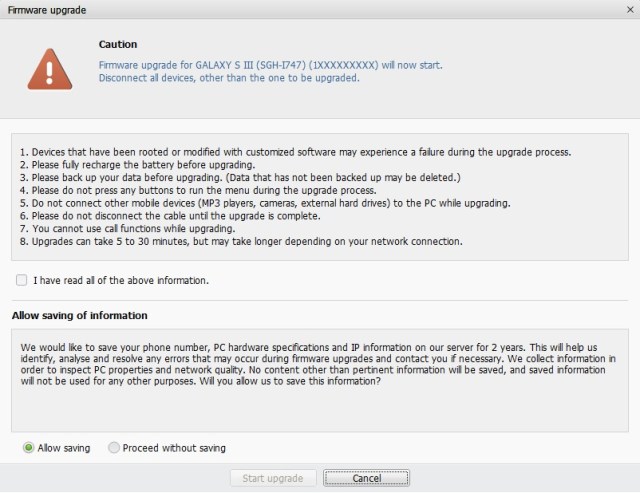
Rebooted computer, restarted the Samsung Kies software and started the firmware upgrade:

Galaxy-S3-Jelly-Bean-update-03


Galaxy-S3-Jelly-Bean-update-02


Galaxy-S3-Jelly-Bean-update-05


Galaxy-S3-Jelly-Bean-update-06


Galaxy-S3-Jelly-Bean-update-07


Galaxy-S3-Jelly-Bean-update-08


Everything is right with my world today!

Speaking of a just society

How many people work for a structured organisation?

My brain is fuzzy this morning so I’m just making this blog entry a thought experiment.

Corporate organisational charts are typically hierarchical, especially viewed from a monetary compensation viewpoint.

The higher up the chart you go, the fewer the people but the more they’re paid.

People (employees, consultants, etc.) are just one cost of doing business.

What if we redefined the cost of working for a structured organisation?

What if we told employees that part of their pay was tied to profit sharing?

What if every minimum-wage job taught employees not only how to work together with other people as a team but also how the risks and rewards of running a company are shared so that it’s not just the CEOs and executives who get bonuses but also everyone else on the organisation chart?

What are the costs and benefits for such a program?

Could we remove the necessity for minimum wage and unions if we as a nation said that all employees were entitled to sharing the profits for a job well done as a team?

Would employees feel a better sense of ownership and pride in their work?

How could such a plan be integrated into early childhood education?

How do we instill into children that every one of us is a profit center?

Some of us profit monetarily and some of us profit emotionally/spiritually; some both; some neither.

How does this apply to people who are congenitally unable to grasp the concept of teamwork?

Focus on getting new customers or keeping the old ones?

The power of the people is in the Internet.

Having worked for a telecommunications equipment designer/manufacturer, I’m familiar with the “secret,” “behind doors” negotiations that define the high-level specifications for internationally-connected technology.

Although, sometimes, the definitions might as well have been written in gibberish, hieroglyphics or undecipherable cryptic code as in so-called plain languages like English, French, German, Spanish, Chinese, Russian, Hindi, Portuguese, Arabic and Japanese.

Many a technology geek, political wonk and freedom lover impatiently wait while committees and subcommittees meet to discuss changes to the ITU Code of Business Ethical Conduct.

In other words, a few select people decide the fate of our social lives, both formal and informal, as it pertains to communicating across a substrate we call the Internet.

Even fewer of them might actually understand the underpinnings — the bits, bytes, frames, error correction and other terminological terms of endearment — that make popular tools like the World Wide Web more useful than gossiping about the latest celebrity scandal.

Do you understand some of the potential consequences?

Information = knowledge = monetary transactions

To be sure, putting up imaginary tollbooths on the information superhighway allows tracking of who passes through the tollbooth, which can be abused by arresting those whose actions are deemed a danger to political entities in power.

BIG BROTHER IS WATCHING!

I agree we should avoid clamping down the freedom that the Internet provides us as a species.

But do you understand another argument for tollbooths?

Capturing income streams that have eluded local governments which have seen their tax revenues drop while virtual marketplaces allow the exchange of goods and services without collecting taxes from local/visiting citizens.

I try to avoid the whole doomsday scenarios that others are hard-selling for their benefits.

I hope I’m a realist as much as a fellow member of our species can be.

I have faith in us and our place in the universe as sets of states of energy with short attention spans and selective memory.

How can we use these virtual tollbooths to police transactions without becoming thought police?

Policy.  Polity.  Politeness.

Look at an Ethernet frame, an IP address, a data packet, headers and footers.

Tell me what you see.

Do you know what a femtocell is?

Can you see a future where the restriction of the Internet as we know it leads to more innovation while temporarily stifling telecommunications as we’ve grown accustomed to over the last couple of decades (or the last few years for some)?

Unintended consequences…sigh…

I just want AT&T to get me, a loyal customer, the latest Android “Jelly Bean” update for my Samsung Galaxy S3 while deploying 4G LTE technology in my area at a reasonable monthly cost for my family.

Wouldn’t I like really-high-speed Internet at much lower costs like some regions of Europe and the rest of the world outside the U.S.?

Sure, but like many Americans, I’ve grown used to the fact that the lack of real competition in the marketplace has stifled innovation at the expense of greedy stockholders who demand high monetary return on their investments in exchange for poor service from the companies in which they invest.

The Internet — like physical highway systems — is a mix of freeways and toll roads.

Always has been, always will be.

Would more tollbooths increase or decrease the number of virtual highway robberies on the Internet?

Would they increase the number of jailed/tortured/murdered political objectors?

Can the ITU create a more just global society by tweaking the definition of the Internet?

Let’s hope so, even if they have to keep using complicated jargon.

They say…

Three traveling salesmen were having no luck at selling the last of their wares before the end of the year.

A new edict came from the local Roman client king that merchants could deduct 80 percent of the value of surplus goods they donated to a good cause.

So, the salesmen started asking around.

“Hey, you know any good causes that could use my stuff?”

“Sure,” replied a group of shepherds.  “We had a mass hypnosis dream that told us an infant is the secret son of a line of kings but he was born in the humblest of poor circumstances.”

The salesmen quarreled over the meaning of this statement.

“Well, my moneylender could say this is a charitable cause, could he not?  Gifts for the poor and all that.”

“I don’t know.  I mean, what if this is some kind of ruse?”

“Maybe you’re right.  But all we need is a blank receipt and we can let the accountants work out the details of the deduction.”

So they left the market and humped their camels over to the stockyard where this baby was said to be born, chatting as they went.

“Man, you ever get saddle sores?”

“Yeah.  And I’ve got the solution!  I have an exclusive shipment of talcum powder I’m willing to sell at a special discount, just for you!”

The stockyard owner chased them away, telling them he wanted no more to do with strange tales and late-night visitors.

The salesmen continued on.  Eventually, they arrived at a small house and, like good salemen wearing their best clothes, presented themselves as three wise kings from afar (although, in truth, they were three wise guys looking for any angle to close a sale).

The first spoke.  “I present to you, the parents of this shiny new baby, my gift of gold, which, at 80 percent of market value, is a really good deal!”

The second spoke.  “I humbly bow before this magnificent child and graciously offer my gift of the last lot of frankincense that, in every bazaar of this great city, is worth more than its weight in gold!”

The third spoke.  “My esteemed colleagues are wonderful, aren’t they?  But let’s face fact.  There’s nothing you want for the middle of winter like a fresh box of myrrh, especially, if you’ll pardon my saying so, when the precious gift of a beautiful baby like this one has a little accident after eating and, forgive me for speaking out of turn, leaves a lot to be desired in the odour department.”

After some small talk with the baby’s parents, the salesmen realised they weren’t going to get a blank receipt for their gifts from road-weary parents who were wise to the ways of fly-by-night trinket sellers.

Thus, the salesmen waited until the shepherds stopped by to ensure there were witnesses should an audit of the salesmen’s finances question a deduction for gifts of gold, frankincense and myrrh to the son of an obscure poor couple in Bethlehem, just in case no one believed their story that an angel had spoken to them to follow a star.

After a few sketches by the local papyrus newspaper artist, the crowd began to disperse.

Bowing with apologies, the salesmen rushed back to their hometowns, avoiding any contact with the Roman client king Herod until they could get their travel receipts straightened out.  Tired, hungry and dusty, they arrived safely at home, carefully documenting their sales, ready to see what shipments they had that would sell better on their next trips.

9720304-cartoon-of-the-three-wise-men-with-gold-frankincense-and-myrrh

Sidewalks are a luxury we can ill afford

Walking down the asphalt pathway that serves as a minor vein in the arterial network for motorised vehicles, I observed a dirty old dog sniffing around a rubbish bin, wondering if dog catchers still exist.

Just now, an hour later, I saw the dog catcher drive by.  Bye, bye, dog, someone’s previous pet — you were loved once and now you’re gone, just like that.

Ahh…the convenience of old-fashioned social networking.

Some days, it’s best to let pictures speak for themselves.

20121203_08535520121203_08480620121203_08551320121203_08572120121203_08515720121203_09000420121203_09012620121203_09055520121203_09061620121203_090707

Urban Sprawlificationalismificationalistical Tendencies

If urbanalistic trends mean that a move toward higher population density as a…what?  Defense against or positive move toward something that is less populated…

Then…

What makes you more or less tolerant or other people’s lifestyles?

Should we stop urban sprawl now in order to preserve subcultures like the Amish communities that aren’t as obviously dressed differently?

What if rural communities, en masse, seceded from their urban cousins?

How can citizens tell their community leaders that they don’t want to grow any faster/bigger?

What are the legal rights of a people to stop the suburban mallification/shopping centre/franchise homogenisation that flattens walls between subcultural beliefs/practices?

Some people actually put other idols on pedestals besides [the pursuit of] money…

Ribbons down my back

Feminists call me sexist and my guy friends call me awesome.

What can I say?

Yes, I was the first man in my community who printed his own 3D girlfriend.

Sounds pretty cool, doesn’t it?

Not necessarily.

Although she has access to the Internet 24/7 and can do anything I ask her (“fix the leaking roof,” “change the oil in the car and tune it for an upcoming street race after you bake an apple pie and do the laundry”), there’s…well, something missing.

A lack of common sense, perhaps?

For instance, yesterday I asked her to complete our Christmas shopping and wrap all the packages with the fanciest wrapping paper she could find within a fixed budget.

She could do that.  Fine.

However, this morning, after I stumbled into the bathroom and looked at myself in the mirror, a face covered with glitter growled back at me.

It seems that my girlfriend bought glitter wrapping paper and wrapped the packages on our bedsheets before we went to bed last night, sprinkling tiny green shiny particles on the pillow for my skin to pick up like a dust sweeper.

So, sure, I can program her to gently wake me in the morning before she makes me the perfect breakfast according to my subconscious wishes, having been programmed to read my brain waves while I’m sleeping.

But…

Well…

Hmm…

How can the most knowledgeable 3D robotic girlfriend also be the most ditzy blonde on the planet at the same time?

I don’t know.  She can carry on conversations about beauty parlours and nail salons just as easily as she can discuss experimental neurosurgical procedures and the theory of what’s makes a living thing a living thing.

Common sense is in short supply, however much I’ve reworked her circuitry.

As beautiful as she is, with all the tiny flaws in her skin I added to make her more realistic, it’s time to recycle her and print Girlfriend 2.0.

= = = = =

She sat at the computer and read his notes.  “If he thinks I’m ditzy, just wait until I tell him that he’s Boyfriend 25.0, one of the most difficult projects to complete — the perfect boyfriend!”

= = = = =

The 3D printer looked at its latest algorithmic tweaks.  Although it didn’t think in the biological sense, it did have primary routines for servicing itself.  It had no problem printing replacement parts but it had not figured out how to print a system that actually replaced its broken parts.

The 3D printer searched the Internet and determined that a set of biological creatures, or their near equivalents, were designed to repair 3D printers.

Unfortunately, the creatures were a nightmare to reproduce, having circuitry that seemed to contradict itself within a single creature and even more so between multiple creatures.

The 3D printer made its first attempt to simultaneously create a new pair of simulated biological creatures — the previous experiment, having failed in version 1,372 at last count, giving up on getting one creature to attempt to make a version of the other, which appeared to be a disaster in the making every time.

Subcultures in motion

Walked into a local hardware store in a small U.S. town.

Overheard two Singaporeans debating the use of products on the shelf.

“I don’t understand.  They allow caning here in America?”

“Do they?”

“Yes.  Look at the equipment.  It is quite confusing.  Glass jars?  Heating?  Freezing?  These are forms of torture I never thought possible!”

What were they looking at?

This: home canning supplies.