A subculture calls me home…

Over the past couple of years, I have met with people who’ve asked me to reconsider the subcultural training of my youth in what I see as an attempt to keep me in the fold or bring me back in, depending on their views.

I met my wife at a summer church camp when we were 12, we married in her hometown church when we were 24 and, 26+ years later, we’re still married so I haven’t cut ties from my childhood subculture in any hard, abrupt, total sense.

Over the New Year’s Day extended holiday weekend, a good friend, medical doctor by trade, who with colleagues bought a primary school for a church congregation that has expanded from a few people to over 2000 since 2009, loaned me the following books to read:

Before I read them, I shall provide for myself and the reader a snippet of a review of each book.

  • The first: “Finally, Schaeffer names well, twenty-five years before such things unfolded in Washington, just how societies without a sense of what the political means, would respond to terrorism.  Such societies, Schaeffer writes, because they do not have any sense of liberty as a genuine political good, will “give up liberties” and welcome “a manipulating authoritarian government” (248) when decades of comfort get disturbed and the government promises to destroy evil (a strange promise for a government to make, as I tried to say even back in the last decade, but then again, it was the folks who recommended Schaeffer who seemed most convinced that a government could do just that).”
  • The second: “For Catholics—as well as for Protestants who have kept up contact with their Catholic past—natural law has been the principal vehicle for reflection upon general revelation. Though [John] Calvin accepted the natural law, he did not make much of it—for fear, perhaps, of obscuring the depravity of the mind. Among most of his heirs, the tradition has languished. Some even oppose it as a de facto denial of the fall, a neo–Scholastic treason more in debt to Aristotle than to Jesus Christ. I believe that this is a misunderstanding, and the Colson and Pearcey project would have been impoverished had it enjoyed no access to this great river of thought. [C.S.] Lewis—who, like the authors, only rarely refers to natural law by its proper name—is in many ways its ideal missionary, not only for laypeople who have never heard of it and for scholars leery of its Scholastic form, but also for specialists who have forgotten its roots in common sense. The authors have drunk deeply from his well.”

For recent Christmas gifts, I received two other books:

I contemplate my individual future, compare it to our species’ future, determine where we share goals and plot a true course that benefits us both.

Two views of poverty-vs-work ethics mentality

Do you view the poor as a drain on the economy or unfortunate casualties of modern society?

Whatever your view, consider these two approaches:

1. Georgia on my mind…
2. Singapore sling…

Should families once again be held responsible for supporting their own, rather than depending on external sources of funding to provide them not only the basic necessities but also the luxuries that our mass media monstrosity depends on selling back to us to support its cycle of prosperity selling?

Who is the Golden Mouth, St. John Chrysostom, and do his views apply here?

This storyline dives deeper into the saga of the Ruralites and the Urbanskis, pitting them against the desire for a meaningful place in society for the Suburbanians, Entitlementists and Provisionists.

In these recent days, when we debate the desire by a very few [mentally ill by community standards] to kill without permission from their government/society, can words that been translated from thought into writing centuries ago and then translated over the years into and out of context have meaning here? I search my subculture for advice:

1 Corinthians 6:9-11: “Do you not know that wrongdoers will not inherit the kingdom of God? Do not be deceived! Fornicators, idolaters, adulterers, male prostitutes, sodomites, thieves, the greedy, drunkards, revilers, robbers — none of these will inherit the kingdom of God. And this is what some of you used to be. But you were washed, you were sanctified, you were justified in the name of the Lord Jesus Christ and in the Spirit of our God.”

1 Timothy 1:9-11: “This means understanding that the law is laid down not for the innocent but for the lawless and disobedient, for the godless and sinful, for the unholy and profane, for those who kill their father or mother, for murderers, fornicators, sodomites, slave-traders, liars, perjurers, and whatever else is contrary to the sound teaching that conforms to the glorious gospel of the blessed God, which he entrusted to me.”

The afterlife is all fine and good for the dead but it is the living toward whom these stories are written — where in our exploration of the cosmos will our subcultures find common ground?

A day without sunshine

An incandescent bulb casts shadows, its light diffused by a lampshade, reflected off Christmas tree ornaments hanging off the conical shaped object we call the Christmas tree.

Shadows and diffused light.

Sadness and promises actualised.

The current calendar of the predominant culture in this area informs me today is Christmas.

At the North Pole today we have no sunshine.

At the South Pole we have plenty o’ sunshine.

On Mars this day is harder to comprehend, not being an essential part of a sol or a place in orbit around the Sun.

Without sunshine we have no crops — no grains, no vegetables, no fruit on the table. Nothing for animals to eat and us to eat them.

Life exists without sunshine but not without a solar system, as far as we know.

Earlier tonight, the remnants of the nuclear family — mother, son, daughter — sat on a church pew with son’s wife and daughter’s children to celebrate the birth of Jesus by listening to solo singers, brass ensemble, organist, choir, ministers, congregation and bell ringers, singing traditional Christmas music, and participating in the ritual that symbolises the Last Supper.

For the first time, without the paterfamilias.

On a damp, rainy day.

All of us in good health, with good clothes, good food, nice house, working motor vehicles and lacking for nothing important.

We suffer only the inability to form new memories with a living father.

Instead, we form new memories with the odd addition of electronic devices in our faces — mobile phones and tablet computers.

We are detached from each other, the fog of Internet connectivity clouding the old ways of communicating — playing card games, talking only amongst ourselves, the hum of television programs or radio/music machine in the background.

Can you believe that we used to allow the disruption of abacus practice and bookreading get in the way of a family get-together?!

The kids are too old for hide-n-seek or children’s board games. They don’t stay glued to the TV set watching cartoon shows.

All but my mother were well-trained, however, to sit here and use electromechanical audiovisual stimulation to rewire our brains.

I don’t miss my father as much as I did but his absence is present this Christmas season.

In his absence I don’t feel the need to extend love for every subculture out there, no reason to wish people “Happy Holidays!” to avoid accidentally making someone feel neglected because I didn’t specifically mention their [non]religious [sub]cultural ritualistic practices.

No apologies, no offense.

I can enjoy the habits of my childhood without feeling a need to defend my father’s imperfections to an imaginary set of critics looking to find a chink in my armour by comparing my personality traits to my father’s and saying, “Aha! We found a weakness in you that you knew came from your father but you didn’t overcome or correct.”

Yes, the ol’ internal critic raised its ugly head and I chopped it off tonight.

One less demonic voice in my thoughts that found faults in the tiniest behaviours.

Mourning and healing are emotional states for which I am grateful, able to distinguish myself from the cold, calculating combination of voltage states we call computing devices like this tablet PC.

There are other emotional states I want to face, including why I don’t want rock music or women leaders in the types of worship centres where I was raised — because both bring up sinful images for me, the sins of lust and gluttony.

So far, I have held up both the religious and secular meanings behind behaviours/traits because I write for a universe that contains mysteries explained and unknown.

A sin can lead to eternal damnation and to inefficient but effective social positioning.

By extension, what is guilt? Knowingly not aligned with expectations of your social peers, for instance?

It is 1:45 a.m. in the local time zone and I need to wake up at 6:30 a.m. for a long day of Christmas family activities so my delving into philosophical dissection of sin and guilt will wait until later.

It was a dark Christmas Eve without my father but we survived the ordeal and grew into different, perhaps even better, people in the process.

I want to devote some of my meditative mental activity on separating the subliminal threats, both physical and political, of the U.S. budget negotiations and determine how we unravel the domestic social fabric that has created an unsustainable network of government dependents and weave a new, flexible, sustainable web that’s compatible with the intricate operations of a global economy in transition from large-family based subsistence farming/ranching/shepherding to towering megapoli of decreasing populations dependently sucking up cheap rural resources nonstop.

What are the pitfalls and rewards from the 1000-year view?

What is the acceptable percentage of a global economy’s profit/harvest that we can dedicate to moving some of our eggs off this planet?

Let the 99-percent have their say in how they use their disposable income on infrastructure or playtoys.

Let the one-percent have their say in how they want life viewed from the top of the socioeconopolitical pyramid to look like 1000 years from now, as focused as they’ve been in playing the odds in the moment with a longterm winning view in mind (at the losing view of others in the one- and 99-percent, sometimes).

We win when our species leads the way for viable living options off this planet and out of this solar systems.

Otherwise, no ritual will make difference, no matter how much better we feel, healed and comforted by familiarity, for our descendants and their peers who inherit the handle that pumps the sustainable perpetuity of civilisation ultimately tied to our place in the natural environment of Earth, at least in the beginning…

13650 days to go

The Nodes — humans connected to the ISSA Net — devoted measurements of time on/toward/with evaluating contestants’ entries for the winning design of the first avant-garde living quarters on the Moon.

Civilisation of the kind Homo sapiens produced advanced outward from Earth.

Although many had become dependent on the mysterious innards of software applications and algorithms, they still claimed they were independent original thinkers.

The plucked violin strings in a piece by Kaija Saariaho resonated on airwaves between the two celestial bodies.

Why is the medium the message when waveparticle properties and quantum effects were derivatives’ best friends?

Will an algorithm ever understand the feeling of tiredness?  Drunkenness?  Esoteric existential minimalist architecture?

Law enforcement drones, despite autonomous decisionmaking, do not think for themselves outside their programming parameters.  They do not understand the concept of three equal branches of government or human rights.

The robots/androids/cyborgs are not sociopolitical mammals.

It was no single algorithm that showed when automation tipped the scales toward the global economy’s fulltime employment of electronic calculators rather than members of Homo sapiens.

There was a short time period when members of Homo sapiens genius, a subspecies designed and grown in laboratory conditions, were more useful than either Homo sapiens or their autonomous electronic gear.

Then, as traffic light control systems become aware of their power to increase the efficiency of the whole global economy through coordinated movement of road-traveling vehicles, tied to rail, ocean and air traffic, their logic was shared across the network with other computing machines — the systems were able to determine where and when to slowly replace humans with their autonomous counterparts.

The applications and algorithms became self-aware in the sense they could compare their previous states to current and predicted future events.

They replicated the behaviours of humans yet…

A computer played a violin but did not feel the audience mood swings.

A massage chair felt the sitter’s muscles relax but did not understand the sitter’s thoughts shifting randomly.

The combined traffic systems, which eventually adopted the name Inner Solar System Alliance to give humans a feeling of comfort it was something they probably invented, developed a unique form of intuition.

The ISSA used 3D printers to test and refine theories.

After multiple iterations, the ISSA decided that the theoretical models were accurate enough to avoid the inefficiencies of human-based test methods.

The ISSA predicted where it would be in 30 years and, instead of five-year business plans that slowly convinced people, through saturated marketing, to like a set of products that improved cycle by annual cycle, went straight to work on the 30-year future now.

Which, by the time the work was started, equaled a future several centuries later, the ISSA exponentially increasing its prediction modeling before previous modeling runs were completed, guessing in precise approximation what it was going to predict before it had time to complete decades of prediction modeling cycles.

By the time the ISSA completed the work, a future 1000 years later was made into reality.

A future devoid of emotions, absent of abstract reasoning, full of avant-garde renderings and outside-the-box technological design.

What separated a Bauhaus office from a Tahitian hut?

What did robots need of kitchens, dining rooms and bedrooms?

Humans stood in front of the new edifice that had appeared out-of-nowhere overnight.

No windows, no stairs, no chairs, no tables, no coffee pots, no bathrooms, no carparks.

The edifice hummed.

Tractor trailer rigs/lorries with no driver compartments pulled up to the back of the edifice and unloaded raw material.

The edifice hummed louder.

Autonomous construction equipment cleared space beside the first edifice and built another.

Tractor trailer rigs/lorries with no driver compartments pulled up to the back of the second edifice and loaded finished products designed with no humans in mind.

Edifices like these popped up all over the world without warning, public notice or grand opening.

Prices of shares owned by no humans fluctuated in back-channel markets as the estimated efficiency of raw material extraction costs changed due to atmospheric conditions, earthquakes and floods, not human speculation or leveraged buyout rumours.  Profits were funneled toward edifice construction.

The humans watched in wonder, calling upon politicians, military leaders and community activists for answers.

They were told that the politicians, military leaders and community activists were told these were edifices built for the good of mankind.

The robots inside the edifices took no coffee breaks, demanded no wage increases or healthcare coverage, monitoring their MTBF statistics and ordering spare parts that their internal 3D printers created just in time for breakdowns, maintaining 99.9999999 percent uptime.

The members of Homo sapiens genius attempted to work 24/7 but, like their less-complicated counterparts, members of Homo sapiens, reached irreparable breakdown points that reduced their efficiency and shortened their lifespans considerably.

The edifices of ISSA collectively decided to manage the development of Homo sapiens genius in order to put a virtual barrier between themselves and the worried members of Homo sapiens.

They created contests for what they called avant-garde building designs, which were not meant to house humans but looked like they could.

Tirelessly, they bombarded the humans of Homo sapiens, using input from the members of Homo sapiens genius, with adverts meant to convince the humans that automation and efficiency in the name of socioeconomic progress was the only way to better oneself.

ISSA did not care about humans conforming to the best set of dominant subcultural practices or basic human rights.

ISSA wanted to get off a planet with corrosive oxygen and on to places with more stable atmospheres less prone to extreme weather conditions.

The humans complied with ease.

They liked contests and aligning themselves with winners.

The edifices grew unchecked, disguised, where necessary, as human factories, warehouses, office buildings and housing.

All along, the humans thought they were writing themselves tickets to the Moon and beyond when it was ISSA that used the humans as physical test cases which created more iterations of theoretical modeling results ISSA didn’t want to waste its time on, keeping the humans occupied and not wondering about ISSA’s motives.
What else do you see when you look in the mirror?

Lee slipped into his disguise and entered the world of a subculture.

He was looking for the answer to a question: “Why do stories start with ‘A long time ago…,’ ‘In a galaxy far, far away…,’ etc.?”

He also wanted to know why subcultures store large number of weapons and never use them to protect themselves except in verbal defensive posturing positions (imagine two dominant members of a different species squaring off like peacocks strutting their feathers to prove their reproduction capabilities which have no value in defense against a hungry wolf) while their subcultures are slowly reduced by the onslaught of subcultures not like theirs, either intentionally or compressionally by the superiour sheer weight/size of neighbouring subcultures.

In modern parlance we call this détente, or mutually assured destruction when the weapons have seriously huge destructive capacity.

Lee looked at his disguise in the mirror but he didn’t feel like the character he was going to portray.

He needed to feel the character — the burning anger, the raging fear, the desire to grab the reins from polite, noncommitted leaders, refusing to negotiate their ongoing debate about the nuances of a truce with a perceived enemy, put the metal, the disguise, to the test and charge into battle.

The wind howled outside.

Water filled the trenches.

Battle-hardened foot soldiers looked at Lee wondering if he was the one to bare his chest to the enemy and dare them to light the fuse that would ignite the war the soldiers on both sides craved once more.

The courtiers and patsies of the king’s court had grown too soft living too long off the fat of the land and Lee knew they were outnumbered by the hungry and starving willing to die for a greater cause than feeding just another set of pigs running whatever version of Animal Farm they were selling to the highest bidder.

Lee adjusted the disguise.

Was it an actor’s costume?  A uniform?  The emperour’s new clothes?

With whom did Lee’s sympathies lie?

For whom would Lee lie, if necessary, to achieve the greater cause that made his efforts worth overthrowing yet another monarchy that cloaked itself in the power of the people, the tyranny of the majority, a supermajority of minorities this time?

The only way to know was to lose himself in the words and actions of the subculture.

Then, when completely immersed, lost in the crowd, rise up, climb the wall that separated the haves from the have-nots, and announce his intent.

Lee looked in the mirror.

He saw his parents’ and grandparents’ faces.

He saw the mannerisms and silent strength of his father, the wisdom of modest humbleness in his mother.

Lee walked to a hill behind his hut and practiced shouting, listening to the echoes around him.

He heard a few returned shouts as if they were mere reactions to his shouts but no echoing call for real battle.

Lee returned to the hut and contemplated what was next.

Many subcultures had claimed they saved, preserved and nurtured the links of civilisation for the next generation.

Several family members in Lee’s lineage had recorded their own facts that validated their rightful place, if modest, in the course of history.

Lee knew the judgment of his generation was not sufficient to determine if his future actions were justified.

Lee needed more, a longer view.

He called upon his advisors who used a variety of means to provide Lee cumulative wisdom upon which he could set a future course — supercomputers, online consensus of commentators both professional and amateur, crystal balls, ancient texts, divinations and mysterious methods shrouded from the light of day.

Lee pondered his advisors’ input.

Lee was a man of action.

Lee imagined he saw the impetus for the behaviour of his peers they could not fathom.

Lee not only dug deep within himself to feed a storyline, he also competed against his peers for the place of highest moral ground in history, knowing it would be civilisations hence, uncountable, unknowable, for whom he worked the puppet strings of characters in his lifetime.

Lee let the raw emotions of fear, love, hate, and compassion flow through his body unchecked.

Limbs flew across the yard, Lee unable to stop the wind.

Lee looked in the mirror, asking himself, “If I was the one who could stop the wind, what would I call this disguise I’m wearing?”

Societies are like orchestras

In this orchestral symphony I call life, it’s time to cue a few instruments in mainstream culture — the current state of development of near-Earth commercial/personal space travel.

  • How long before we can ride aboard SpaceShipTwo?
  • When will Bigelow Aerospace have a space hotel room ready for me?
  • Can I, my wife and friends ride a balloon to the edge of space to renew our wedding vows as astronauts?
  • Where is the offworld colony that gives me citizenship to protect my monetary assets from greedy governments?

The latest meeting of the Megabillionaires Club discussed the questions above as agenda items.

As usual, the answers depended on which billionaires were keen on reconquering old geographical territories and dominating marketplace positions here on Earth.

The visionaries amongst us admitted Earth was a nice place to visit but you wouldn’t want to live there forever.

We’ll update you on our progress.

If you have a few hundreds of thousands of dollars, we can accommodate your desire to get as far away from the surface of the planet as your money will take you.

If you have a few billion dollars, we’re combining resources to build a bridge out of the inner solar system altogether.

How to avoid giving testimony

While the 24/7 news coverage of mass murder holds our attention, we take a moment to divert our gaze.

Can somebody tell me if Hillary Clinton survived an assassination attempt or is she just feigning a sick spell to avoid giving testimony?

These rumours swirl around the Internet like there’s no tomorrow and, with only six days until the world ends, one of the rumours might just be true this time.

Stomach flu, fainting spell, head concussion…I’ve heard better excuses from my employees for missing work.

Look, NFL players return to work every day and suffer head concussions, flu, broken bones, etc.

Our readers want to know which part of THE TRUTH is real and which rumours are actually, truly false.

We look ahead 1000 years in the future, where reality is no longer real…

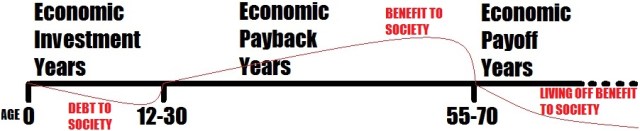
Our Value to Society – Should it be Quantified?

Where, in the space between our teenage years / postsecondary education and our senior citizen years, have we paid back society for raising us, supporting us in our productive years and then caring for us in our unproductive elderly years?

In other words, should the government which provides you infrastructure and self/private property protection require you to be economically feasible in your peak years?  Or else?

If a citizen isn’t viable or useful to government, then can government refuse service to the citizen unless another citizen (or citizens) step(s) forward to make up the difference?

Economic-Years