Animal magnetism — what if your fridge magnets were animatronic beings?
A thought to behold…
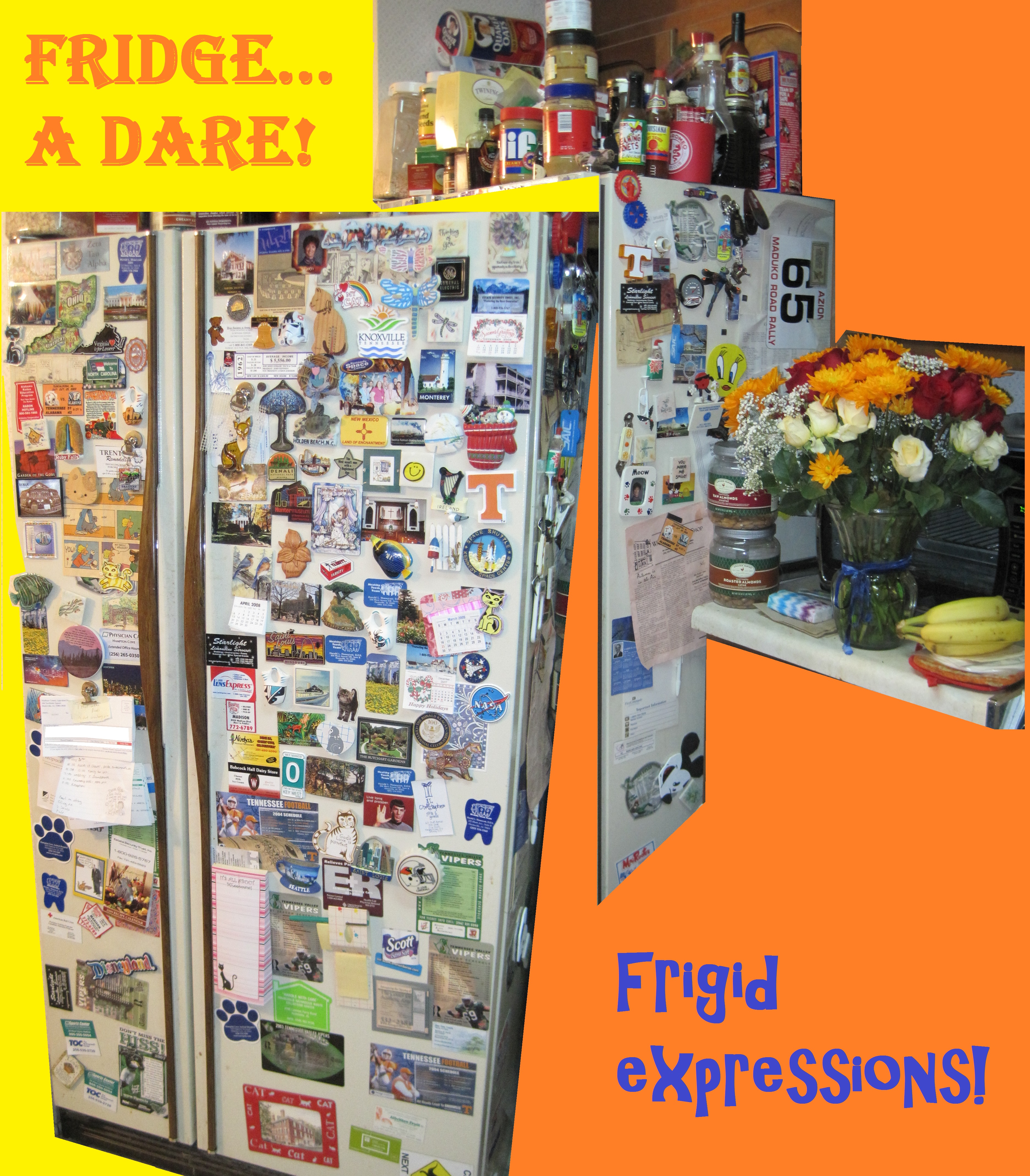
Animal magnetism — what if your fridge magnets were animatronic beings?
A thought to behold…
HARRISON BERGERON by Kurt Vonnegut, Jr.

THE YEAR WAS 2081, and everybody was finally equal. They weren't only equal
before God and the law. They were equal every which way. Nobody was smarter
than anybody else. Nobody was better looking than anybody else. Nobody was
stronger or quicker than anybody else. All this equality was due to the
211th, 212th, and 213 th Amendments to the Constitution, and to the unceasing
vigilance of agents of the United States Handicapper General.

Some things about living still weren't quite right, though. April for
instance, still drove people crazy by not being springtime. And it was in
that clammy month that the H-G men took George and Hazel Bergeron's fourteen-
year-old son, Harrison, away.

It was tragic, all right, but George and Hazel couldn't think about it very
hard. Hazel had a perfectly average intelligence, which meant she couldn't
think about anything except in short bursts. And George, while his
intelligence was way above normal, had a little mental handicap radio in his
ear. He was required by law to wear it at all times. It was tuned to a
government transmitter. Every twenty seconds or so, the transmitter would
send out some sharp noise to keep people like George from taking unfair
advantage of their brains.

George and Hazel were watching television. There were tears on Hazel's
cheeks, but she'd forgotten for the moment what they were about.

On the television screen were ballerinas.

A buzzer sounded in George's head. His thoughts fled in panic, like bandits
from a burglar alarm.

"That was a real pretty dance, that dance they just did," said Hazel.

"Huh" said George.

"That dance-it was nice," said Hazel.

"Yup, " said George. He tried to think a little about the ballerinas. They
weren't really very good-no better than anybody else would have been, anyway.
They were burdened with sashweights and bags of birdshot, and their faces
were masked, so that no one, seeing a free and graceful gesture or a pretty
face, would feel like something the cat drug in. George was toying with the
vague notion that maybe dancers shouldn't be handicapped. But he didn't get
very far with it before another noise in his ear radio scattered his
thoughts .

George winced. So did two out of the eight ballerinas.

Hazel saw him wince. Having no mental handicap herself, she had to ask George
what the latest sound had been.

"Sounded like somebody hitting a milk bottle with a ball peen hammer, " said
George .

"I'd think it would be real interesting, hearing all the different sounds,"
said Hazel a little envious. "All the things they think up."


"Urn, " said George.

"Only, if I was Handicapper General, you know what I would do?" said Hazel.
Hazel, as a matter of fact, bore a strong resemblance to the Handicapper
General, a woman named Diana Moon Glampers. "If I was Diana Moon Glampers,"
said Hazel, "I'd have chimes on Sunday- just chimes. Kind of in honor of
religion . "

"I could think, if it was just chimes," said George.

"Well-maybe make 'em real loud," said Hazel. "I think I'd make a good
Handicapper General."

"Good as anybody else," said George.

"Who knows better than I do what normal is?" said Hazel.

"Right," said George. He began to think glimmeringly about his abnormal son
who was now in jail, about Harrison, but a twenty-one-gun salute in his head
stopped that.

"Boy!" said Hazel, "that was a doozy, wasn't it?"

It was such a doozy that George was white and trembling, and tears stood on
the rims of his red eyes. Two of the eight ballerinas had collapsed to the
studio floor, were holding their temples.

"All of a sudden you look so tired," said Hazel. "Why don't you stretch out
on the sofa, so's you can rest your handicap bag on the pillows, honeybunch."
She was referring to the forty-seven pounds of birdshot in a canvas bag,
which was padlocked around George's neck. "Go on and rest the bag for a
little while," she said. "I don't care if you're not equal to me for a
while . "

George weighed the bag with his hands. "I don't mind it," he said. "I don't
notice it any more. It's just a part of me."

"You been so tired lately-kind of wore out," said Hazel. "If there was just
some way we could make a little hole in the bottom of the bag, and just take
out a few of them lead balls. Just a few."

"Two years in prison and two thousand dollars fine for every ball I took
out," said George. "I don't call that a bargain."

"If you could just take a few out when you came home from work," said Hazel.
"I mean-you don't compete with anybody around here. You just set around."

"If I tried to get away with it," said George, "then other people ' d get away
with it-and pretty soon we'd be right back to the dark ages again, with
everybody competing against everybody else. You wouldn't like that, would
you?"

"I'd hate it," said Hazel.

"There you are," said George. The minute people start cheating on laws, what
do you think happens to society?"


If Hazel hadn't been able to come up with an answer to this question, George
couldn't have supplied one. A siren was going off in his head.

"Reckon it'd fall all apart," said Hazel.

"What would?" said George blankly.

"Society," said Hazel uncertainly. "Wasn't that what you just said?

"Who knows?" said George.

The television program was suddenly interrupted for a news bulletin. It
wasn't clear at first as to what the bulletin was about, since the announcer,
like all announcers, had a serious speech impediment. For about half a
minute, and in a state of high excitement, the announcer tried to say,
"Ladies and Gentlemen."

He finally gave up, handed the bulletin to a ballerina to read.

"That's all right-" Hazel said of the announcer, "he tried. That's the big
thing. He tried to do the best he could with what God gave him. He should get
a nice raise for trying so hard."

"Ladies and Gentlemen," said the ballerina, reading the bulletin. She must
have been extraordinarily beautiful, because the mask she wore was hideous.
And it was easy to see that she was the strongest and most graceful of all
the dancers, for her handicap bags were as big as those worn by two-hundred
pound men.

And she had to apologize at once for her voice, which was a very unfair voice
for a woman to use. Her voice was a warm, luminous, timeless melody. "Excuse
me-" she said, and she began again, making her voice absolutely
uncompetitive .

"Harrison Bergeron, age fourteen," she said in a grackle squawk, "has just
escaped from jail, where he was held on suspicion of plotting to overthrow
the government. He is a genius and an athlete, is under-handicapped, and
should be regarded as extremely dangerous."

A police photograph of Harrison Bergeron was flashed on the screen-upside
down, then sideways, upside down again, then right side up. The picture
showed the full length of Harrison against a background calibrated in feet
and inches. He was exactly seven feet tall.

The rest of Harrison's appearance was Halloween and hardware. Nobody had ever
born heavier handicaps. He had outgrown hindrances faster than the H-G men
could think them up. Instead of a little ear radio for a mental handicap, he
wore a tremendous pair of earphones, and spectacles with thick wavy lenses.
The spectacles were intended to make him not only half blind, but to give him
whanging headaches besides.

Scrap metal was hung all over him. Ordinarily, there was a certain symmetry,
a military neatness to the handicaps issued to strong people, but Harrison
looked like a walking junkyard. In the race of life, Harrison carried three
hundred pounds .


And to offset his good looks, the H-G men required that he wear at all times
a red rubber ball for a nose, keep his eyebrows shaved off, and cover his
even white teeth with black caps at snaggle-tooth random.

"If you see this boy, " said the ballerina, "do not - I repeat, do not - try
to reason with him."

There was the shriek of a door being torn from its hinges.

Screams and barking cries of consternation came from the television set. The
photograph of Harrison Bergeron on the screen jumped again and again, as
though dancing to the tune of an earthquake.

George Bergeron correctly identified the earthquake, and well he might have -
for many was the time his own home had danced to the same crashing tune. "My
God-" said George, "that must be Harrison!"

The realization was blasted from his mind instantly by the sound of an
automobile collision in his head.

When George could open his eyes again, the photograph of Harrison was gone. A
living, breathing Harrison filled the screen.

Clanking, clownish, and huge, Harrison stood - in the center of the studio.
The knob of the uprooted studio door was still in his hand. Ballerinas,
technicians, musicians, and announcers cowered on their knees before him,
expecting to die.

"I am the Emperor!" cried Harrison. "Do you hear? I am the Emperor! Everybody
must do what I say at once!" He stamped his foot and the studio shook.

"Even as I stand here" he bellowed, "crippled, hobbled, sickened - I am a
greater ruler than any man who ever lived! Now watch me become what I can
become ! "

Harrison tore the straps of his handicap harness like wet tissue paper, tore
straps guaranteed to support five thousand pounds.

Harrison's scrap-iron handicaps crashed to the floor.

Harrison thrust his thumbs under the bar of the padlock that secured his head
harness. The bar snapped like celery. Harrison smashed his headphones and
spectacles against the wall.

He flung away his rubber-ball nose, revealed a man that would have awed Thor,
the god of thunder.

"I shall now select my Empress!" he said, looking down on the cowering

people. "Let

the first woman who dares rise to her feet claim her mate and her throne!"

A moment passed, and then a ballerina arose, swaying like a willow.

Harrison plucked the mental handicap from her ear, snapped off her physical
handicaps with marvelous delicacy. Last of all he removed her mask.

She was blindingly beautiful.


"Now-" said Harrison, taking her hand, "shall we show the people the meaning
of the word dance? Music!" he commanded.

The musicians scrambled back into their chairs, and Harrison stripped them of
their handicaps, too. "Play your best," he told them, "and I'll make you
barons and dukes and earls."

The music began. It was normal at first-cheap, silly, false. But Harrison
snatched two musicians from their chairs, waved them like batons as he sang
the music as he wanted it played. He slammed them back into their chairs.

The music began again and was much improved.

Harrison and his Empress merely listened to the music for a while-listened
gravely, as though synchronizing their heartbeats with it.

They shifted their weights to their toes.

Harrison placed his big hands on the girls tiny waist, letting her sense the
weightlessness that would soon be hers.

And then, in an explosion of joy and grace, into the air they sprang!

Not only were the laws of the land abandoned, but the law of gravity and the
laws of motion as well.

They reeled, whirled, swiveled, flounced, capered, gamboled, and spun.

They leaped like deer on the moon.

The studio ceiling was thirty feet high, but each leap brought the dancers
nearer to it.

It became their obvious intention to kiss the ceiling. They kissed it.

And then, neutraling gravity with love and pure will, they remained suspended
in air inches below the ceiling, and they kissed each other for a long, long
time .

It was then that Diana Moon Clampers, the Handicapper General, came into the
studio with a double-barreled ten-gauge shotgun. She fired twice, and the
Emperor and the Empress were dead before they hit the floor.

Diana Moon Clampers loaded the gun again. She aimed it at the musicians and
told them they had ten seconds to get their handicaps back on.

It was then that the Bergerons' television tube burned out.

Hazel turned to comment about the blackout to George. But George had gone out
into the kitchen for a can of beer.

George came back in with the beer, paused while a handicap signal shook him
up. And then he sat down again. "You been crying" he said to Hazel.

"Yup, " she said.


"What about?" he said.

"I forget," she said. "Something real sad on television."

"What was it?" he said.

"It's all kind of mixed up in my mind," said Hazel.

"Forget sad things," said George.

"I always do," said Hazel.

"That's my girl," said George. He winced. There was the sound of a rivetting
gun in his head.

"Gee - I could tell that one was a doozy, " said Hazel.

"You can say that again," said George.

"Gee-" said Hazel, "I could tell that one was a doozy."

"Harrison Bergeron" is copyrighted by Kurt Vonnegut, Jr., 1961.
Well, what did the captain used to say?:
Space: the final frontier. These are the voyages of the starship Enterprise. Its five-year mission: to explore strange new worlds, to seek out new life and new civilizations, to boldly go where no man has gone before.
Kirk was busy violating the Prime Directive in more ways than one!

The Prime Directive, for those who don’t know:
“No identification of self or mission. No interference with the social development of said planet. No references to space or the fact that there are other worlds or civilizations.”
Ahh…science fiction, where art imitates life in parallel universes…
For some of my colleagues, spacecraft engine development is practically an obsession.
For others, bending of spacetime is the primary focus.
In either case, moving purpose-built beings from Earth to celestial bodies in this solar system holds their attention.
But then there are those whom we haven’t mentioned…
…the ones who pop up out of newly-discovered multidimensional spacetime travel methods.
But first, a Martian field trip’s in order.
From there, who knows?!
Going with the fallen log look for the cedar bridge stair steps…




The baby hawks are back this afternoon — another fun day in the forest!
In war and peace, family stays together…










The basic bridge, ready for structurally supportive decorative elements to be added next week.
But first, finish reading “Currahee!: A Screaming Eagle at Normandy” for July 4th weekend enlightenment.
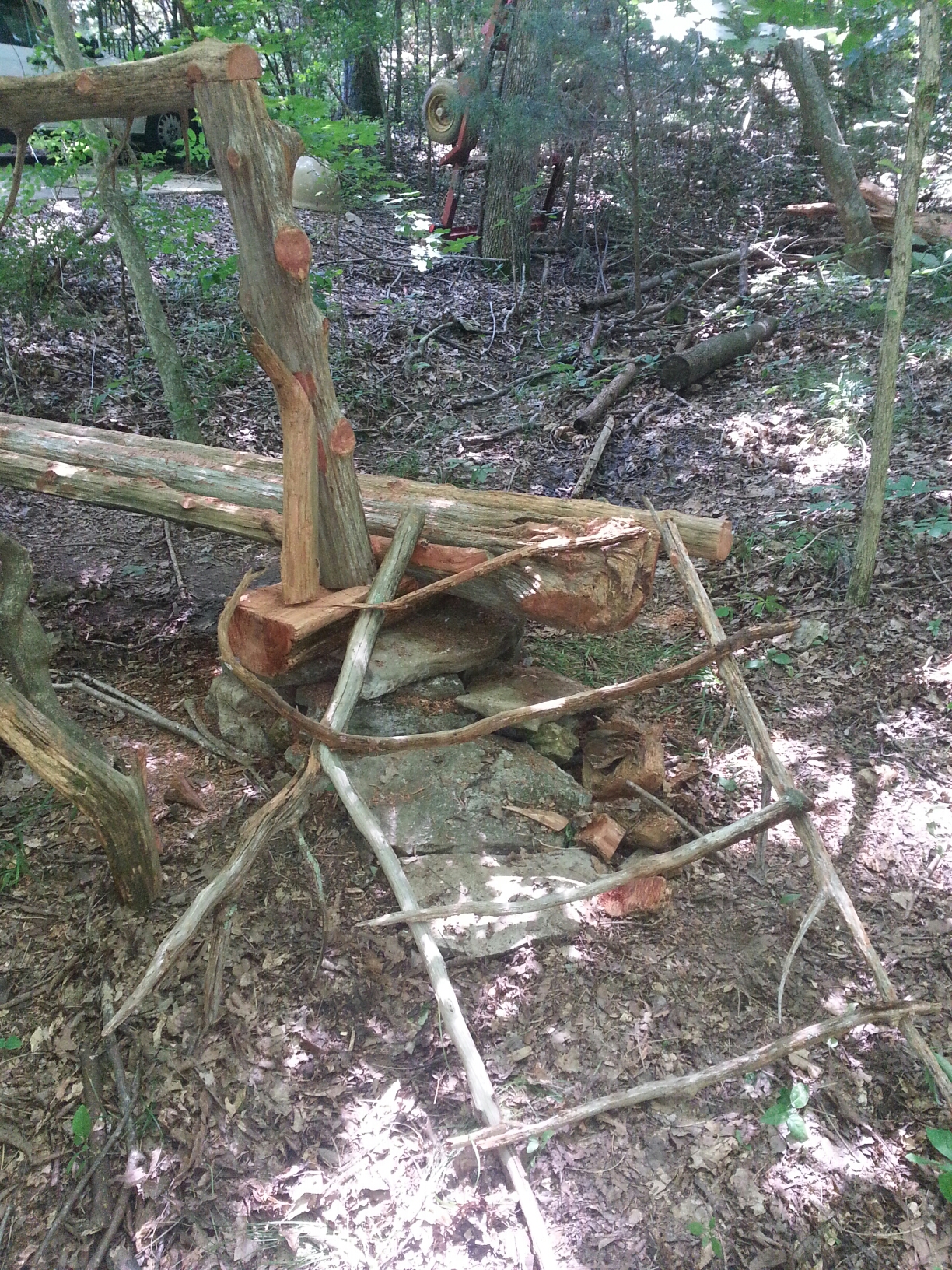
Visualising what a frame for the small set of stairs will look like, spatially…
Bartering as a Lifestyle
I’ve learned to live on very little money in order to support my lifestyle as an artist. I haven’t had medical insurance since 1985 and luckily I’m very healthy but whenever I have needs, such as dental work, and once, a doctor, I asked around and found someone I could barter with. I’ve bartered for airline tickets, amazing places to live, places to stay while I’m traveling overseas and this continent, and car repairs. I usually barter my art, but I’ve met people with skills such as massage, hairstyling, jewelry making, and bookkeeping, to name just a few, who have done well with barter. If you are willing to work, create art, or have something to trade, then you’ve got something you can barter with. I’ve found that there are many times people might not want to spend money but will barter.
When I quit my systems analyst job and didn’t want to be stressed out about money, as a single person I learned that caretaking other people’s property allowed me the freedom to make my art. This lifestyle has landed me in extremely beautiful places, with my rent, utilities and, depending on the situation, food, salaries, vehicles, and use of swimming pools, as part of the deal. On this blog site I intend to tell my stories as well as those I’m collecting from other people, and pass on some web sites that will help you meet up with other people interested in bartering.
In my twenties I traveled around the world and found wonderful opportunities for work exchanges along the way. In Australia I lived for a couple of years in the outback where I rented a house on a two hundred acre farm for the low rent of $80 a month in exchange for keeping an eye on my landlord’s cows. In Bodh Gaya, India I spent a couple of weeks in a Thai Buddhist monastery, in exchange I spent an hour a day helping one of the monks with his university studies. In Israel I lived on a kibbutz for three months and did a variety of jobs in exchange for everything I needed. I learned that honest, loyal, hard working people were really appreciated and could get jobs anywhere in the world.
In my thirties I finally settled down and worked as a computer programmer until I sold two of my short travel stories to a magazine and a piece of art that I’d created was accepted for an important juried show the City of Los Angeles was sponsoring. I quit my job and began looking for ways to survive as an artist, which in L.A. meant long-term house sitting and scenic painting for movies.
In my forties my first creative work exchange was as a scenic painter for the New Hope Theater in Pennsylvania. I spent the summer painting sets in the Pocono Mountains while living in a beautiful resort hotel. I stayed for two months in an apartment in Venice Beach, CA in exchange for doing all the black and white still photography for a video project an artist friend was working on. On vacation in Jamaica I met a woman who lived in a beautiful villa on a hillside overlooking the Carribean and ended up house sitting it for a week when she had to go away. While there I learned wood carving from a local artist.
One of my favorite work exchanges was for a real estate investor in Bel Air, CA. For three years I worked two days a week as his office assistant in exchange for a salary and a nice little apartment in one wing of his house. I had full use of the grounds and swimming pool. It was while living in Bel Air that I began carving large sculptures for the Treepeople Park in Beverly Hills. I finally left Bel Air to do a summer work exchange at the Avondale Forest Park in County Wicklow, Ireland where I carved a large sculpture (see photo above) from a famous tree that had died. After this experience many of my work exchanges were art related.
Several times a week I will update this site with these stories and many more. I’m hoping to interview Ryan McDonald of The One Red Paper Clip fame, have a piece on house swapping, do an article on business barter sites, and much more. Don’t get me wrong, money is great, but if you don’t have much, there are alternatives with bartering. World travel, living in millionaire homes, the sky’s the limit on what you can manifest.
You can see some of my work on these blog sites:
barbarayates-sculpture.blogspot.com
woodenbooks.blogspot.com
barbarayates-photos.blogspot.comIf you have questions to can contact me at: byates3347@gmail.com
Sunday, July 12, 2009
Barbara’s Bartering Blog

 treetrunkdings