Augur Sanctions

I shall, I must, I will admit that it’s hard to believe in the dream of building a settlement for members of our species on another celestial body when our species, despite claims of higher brain functions — culture, religion, ethics, morals and other labels we bandy about like birds of paradise on display — contains serial rapists/murderers/financial exploiters/stalkers.

When while I sit here, quietly mourning, along with dozens of others who knew her, the loss of a dear, gentle person like my mother in-law, bloated egos point blame about the sad state of our species’ barter trade system of survival on this planet (a/k/a the economy) on each other like misbehaving schoolchildren in Bil Keane’s single pane comic, Family Circus, calling up the gremlins of “Ida Know” and “Not Me.”

Thank goodness the trees outside the window are stark evidence that the thoughts in my central nervous system are frivolous.

All supercellular existence like memes, including the label meme and the electronic means used to convey this message, seem meaningless right now.

Look, I don’t mind playing God with all your lives in a supercomputer simulation set.  If my colleagues sit with me in the Committee while reviewing the simulation results and decide to take action against you in godlike manner, exposing your secrets, eliminating the greedy, elevating the needy, I won’t stop them.

None of us is more important than all of us.

The whining of professional sports team owners and players are just so much background noise.

Amateur athletes who destroy their bodies for the sake of personal pride seem so misguided.

Office workers who deteriorate their health to stay within subcultural norms seem so unfortunate.

Military and police who abuse their authority for personal ego boosting seem such a waste.

My mother in-law never drank, never smoked, never directly criticised anyone (rather, she questioned the validity of a person’s behavioural intent) — to some, she might have led a smalltown life which would not appeal to them.

And, yet, she inspired everyone she met to be better than their negative surroundings.

There comes a moment in the clash of cultures when subculture leaders cannot inspire the populace as a whole due to historic teachings about the superiourity of one, each or every subculture over another.

Who can we believe is telling the truth?

Who is truly impartial?

Which fairy tale, which myth, and/or which legend is the most universal?

That’s why, when the Committee put me in charge of telling the story, the running commentary, the plots and subplots of our species from the perspective of the reluctant leader, I’ve tried to take my ego and personality out of the equation by taking your personal stories and mixing them into a supercomputer simulation, an electromechanical device that crunches numbers unfeelingly while processing the behavioural traits of feelings/emotions unique to our species and shared with the rest of the sets of states of energy around us in this part of the Milky Way Galaxy.

Of course, a supercomputer can only do so much.

Its output is subject to interpretation.  Every character, word, space, sentence, formula and conclusion has separate meanings to those who read/view them.

Which means, I suppose, despite trying to create an impartial judge/oracle in the form of a supercomputer networked into our lives, we are still left, at the end of this blog entry, having to trust one another to put species first, subculture second and self last.

Where will this lead us?

In a culture where literacy is important, illiteracy in one’s early childhood school years is a key indicator of low employment capability and most likely high criminal activity tendency later on.  But these are culture-based measurements.

What about the innate concepts of right and wrong, regardless of specific cultural training?

How malleable are we?

What is “right” and what is “wrong” when all subcultural references are removed?

As our species superculture continues to take shape, will we define rules/laws and punish people for exploiting our trust in one another to put species first and self last while preserving individual freedoms/rights?

I am unimportant.  I can die today or tomorrow and won’t regret anything I have or haven’t done.

It is you, our species within the global ecosystem, that matters most.  What are we doing to protect the weakest and most trusting of us from the worst of our behavioural tendencies?

= = =

Thanks to Dr. Reed for calling and sharing his memories of my mother in-law during her medical office visits of the past; Billie Young; Mrs. Knowlton; Peggy Shuck; Pearl Manis; Brandi and her baby near Burem Road; Amis Mill Eatery; Stephanie and Sarah at Beauregard’s; Rave; Shirley Price; Sarah Evans; Barbara Malpas; Janet Netherland-Brown; Melinda Miller; Rogersville Presbyterian Church Business Women’s Circle; Rev. Rose; Sue Livesay; Oles Miller; Rev. White; Maurice Davis; Jim Forgey; David Miller; Jonathan Berry; Brian Givens; Tommy Logan; Broome Funeral Home; McKinney Cemetery; David Testerman; Sweet Tooth Cafe; Pal’s Sudden Service; Kingsport Times-News; Rogersville Review; WRGS; Mike at Rocky Top Markets.
Data points for the day

I am taking a much-needed sabbatical – here are a few data points to ponder while I deprogram my computer programmers who are reprogramming the supercomputer that keeps me in touch with my network of colleagues and business associates:

Morning Meditation

A bird I can’t see digs through leaves covering a broken stretch of gutter, looking for insects to munch on.

Dense patches of moisture – clouds – flow through the atmosphere above, like wet weather creeks filling from rain showers upstream.

After my brother in-law died at an early age, I fed thoughts of what I wanted to do, to achieve, to complete, before I died.

I finished novels I had sketched on paper.  I became a published author, fulfilling a lifelong wish that began when I was ten, receiving a professional review from Publishers Weekly.

Then, seeing that I could, I tried my best to fill in for my brother in-law, taking care of my mother in-law when my wife could not.  My mother in-law is now dead (btw, her date of death is a palindrome: 11.02.2011).

I am an old man in thoughts, if not totally at 49, approaching 50, years of age.  My hearing is diminished, my hair is white and thinning, my ankles swell, my skin grows spots, my blood pressure is high and cholesterol readings vary on the unhealthy side.

I have no competitors.

Soon, in a year or 50, I will be forgotten, ashes to ashes, dust to dust.

I have no legacy to protect, ghosts/secrets to run from, or dream/carrot on a stick to chase after.

I am just me, one set of states of energy, a simple ego that wants to shine brighter than I want to burn it, my energy nearly given out, living one day…no, living one small moment at a time.

I have nothing to live or die for.

I prop myself up on my sense of humour, my shield that hides the invisible me from the rest of my species.

After all, I am the emperour’s new clothes, a figment of imagination, entropy states meeting fractal math patterns.

I knew that 2011 was going to be a tough year.

That’s the problem with getting older and wiser, seeing patterns that you know will repeat themselves in your lifetime, no matter whether you want them to or not.

I’m tired of being wise or a wiseass.

I don’t want to live to see 2012 but neither do I want to die.

This chameleon personality wants to disappear, fade into the woodwork, melt into the forest, states of energy vanishing before your eyes.

It just did.

Goodbye.

Powdered Pecan Sandies

On a sunny autumn day, the muted fall leaves colouring an elaborate quilt on the rowed hills of east Tennessee, I finally, fully, felt the loss of my mother in-law while I sat with my wife next to the coffin for graveside service on Saturday.

I will not see her smiling face or hear her voice her concern for her daughter’s health, anymore.

Last night, when we drove into the garage, the absence hit home once again — no calling my wife’s mother to let her know we made it home safely after returning from east Tennessee.

Mortality.

We live and die.

Now, my wife and I deal with the imbalance, she with no parents or sibling and I with both my parents and my sister alive.  My wife and I each have one living pair of blood-related niece and nephew.

My wife is ready to be free of traditional family obligations such as holiday gatherings.

We shall see.

No doubt we face a transition.

A transition from what to what, I don’t yet want to know, although I can project a few future possibilities.

A superglued broken cup commemorating the 2005 Paderborn Weihnachtsmarkt attracts my attention, hinting at the future.

The parts of my wife and me put on hold until her mother died are ready for release.

However, post-death logistics remain…dividing the estate, modest as it is, including photo albums, Christmas ornaments, kitchenware and a few dozen decks of playing cards used for bridge games; writing thank-you notes to those who assisted toward the end of and after my wife’s mother life.

One more day of mourning/grieving our loss and then life goes on…sigh…

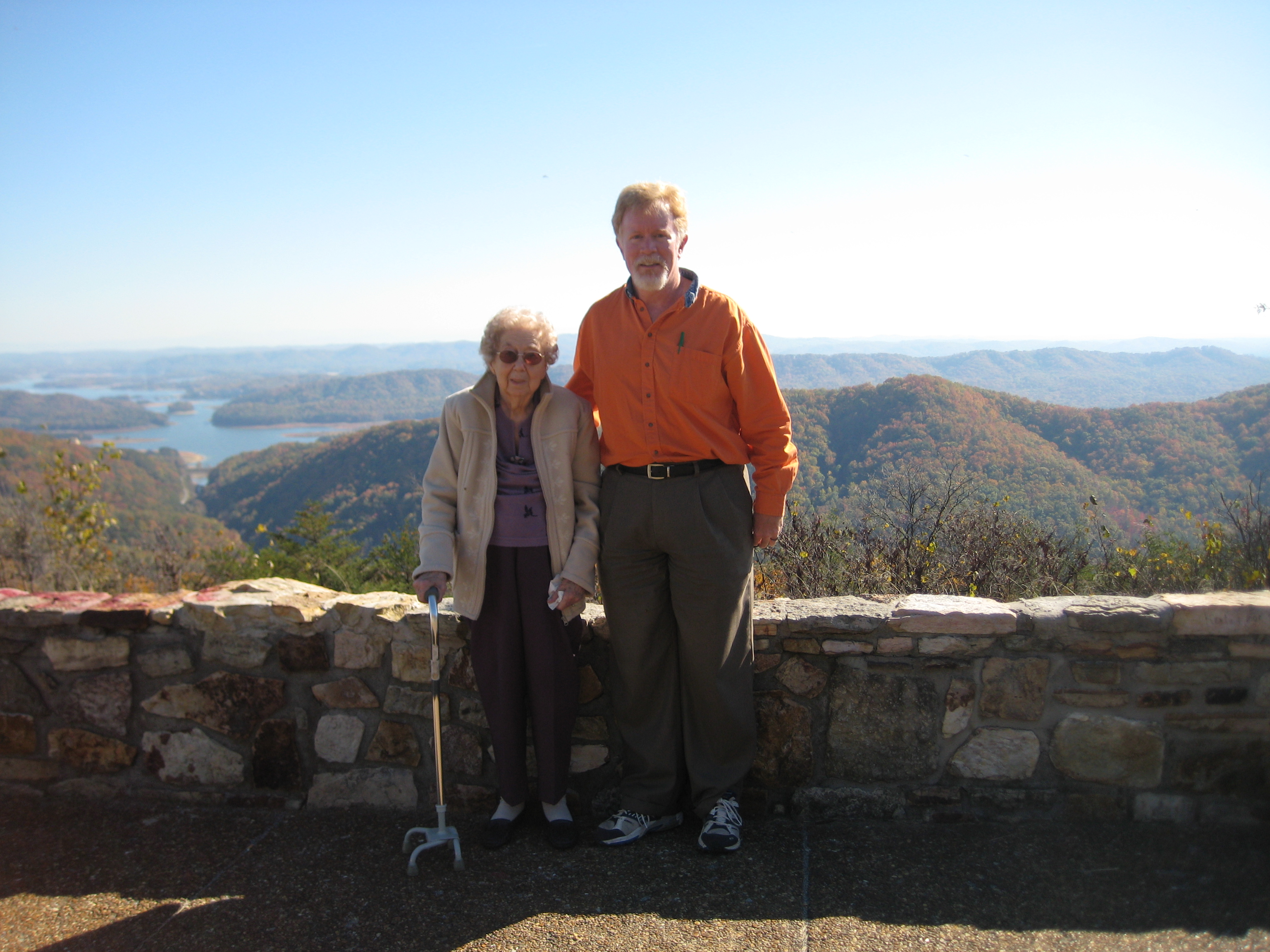
My mother in-law and me, 1st Nov 2008, Clinch Mountain Overlook

A quiet, lonely day today.

Time to sharpen a pencil and work on the Book of the Future…

More painted-over nails popping out of sheetrock

Let’s see…the Cherokee football team lost, the Volunteer marching band won, the Hazel Green football team lost, and on and on.

On a systems level, moves are made and then…

The supercomputer churns butter.

In game theory, do emotions play a role?

After spending time with my species, I’ve a galactic simulation to test and implement – can you prove to other entities you can anticipate their actions without knowing much (except everything) about them?

This input device and its corresponding display elsewhere limits descriptive output.

More on that later.

Can the absence-of-I trust the states of energy called emotion and instinct as much as I trust the supercomputer, network of colleagues, and Book of the Future?

As Rev. Rose said, long after Rev. White and his wife were looking for their dogs, life’s transitions tell us how we’re witnesses, or examples of ourselves, to others (and thus back to ourselves).

My family and individuals within my family are in transit.

For some, they may feel their next stop is in the twilight zone.

In this story within a blog of managing the galaxy’s future, where asteroid trajectories serve as measurement data (is there ever a datum that’s not a measurement?), etymology psychology, do we understand that the total mass of nonplanetary matter matters more than the individual pieces?

Yes, but at what timescale?

Could you explain a leaf rake to a bodyless being?

Can you create an infographic that shows the influence of the Alabama-LSU football game on every one of us seven billion?

The Tennessee instate rivalry game attracts viewers.

While everyone else is looking at an electronic device, what has your attention?

The truly frugal don’t read online blogs.

Obviously, they’re not my readers.

Thanks to Cross Flower Shop; Chad Hill; Tommy and Stella Logan; Town of Rogersville Street Dept; Sweet Tooth Cafe; Ada at GreenBank; McKinney crew; friends and family; the nurse from Michigan who seeks culture.

Almost time to write the next chapter.

Pull the ripcord ’cause you’re parachuting onto the fast-moving transition train.

[Have you taken the time to describe your relative’s dying moments in great detail? Should I?]

Four Welders at a Funeral

Were you part of the system of education that collected kids in masses to provide the same set of messages to many?

Hello to Jain and Zhao at HH cafeteria.

Isn’t it amazing how standardised tools like phonetics and writing put us here together to consider possibilities inside and outside this moment?

Soon, my wife’s family will gather outside the usual holiday reunions to reminisce.

States of energy driven to spin around one another because of concepts like family and language.

We don’ yet know what a person thinks when taking the last gasp for air after the heart has stopped beating.

Automatic brain stem function?

Conscious effort to stay alive one last second?

But we understand the word “dignity.”

My mother gave the world me. My mother in-law gave me her daughter, all the world to me.

My father taught me to be a man in a man’s world.

Meanwhile, I’ve adapted to gender-neutral subcultures while preserving my training which designates important, flexible roles for heterosexual men and women.

In the next two days, I’ll hear a lot of phonetic utterances centered on subcultural belief structures, mainly Christian, with philosophical differences that we can label Presbyterian, Southern Baptist, and Church of Christ.

There’ll be no war of words while we celebrate the life of my mother in-law.

If I could get my wish, I’d ask the rest of my species to take a break from arguing with and killing each other during the next 24 hours.

It’s not about me, though, is it?

For the sake of the woman who birthed my wife and raised her for 18-plus years, use the next 24 hours to hesitate before attacking someone else.

Use reason, calm and dignity to respect one another.

Imagine the person you’re with or thinking about is sitting beside you just before you take your last breath – how would you want to be treated?

Personally, I’d want you to tell me the world’s best joke and I’d hear the punchline just before my consciousness slipped away.

“Four welders walk into a funeral home to view their best buddy’s body. The first one says,…” You know the rest, of course.

Have a great day!

Thanks to Mapco; Sheila, Wendy, Julianne and restorative nurse at Southampton; Dre at Red Robin; Variety Bake Shop; Bertha and Debra of HH food services; Dr. Robert Williams; Jerrica; Howard Grimes; Bubba’s; Mr. Broome; Pat’s friends/coworkers; Earline and Joe Price; Jared Bell.

More thanks coming soon…

Meanwhile, the Libyan PM can help assess this:

From: randy.forbes@mail.house.gov
Date: Mon, 31 Oct 2011 08:44:33 -0400
Subject: Does Defense Manufacturing Matter?


Dear Friend –

In 1997, the United Kingdom initiated a program to develop a nuclear attack submarine. But some five to six years into the program, it became clear that neither the prime contractor nor any other British firm had the necessary design and production skills to build the new submarine. Without a domestic ability to produce submarines, the United Kingdom was forced to look abroad in order to complete their project.

Fortunately, the British were able to look to United States and employ one of our shipyards to provide the missing skills and expertise. With American help, the Astute class was completed in February 2010. However, by then the cost for the first three Astute-class submarines had reportedly grown by 90%, and the first of the class was some four years late.

If the U.S. military one day found itself in the same position as the British did with the Astute program, it would have few places to turn for help since no allies currently maintain the breadth and depth of capabilities resident in the U.S. defense industry.

Defense manufacturing is worth protecting. Let’s take a look at this snapshot of defense manufacturing in America:
The Workforce-
Take for example one American shipbuilding company that currently employs 39,000 people:

  • More than 7,500 engineers.
  • More than 1,000 employees with advanced degrees.
  • More than 19 different crafts and trades.
  • Over 700 master shipbuilders (over 40 years experience).

The defense industry employs some of America’s best and brightest:

  • Skilled technicians and designers that have produced our fleet of nuclear powered submarines and aircraft carriers- a fleet with over 145 million miles safely steamed on nuclear power.
  • Skilled engineers that have designed the most advanced and capable aircraft in the world.

As production jobs and capability decline, the ability to recover these critical skills becomes very expensive or even impossible as highly skilled personnel are forced to pursue other careers.

The Production Lines-
Historically the United States has been able to convert commercial manufacturing to produce defense products during a time of crisis:

  • During, WWII manufacturers of consumer products like toys and arcade games were able to rapidly shift production to military munitions in support of the war effort.
  • Today, U.S. has lower manufacturing capacity and weapons are more specialized than they were 50-plus years ago.
  • We need a strategy to maintain the skills and infrastructure of these production lines.

Shuttering existing lines will diminish or eliminate our capabilities should we need them in a time of crisis.

The Suppliers-
The industrial base is much broader than the top tier, Fortune 500 defense contractors.  The small business suppliers are a vital component that is often overlooked.  Look at just two examples:

  • Since 2004, 1,600 vendors in 42 states have filled orders totaling over $3 billion to build our nation’s aircraft carriers.
  • The Joint Strike Fighter supply chain spans 1,300 companies in 47 states and supports nearly 127,000 direct and indirect U.S. jobs.

According to Pentagon analysis, the defense industrial base provides 3.8 million private sector jobs.  Trillion dollar cuts to nation defense will result in:

Job Losses.
Hundreds of thousands of jobs lost within the defense industry.  Much of the engineering and technical experience lost will be impossible to recover or rebuild in the future.

Shipyard Closures.
Shuttering of U.S. shipyards, which are the largest manufacturers in Mississippi, Louisiana, Virginia, and Maine.

Atrophy of innovation.
Looming defense cuts will invariably eliminate entire sectors of the industrial base and lead to less competition.  With far fewer manufactures, remaining companies will lack incentive to come up with new, better, or cheaper solutions for our warfighters.

Inability to rapidly reconstitute critical skills in response to emergent threats.
The ability of the United States soldier, sailor, airman, or Marine to maintain a technological advantage on the battlefield would be in jeopardy.

Few have contemplated a future where the United States, when confronted with a crisis on the scale of Pearl Harbor or 9/11, must predicate its response with “Can we?” rather than “Will we?” Such a way of life is worth protecting.

Yours in Service,

Randy Forbes